
Best ERP for Manufacturing — or Do You Actually Need One?
Most guides to the best ERP for manufacturing are ranked lists that assume you have already decided to buy one. This is the honest version: when a manufacturer genuinely needs a full ERP, when it is overkill, what the real options (Odoo, NetSuite, SAP and the rest) actually cost in money and implementation pain, and what to do if you sit in the gap — outgrowing spreadsheets and disconnected tools.
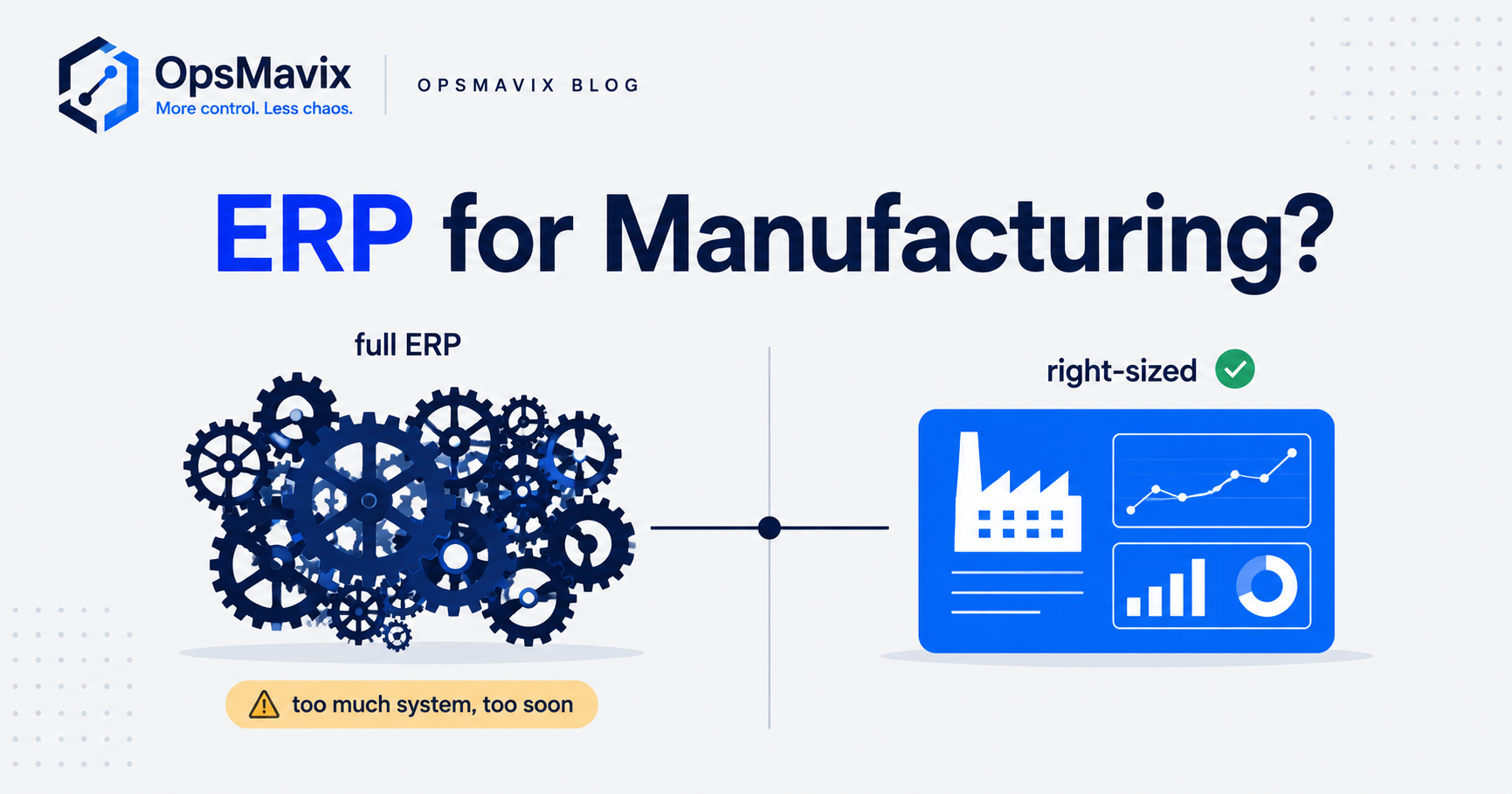
Best ERP for Manufacturing — or Do You Actually Need One?
Quick summary: The best ERP for manufacturing is whichever system matches your size and how you make things — SAP, Oracle NetSuite and Microsoft Dynamics for large or complex plants, Infor, Acumatica, SYSPRO and Odoo for the mid-market — but for most growing shops the honest answer is that a full ERP is either too early or plain overkill. What you almost always need first is shop-floor control — jobs, work-in-progress, job costing and stock on one truth — and you can get that from a right-sized operations system for a fraction of an ERP’s money, time and failure risk.
Search “best ERP for manufacturing” and you get ranked lists. Every one assumes you have already decided to buy an ERP, and most are written by people who sell or implement them. This guide starts one question earlier: do you actually need one yet? For a lot of manufacturers the answer is no — not never, just not now — and buying too much system too early is one of the more expensive mistakes a growing shop can make.
Contents
- What “ERP for manufacturing” actually means
- When a manufacturer truly needs a full ERP
- When a full ERP is overkill
- The real ERP landscape, named honestly
- What an ERP actually costs
- The failure rate the sales deck skips
- The gap most growing shops sit in
- What shop-floor control actually requires
- The right-sized alternative to a full ERP
- How to decide
What “ERP for manufacturing” actually means
ERP stands for Enterprise Resource Planning: one connected system that runs finance, purchasing, inventory, production and often sales and HR off a single shared database. The manufacturing part adds the shop-floor layer — a bill of materials, MRP-style planning, works orders, scheduling, job costing and quality — so the factory and the accounts run on the same numbers.
That single-database idea is the whole point of an ERP, and it is genuinely valuable. When it works, a sale, a stock movement and a ledger entry are the same event seen from three angles, not three spreadsheets someone re-keys at month end. The trouble is that the value scales with your complexity, and so does the cost. Below a certain size you pay full ERP price for benefits you cannot yet use. That gap between what an ERP charges and what a smaller shop can actually absorb is where this guide lives — and it is why the distinction between a heavy finance-first ERP and a lighter operational ERP matters so much before you buy.
When a manufacturer truly needs a full ERP
Some manufacturers genuinely need the full thing, and it is worth being honest about that rather than pretending an ERP is never the answer. You are probably at that point when several of these are true:
- Multiple sites or legal entities that must consolidate finances, stock and production into one set of books.
- Statutory or regulatory complexity — multi-currency, multi-jurisdiction tax, full audit trails, industry compliance (aerospace, medical, food traceability at scale).
- Serious production planning — finite-capacity scheduling, MRP across hundreds of components and multi-level BOMs, demand and supply netting across sites.
- Headcount that outgrows informal coordination — dozens of people in finance, purchasing, planning and the shop floor who need role-based access to the same live data.
- An integration sprawl — a dozen disconnected tools where the cost of stitching them together now exceeds the cost of one platform.
If most of that describes you, stop reading listicles that lump SAP in with a £30-a-month app and get a proper selection process going. The rest of this guide is for everyone who read that list and recognised maybe one item.
When a full ERP is overkill
A full ERP is overkill when your real problem is narrower than “everything at once.” The classic signs:
- One site, one company, one currency. Consolidation is the feature you are paying the most for and using the least.
- Your finances already work. If your accounts package (Xero, QuickBooks, Sage) is fine and the pain is on the shop floor, replacing your finance system to fix a production problem is the wrong operation entirely.
- The actual pain is visibility, not planning. You do not know where jobs are, what work-in-progress is worth, or whether the stock number is real. That is a control problem, not a resource-planning problem.
- Nobody has the appetite to run a 6–18 month project. An ERP implementation is a second job for your best people while they still do their first one.
The difference between an ERP and a focused operational system is exactly this: an ERP tries to be the system of record for the whole company; an operational system nails the handful of workflows that are actually bleeding time and money. Buy the second when the first is more than you need.
The real ERP landscape, named honestly
Here is the landscape without the affiliate gloss. The market splits cleanly by size and manufacturing mode (discrete, process, engineer-to-order, make-to-order).
| System | Best fit | Reality check |
|---|---|---|
| SAP S/4HANA | Large, complex, multi-site manufacturers | Deepest breadth of anything on the market; also the heaviest and most expensive to implement. Overkill below enterprise scale. |
| Oracle NetSuite | Mid-market to upper-mid, cloud-first | Strong all-rounder; manufacturing is add-on modules on top of a finance core. Costs climb fast with users and modules (see below). |
| Microsoft Dynamics 365 | Shops already standardised on Microsoft | Broad coverage, tight Azure/Power Platform ties; implementation partner quality varies wildly. |
| Infor CloudSuite (SyteLine) | Mid-market needing deep MRP, multi-site | Purpose-built for manufacturing, less general-purpose than NetSuite. |
| Acumatica / SYSPRO | Growing mid-market manufacturers | Modular, more approachable pricing; SYSPRO in particular is manufacturing-and-distribution specialist. |
| Odoo | Small-to-mid, budget-conscious | Cheap per-user licence, huge app range including Manufacturing/MRP — but “cheap licence” is not “cheap project,” and it gets complex fast for a small shop. |
Two honest notes. First, “best” is meaningless without “for whom” — SAP is the best system in the world for a business that needs SAP and a catastrophe for one that does not. Second, the cheap end of this table is where most growing shops get burned, because the licence price is the smallest number in the whole exercise.
What an ERP actually costs
The subscription is the sticker price. The real number is the implementation, and it is usually several times larger.
Licences. NetSuite’s base platform runs about £790/month (converted) plus roughly £78–£157 per user per month (converted), with manufacturing modules adding more on top (ERP Research NetSuite pricing). Odoo looks dramatically cheaper on paper — around £10 per user per month for its Standard plan (converted), rising for the Custom tier (odoo.com/pricing) — which is exactly why so many small manufacturers start there and then meet the implementation bill.
Implementation. This is the part the listicles bury. For a mid-sized organisation, ERP implementations average around £355,000 (converted), according to Panorama Consulting’s benchmark research (ERP statistics roundup). Platform by platform the range is wide: a NetSuite implementation alone runs anywhere from about £20,000 (converted) for a small go-live to well over £590,000 (converted) at the top end (ERP Research NetSuite pricing). That spend is data migration, configuration, integration, testing and training — the invisible work that decides whether the thing actually gets used.
Time and disruption. Budget 6 to 18 months, during which your best operations and finance people are running the project on top of their day jobs. That opportunity cost never shows up on the quote, and it is real.
For a fuller worked breakdown of one platform, Odoo implementation cost is a useful reality check even if you are looking at a different vendor — the shape of the numbers is similar everywhere.
The failure rate the sales deck skips
Here is the number no vendor leads with. Depending on the source, between 55% and 75% of ERP projects fail to meet their objectives — a range Gartner has cited for years — and more than 70% fail to reach their original business goals (ECI Solutions); Panorama’s own 2025 research puts the overall failure rate at 68% (ERP statistics roundup). Budget overruns are routine too: more than a quarter of organisations exceed their ERP budget outright (Panorama Consulting).
Read that against the cost figures above. You are being asked to spend six figures and 6–18 months on a project that, on the base rate, is more likely than not to miss its own goals. That is not an argument against ever buying an ERP — big manufacturers do it successfully all the time. It is an argument against buying one to solve a problem a smaller, cheaper system would solve with a fraction of the risk. The bigger the swing, the more it matters that you actually needed to take it.
The gap most growing shops sit in
Between “a spreadsheet and a shared drive” and “a full ERP” there is a wide, badly-served middle. It looks like this: you have outgrown the spreadsheet — jobs get lost, the stock number is fiction, nobody can tell you what a job cost until it is invoiced — but you are nowhere near ready to justify a six-figure ERP programme and the year of disruption it brings.
This is the gap: outgrowing spreadsheets and disconnected tools. Most manufacturers in it do one of two wrong things. Either they limp along in spreadsheets past the point of pain, because the only alternative anyone offers them is a full ERP — or they over-buy, sign the ERP, and become another entry in the failure statistics because the project was too big for the problem.
There is a third option, and it is the one the ranked lists never mention because nobody in them sells it: get the specific control you need, at the size you actually are, without buying the whole enterprise platform to do it.
What shop-floor control actually requires
Strip away the ERP marketing and the thing a growing manufacturer actually needs is short and concrete. Four capabilities, on one shared truth:
- Jobs. Every works order visible — what stage it is at, who is on it, when it is due. No walking the floor to find out where things are. This is plain shop-floor job tracking, and you do not need an ERP to have it.
- Work-in-progress. What is on the floor right now and what it is worth, so you are not blind between raw material and finished goods. WIP tracking is where money hides in a manufacturer.
- Job costing. Real cost per job — materials, labour, machine time — captured as the job runs, not reconstructed after invoicing. This is the number that tells you whether you are actually making money, and how you calculate it is the difference between pricing on fact and pricing on hope.
- Stock that matches reality. One live stock figure the shop floor and the office both trust, so you stop promising stock you cannot ship.
That is it. Four things, tightly connected. An ERP gives you these — buried inside finance, HR, CRM and a dozen modules you did not need, at enterprise price and enterprise risk. The question is whether you want the four things or the other forty.
The right-sized alternative to a full ERP
If what you need is those four capabilities and not a company-wide system of record, you can have an owned operations system sized to your shop instead — one that gives you jobs, WIP, job costing and real stock on a single screen, connects to the finance package you already run rather than replacing it, and does not demand a year of your team’s life to stand up.
The outcome is the shop-floor control an ERP promises, without the ERP weight: no six-figure programme, no 6–18 month project, no betting the business on a base rate that says most of these projects miss. You keep Xero or Sage. You keep the workflows that already work. You fix the ones that bleed. And because the system is built around how you actually make things rather than a vendor’s template, adoption is the easy part instead of the failure point.
This is the OpsMavix position in one line: outgrowing spreadsheets and disconnected tools. Not an ERP alternative for everyone — a right-sized system for the large middle the ERP market prices out and the spreadsheet has outgrown. If you genuinely need SAP, buy SAP. If you need the four things, do not buy SAP.
How to decide
A short, honest test. Score yourself:
- Multiple sites or entities to consolidate? Yes → lean ERP. No → lean lighter.
- Is finance the problem, or the shop floor? Finance → ERP territory. Shop floor only → you need control, not an ERP.
- Is the pain planning (MRP across hundreds of parts) or visibility (where are my jobs, what did they cost)? Planning → ERP. Visibility → right-sized system.
- Can you afford six figures and 6–18 months, and stomach a coin-flip on the outcome? Yes → run a real ERP selection. No → do not force it.
- Would fixing four workflows — jobs, WIP, job costing, stock — solve 80% of the pain? Yes → you have your answer.
The “best ERP for manufacturing” is a real question with a real answer for the manufacturers who need one. For everyone else, the best ERP for manufacturing is the one you did not have to buy — because you fixed the actual leak at the size you actually are. Start from the problem, not the product, and you will spend a fraction of the money on a fraction of the risk.