
Construction ERP Software: What It Is & Whether You Actually Need One
Construction ERP software promises one system for accounting, job costing, procurement, CIS and plant. But most UK contractors are sold far more system than they need. Here is what it actually does, who it fits, and the cheaper way to get control.
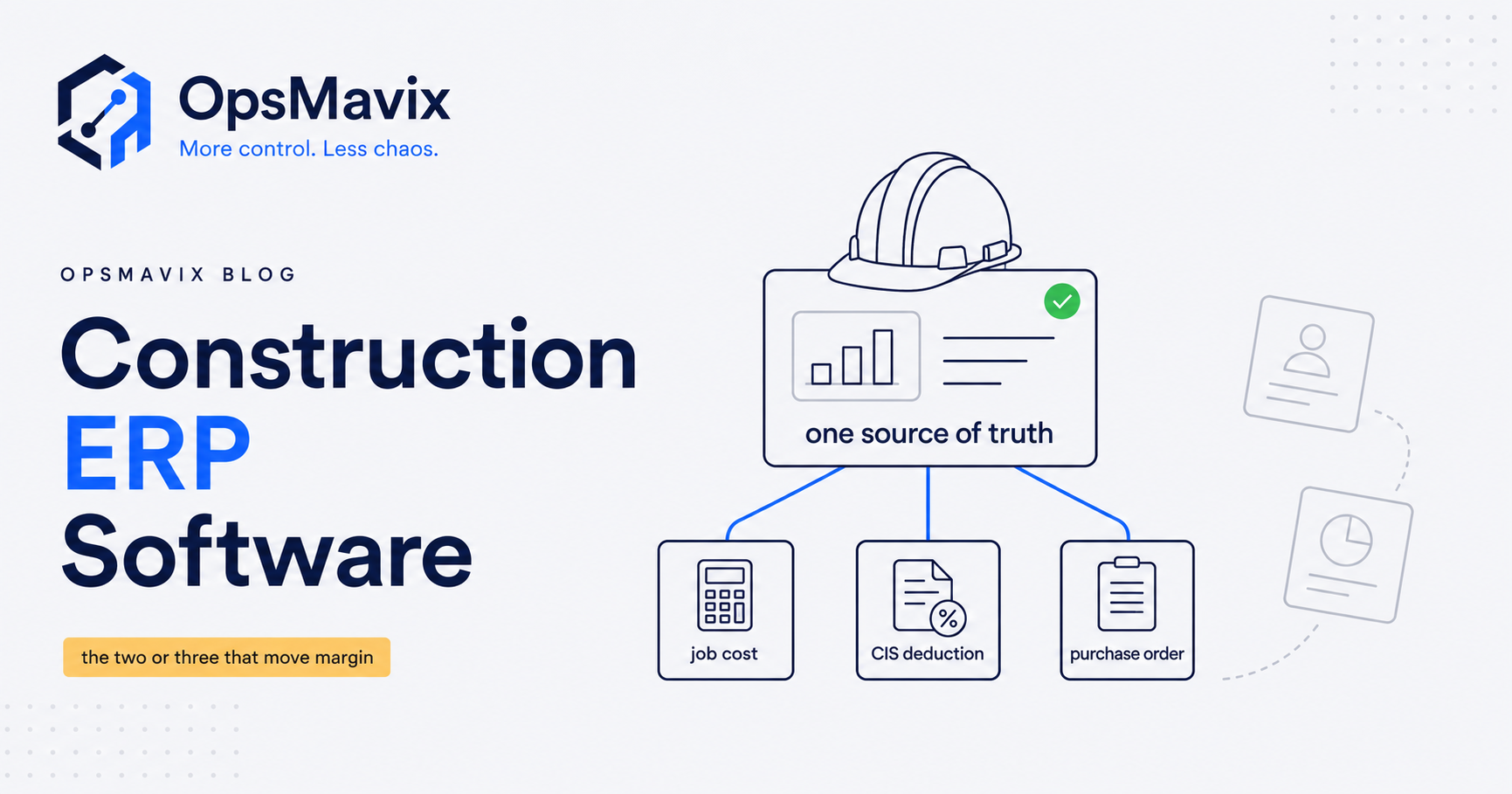
Construction ERP software is a single integrated system that runs the financial and operational side of a contracting business, so that project accounting, job costing, procurement, subcontractor payments, plant, payroll and document control all share one set of data instead of living in separate tools. The idea is simple: enter something once, see it everywhere, and know what each job is actually making while it is still live rather than months after practical completion.
Quick summary: Construction ERP replaces the spreadsheet-and-Sage sprawl that most contractors run on, but a full platform is heavy, expensive and slow to embed, and many firms only ever use a fraction of it. Given that construction is consistently the highest-volume sector for company insolvencies in England and Wales, with 3,934 construction insolvencies in the 12 months to August 2025 — 17% of all cases where an industry was recorded (Insolvency Service) — the real problem to solve is cash and cost visibility, not owning the biggest system on the market.
Contents
- What construction ERP software actually is
- The core modules, explained
- Who genuinely needs a full construction ERP
- Who is over-buying (and paying for it)
- Spreadsheet vs full ERP vs right-sized owned system
- A worked example: the £40k that vanished
- What “right-sized and owned” means in practice
- How to decide without getting sold
- FAQ
What construction ERP software actually is
ERP stands for Enterprise Resource Planning. In a general business it ties finance, stock, sales and HR together. A construction ERP is the same idea shaped around how contracting actually works: the unit of profit is the job, revenue is recognised across long, messy timelines, and a large chunk of your cost base is subcontractors and plant rather than shelf stock.
The point of any ERP is a single source of truth. When a purchase order is raised against a job, the cost should flow automatically into that job’s cost report, the supplier’s ledger, your VAT position and your cash forecast — without anyone re-keying it into a spreadsheet at month end. That is the promise. Whether a given firm needs the whole machine to get it is a separate question, and it is the one most vendors skip.
If you want the wider distinction between an accounting-led system and an operations-led one, we cover it in operational systems vs ERP and finance ERP vs operational ERP.
The core modules, explained
A full construction ERP is really a bundle of modules. You are rarely buying “an ERP”; you are buying a stack you may only half-use. The main ones:
Project accounting. Ledgers organised by contract, with retentions, applications for payment, valuations and stage billing built in. This is the spine of the system and the reason generic accounting packages struggle with construction.
Job costing and WIP. The module that tells you committed cost, actual cost and forecast cost to complete against the value of each job, so you can see margin while the job is live. Work in progress (WIP) accounting — recognising cost and revenue on unfinished contracts — is where most spreadsheet setups quietly go wrong. If job costing is your one real pain, read how to track project profitability without spreadsheets and job costing software before you buy anything.
Procurement and materials. Requisitions, purchase orders raised against a job and cost code, goods receipting, and supplier invoice matching. Done well this is where cost overruns get caught early.
Subcontractor management and CIS. The Construction Industry Scheme requires contractors to deduct money from most subcontractor payments and pass it to HMRC as an advance on the subcontractor’s tax and National Insurance. Deductions are 20% for registered subcontractors, 30% for unregistered ones, and 0% for those with gross payment status (HMRC). An ERP automates verification, deduction, statements and the monthly CIS return.
Plant and equipment. Tracking owned and hired plant, allocating its cost to jobs, and managing maintenance and utilisation so idle kit stops being invisible.
Payroll. Often construction-specific: CIS alongside PAYE, operatives across multiple sites, and time captured against cost codes.
Document control. Drawings, RAMS, variations, certificates and correspondence versioned and tied to the contract. On larger projects this is a compliance requirement, not a nicety.
Who genuinely needs a full construction ERP
Some firms genuinely do. The honest indicators:
- Scale and complexity. You are running many concurrent contracts, multiple entities or divisions, and the volume of transactions makes manual reconciliation impossible.
- Heavy compliance load. You bid public-sector or tier-one framework work with formal document control, audit trails and reporting obligations baked into contracts.
- A finance team that will own it. ERPs reward organisations with the people and process discipline to run them. A part-time bookkeeper cannot embed a full construction ERP.
- Genuine module breadth. You need project accounting and procurement and plant and CIS payroll and document control, all integrated, and you will actually use each one.
If most of those are true, a purpose-built construction ERP is a reasonable buy. Do it with eyes open on the total cost: licences, implementation, data migration, training and the internal time to run it are the real number, not the headline per-seat price.
Who is over-buying (and paying for it)
Here is the uncomfortable part. The UK construction sector is dominated by smaller firms. There were 370,770 VAT and PAYE-registered construction firms operating in Great Britain in 2024 (ONS), and the overwhelming majority are micro and small businesses running a handful of concurrent jobs.
For a firm like that, a full ERP is usually too much system, too soon. The classic signs of over-buying:
- You are paying to license modules (plant fleet management, formal document control, multi-entity consolidation) you will never switch on.
- Implementation drags for months and the team quietly drifts back to spreadsheets for anything urgent.
- You needed job-cost visibility and CIS handled cleanly, and instead you bought a platform that does forty things adequately and your two things awkwardly.
- The system now owns you: you cannot change a workflow without a consultant, and the annual licence renewal is a line item nobody can justify but everyone is scared to cancel.
Over-buying is not a moral failing; it is what happens when the only options presented are “spreadsheets” or “enterprise platform”. There is a middle, and this is our recurring theme — see when Odoo is too complex for a small business.
Spreadsheet vs full ERP vs right-sized owned system
| Dimension | Spreadsheets + accounts package | Full construction ERP | Right-sized owned system |
|---|---|---|---|
| Single source of truth | No — data re-keyed across files | Yes, if fully embedded | Yes, scoped to your real workflows |
| Live job costing / WIP | Manual, lagging, error-prone | Strong | Strong, built around your cost codes |
| CIS + subcontractor handling | Manual, risky at scale | Automated | Automated for your process |
| Modules you don’t need | N/A | Paid for anyway | Not built, not paid for |
| Time to value | Immediate but fragile | Months | Weeks |
| Cost shape | Low cash, high hidden labour + risk | High licence + implementation, ongoing | One build cost, you own the asset |
| Who controls change | You (but it breaks) | The vendor / a consultant | You own the code and the data |
| Fails when | Volume or staff turnover rises | Team never fully adopts it | Requirements far outgrow the scoped design |
The right-sized column is not “cheap ERP”. It is a deliberately narrow system that does the two or three things that actually move your margin and cash, owned by you, with no licence rent and no unused modules.
A worked example: the £40k that vanished
A groundworks contractor runs six to ten concurrent jobs. Valuations go out monthly, subcontractor invoices come in weekly, and plant hire is booked by whoever needs it. Job costing lives in one master spreadsheet that the office manager updates “when there’s time”.
On a £220k job, committed subcontractor cost and plant hire quietly ran £40k over the allowable. Nobody saw it because the spreadsheet reflected invoices received, not cost committed via purchase orders, and hired plant kept billing after it should have gone back. By the time the numbers reconciled at month end, the job was near complete and the money was gone. On a thin margin, that single blind spot wiped the profit on the job.
Nothing here needed document control, multi-entity consolidation or a plant maintenance module. It needed one thing: committed cost visible against each job the day it was committed, with hired plant tracked to an off-hire date. That is a scoped build, not an enterprise platform. Under the payment framework of the Housing Grants, Construction and Regeneration Act 1996 — the “Construction Act” — contractors have statutory rights to stage payments and defined payment notices, and knowing your true committed cost per valuation cycle is what lets you actually use them.
What “right-sized and owned” means in practice
A right-sized owned system takes the two or three modules that carry your business case and builds them properly, on data you control, with nothing you will not use.
For most contractors that means: purchase orders raised against a job and cost code, a live job-cost view showing committed vs actual vs forecast, clean CIS handling for subcontractor payments, and a single dashboard the directors trust. Not seven modules. The ones that end the leak.
Crucially, you own it. No per-seat licence rent, no vendor gatekeeping every change, and your data stays yours. When the process changes — and in construction it always does — the system changes with it because it was built around how you actually work, not the other way round. That is the difference between an operations control system and renting someone else’s platform. If you want the fuller argument, see what is an operations system and how it differs from custom software for a business.
How to decide without getting sold
Run this order before you talk to any vendor:
- Name the leak. Write down the two or three problems costing you real money: usually live job costing, CIS admin, and committed-cost visibility. Everything else is secondary.
- Count what you’d actually use. List the ERP modules and mark the ones you will switch on in year one. If it is two or three, you do not need a seven-module platform.
- Price the whole thing. Licences plus implementation plus migration plus training plus internal time. Compare that to a one-off build you own outright.
- Check who controls change. If every future tweak needs a consultant, you are renting, not owning.
The related read on MIS vs ERP and Odoo vs custom software will help if you are weighing named platforms. And you can see the shape of a scoped build on our project operations dashboard page.
FAQ
What is the difference between construction ERP and normal accounting software?
Normal accounting software (Sage, Xero, QuickBooks) is organised around your business as a whole — ledgers, VAT, payroll. Construction ERP is organised around the job: retentions, applications for payment, WIP, committed cost and CIS all sit against individual contracts. You can bolt job costing onto standard accounts software, but it usually ends up in spreadsheets, which is where the errors creep in.
Do I legally need construction ERP software for CIS?
No. CIS is a legal obligation for contractors — you must verify subcontractors, apply the correct deductions (20%, 30% or 0%) and file monthly returns (HMRC) — but you can meet it with much simpler tools. An ERP automates it; it is not the only compliant option.
How much does construction ERP software cost in the UK?
It varies widely and the licence price is the small part. The real cost is implementation, data migration, training and the internal time to embed it, which for a full platform runs into months of effort. A right-sized owned system is usually a single build cost with no ongoing licence rent, though the exact figure depends entirely on scope.
Is a right-sized owned system just a cheaper ERP?
No. It is a deliberately narrow system that solves the two or three things carrying your business case — typically live job costing, committed-cost visibility and clean CIS — and nothing else. You own the code and the data, so there is no licence rent and no vendor gatekeeping changes. It is not a stripped-down ERP; it is a different model.
When should a contractor genuinely buy a full ERP?
When you run many concurrent contracts or multiple entities, carry a heavy compliance and document-control load (typically public-sector or tier-one framework work), have a finance team that will own the system, and will genuinely use most of the modules. If two or three of those are not true, you are likely over-buying.
How OpsMavix Can Help
OpsMavix builds right-sized, owned operations systems for construction firms that are outgrowing spreadsheets but not looking to bend the business around a packaged ERP. We start with where money and margin are actually leaking across your jobs, then build the smallest system that ends it: live job costing, committed-cost visibility, clean CIS handling and a dashboard your directors trust. You own it outright. No per-seat licence, no vendor lock-in, no modules you will never switch on.
We are not an ERP vendor and we do not sell code by the hour. We sell the outcome: one source of truth, the end of double entry, and knowing what each job is making while it is still live. Our guarantee is on delivery, and we will tell you honestly if a full platform is genuinely the better fit for you. Book a Free Operations Leak Audit.
Sources
- HMRC / GOV.UK — Construction Industry Scheme (CIS): what it is and deduction rates (20% / 30% / 0%): https://www.gov.uk/what-is-the-construction-industry-scheme
- Insolvency Service / GOV.UK — Company Insolvency Statistics commentary (construction the highest-volume sector, 3,934 in the year to August 2025, 17% of cases): https://www.gov.uk/government/statistics/company-insolvencies-september-2025/commentary-company-insolvency-statistics-september-2025
- legislation.gov.uk — Housing Grants, Construction and Regeneration Act 1996, Part II (payment provisions: stage payments and payment notices): https://www.legislation.gov.uk/ukpga/1996/53/part/II/crossheading/payment
- Office for National Statistics — Construction statistics, Great Britain: 2024 (370,770 registered construction firms in GB): https://www.ons.gov.uk/businessindustryandtrade/constructionindustry/articles/constructionstatistics/2024