
Operational Systems vs ERP: Which Do You Actually Need?
An ERP isn't the only step up from spreadsheets — and for most growing businesses it's the wrong one. Here's the honest comparison and how to choose.
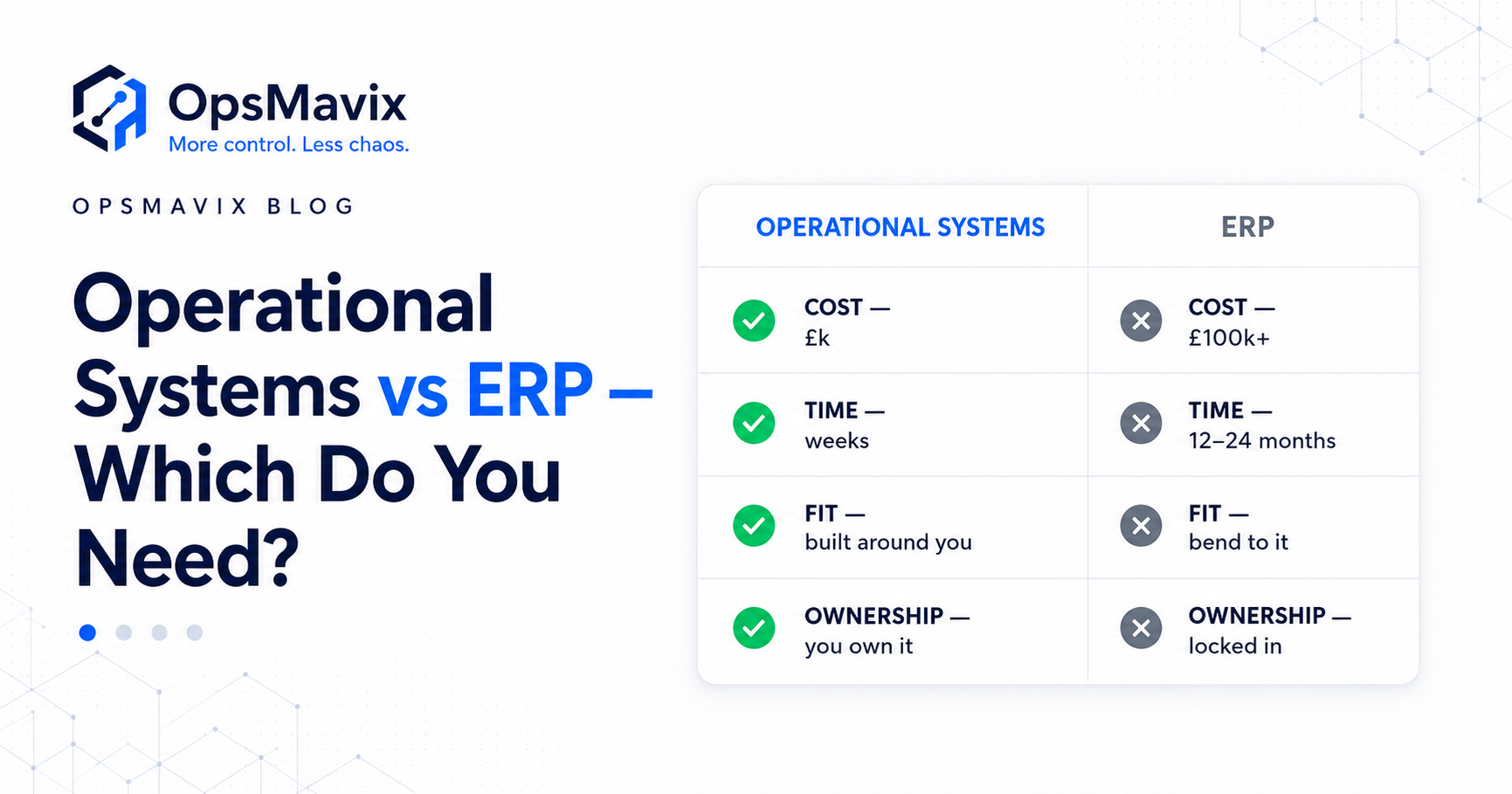
By OpsMavix. ERP pricing references checked September 2026.
Your spreadsheets have stopped coping. Someone tells you the only serious fix is an ERP, so you request a quote, and back comes a six-figure number with a timeline measured in quarters. You look at the problem in front of you, a handful of connected jobs going wrong, and the “solution” is plainly bigger than the problem. So you close the quote and go back to the spreadsheets.
That gap between the problem you have and the system you were shown is what operational systems vs ERP is really about.
For UK businesses that buy, make or move physical products, the honest question is not “which ERP”, it is “does this business need an ERP at all yet, or a focused operations system built around how it already works”. This guide sets the two approaches side by side across the things that actually decide it, cost, time, fit and ownership, so you choose the right system rather than the only one a salesperson put in front of you.
What is an ERP?
An ERP (Enterprise Resource Planning) is one large integrated suite designed to run the whole business from a single vendor platform: finance, inventory, purchasing, manufacturing, HR and often CRM, all sharing one database. That breadth is the selling point. It is also the catch. You buy, pay for and train on far more than you use, and because the suite has its own fixed way of doing things, your team reshapes proven workflows to match the software.
ERPs range from mid-market products a growing company can actually run, such as Microsoft Dynamics 365 Business Central, up to tier-1 platforms like SAP S/4HANA, Oracle and NetSuite that are built for large, multi-entity enterprises.
What is an operational system?
An operational system is a focused set of connected tools that runs your actual day to day, stock, orders, production, approvals and reporting, joined into one source of truth and shaped around how your team already works. You get the capability you need for the problem you are solving, connected to the tools you already rely on, without the modules you will never open.
The difference in one line: an ERP asks your business to fit the software. An operations system fits the software to the business you run now.
Operational systems vs ERP: the comparison
| Comparison point | Operations system | ERP |
|---|---|---|
| What it is | A focused set of connected tools (stock, orders, production, approvals, reporting) built around how your team already works | One large integrated suite covering finance, inventory, HR, manufacturing and CRM from a single vendor platform |
| Typical UK cost | A fixed project scope, roughly £3,000 to £25,000 and up | Mid-market from about £60 per user each month plus implementation; tier-1 ERP reaches six figures |
| Time to live | Weeks | Several months to more than a year |
| How it fits your process | Shaped to your workflow | Your workflow adapts to the platform |
| Ongoing cost | Owned outright, support optional | Per-seat licences and annual increases |
| Ownership | Yours, handed over, no lock-in | Vendor-hosted access, data held on their terms |
| Changing it later | A scoped change to your own system | A consultant, a partner or a new module |
| Best fit | A business with specific, connected operational pain | A large, multi-entity organisation with deep needs across many departments |
Prices are indicative and dated: mid-market ERP per-user pricing such as Business Central is published, while NetSuite and SAP are quoted on request. Confirm current figures and VAT treatment with each vendor before you rely on them.
The four differences that actually decide it
The table is the summary. These are the four points where the decision is genuinely made.
Cost: a fixed scope versus an open meter
An ERP quote rarely stops at the licence. Implementation, consultants, data migration, per-seat fees and annual increases stack on top, and the first number you are shown is often a fraction of the number you end up paying. A scoped operations system is priced to the specific problem, a fixed figure agreed before work starts, typically a few thousand to low tens of thousands. With an ERP you seldom pay the quote. With a scoped system, the number is the number.
Time: this quarter versus next year
ERP rollouts routinely run a year or more, and a meaningful share stall before they are fully live, while the meter keeps running. Operations systems are built and launched in weeks precisely because they are focused rather than all-encompassing. You feel the relief this quarter, not the year after next.
Fit: built around you versus bend to it
This is the deepest difference. An ERP carries its own model of how a business should run, so your team adapts to it, and changing anything later means a developer or a value-added reseller. An operations system is designed around the way your team already works, so adoption is natural and later changes are simple. One works against your process. The other reinforces it.
Ownership: yours versus rented
With most ERPs you are renting access. You are tied to the vendor, the per-seat fees and data that lives on their terms. An operations system built for you is handed over and owned outright, no lock-in, no hostage data. Owning the system and renting a platform are two very different futures for the same money.
Worked example: told to buy an ERP, sized to what was needed
A homeware brand turning over about £4 million runs on Shopify, Xero and a set of shared spreadsheets. Stock counts drift, purchase orders are chased by email, and nobody can see live what is committed against what is on the shelf. The brand is told it needs an ERP, and the quote lands near £120,000 with a nine-month rollout.
Walk through the actual problem. Three things are broken: stock accuracy, purchasing visibility and a single live view of orders. None of them needs finance, HR or manufacturing modules rebuilt. A connected operations system covering stock, purchasing and order visibility, wired into the Shopify and Xero already in place, solves all three in weeks for a fraction of the ERP figure, and the brand owns it. The ERP was not wrong because ERPs are bad. It was wrong because it answered a far larger question than the business was asking.
When you genuinely need a full ERP
This is not an argument against ERP. It is an argument for matching the tool to the business. A genuinely large, multi-entity organisation with deep, integrated needs across finance, supply chain, manufacturing and HR, running in several currencies or jurisdictions, can justify an ERP’s breadth and cost, and will outgrow a focused system. The mistake is reaching for an ERP before you are that business, on the assumption that it is the only serious option.
Worth being clear here: OpsMavix builds full ERP systems as well as right-sized operations systems. So the honest answer is not “avoid ERP”, it is “buy the ERP when the business actually needs one, and buy a focused system when it does not”. The point of the comparison is to place you correctly, not to sell you the smaller thing by default.
How much each approach costs in the UK
An operations system is scoped to a fixed price for the problem in front of you. As a guide, OpsMavix project bands run Starter Fix £3,000 to £10,000, Growth System £10,000 to £25,000, and Operations Platform from £25,000, set against the specific work rather than a per-seat meter.
An ERP is priced differently. Mid-market products publish a per-user monthly rate, for example Business Central Essentials sits around £61.50 per user each month, paid yearly and excluding VAT, before implementation. Larger platforms such as NetSuite and SAP are scoped and quoted on request, and total cost of ownership across licences, implementation and consultants routinely reaches six figures. The figure that matters is not the licence line, it is the all-in cost over the first two to three years, which is where the two approaches separate most.
A practical checklist for choosing
Work through these before you commit to either path.
- Write down the specific jobs that are going wrong today, in plain language, not “we need a system”.
- Count how many business functions those jobs touch. A few connected ones point to an operations system. Many deep ones across the whole company point to ERP.
- Ask whether you would have to change how your team works to fit a given option, and whether that change is worth it.
- Get the all-in cost over three years for each option, not the headline licence or the first quote.
- Check what you own at the end, the system and the data, or access you keep paying for.
- Confirm what connects to the tools you already run, mapped before anything is promised.
How to avoid the expensive mistake
The common error is not choosing ERP over an operations system, or the reverse. It is choosing by the size of the tool rather than the shape of the problem. If your pain is a handful of connected operational failures, stock that is wrong, orders chased by hand, no live visibility, a focused system solves it faster, cheaper and in a form you own. If you are a large multi-entity enterprise straining a fully integrated suite across every function, an ERP earns its weight. Most businesses asking the question sit firmly in the first camp. They have simply only been shown the second.
Frequently asked questions
What is the difference between operational systems and an ERP?
An ERP is one large integrated suite that runs the whole business and that you adapt to. Operations systems are focused, connected tools built around how your business already works. ERPs generally cost more, take longer and tie you in. Operations systems are scoped, quick to launch and owned by you. Neither is better in the abstract. The right one depends on the size and shape of the problem.
Are operational systems cheaper than an ERP?
Usually, yes, for a sub-enterprise business. ERP total cost runs into six figures once implementation, consultants, per-seat fees and annual increases are counted. An operations system is scoped to a fixed price for a specific problem, typically a few thousand to low tens of thousands. Compare the all-in cost over three years rather than the first quote.
Is an ERP overkill for a small business?
Often, yes. Most small and growing businesses use a fraction of an ERP’s functions while paying for all of them and bending their workflows to fit. A system sized to how you work now is usually the better fit until real enterprise complexity arrives.
Can an operations system connect to the tools I already use?
Yes. It is built to connect to what you rely on, such as Shopify, Xero, QuickBooks, Stripe and supplier feeds, so data syncs instead of being re-typed. What connects is mapped before anything is promised.
When should I actually move to an ERP?
When you are a large, multi-entity organisation with deep, integrated needs across many departments that a focused system genuinely cannot cover. For most businesses that point arrives later than they are told, and an operations system bridges the gap until then. OpsMavix builds the ERP too when that day comes, so the move can be planned rather than forced.
How OpsMavix can help
OpsMavix builds operations systems for UK product businesses, connected stock, orders, production and reporting shaped to how your team actually works, and full ERP systems when a business genuinely needs one.
Start with one hard question: when something changes upstream, a supplier slips a date, a count is wrong, an order is amended, can your team see every job affected, or does it take several spreadsheets and a round of messages to find out?
If it takes the messages, bring that example to an Operations Leak Audit. We map how you work, show where the operation leaks time and money, and give you an honest read on whether a focused stock, order or reporting system, or a full ERP, is the right answer. You can also review our current project price bands before getting in touch.
Whichever way the decision goes, it should be made by the problem in front of you, not by the biggest tool on the shelf.