
Odoo Implementation Cost: The Bill Beyond the Licence
The Odoo implementation cost people quote you is the per-user licence — the small, predictable part. The real bill is the partner implementation, the customisation to make it fit, the hosting, the third-party apps, and the upgrade tax you pay every version. Here's how the cost is structured, why an open-ended config project drifts, and how to compare it fairly against a fixed-scope custom build.
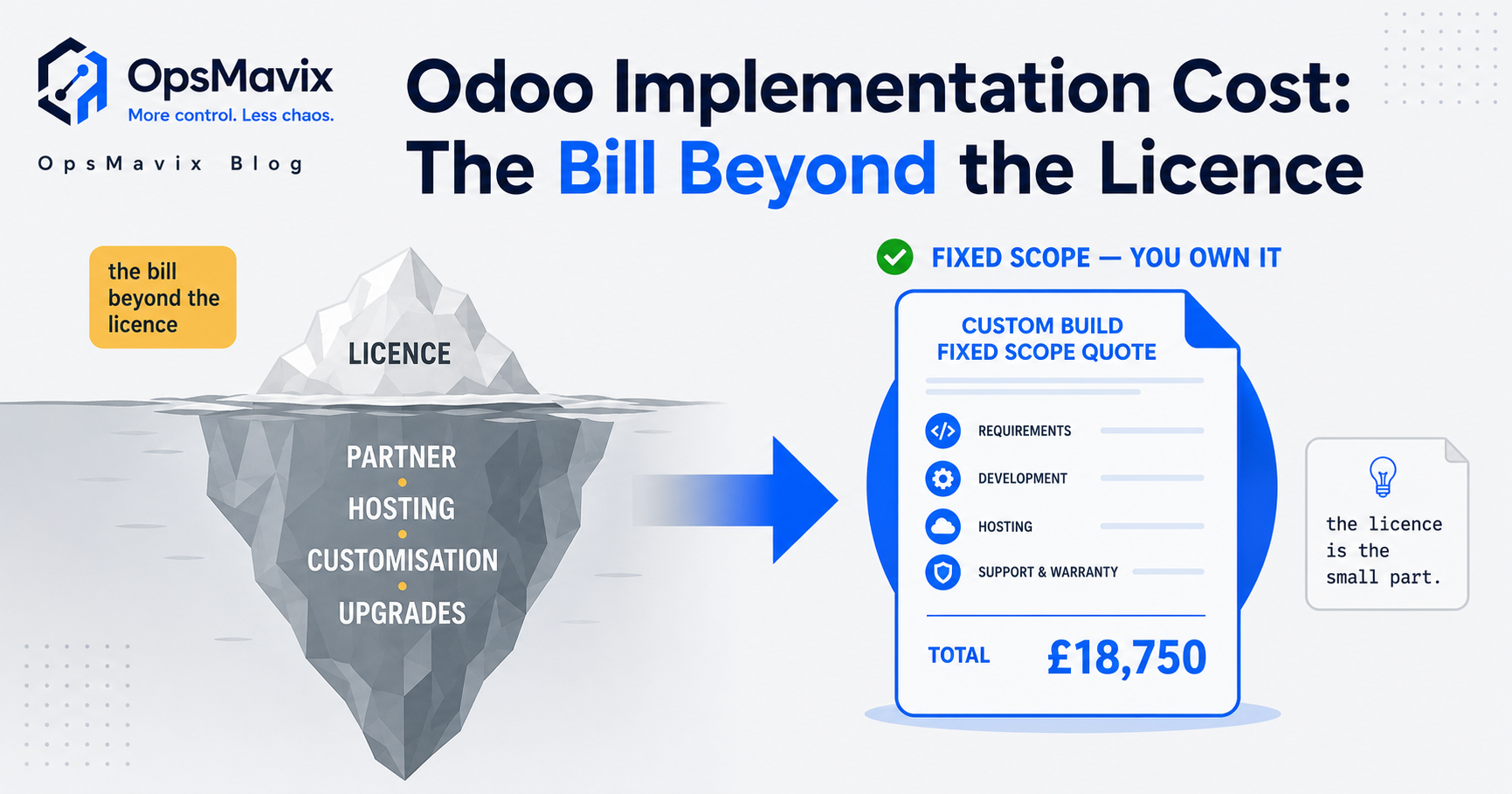
Odoo implementation cost is almost never the number you first see quoted, because that number is the licence — the per-user, per-month subscription — and it’s the small, predictable part of the bill. The cost that actually decides whether an Odoo project is worth it lives underneath: the partner who configures it, the customisation to make it fit, the hosting you run it on, the third-party apps that fill the gaps, and the upgrade work you pay for every time a new version lands. Add those up and the licence is often a fraction of the total.
This post breaks down the real cost structure of an Odoo implementation — where each layer comes from, which are predictable and which drift — so you can read a quote properly before you sign. We won’t invent totals: Odoo doesn’t publish implementation pricing, and the real figure swings enormously with your scope, your partner and how much you customise. What we can do is show you the shape of the bill, and set it honestly against a fixed-scope custom build.
Key Takeaways
- The licence is the visible, predictable part — a per-user, per-month subscription — and usually the smallest line in the real total.
- Implementation is where the money is: a partner charges to configure, migrate data, integrate other tools and train your team, and that fee is one-off but open-ended, scaling with scope and customisation.
- Per-app and per-user pricing rewards a small footprint and punishes a big one — the more apps and people you add, the more the standing cost climbs, and the “one app free” tier rarely survives contact with a real operation.
- The upgrade tax is the cost nobody quotes: every custom change has to be re-tested and often re-built when Odoo releases a new version, and that maintenance recurs for as long as you run it.
- An Odoo project is an open-ended config exercise; a custom build is a fixed scope. The honest comparison isn’t licence-vs-build-fee — it’s total cost, and control, over three to five years.
- Get real quotes before you decide. Ask a partner for a written breakdown of every layer below, and compare it to a fixed-price custom quote for the same outcome.
The Licence Is the Part Everyone Quotes — and the Part That Matters Least
Odoo’s subscription is priced per user, per month, across three tiers: a limited free entry point (broadly, one app for unlimited users on Odoo’s own hosting), a standard plan that opens up the full suite of apps on Odoo’s cloud with no custom development, and a custom plan that adds custom development, third-party apps, multi-company setups and a choice of hosting — at a higher per-user rate. The exact figures move by region and over time, so check Odoo’s current published pricing rather than trusting any number in a blog, including this one.
The thing to understand is that this licence is the cheapest, most predictable line on the whole project — a known monthly figure that scales cleanly with headcount. It’s the part that’s easy to quote precisely, which is exactly why it’s the part you get quoted first. The rest of this post is the rest of the bill.
Per-App and Per-User Pricing: the Trap Is Success
Odoo’s model rewards a small footprint. Stay on one app for a handful of users and it’s genuinely cheap. But a real operation rarely stays there. You start with inventory, then you want the sales module talking to it, then purchasing, then accounting, then a bit of manufacturing — and each app you switch on, plus each person who needs to be in the system, moves you up the pricing. The “one app free” tier is a doorway, not a destination; the moment you need a second app you’re on a paid per-user plan for the whole suite.
That’s not a criticism so much as a warning about how the cost behaves. Per-user pricing means the more of your team you bring in — the whole point of an operations system — the more your standing cost climbs. A tool you adopt because you want everyone in one place charges you by the number of people you put in it. Model the cost at the headcount you’ll be at in two years, not the pilot team you start with.
Partner and Implementation Fees: the Real Line Item
Here’s where the bulk of the money goes, and where quotes vary most. Below a certain size some businesses configure Odoo themselves or buy Odoo’s own guided “success pack” hours; above it, most work with an implementation partner handling project management, configuration, data migration, integrations and training. That fee is a one-off, but open-ended by nature — it scales with how many modules you turn on, how much data has to be migrated cleanly, how many tools it must talk to, and how far your processes differ from Odoo’s defaults.
This is the line that turns a “cheap ERP” into a serious project. Published breakdowns put small deployments in the low five figures and larger multi-module, multi-entity rollouts far higher — but treat those as shape, not gospel, and get your own written quote. The point is that the implementation fee typically dwarfs a year of licences, and it’s the number a partner is least keen to fix in advance, because they can’t fully see your scope until they’re inside it.
The subtler cost is time. A partner-led implementation runs for months, during which your team is learning, mapping processes and testing — real hours pulled off the day job that never appear on the partner’s invoice.
Customisation and the Upgrade Tax
Odoo is configurable, and for processes that match its assumptions you get a long way with settings alone. The cost appears when your process doesn’t match — a pricing rule Odoo has no field for, a workflow that runs in an unexpected order, a report the standard module can’t produce. Then you’re into custom development: paid work to bend the platform to your operation, on top of the implementation fee.
And custom development carries a cost most quotes never mention: the upgrade tax. Odoo ships a major new version roughly once a year, and standard configuration usually migrates without much drama. Custom code does not — every bespoke change has to be re-tested against the new version, and often partly re-built when the platform shifts beneath it. That’s a recurring maintenance cost that scales with how heavily you’ve customised: the more you changed to make it fit, the more you pay every year to keep it fitting. You can freeze on an old version to avoid the bill, but then you’re running ageing software and losing the updates you’re paying a subscription for.
Hosting, Support and the Third-Party App Bill
Where Odoo runs adds another layer. The standard plan lives on Odoo’s own cloud, included in the subscription. The moment you need custom modules or more control you move to Odoo’s developer-hosting platform or to self-hosting — both of which carry their own cost, whether that’s a hosting fee or the infrastructure and technical staff to run it yourself. On-premise looks free until you count the server, the backups and the person who keeps it patched.
Then there are the apps you didn’t budget for. Odoo’s own modules cover a lot, but real implementations routinely reach for third-party apps from its marketplace to fill specific gaps — each a separate purchase, sometimes recurring, and each another thing to test through every upgrade. Add ongoing support — a retained block of partner hours or an internal Odoo-literate hire — and you have a standing annual cost well above the headline licence. None of these are hidden exactly; they’re just rarely totalled up in the first quote.
Fixed-Scope Custom Build vs Open-Ended Config
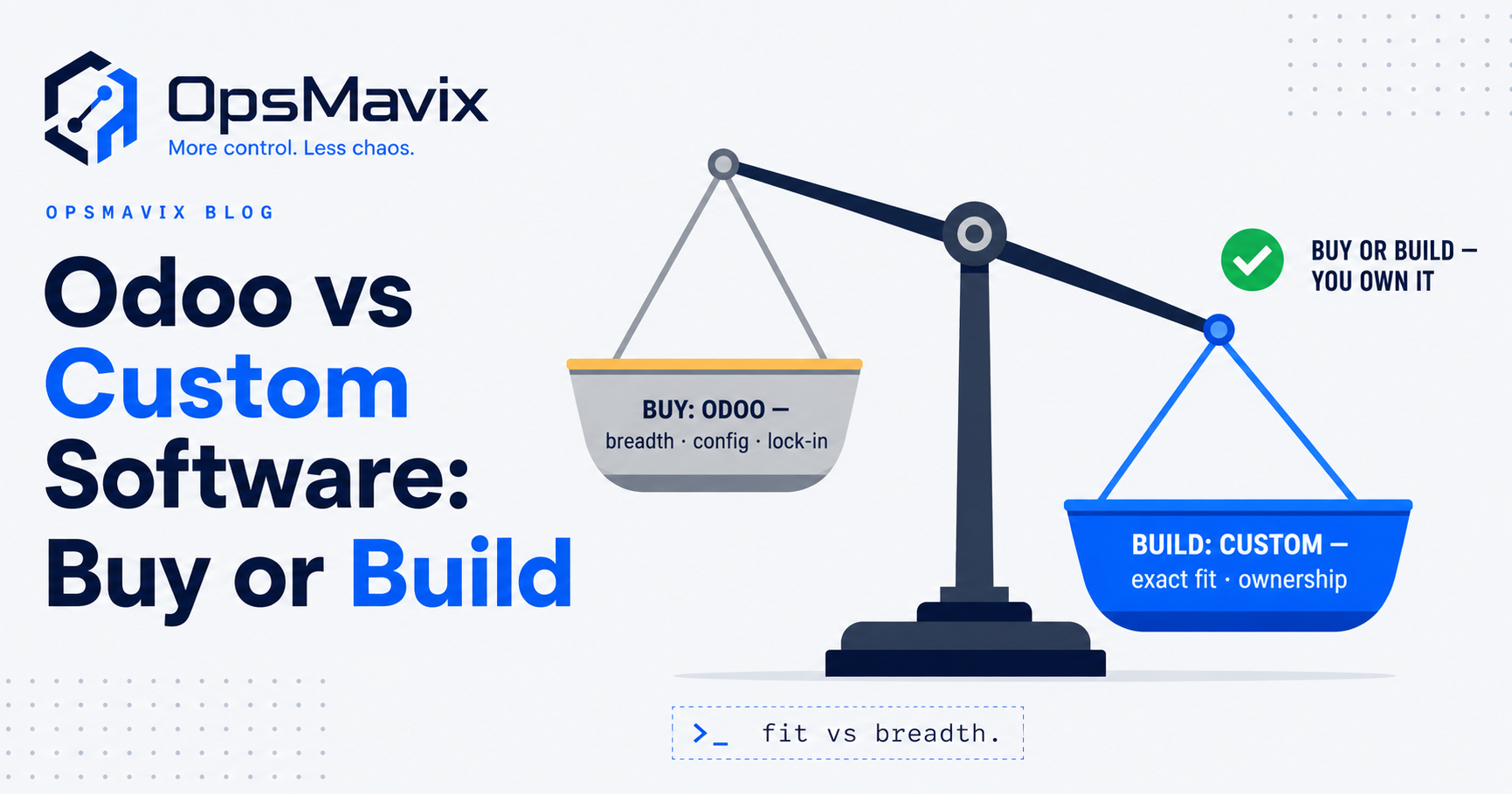
Here’s the framing that actually matters, and it isn’t “licence versus build fee.” It’s the difference between an open-ended configuration project and a fixed scope. An Odoo implementation is open-ended by nature: you take a suite built for the general case and configure, customise and integrate until it approximates your operation — and you don’t fully know how far that goes until you’re in it. The costs above compound because each layer feeds the next: more customisation means more upgrade tax, more integrations mean more support.
A custom operations system inverts that. It’s scoped and priced up front to do the specific things your business actually does — nothing more to configure, because it’s built to fit rather than bent to fit. There’s no per-user creep, because you own it outright. There’s no upgrade tax in the Odoo sense, because you’re not chasing a vendor’s release cycle and re-testing customisations against it. This is the OpsMavix model: a fixed-scope build for a defined outcome — a custom system shaped to how your stock and orders actually move, in the range most starter and growth projects sit in, rather than an open-ended config exercise whose final total you learn at the end.
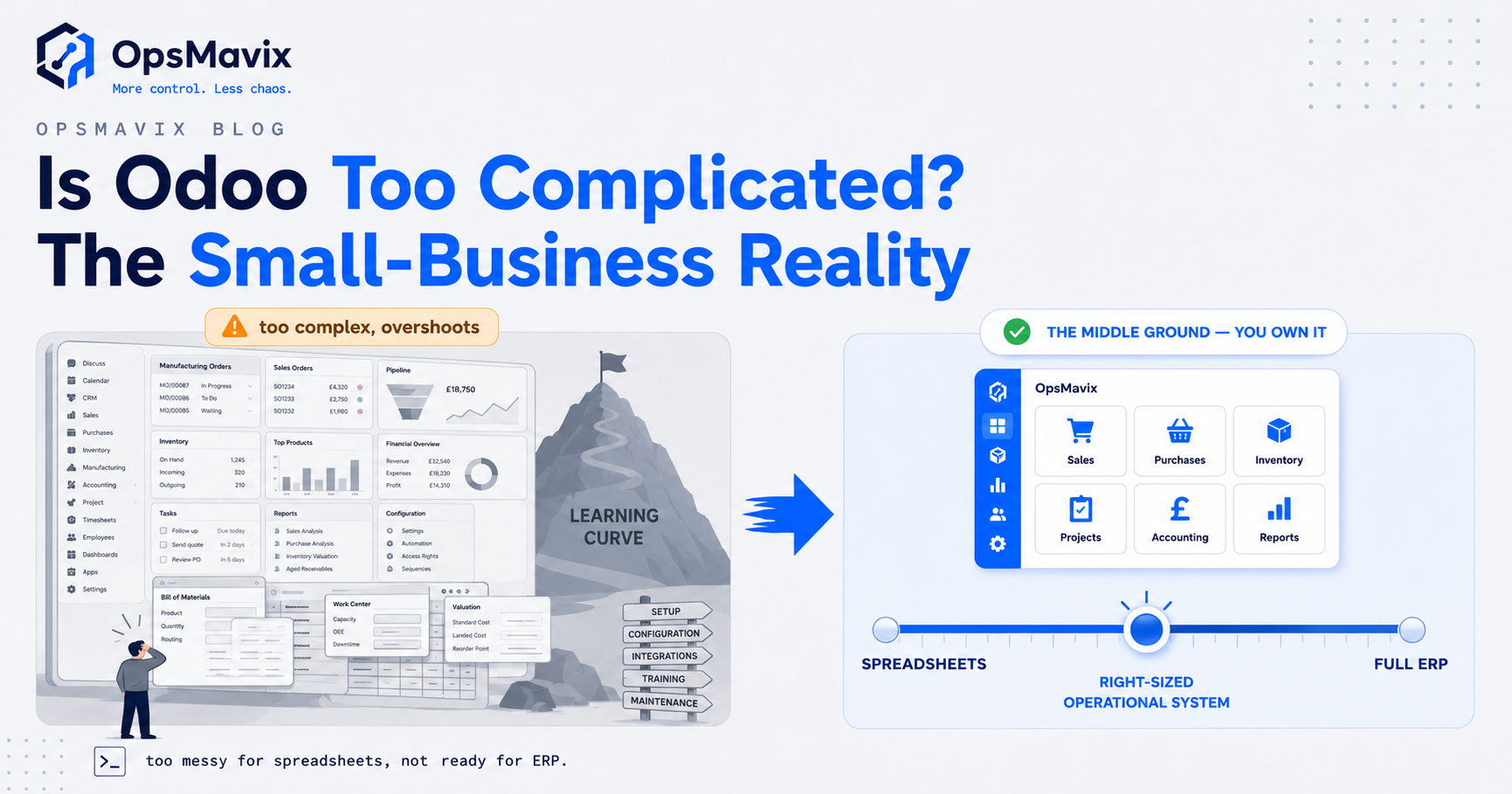
To be fair, that trade only makes sense when your needs are focused. If you genuinely need thirty interlocking apps across finance, HR, manufacturing and CRM, a suite’s breadth is real value. The custom case is strongest when a handful of operational processes — inventory, orders, production, reporting — are where your pain lives, and you’d be configuring a whole ERP to use a fifth of it. That’s the wedge covered in full in the Odoo alternative post.
When Odoo’s Cost Stays Contained (the Honest Bit)
Odoo isn’t a trap, and plenty of businesses run it well without the bill running away. The cost stays contained when your processes are close to standard, so you live on configuration rather than custom development; you have Odoo skills in-house or a fixed-price partner you trust; you actually use a broad spread of the suite, so the per-user licence buys genuine breadth; and you stay near the defaults so upgrades stay cheap. Under those conditions Odoo can be a sensible, well-priced choice, and we’d say so.
The cost runs away in the opposite conditions: heavy customisation to force a fit, a widening scope nobody fixed at the start, a growing per-user bill, and an upgrade tax that compounds every year. If you recognise your project in that second description, that’s the signal to compare it against a right-sized custom build before you commit — not after the implementation is half done and the sunk cost is talking.
FAQ
How much does an Odoo implementation actually cost?
There’s no single honest number, because Odoo doesn’t publish implementation pricing and the real cost swings enormously with scope. The structure is: a per-user, per-month licence (the predictable, smaller part), plus a one-off partner implementation fee that usually dwarfs it, plus customisation, hosting, third-party apps and ongoing support. Small deployments tend to land in the low five figures and mid-market rollouts substantially higher, but treat those as shape only and get a written quote broken down by each layer.
What is the Odoo upgrade tax?
It’s the recurring cost of keeping custom development working through Odoo’s roughly annual major releases. Standard configuration usually migrates cleanly, but custom code has to be re-tested and often partly re-built for each new version — so the more heavily you customised to make Odoo fit, the more you pay every year to keep it fitting. It’s a real ongoing cost that rarely appears in the initial quote.
Is a custom system cheaper than Odoo?
On the headline it depends entirely on scope, and for a genuine multi-department suite need Odoo’s breadth is hard to beat. But the honest comparison is total cost and control over three to five years, not licence versus build fee. A fixed-scope custom build is priced up front for a defined outcome, with no per-user creep and no upgrade tax; an Odoo implementation is open-ended and compounds. Where your needs are focused on a few operational processes, a right-sized build often wins on both cost and fit.
What should I ask an Odoo partner before signing?
Ask for a written breakdown of every layer: licence at your projected two-year headcount, the one-off implementation fee and whether it’s fixed or open-ended, expected customisation, hosting, any third-party apps, ongoing support, and the likely cost of the next version upgrade given your customisations. Then ask for a fixed-price custom quote for the same outcome and compare the two totals over several years, not the first year.
How OpsMavix Can Help
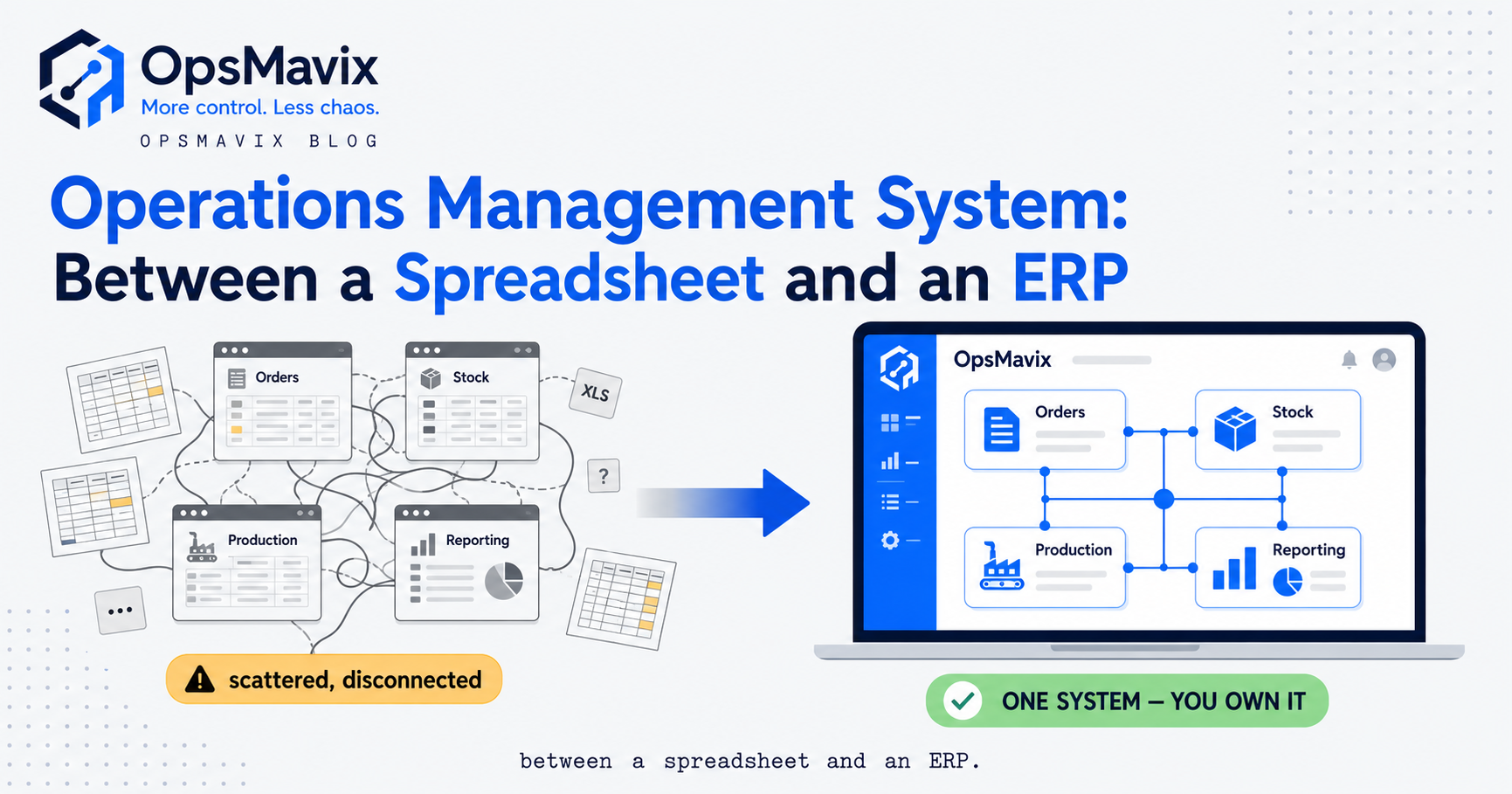
OpsMavix builds right-sized operations systems for businesses weighing a full suite like Odoo against staying on spreadsheets — too messy for the workbook, not ready for the whole ERP. Instead of an open-ended config project whose total you learn at the end, we scope and price the specific outcome up front: inventory that stops drifting, orders entered once, the reporting you actually need — built to fit how you work rather than bent to fit a suite’s defaults. You own it outright, so there’s no per-user creep and no upgrade tax chasing a vendor’s release cycle. If your needs genuinely span thirty interlocking apps, we’ll tell you a suite is the better call — the honest version of this decision lives in the Odoo alternative post and what an operational ERP really is.
If you’re staring at an Odoo quote and can’t tell the real total from the licence, start by knowing what your current operation costs. Book a Free Operations Leak Audit and we’ll map where your operations leak today, put a number on it, and show you honestly whether a fixed-scope custom build or a full suite is the right fit for how you actually run.
Keep reading
Getting value from OpsMavix? Add us as a preferred source on Google — you'll see more of our operations content in your AI Overviews, AI Mode and Search.