
Is Odoo Too Complicated? The Small-Business Reality
Is Odoo too complicated for a small business? Often, yes — not because it's bad software, but because it's a full ERP suite aimed at a business bigger than the one asking. This is an honest look at why Odoo feels heavy for SMEs, the config and admin curve nobody quotes you upfront, the middle ground most small businesses actually sit in, and how to choose without over-buying a suite you'll use a fraction of.
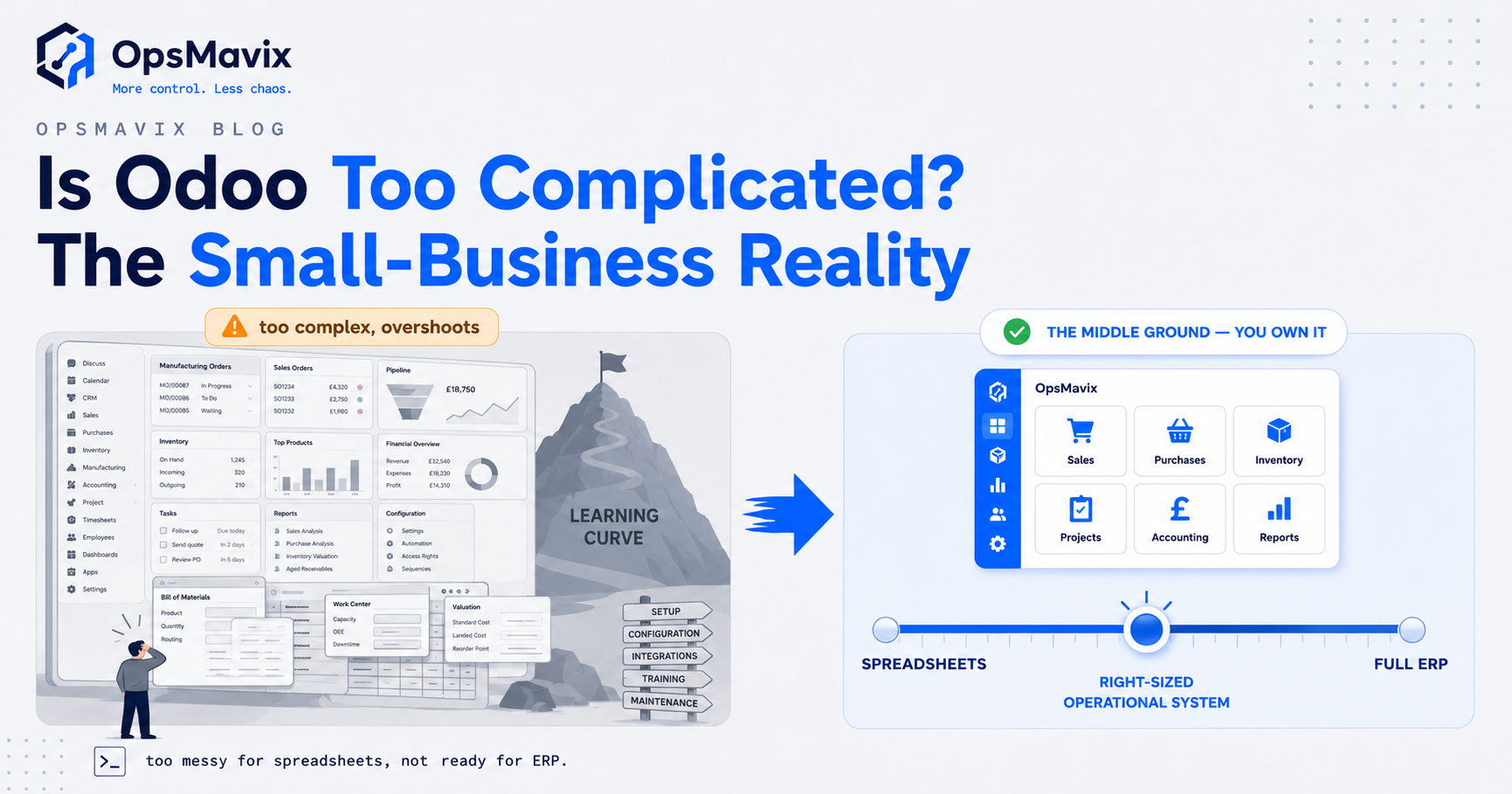
Is Odoo too complicated for a small business? For a lot of the businesses asking, the honest answer is yes — and it’s worth being precise about why, because “too complicated” isn’t a flaw in Odoo so much as a mismatch in fit. Odoo is a genuinely capable ERP suite, open-source at its core, with dozens of official apps and thousands of community modules covering accounting, inventory, sales, manufacturing, CRM, HR and more. It runs thousands of companies well. The trouble is that a suite built to run a whole company across many departments is a heavy thing to point at a fifteen-person business that just wants to stop losing orders and stock in spreadsheets.
This post is about that gap. If you’re at the doubt stage — you’ve watched a demo, read that Odoo is cheap and modular, and come away feeling this is more machine than you need — you’re not wrong to hesitate. Below is a fair account of why Odoo feels heavy for smaller operations, the setup and learning curve that rarely makes it into the sales conversation, the middle ground most SMEs genuinely occupy, and how to choose without buying a suite you’ll use a fraction of. We won’t pretend Odoo is never the answer; when it is, we’ll say so.
Key Takeaways
- “Is Odoo too complicated” is usually a fit question, not a quality one. Odoo is a full ERP suite; if you’re a small business with a couple of sharp process problems, you may be pointing an enterprise tool at an SME-sized job.
- The heaviness comes from breadth. Dozens of apps and thousands of modules mean most small businesses configure, learn and maintain far more surface than they’ll ever use.
- The real cost isn’t the licence. Across most Odoo implementations the software licence is a minority of the total — configuration, data migration, customisation, training and ongoing admin are the bulk of it.
- Most SMEs sit in a middle ground: outgrowing spreadsheets and disconnected tools. Odoo tends to overshoot that middle; a right-sized system sits in it.
- A right-sized operational system covers only what you actually do — the orders, stock, production and reporting that hurt — you own it, and if multi-entity finance and many departments are genuinely coming soon, a full ERP can still be the honest call.
Why Odoo Feels Heavy for a Small Business
The first thing to understand is that Odoo’s strength and its heaviness are the same property: breadth. It ships as a modular suite where you switch on apps — Sales, Inventory, Accounting, Manufacturing, Purchase, CRM, and on and on — plus a community app store running into the thousands of add-ons. For a business that genuinely runs across many functions, that breadth is the point: one platform, everything talking to everything. For a small business with two or three real pain points, that same breadth is surface you have to reason about whether you use it or not.
The heaviness shows up as decisions. Every app you turn on brings its own settings, its own data model, its own way of wanting the world arranged. Turn on Inventory and you’re making choices about warehouses, locations, routes, replenishment rules and lot tracking — some of which you need, much of which you don’t, and all of which you have to understand well enough to configure or ignore safely. A small team doesn’t experience that as power. It experiences it as a lot of screens with a lot of fields that don’t obviously map to how they work.
None of this means Odoo is badly built. It’s built to be general, and generality has a cost that lands hardest on the smallest users — the business that says “I just want to stop double-selling stock and re-keying orders” is handed a platform designed to also run payroll, projects, a helpdesk and a website, and asked to trim it to their reality themselves.
The Setup, Learning and Admin Curve Nobody Quotes You
The marketing around Odoo — accessible pricing, modular, do-it-yourself — creates a reasonable expectation that setup is quick and cheap. The reality most implementers describe is different. A typical small-business rollout is commonly measured in weeks, not days, once you account for configuration, migrating your data in, and getting people trained to the point they actually use it daily. That last part — change management — is the one nearly everyone underestimates.
Then there’s the money shape, which is the opposite of what the headline suggests. Across most Odoo implementations the software licence is a minority of the total; the majority goes on the implementation itself — configuration, data migration, customisation, training, and post-launch support. That’s not a hidden trap; it’s the true cost profile of standing up an ERP suite, and it holds whether you self-implement (paying in time and mistakes) or bring in a partner (paying in fees).
And the curve doesn’t end at go-live. A suite is a living thing you maintain — version upgrades, apps interacting in ways you didn’t intend, the person who becomes your in-house Odoo expert and quietly becomes a dependency. For a business without an IT function, that ongoing admin is a standing cost that’s easy to miss when you’re staring at a monthly per-user figure.
The Middle Ground Most SMEs Actually Sit In
Here’s the wedge the doubt at the demo is pointing at. There’s a real category of business that has outgrown spreadsheets — too many people touching them, too much drift, too much re-keying, key-person risk sitting in one 40-tab workbook — but is nowhere near needing a full multi-department ERP. outgrowing spreadsheets, not looking for a suite. That middle ground is where a huge number of growing businesses live, and it’s precisely the ground a full ERP overshoots.
The mismatch is one of altitude. A suite like Odoo is built to be the operating system for a whole company — finance, operations, HR, sales, projects, the lot — which is the right ambition when you have all those departments and need them joined up. If you want the definition of where a lightweight operational ERP sits relative to the heavier finance-led suites, that’s the post that draws the line; the short version is that most SMEs don’t need the whole business operating system, just the two or three operational threads that actually cost them money.
The tell is what you’d honestly switch on. If you imagine deploying Odoo and can already see you’d use Inventory and Sales hard, touch Accounting lightly, and never open the other thirty apps — you’re not an ERP business yet. You’re a business with a focused operational problem, being sold a platform sized for a different stage.
What “Right-Sized” Actually Looks Like
A right-sized operational system is the opposite trade to a suite. Instead of buying breadth and trimming it to fit, you build only the part that hurts and own exactly that. If the pain is orders arriving by email and phone and getting re-keyed into accounting by hand, that’s what it does — takes orders once, validates them against your real catalogue, stops the re-typing. If it’s stock drifting between channels and the shelf, it keeps one true figure everyone reads from. If it’s production on a whiteboard, it’s a shop-floor view shaped to how you actually make things. Nothing you don’t use, no thirty apps behind a settings menu.
The difference a small team feels is the absence of surface. There’s no “which of these forty modules do I need,” no configuring warehouses you don’t have, no learning a general data model and bending it to your reality. The system already is your reality, because it was built around your flow rather than a template you adapt to. That’s the same argument that leads businesses replacing spreadsheet-run stock to a custom inventory system rather than a suite module: not a cheaper version of the big tool, but a smaller, exactly-shaped one that covers your job and no one else’s. And it’s a fixed-scope build you own outright — no per-user licence climbing as you hire, nothing a vendor can reprice or retire under you. For a middle-ground business, that’s a very different commitment from running and maintaining an ERP suite indefinitely.
The Honest Bit: When You Genuinely Do Need the Suite
It would be dishonest to pretend a right-sized system is always the answer, so here’s the other side plainly. If you can see multi-entity finance coming — separate legal entities, intercompany transactions, consolidated reporting — a proper ERP suite earns its complexity, and building that bespoke is usually the wrong economy. If you genuinely span many interlocking departments that all need one shared data model — finance, HR, projects, procurement, manufacturing, sales — the whole point of a suite is that integration, and stitching it from custom parts gets expensive and fragile. And if you have the IT capacity or partner budget to run a suite well, the maintenance burden that sinks a small self-implementer is manageable.
Odoo specifically is a strong pick when those conditions are real: it’s open-source at the core, broad, actively developed, and cheaper to licence than the big-name enterprise suites. A growing business with a real trajectory into multi-department, multi-entity operations can sensibly plant a flag on a platform it will grow into. The failure mode isn’t choosing Odoo — it’s choosing it for a need that’s aspirational rather than present, and paying the full-suite tax years before the suite pays you back.
How to Choose Without Over-Buying
Strip the decision down and it comes to three honest questions. First: how many of a suite’s departments would you truly use in the next eighteen months? If the answer is two or three operational threads, you’re a right-sized candidate, not an ERP one. Second: who’s going to run it? A suite needs an owner — IT capacity or partner budget — and if that owner is “the founder, in the evenings,” the admin curve will eat you. Third: what does the leak actually cost today? Until you’ve put a number on the re-keying, the drift and the reports you can’t get, you can’t tell whether a full suite or a focused build is the better spend.
The trap to avoid is buying for a future you’re not certain of. Over-buying an ERP “to be safe” feels prudent and is usually the expensive mistake: you pay the full complexity now, use a fraction of it, and carry the maintenance for years while the growth that justified it may or may not arrive. The disciplined move is to solve the present problem well, own the solution, and revisit at the next stage — and if you truly outgrow it, you graduate to a suite knowing exactly what you need, because you’ve been running the real thing. For the framing underneath this choice — where lightweight operational systems end and full ERP begins — the operational systems vs ERP comparison lays out the trade in full.
FAQ
Is Odoo too complicated for a small business?
Often, but it depends on the business, not on Odoo. It’s a full ERP suite with dozens of apps and thousands of modules, built to run a whole company across many departments. If you have two or three sharp operational problems — orders, stock, production, reporting — you’ll configure, learn and maintain far more surface than you’ll ever use, and that’s what “too complicated” usually means. If you genuinely span many departments and need them joined up, the complexity is doing a job worth doing.
Is Odoo cheap for a small business?
The licence looks cheap, and that’s the misleading part. Across most implementations it’s a minority of the total; the majority goes on configuration, data migration, customisation, training and support — paid in partner fees or your own time. So the headline per-user figure understates the real cost of a suite. Compare the whole project, not the licence line — and against building only the part you actually need.
What’s the alternative to Odoo for a small business?
Not a cheaper suite — a right-sized operational system that covers only what you do. If your pain is re-keyed orders, drifting stock or production on a whiteboard, you build exactly that and own it outright, without the thirty apps you’d never open. It sits in the middle ground — outgrowing spreadsheets and disconnected tools — that a suite overshoots. If your real trajectory is multi-department, multi-entity operations soon, growing into a suite like Odoo can be the right call instead.
When should a small business actually choose Odoo?
When the multi-department need is real and near, not aspirational. If you can see multi-entity finance, real HR, projects and procurement all needing one shared data model within the next year or two — on a plan you’re actually executing — a suite earns its complexity, and Odoo is a strong, open-source option that’s cheaper to licence than the big enterprise names. The failure mode is choosing it for a someday future and paying the full-suite tax years before it pays you back.
How OpsMavix Can Help
OpsMavix builds right-sized operational systems for exactly the business asking whether Odoo is too complicated — the one that’s outgrown spreadsheets but is nowhere near needing a full ERP. Instead of standing up a suite and trimming thirty apps down to the three you’ll use, we build only the operational threads that actually cost you money — orders entered once and validated so nothing gets re-keyed, inventory that stops drifting between channels and the shelf, production and reporting shaped to how you work — and you own it outright, with no per-user licence and no suite to maintain.
And we’ll be honest about fit: if your trajectory runs into multi-entity finance and many interlocking departments soon, we’ll tell you a suite is the better long-term home and why. If you’re stuck in the middle ground and unsure whether a full platform is over-buying, start by seeing the leak. Book a Free Operations Leak Audit and we’ll map where your operation costs you today, what it’s worth to fix, and whether a right-sized system or a full suite is the honest choice for the business you run now.
Keep reading
Getting value from OpsMavix? Add us as a preferred source on Google — you'll see more of our operations content in your AI Overviews, AI Mode and Search.