
Odoo Manufacturing (MRP): When It's Too Much for a Small Maker
Odoo Manufacturing (MRP) is a genuinely capable production suite — multi-level BOMs, work orders, routings, capacity planning, shop-floor and quality apps. That depth is the point for a complex factory, and the problem for a small maker. This post covers what Odoo MRP actually does, the complexity threshold where it earns its keep, the setup burden it lands on a small shop, and the focused parts most makers actually need instead.
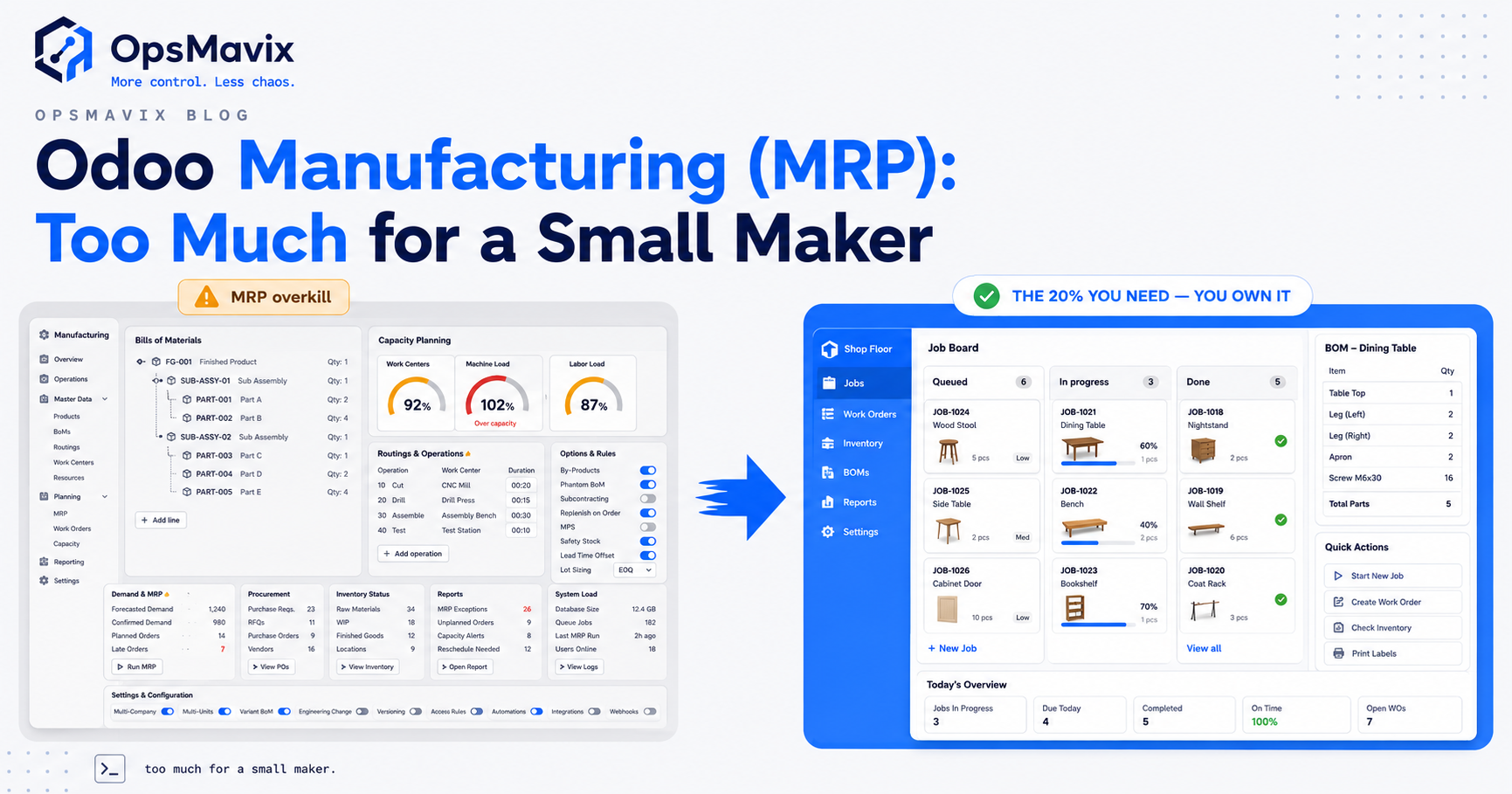
Odoo Manufacturing — the MRP app inside the wider Odoo suite — is a genuinely capable production system, and that is exactly why it can be the wrong tool for a small maker. It handles multi-level bills of materials, work orders routed across work centres, capacity planning, a master production schedule, tablet-based shop-floor control, quality checkpoints and engineering change orders. For a factory with real routing complexity and dozens of people on the floor, that breadth is the reason to buy it. For a workshop of five turning raw material into finished goods on a couple of benches, it is a heavy configuration project standing between you and the handful of things you actually needed.
This post is a fit-check, not a teardown. Odoo MRP is well-built and, for the right operation, worth every hour of setup. The question isn’t whether it’s good software — it is — but whether the complexity you’d be adopting matches the complexity you actually run. We’ll cover what it genuinely does, the threshold where its depth pays off, the setup burden it lands on a small shop, the 20% most makers actually use, and where a right-sized shop-floor and BOM system fits instead. For the underlying concepts we link up rather than re-teach: if you’re still deciding whether you need MRP at all, start with what an MRP system is.
Key Takeaways
- Odoo Manufacturing (MRP) is deep, not shallow — multi-level BOMs, work orders, routings, capacity planning, MPS, shop-floor and quality apps — and that depth is a genuine asset for a complex factory.
- The complexity threshold is the whole question. Odoo MRP earns its keep when you have real multi-level BOMs and capacity/scheduling constraints; below that line you’re buying machinery you won’t run.
- The cost isn’t just the licence — it’s the configuration. Work centres, routings, cost rules, lead times and BOM structures all have to be set up and kept accurate before the system tells the truth.
- Most small makers use a fraction of it. A clear BOM, a work order they can follow, a live view of what’s in progress, and stock that decrements when material is consumed covers the bulk of the real need.
- Odoo also assumes you’re adopting the suite. MRP is tightly wired to Inventory, Purchase and Accounting — powerful if you want all of it, overhead if you only wanted the production bit.
- Right-sized beats heavy when your process is simple. A focused system shaped to how you actually make things delivers the parts you use without the parts you don’t have to maintain.
What Odoo Manufacturing Actually Covers
Give Odoo its due first. Odoo MRP defines multi-level, nested bills of materials — including phantom BOMs for kits and sub-assemblies — and explodes the full hierarchy to work out material requirements at every level. It creates manufacturing orders, breaks them into work orders, and routes those across work centres in a defined sequence. Each work centre carries its own capacity, operating cost and availability, so the scheduler can sequence production and cost it at the same time. Materials that fall short trigger procurement or internal transfers automatically, because MRP is wired into Odoo’s Inventory and Purchase apps.
On top of that core sit the heavier modules: a master production schedule and capacity planning; a tablet-optimised Shop Floor app for operators to log work orders, record time and flag issues; a Quality app that fires inspection checkpoints inside routines and spins up a rework routing when a check fails; a PLM app managing engineering change orders and versioned BOMs; and maintenance. One honesty note: the lighter MRP features exist across editions, but the MRP II layer — capacity planning, MPS, quality, maintenance, MES-style shop-floor — is largely an Enterprise-edition and paid-app story, not a free open-source freebie. Verify what your edition and app selection actually include before you plan around a feature.
The Complexity Threshold — Where Odoo MRP Earns Its Keep
Every feature above answers a real manufacturing problem. The question is whether you have those problems. Multi-level BOM explosion earns its keep when you genuinely build sub-assemblies that feed other sub-assemblies that feed a finished product — three or four levels deep, where working the requirements by hand would be error-prone. Capacity planning and a master production schedule earn theirs when you have finite work-centre capacity, competing jobs, and a real decision about what runs where and when — though be clear about what native Odoo actually does here: it schedules with infinite capacity by default, setting dates from lead and work-centre times rather than enforcing hard capacity limits, and its MPS is a manual planning tool with a capacity-analysis view. Genuine finite, constraint-based sequencing needs the frePPLe integration or custom work. The Quality and PLM apps earn theirs when you have formal inspection gates and controlled engineering changes that must be versioned and approved.
If those sentences describe your shop, Odoo MRP is a serious candidate and the depth is the point. The trouble is that a large share of small makers recognise almost none of them. Their BOM is one level: material and components in, one finished product out. Their “capacity plan” is a whiteboard and the fact that there are two benches. Their quality gate is the founder looking at the thing before it ships. For that operation, the machinery that makes Odoo powerful is machinery with nothing to grip.
The Setup Burden a Small Shop Actually Feels
The licence is the cheap part; the configuration is where a small maker feels the weight. Before Odoo MRP tells you the truth, someone has to build it: every work centre defined with its capacity, cost per hour and availability; every routing laid out as a sequence of operations; every BOM structured correctly with the right quantities and any phantom sub-assemblies; lead times and reordering rules set so procurement fires sensibly; and cost methods configured so the numbers coming out mean something. Get any of it wrong and the scheduler produces confident nonsense — the classic garbage-in problem, dressed up in a good UI.
That’s not a one-off, either — the configuration is only as good as it stays accurate. Change a supplier, a process step, a component or a work centre and the model has to be updated to match, or it drifts from the floor — the same trap that makes a production tracking spreadsheet rot, except now it’s a bigger, more interconnected model to keep in sync. And it isn’t only the MRP app: because Odoo MRP is wired into Inventory, Purchase and Accounting and leans on them, running it well means configuring and maintaining those surrounding modules too — the whole suite’s admin, not just the production bit you came for. A factory with a process engineer or operations lead can carry that. A five-person workshop where the founder is also the machinist, the buyer and the person on the phone usually can’t, and the system slowly stops matching reality.
The 20% Most Makers Actually Need
Strip a small maker’s requirement back to what they touch every day and it’s a short list. A clear bill of materials they can trust and update without fear. A work order the floor can follow — what to make, from what, in what order. A live view of what’s in progress, so the founder can answer “where’s that order?” without walking the shop. Stock that decrements when material is consumed and reflects finished goods when a job closes, so the screen matches the shelf. Basic job costing — material plus time — so quoting isn’t guesswork. That’s the working core. Most of the master production schedule, the capacity and load planning, the PLM change workflow and the formal quality gates go unused.
None of those five things is exotic, and none requires a full MRP suite to deliver. What they require is a tool that matches your actual process rather than a generic manufacturing template. A single-level BOM shouldn’t demand routing and work-centre configuration to function; a two-bench shop shouldn’t model capacity it doesn’t schedule against. The gap between “the 20% I use” and “the 100% I maintain” is precisely the overhead a small maker feels — and the gap a right-sized system is built to close. If the BOM itself is where your pain concentrates, bill of materials software covers that piece on its own terms.
What a Right-Sized Shop-Floor and BOM System Does Instead
A right-sized system isn’t a cut-down Odoo — it’s shaped to how you genuinely make things, holding the parts you use and nothing you don’t. The BOM is structured the way your product is actually built, not forced through a template that assumes routings you don’t run. Work orders read the way your floor works. Work-in-progress is visible live, so status is a glance, not a walk. Stock moves as material is consumed and finished goods are booked, against one true figure — the same single-source discipline that keeps shop-floor tracking honest. And because it’s built to your process, there’s no surrounding suite to stand up just to make the production bit work.
The deeper difference is ownership and fit. A configured MRP module is your process bent to fit the software’s model, then maintained forever against updates and app dependencies you don’t control. A built-for-you system is the software bent to fit your process, owned outright, with no per-user licence and nothing a vendor can reprice or retire. When your manufacturing genuinely outgrows that — real multi-level assemblies, capacity and load planning (and, if you need true constraint-based sequencing, frePPLe on top of Odoo or custom work), formal change control — you’ll know, because you’ll be hitting limits you can name. Where that sits against a full manufacturing execution system is a fair next question, worth asking before you assume you need the heavier tier.
When Odoo MRP Is the Correct Choice (the honest bit)
There’s a clear line where this flips. If you have genuine multi-level bills of materials — sub-assemblies feeding sub-assemblies — and working the requirements by hand is already error-prone, Odoo’s BOM explosion is doing real work. If you have finite work-centre capacity and a real scheduling decision about what runs where and when, the capacity planning and master production schedule answer a question you actually have. If you need formal, versioned engineering changes or enforced inspection gates, the PLM and Quality apps are built for exactly that. And if you’re adopting the whole Odoo suite anyway, using its MRP module keeps everything in one place instead of bolting a separate tool alongside it.
In those cases, don’t let “it’s heavy” talk you out of the right tool. Heavy is what complex manufacturing needs, and a lighter system would just push the complexity back onto spreadsheets beside it. The honest test is symmetrical: pick Odoo MRP when your process complexity matches its depth, and pick right-sized when it doesn’t. The failure mode isn’t choosing Odoo — it’s choosing it for a two-bench shop, or choosing a light tool for a factory that genuinely needed routing and capacity planning.
FAQ
What does Odoo Manufacturing (MRP) do?
Odoo Manufacturing is the MRP app inside the Odoo suite. It handles multi-level and phantom bills of materials, manufacturing and work orders, routings across work centres, capacity planning and a master production schedule, plus tablet-based shop-floor control, quality checkpoints and engineering change orders via its PLM app. It’s tightly integrated with Odoo’s Inventory, Purchase and Accounting modules. Note that the heavier MRP II features are largely an Enterprise-edition or paid-app capability — verify what your edition includes.
Is Odoo MRP overkill for a small manufacturer?
Often, yes. The depth that makes Odoo MRP powerful — multi-level BOM explosion, capacity and load planning, formal quality and change control — only pays off if you actually have those problems. A small maker with a single-level BOM, a couple of work centres and an informal quality check uses a fraction of the suite while carrying the full configuration and maintenance burden — maintaining machinery with nothing to grip.
What’s the real cost of running Odoo MRP?
The licence is the smaller part. The real cost is configuration and upkeep: defining every work centre, routing, BOM, lead time and cost rule accurately before the system tells the truth, then keeping it in sync as your process changes — and, because MRP leans on the Inventory, Purchase and Accounting modules, maintaining those too. A factory with an operations lead can carry that; a five-person shop where the founder wears every hat usually can’t.
What do most small makers actually need instead?
A short list: a clear, trustworthy BOM; a work order the floor can follow; a live view of work-in-progress; stock that decrements as material is consumed and reflects finished goods; and basic material-plus-time job costing. That working core doesn’t need a full MRP suite — it needs a tool matched to your actual process. The overhead a small maker feels is the gap between the 20% they use and the 100% they’d have to maintain.
When should I choose Odoo MRP over a right-sized system?
When your complexity matches its depth: genuine multi-level BOMs where manual planning is error-prone, finite work-centre capacity with real scheduling decisions, formal versioned engineering changes or enforced quality gates, or a commitment to the whole Odoo suite. Below that line, a right-sized shop-floor and BOM system delivers what you use without the overhead of what you don’t.
How OpsMavix Can Help
OpsMavix builds right-sized manufacturing and production tracking systems for small makers stuck between spreadsheets and a full MRP suite — too messy for the workbook, not complex enough to justify configuring and maintaining Odoo Manufacturing. Instead of bending your shop to a generic template, we build the parts you actually use: a BOM structured the way your product is genuinely built, work orders the floor can follow, live work-in-progress visibility, and stock that moves as material is consumed against one true figure — no surrounding suite to stand up, no per-user licence, nothing a vendor can reprice or retire, because you own it.
And if the honest answer is that your manufacturing genuinely needs Odoo MRP’s depth — real multi-level assemblies, capacity and load planning, formal change control — we’ll tell you that too. Book a Free Operations Leak Audit and we’ll map how you actually take a job from order to finished goods, where the leaks are today, and whether a right-sized system or a full MRP suite is the honest fit for the way you make things.
Keep reading
Getting value from OpsMavix? Add us as a preferred source on Google — you'll see more of our operations content in your AI Overviews, AI Mode and Search.