
Manufacturing Job Costing: Materials, Labour and Machine Time Per Works Order
Manufacturing job costing is the practice of costing a single works order by its materials, its labour hours and its machine and overhead time, then comparing that estimate to what the job actually consumed on the floor. This post covers the machine-hour piece most guides skip, how to track work in progress, and why the estimate-versus-actual gap is where your real margin lives.
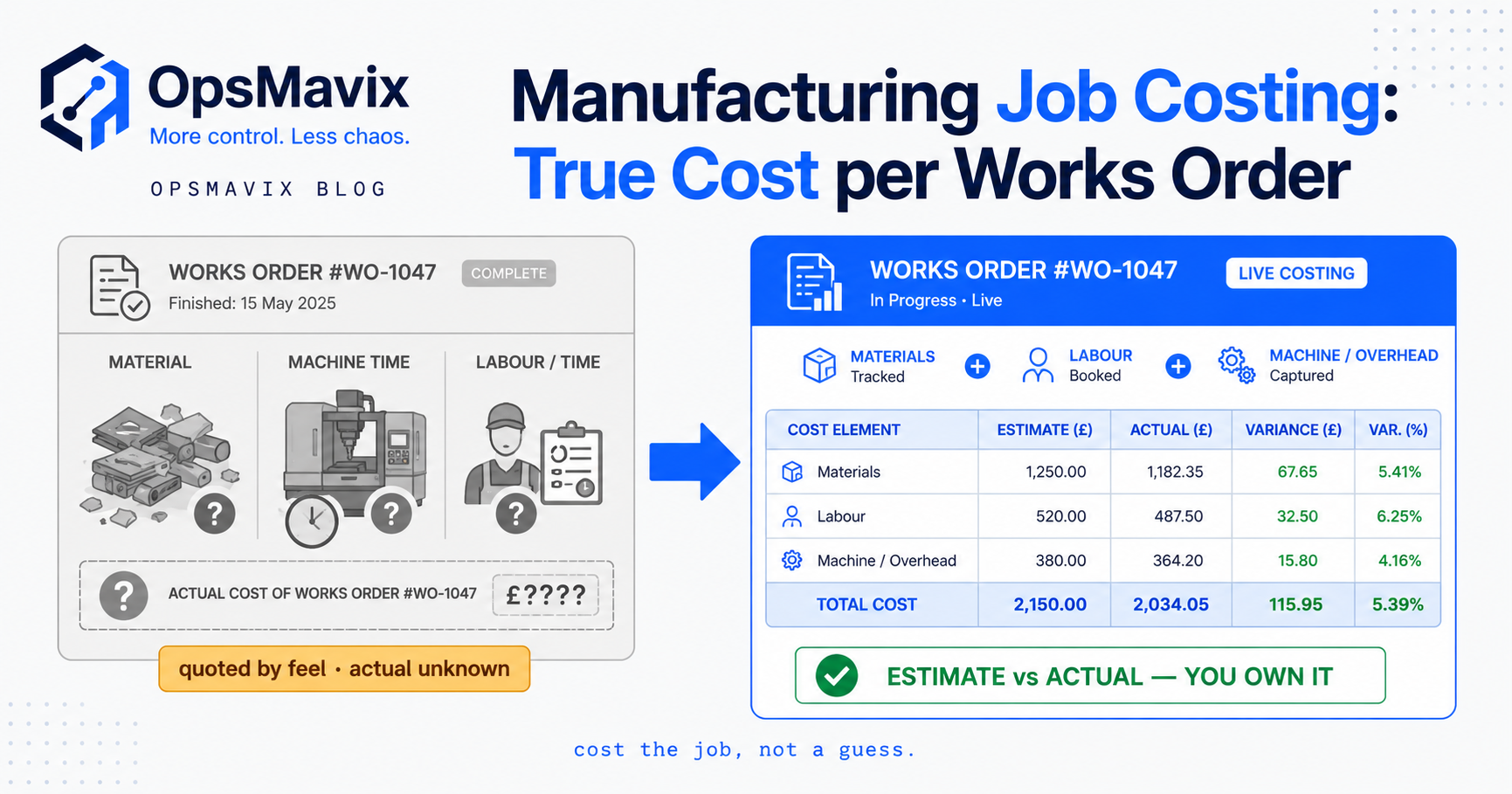
Manufacturing job costing is the practice of costing a single works order by three things it actually consumes — materials issued to it, labour hours booked against it, and machine plus overhead time it ties up — and then holding that estimate against what the job really cost once it came off the floor. It differs from general job costing in one way that matters: on a factory floor the machine is often the most expensive resource in the building, so costing labour and materials while ignoring machine time gives you a number that looks right and quotes you into a loss.
This is the manufacturing-specific version. If you want the plain definition, that’s what is job costing, and the full arithmetic with a worked example lives in how to calculate job costing. Here we deal with the things a workshop has that a general costing article doesn’t: a machine-hour rate, work in progress sitting half-finished across the floor, and the estimate-versus-actual check that has to survive contact with real production.
Key Takeaways
- A works order is the unit of cost. In manufacturing you don’t cost “a job” in the abstract — you cost a specific works order, and everything (materials, hours, machine time) books against that number.
- Machine time is a cost centre, not a freebie. A CNC cell running at £45/hour of loaded machine cost changes the answer completely; leave it out and your busiest jobs quietly lose money.
- Materials get issued, not estimated, once the job runs. The estimate uses a BOM; the actual uses what stores actually issued, including the offcut you scrapped and re-cut.
- WIP is real money you can’t see. A half-finished works order is materials plus labour plus machine time already spent with nothing sold yet — and most spreadsheets can’t tell you the total.
- Estimate-versus-actual per works order is the whole point. One number tells you the job made margin; the pattern across jobs tells you your estimating is wrong and where.
- Spreadsheets cost one works order fine. They fall over when you need live cost across every open order, updated as issues and hours land, without someone re-keying the floor into a sheet at 6pm.
Start With the Works Order, Not the Job
In manufacturing the works order (or production order, or job ticket — same thing) is the object you cost against. It’s raised when you decide to make something, it carries a bill of materials and a routing, and it becomes the bucket that materials, labour and machine time all book into. Cost the works order and you’ve costed the job.
That sounds obvious until you look at how most small manufacturers actually do it: they cost the quote carefully, win the work, raise a works order, and then never reconcile the two. The estimate and the actual live in different places and never meet. Manufacturing job costing is the discipline of making them meet on the works order.
If you want the paperwork side of raising and tracking these orders, that’s works order processing software — this post is about the money that flows through them.
The Three Cost Buckets — and the One Everyone Forgets
General job costing gives you materials, labour and overhead. Manufacturing splits overhead because the machine is usually the expensive part, so you cost four things and roll the last two together as “conversion cost”:
Materials. The BOM at estimate; the actual issues from stores at actual. These diverge more than people expect — scrap, re-cuts, substituted stock at a different price, and the extra metre you needed because the first setup was wrong.
Direct labour. Hours booked against the works order at a loaded rate, not the wage. Setup time counts. The hour spent waiting for the crane counts if it’s on the clock.
Machine time. This is the bucket the general guides skip. Every expensive machine — CNC, injection moulder, press, oven, laser — has a running cost: depreciation, power, tooling, maintenance, floor space, the operator if the machine can’t run unattended. Divide that annual cost by the hours the machine actually runs and you get a machine-hour rate. A part that hogs the five-axis for two hours costs more than an identical-labour part that runs on a manual mill, and only a machine-hour rate shows it.
Overhead. Everything that keeps the doors open but doesn’t attach to one order — applied on a base, usually labour or machine hours.
Get the machine-hour rate honest and a lot of “we’re busy but not making money” mysteries solve themselves.
Track Work in Progress or You’re Flying Blind
Work in progress is every works order that’s been started but not finished — and it’s real money. The steel is issued, three hours of labour are booked, the part has had its first two operations of five, and none of it has been invoiced. That value is sitting on your floor.
Two things go wrong without WIP visibility. First, you can’t value the business honestly — your stock figure is missing everything that’s mid-conversion. Second, and worse operationally, you can’t see a works order bleeding cost until it’s finished and the damage is done. WIP tracking means each order carries its running cost as it progresses, so a job burning through its estimate at operation three is visible at operation three, not at dispatch.
Operators tell us the moment WIP became visible was the moment they stopped discovering losses a month later in the accounts and started catching them on the floor while the job was still open.
Estimate Versus Actual, Per Works Order
This is where manufacturing job costing pays for itself. Every works order should carry two columns: what you estimated (the quote’s BOM, planned hours, planned machine time) and what it actually consumed (issued materials, booked hours, real machine run-time). The gap is the lesson.
A single job’s gap tells you whether that job made its margin. The pattern of gaps across many jobs tells you something more valuable: where your estimating is systematically wrong. If setup time is always underestimated by 40 minutes, that’s not bad luck across ten jobs — that’s a broken estimating assumption you can fix at the source.
Consider a fabrication run quoted at £700. Estimate: £145 materials, £180 labour, £90 machine, £60 overhead — call it £475 cost, £225 margin. Then it runs: a re-cut adds £30 of steel, setup ran 40 minutes long, the laser took an extra pass. Actual lands at £560. The job still made money, but £85 of your margin evaporated on the floor — and if that same pattern hits every job on that machine, your next quote for similar work needs to move.
Do this per works order, consistently, and within a quarter your quotes stop being hopeful and start being priced on what the work actually costs your floor.
Why Spreadsheets Cost One Job Fine and All Jobs Badly
A spreadsheet costs a single works order perfectly well. Type in the materials, the hours, the machine time, sum it. Done. The trouble is never one job — it’s fifty open orders at once, each moving through operations daily, each needing its cost updated as stores issue material and the floor books hours.
At that scale the spreadsheet needs someone to re-key the floor into it every day, and that person is always behind, so the numbers are always stale. WIP across all orders is a figure nobody can produce on demand. Estimate-versus-actual exists only for the jobs someone had time to reconcile — which are never the ones going wrong.
The fix isn’t a bigger spreadsheet or a full manufacturing ERP you’ll spend a year implementing and never fully use. It’s a system where the works order is live: materials book cost when stores issues them, hours book when the floor logs them, machine time books from run-time, and estimate-versus-actual and total WIP are just always there because the data arrived as the work happened, not at 6pm from a clipboard. That’s the practical layer this sits in — see manufacturing production tracking for how the floor data feeds the cost.
Build It, Buy It, or Own the Right-Sized System
Straight take. If you’re a small shop with a handful of orders a week and disciplined people, a well-built spreadsheet genuinely works — don’t let anyone sell you off it. Buy a full manufacturing ERP and you get real job costing, but you also get a twelve-month implementation, a module for everything you don’t do, and a per-seat bill that assumes you’re ten times your size; plenty of shops buy one and still run the real costing in a spreadsheet on the side.
The middle most growing manufacturers actually need is a system sized to how they work: works orders that book their own materials, labour and machine time, WIP you can see, estimate-versus-actual that’s automatic — and nothing you don’t use. That’s the layer between a spreadsheet you’ve outgrown and an ERP that would own you.
Wherever you land, the test is the same: can you look at any open works order right now and see what it’s cost so far against what you estimated? If yes, your costing works. If it takes a phone call and a clipboard, that’s the leak.
Keep reading
Getting value from OpsMavix? Add us as a preferred source on Google — you'll see more of our operations content in your AI Overviews, AI Mode and Search.