
Finance ERP vs Operational ERP: The Split Inside One System
Finance ERP and operational ERP aren't two rival products — they're two halves of the same suite. The finance side records money after the fact; the operational side runs the physical work as it happens. If you're already ERP-shopping and trying to tell them apart, here's the honest split — plus the punchline most vendors won't give you: a lot of growing businesses need neither the full finance ERP nor the full operational one.
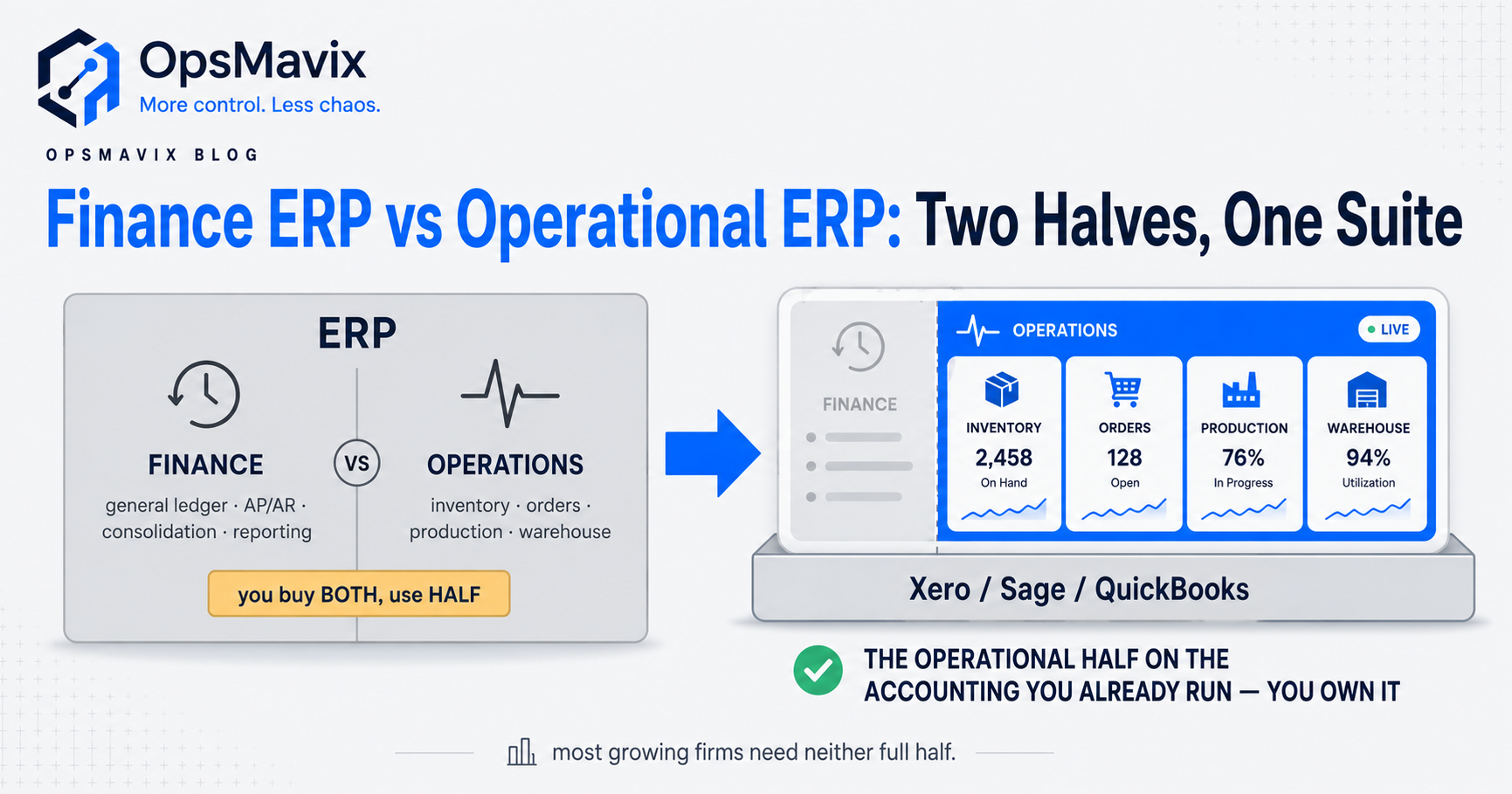
Finance ERP and operational ERP are not two competing products you choose between — they’re two halves of the same ERP suite, and the difference is what each half is built to do. The finance side (general ledger, accounts payable and receivable, consolidation, financial reporting) records money after it moves. The operational side (inventory, orders, production, warehouse, procurement) runs the physical work as it happens. One answers what happened?; the other answers what’s happening right now, and what do we do next? If you’re already deep in an ERP evaluation and trying to tell the modules apart, that’s the split that matters.
This post is for the buyer further down the ERP path — you’ve decided you might want a system and now you’re comparing types, tiers and modules. We’ll draw the finance-versus-operational line cleanly, show where each genuinely earns its keep, and then give you the part the sales deck skips: a lot of growing businesses shopping ERP need neither the full finance suite nor the full operational one. They need a focused operational system sitting on top of the accounting they already have.
Key Takeaways
- Finance ERP and operational ERP are not separate products — they’re the financial modules and the operational modules of one ERP suite, priced and sold as a whole.
- The finance side records money after the fact: general ledger, AP/AR, bank recs, consolidation, statutory reporting. Its strength is control, traceability and a number that ties.
- The operational side runs the work live: stock levels, orders, production, picking, purchasing. Its strength is knowing what’s happening now and what to do next.
- The clean tell: finance ERP answers what happened? Operational ERP answers what’s happening, and what happens next? Most day-to-day pain lives in the second question.
- Buying the whole suite to fix one half is the common, expensive mistake — you pay for and configure modules you’ll never switch on.
- Most growing firms don’t need a finance ERP or a full operational ERP. They need a right-sized operational system that plugs into the accounting they already run.
Finance ERP vs Operational ERP: One Suite, Two Jobs
The reason this comparison confuses people is that the market sells it as a spectrum when it’s really a division of labour. A full ERP contains both — the vendor just leads with whichever half your pain is loudest in. Ask an accountant and ERP means consolidation and close; ask a warehouse manager and it means stock and picking. Same product, different door.
So the useful question isn’t “finance ERP or operational ERP?” It’s “which half of the work is actually leaking — the recording of money, or the running of the operation?” Answer that honestly and the buying decision gets much smaller, because you rarely have a serious problem in both at once. The same confusion turns up one layer higher, between the system that records the work and the one that reports on it; see ERP vs MIS.
What a Finance ERP Module Actually Does
The financial side of ERP is the system of record for money. It’s the general ledger, accounts payable and receivable, bank reconciliation, fixed assets, tax and compliance, multi-entity consolidation, and the financial statements the board and HMRC see. Its whole job is accuracy and auditability after the fact — every transaction traceable, every period closing to a number that ties and holds up under scrutiny.
For a multi-entity group, that side genuinely matters. One group financial controller described her month-end to us plainly: the first week of every month gone to hand-consolidating each entity’s trial balance in Excel, chasing intercompany that “won’t tie”, re-keying figures across a stack of linked workbooks, then rebuilding the board pack from scratch before the numbers were even final. That’s a real finance problem, and a finance ERP’s consolidation engine is built precisely for it. If those entities sit in different countries, the reporting rules differ too; The WealthBlueprint explains why in its guide to international accounting standards.
The catch: the fix she was quoted for it was a full mid-market ERP at “well over £250k” and a year to implement — with a peer warning the migration team would “screw up your books” on the way in. The finance module she needed came bolted to an entire suite she didn’t.
What an Operational ERP Module Actually Does
The operational side is the opposite discipline: it runs the physical business in real time. Inventory levels and movements, sales and purchase orders, production scheduling and work orders, warehouse picking and goods-in, procurement, fulfilment. Where finance records the transaction after it settles, operational ERP is the transaction happening — stock decrementing as an order ships, a work order moving down the line, a reorder firing when a bin hits its trigger.
This is where most growing businesses actually hurt, because operational pain is daily and physical. The stock figure that says twelve when there are four on the shelf. The purchase order raised because nobody could see one already existed. The order that shipped short because two people were working off two spreadsheets. None of that is a money-recording problem — the ledger is fine. It’s a what’s-happening-right-now problem, and it’s exactly the gap the term “operational ERP” points at.
The Real Tell: “What Happened?” vs “What Happens Next?”
Here’s the cleanest way to sort any ERP feature into the right bucket. Finance ERP is retrospective and precise — it registers events after they occur so you can report, comply and audit. Operational ERP is live and decision-driving — it tells you the current state and what to do about it: reorder now, this job’s behind, that customer’s order can’t be fulfilled from current stock.
That distinction decides your priority. If your close is the ordeal — consolidation by hand, intercompany that won’t tie — your leak is on the finance side. If your days are firefighting stockouts, order errors and blind production, your leak is operational, and a shinier accounting system won’t touch it. Most owners we talk to are firefighting the second thing while a vendor tries to sell them the first, because the finance modules demo better.
Why Firms Buy the Whole Suite to Fix One Half
The expensive mistake isn’t picking the wrong half — it’s paying for both when one is fine. ERP is sold as an integrated whole, so a business with a purely operational problem ends up buying, configuring and migrating the finance modules too (or the reverse), then running a fraction of what they paid for. The classic outcome: the stock and orders side switched on and used daily, the consolidation and forecasting modules configured, paid for, and never touched — with an implementation partner on retainer to keep the whole thing breathing.
The cost that bites isn’t the licence sticker. It’s the year-long implementation, the rip-and-replace migration risk over ledgers you’re trusted to get right, the per-seat fees that climb as you hire, and the lock-in to a platform sized for a company ten times yours. You bought a two-halves machine to fix one half, and now you maintain both forever.
The Honest Punchline: Most of You Need Neither
Here’s the OpsMavix view, and it’s the thing the comparison articles won’t say. If you’re a growing business — outgrowing spreadsheets and disconnected tools — you very likely don’t need a finance ERP or a complete operational ERP. Your accounting probably already works: Xero, Sage or QuickBooks does the ledger, VAT and statutory reporting fine. What’s broken is the operational layer around it — stock, orders, production, the daily visibility — and that doesn’t require replacing your finance system to fix.
The right-sized move is a focused operational system built around how you actually run: it holds your real stock, orders and production logic, gives everyone one live view instead of three spreadsheets, and pushes clean figures into the accounting software you already have. You get the operational half of ERP, shaped to your business, without buying the finance half you don’t need or the enterprise weight neither half comes free of. That’s the middle path between the spreadsheet and the six-figure suite — and it’s a different question from whether to get an ERP at all, which we cover in operational systems vs ERP. If you’re not even sure what that operational layer is, start with what is an operations system, or see how the pieces fit together as a business operating system.
FAQ
Is finance ERP a different product from operational ERP?
No. They’re the financial modules and the operational modules of the same ERP suite. A full ERP includes both — general ledger, AP/AR and consolidation on the finance side; inventory, orders, production and warehouse on the operational side. Vendors just lead with whichever half matches the pain you walked in with, which makes them feel like separate products when they’re two jobs inside one system.
What’s the core difference between them?
The finance side records money after the fact — it answers what happened? with accuracy, traceability and reports that tie. The operational side runs the physical work live — it answers what’s happening now and what do we do next?: reorder, this job’s behind, that order can’t be fulfilled. Finance ERP is retrospective and precise; operational ERP is real-time and decision-driving.
Which one do I actually need?
Whichever half is leaking. If your month-end close is the ordeal — manual consolidation, intercompany that won’t balance — your problem is on the finance side. If your days are stockouts, order errors and blind production, it’s operational, and a better accounting system won’t fix it. Most growing businesses are firefighting the operational half while their existing accounting software handles the finance half perfectly well.
Can I get operational ERP without replacing my accounting system?
Yes — and for most growing firms that’s the right move. A focused operational system runs your stock, orders and production and pushes clean figures into the Xero, Sage or QuickBooks you already use. You get the operational half of ERP without buying the finance half you don’t need or migrating a ledger that already works. That’s the middle path between a spreadsheet and a full suite.
How OpsMavix Can Help
OpsMavix builds right-sized operational systems for businesses stuck in the gap the ERP comparison never names — outgrowing spreadsheets and disconnected tools, and not actually in need of either the finance suite or the operational one. We build the operational half you’ll genuinely run every day: one live view of stock, orders and production, built around how your business really works, that pushes clean numbers into the accounting software you already have. No finance modules to configure and ignore, no rip-and-replace migration over ledgers that already work, no per-seat creep or lock-in — you own it. Where you need it, that runs through a single operations dashboard and the inventory automation underneath it.
If you’re weighing finance ERP against operational ERP, start by finding out whether you need either. Book a Free Operations Leak Audit and we’ll map where your operation actually leaks today, what it’s worth to close, and whether a full ERP, a finance module, or a right-sized operational system is the honest fit for how you run now.
Keep reading

Getting value from OpsMavix? Add us as a preferred source on Google — you'll see more of our operations content in your AI Overviews, AI Mode and Search.