
What Is Job Costing? Tracking the True Cost of Every Job
What is job costing? It's tracking the actual cost of one specific job — its direct materials, direct labour and share of overhead — so you can hold what the job really cost against what you quoted. Here's the concept, the three cost components, and why the estimate-vs-actual gap is the whole point.
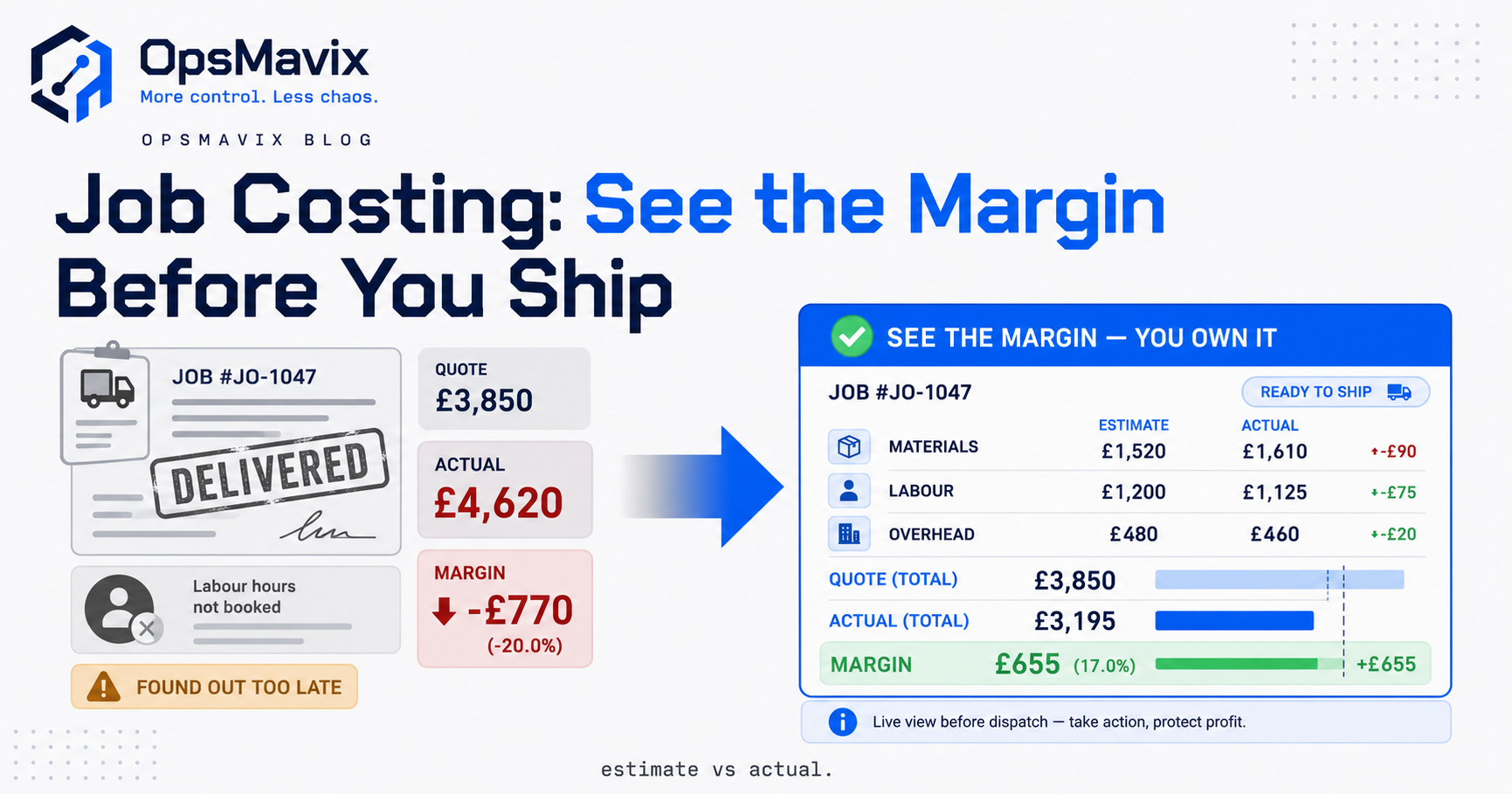
What is job costing? It’s the practice of tracking the actual cost of one specific job — its direct materials, its direct labour, and a fair share of overhead — so you can hold what the job truly cost against what you quoted for it. Not a monthly average across everything you made, not a category on a P&L. One job, one number, built from the real costs that landed on that job and nothing else.
The concept exists because of the gap between two figures: what you thought a job would cost when you priced it, and what it actually cost by the time you delivered it. Without job costing you learn a job lost money only after it’s shipped and the invoices reconcile — a verdict you can record but never reverse. With it, you see the gap open while the work is still live. Everything here serves that one idea: the estimate-versus-actual comparison, on a single job, is the whole reason to bother.
Key Takeaways
- Job costing tracks the actual cost of a single job — direct materials, direct labour, and a share of overhead — as a running total against that job, not a month-end average.
- The three components are materials, labour and overhead. Materials and labour are direct (they belong to one job); overhead is allocated (a slice of the cost of running the place).
- Job costing suits distinct, custom jobs. Where every unit is identical and flows in a continuous stream, process costing fits better — the split is about whether jobs are meaningfully different.
- The estimate-vs-actual gap is the point. A cost with no quote beside it is just a number; the two held together tell you whether the job made money and where the margin went.
- Spreadsheets lose the thread when labour goes unbooked and materials get guessed — the two streams that quietly sink margin are exactly the two a spreadsheet captures worst.
- A few simple, similar jobs can be costed in a spreadsheet. It stops holding up when volume, variation, or the number of people booking cost climb past what one person keeps honest.
What Job Costing Is — and Isn’t
Job costing answers a narrow, useful question: what did this job cost me? You pick a unit of work distinct enough to price on its own — a build, an install, a project, a repair — give it a job number, and gather every cost that belongs to it against that number. Hold the true cost beside the price you quoted and you know, for that job specifically, whether you made money and why.
What it isn’t: general accounting. Your accounts tell you the business made or lost money last month across everything — a necessary number, but one that hides the job that lost £900 while three others quietly subsidised it, so the month came out flat and nobody noticed the leak. Job costing exists to stop that averaging-out.
It’s also not estimating, though it feeds it. Estimating is the guess you make before the work — micro-estimating is one disciplined way to build it — and job costing is the truth you collect during and after. The two only matter side by side.
The Three Cost Components
Every job cost is built from three streams.
Direct materials are the physical things consumed to do the job — the steel, the timber, the components pulled from stock. “Direct” means they belong to one job only: you can point at them and say those went into that job. The honest figure is the real landed cost of what got used, not the list price or an estimate back-filled from a delivery note weeks later.
Direct labour is the time people spent doing the job, costed at their rate. Same test as materials — the hours belong to a specific job. This is the stream that goes wrong most often, because hours live in people’s heads until someone reconstructs a timesheet on Friday, by which point they’re guessed, rounded, or booked to the wrong job.
Overhead is everything it costs to run the place that isn’t tied to one job — rent, machinery, electricity, admin, insurance. You can’t point at rent and say it went into Job 412, so overhead gets allocated: spread across jobs by a fair rule, usually a rate per labour or machine hour. If overhead works out to £15 an hour, a job with 40 hours on it carries £600 of it. Getting the rule roughly right matters more than precisely wrong.
Job Costing vs Process Costing
Job costing isn’t the only way to cost work. The alternative is process costing, and the split is simple: are your jobs meaningfully different, or essentially identical?
Job costing fits when work comes in distinct units you’d price individually. A fabrication shop building a one-off staircase, a joinery making a bespoke kitchen, an installer fitting a specific site, an agency running a defined project — each job has its own materials, hours and quote. Tracking cost per job makes sense because each job is different, and the differences are what you need to see.
Process costing fits the opposite case: continuous, uniform output where one unit is indistinguishable from the next. A business making tens of thousands of identical bottles can’t sensibly cost “one bottle” as a job — there’s no distinct job to cost. Instead they total cost over a period and divide by units for an average per unit. That average is right there and wrong for bespoke work, where it blurs precisely the job-to-job variation you care about.
Estimate vs Actual — Why Job Costing Exists at All
Collecting a job’s actual cost is only half the exercise. The other half — the half that gives the number meaning — is the estimate you set when you quoted. A £4,000 spend is healthy on a £10,000 job and a disaster on a £4,500 one; only the gap between quoted and actual tells you which.
When you win a job, the estimate is fixed. As the work happens, the actual climbs. Land under the estimate and you made the margin you planned; blow past it and you didn’t — and the size and cause of the overrun tells you what to change on the next job like it.
The owner of a small fabrication shop put the failure mode in one line: “We’d know a job went bad the day we invoiced it. Never the day it started going bad.” With no estimate-vs-actual discipline you find your losers a month too late to do anything but record them. Job costing moves that discovery earlier — while the job’s still live if you can, the moment it closes at the latest.
A Worked Example
Figures below are illustrative — made up to show the mechanics, not a real client.
Say a workshop quotes a bespoke fit-out at £8,000. Behind that price sits an estimate: £3,000 materials, 120 labour hours at £25 (£3,000), and overhead at £15/hour across 120 hours (£1,800). Total estimated cost £7,800 — a slim £200 of margin, already tight.
The drawings then changed twice mid-build, so the actuals land like this:
- Direct materials: £3,400. An extra £400 — a second order of board after the design change, plus offcuts that couldn’t be reused.
- Direct labour: 150 hours at £25 = £3,750. Thirty hours over estimate, most of it rework after the drawings moved.
- Overhead: 150 hours at £15 = £2,250. Allocated per labour hour, so the labour overrun quietly dragged £450 of extra overhead with it.
Actual total cost: £9,400 against an £8,000 price. The job didn’t make £200 — it lost £1,400. And the breakdown tells you where: not the materials (£400 over) but the labour, which dragged its own overrun and £450 of overhead behind it. That points straight at unpriced rework from the drawing changes — something to price as a variation next time instead of absorbing silently.
Why Spreadsheets Lose the Thread
A spreadsheet can do job costing. For a handful of simple, similar jobs, a tab per job with materials and hours typed in is genuinely fine — anyone telling you that you need software to cost three jobs a month is selling something. The concept requires two numbers honestly captured, not software.
The trouble is the honestly captured part, and it fails in the two streams that sink margin. Labour never gets booked. Hours live in people’s heads until Friday, and Friday-afternoon timesheets are reconstructed, not recorded — rounded, half-remembered, booked to whichever job someone thinks it was. A spreadsheet that under-captured the worked example’s 30-hour overrun would show that job breaking even, and you’d go on quoting the next one at a losing price. Materials get guessed. Someone types the quoted figure back in instead of real consumption — so the material line reflects the plan, not what happened.
Both failures share a root: a spreadsheet holds only what someone remembers to type in, away from the moment the cost happened — and the further from that moment, the more the number drifts toward the estimate it’s meant to be checking. It doesn’t scale sideways either: one person can keep three jobs honest, not thirty with five people booking time. This is the wall businesses hit trying to track project profitability without spreadsheets — the tool holds the data but can’t keep it true.
Where Job Costing Connects
Job costing isn’t a standalone report — it sits in the middle of a chain, and its value comes from being joined to what’s either side: quote → job → materials and labour → invoice.
It starts with the quote, because that’s where the estimate comes from — the reference line the whole exercise measures against. Good quoting and estimating software doesn’t just produce a price; it produces a structured estimate — this many hours, these materials, this overhead — that job costing can later compare against line for line. A price with no breakdown behind it gives you nothing to hold the actuals against.
The job is the container: that structured quote becomes a job number, and every cost posts against it. Then materials and labour flow in — stock booked, hours logged at the point they happen so the total stays true. Finally the invoice: compare what you bill against the true cost you collected and you know the real margin, which feeds back into how you quote the next one. Break any link and you’re back to finding out too late.
When You Need Software, Not a Spreadsheet
So when does a spreadsheet stop holding up? Not at a magic number, but at recognisable pressure points: when one person can no longer keep every job honest by hand; when several people book time and materials, so capture has to happen where the work is; when jobs vary enough that each needs its own structure; when reconciliation lags reality and the numbers are always a week stale. Cross a few of those and the spreadsheet isn’t costing your jobs any more — it’s a form people fill in late, if at all, and a costing system with no honest data is just an expensive form.
At that point the right move isn’t a bigger spreadsheet or a full ERP — it’s a system shaped to how your work flows: hours captured at the bench, materials booked as stock is pulled, every actual held against the quote it came from, and this-job-vs-its-estimate as one live view. For a deeper look — features, build-vs-buy, what to check — the companion guide on job costing software covers the commercial question.
The businesses that feel this most sit in the gap OpsMavix builds for — outgrowing spreadsheets and disconnected tools. A right-sized custom system fits the way your jobs work instead of forcing them into someone else’s categories, and it feeds a live project operations dashboard where job cost sits beside everything else you run the day on.
FAQ
What is job costing in simple terms?
It’s working out what one specific job cost you — the materials it used, the labour hours spent on it, and its share of overhead — and comparing that against what you quoted. Instead of averaging costs across a whole month, you keep each job’s economics separate, so you can see whether that job made money and where the margin went.
What are the three components of job cost?
Direct materials, direct labour, and overhead. Materials are the physical things consumed on the job at real cost; labour is the time people spent on it, at their rate. Both are “direct” because they belong to that one job. Overhead is everything else it costs to run the business — rent, machines, admin — which isn’t tied to a single job, so it’s allocated by a fair rule, usually a rate per labour or machine hour.
What’s the difference between job costing and process costing?
Whether your output is distinct or uniform. Job costing suits different, individually priced units — a bespoke build, a specific install, a defined project. Process costing suits continuous, identical output, like mass-producing the same item, where you divide total costs over a period by units for an average per unit.
Do I need software for job costing?
Not always. A few simple, similar jobs can be costed adequately in a spreadsheet. It stops holding up when labour goes unbooked and materials get guessed, when several people capture cost, or when volume and variation make reconciliation lag reality — at which point a right-sized system that captures cost at the point of work keeps the numbers true in a way a spreadsheet no longer can.
How OpsMavix Can Help
Understanding what job costing is comes first; getting the numbers to arrive honestly and on time is the harder part, and where most tools fall down. OpsMavix builds custom job costing into the systems businesses already use to run the day — hours booked at the point of work, materials pulled from the stock you track, overhead allocated by logic that fits your setup, every actual held against the quote it came from. Shaped to how your jobs actually flow, so people enter the data instead of routing around it.
If the only way you learn a job’s true cost is by reconciling invoices weeks after delivery, you’re finding your losers long past the point of fixing them — and every quote you build on a guess repeats the mistake. Book a Free Operations Leak Audit.
Keep reading
Getting value from OpsMavix? Add us as a preferred source on Google — you'll see more of our operations content in your AI Overviews, AI Mode and Search.