Custom Software for Business: When It's Worth It
Off-the-shelf got you here; it won't get you further. Here's how to tell when custom software for business is the right call, and when it isn't.
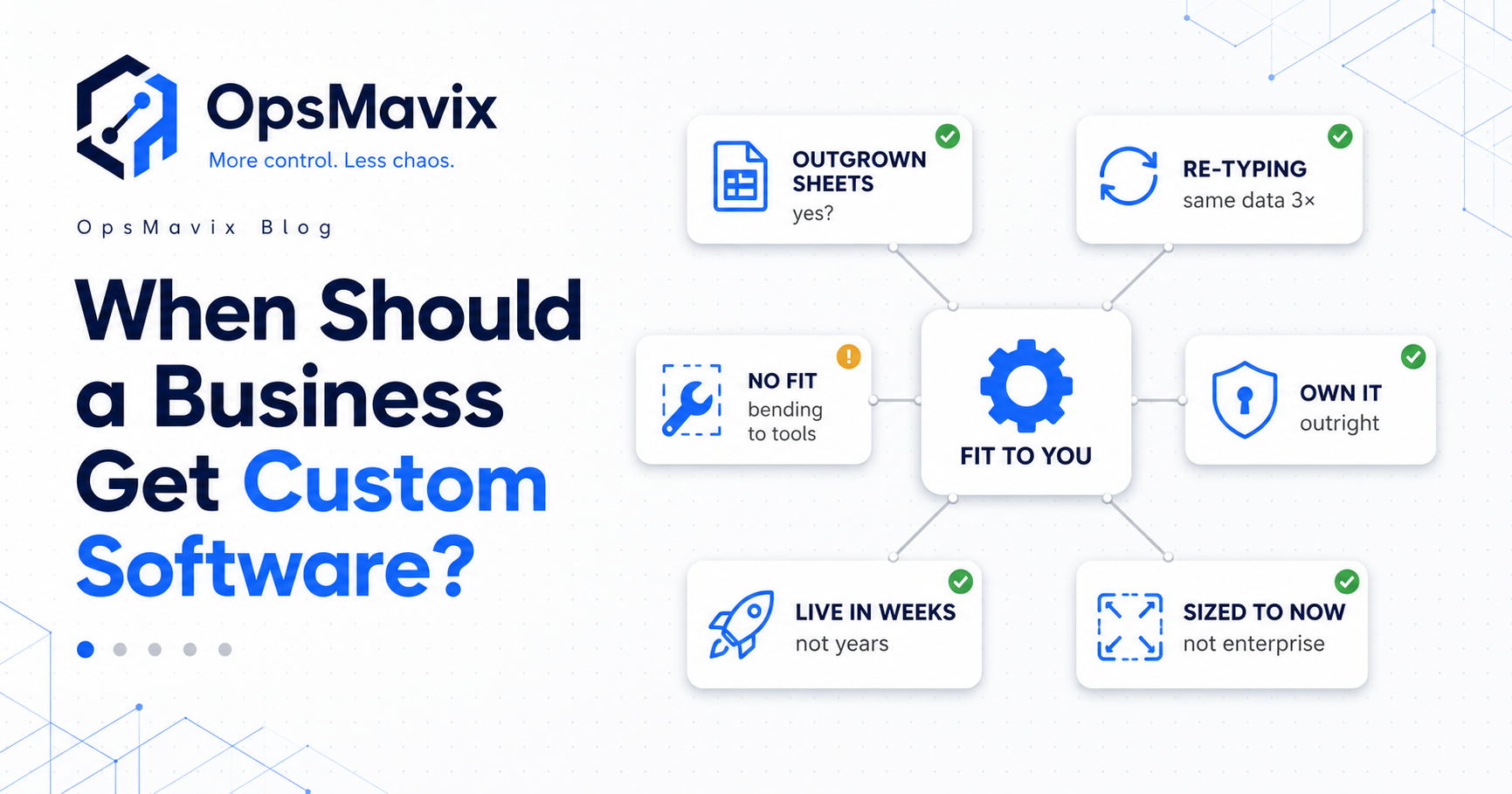
Get custom software when off-the-shelf tools have stopped fitting how you actually work: you’re re-typing data between apps, bending your process to suit the software, or staring at a six-figure ERP quote for a system you’d half-use. Before that point, buy. It’s cheaper, it’s faster, and someone else maintains it. The real question was never custom versus cheap. It’s whether a tool exists that fits the problem in front of you, or whether you’re paying to force a misfit.
This is the honest version of build-vs-buy for an ops-heavy business: the signs you’ve outgrown what you can buy, when custom is the wrong move, and how to choose without getting robbed.
(If an ERP is the only “step up” you’ve been shown, start with operational systems vs ERP.)
Key Takeaways
- Buy off-the-shelf when a tool fits your process well enough. It’s faster and cheaper, and most early-stage needs are solved this way.
- Build custom when you’ve outgrown the buyable options but a full ERP is overkill: the practical middle.
- The clearest signs to build: re-typing data between disconnected tools, bending your workflow to fit software, and paying for modules you never open.
- Custom doesn’t mean a six-figure, year-long project. It means scoped to the one problem costing you most.
- The biggest risk isn’t building too soon. It’s assuming a £100k ERP is your only “real” option.
1Start By Buying — Custom Is Not the Default
Custom software is the wrong first move for most businesses. If an off-the-shelf tool genuinely fits how you work (accounting, email, a basic stock app) buy it. It’s cheaper, faster to roll out, and someone else handles the upkeep. The case for custom only opens up once the buyable options stop fitting. Building something bespoke to do what Xero already does well is how you waste money, not save it.
2The Real Trigger: You’re Bending the Business to the Software
Every off-the-shelf tool comes with an opinion about how you should work, and at first you adapt to it happily. The trouble starts when adapting turns into distorting. You re-number jobs to suit a field. You split one process into three because the tool can’t model it as one. You train every new hire on the same workaround. We hear the same dread from MDs who’ve sat through ERP demos: the fear of having to reshape the business to fit the software. When the tool dictates the process instead of serving it, you’ve outgrown what you can buy.
3Disconnected Tools and Re-Typed Data
The most common reason a growing business reaches for custom software is that nothing talks to anything. An order arrives by email, gets typed into a spreadsheet, then re-keyed into accounting, then checked against a separate stock sheet. Your team has quietly become the integration layer between tools that were never built to connect, and every hop is a fresh chance for a wrong number to slip through. No off-the-shelf app fixes that, because the apps in question don’t speak to each other by design. (We’ve covered why stock never matches the system once this sets in.)
4The £100k Quote for a System You’d Half-Use
This is where most ops-heavy businesses get stuck. You’ve outgrown QuickBooks and spreadsheets, so you sit through the ERP demos and recoil. One MD did the maths out loud: a hundred grand for the software, then thirty-eight a year on top, for a system his team would half-use, run by what he called a partner-driven industry that’s frankly a robbery. His real question was the one nobody answered cleanly. QBO is too small, NetSuite’s too expensive: where’s the middle ground he actually owns? That middle ground is what custom software is meant to be. Sized to now, not built to impress a board. (The full ERP-versus-middle-ground cost breakdown is in operational systems vs ERP.)
5When Custom Is the Wrong Move
Custom isn’t always the answer, and an honest agency will tell you when to walk. Don’t build if a well-fitting off-the-shelf tool already exists and you’d only be replacing it for taste. Don’t build if your processes change every month and aren’t stable enough to encode. Don’t build chasing a feature you’d use twice a year. And don’t build if you can’t name the specific leak it’s meant to plug; “we want a system” is not a brief. Custom pays off when the misfit is real, measurable, and stable enough to be worth shaping software around.
6Build vs Buy: How to Actually Decide
Run three questions.
First, does a tool exist that fits your process without forcing you to distort it? If yes, buy.
Second, is the cost of the misfit (the re-keying, the errors, the chasing) bigger than the cost of building? If yes, custom is on the table.
Third, is the problem stable enough that the system will still be right in two years? If yes, build it.
Most businesses asking the question land firmly in the build-the-middle camp. They’ve only been pitched the extremes: a cheap app that doesn’t fit, or an enterprise suite that’s too much. (A live operations dashboard is often the first thing this unlocks.)
7Custom Without the Lock-In
The fear that keeps people on broken spreadsheets is that custom means being held hostage: to a developer, a partner, a VAR billing by the hour. It doesn’t have to. Custom software can be scoped to a fixed price, built around how you already run, delivered in weeks, and handed over so you own it outright. No per-seat fees. No renewal escalator. No hostage data. That’s the opposite of the partner-driven robbery the ERP route is feared for, and it’s the version of custom that’s actually worth doing.
FAQ
When should a business get custom software?
When off-the-shelf tools no longer fit how you work: you’re re-typing data between disconnected apps, bending your process to suit the software, or facing an ERP quote for a system you’d only half-use. Before that, buy off-the-shelf. It’s cheaper and faster.
Is custom software cheaper than an ERP?
Usually, when it’s scoped to the specific problem rather than trying to run everything. A focused custom build is typically thousands to low tens of thousands at a fixed price, versus an ERP that can run into six figures with consultants, per-seat fees, and annual increases.
What’s the difference between build and buy?
Buy means licensing an off-the-shelf tool that already exists: fast and cheap, but you adapt to it. Build means software shaped around your process: more upfront effort, but it fits and you can own it. Buy until buying forces you to distort how you work.
Does custom software lock me into a developer forever?
It shouldn’t. Done well, custom software is fixed-scope, built around your existing process, and handed over so you own it outright: no lock-in, no per-seat fees, no VAR billing by the hour. Confirm ownership and handover in writing before you commit.
How long does custom software take to build?
A focused operational system is typically built and launched in weeks, not the year or more a full ERP rollout takes, because it solves a defined set of problems instead of trying to run the whole business at once.
How OpsMavix Can Help
OpsMavix builds the middle path: custom software for businesses too big for spreadsheets and not ready for a £100k ERP. We map how you already work, then build connected stock and reporting systems. Fixed scope, live in weeks, yours to own, no lock-in.
If you’ve outgrown off-the-shelf but the ERP route feels like overkill, that gap is costing you every week. Book an Operations Leak Audit and we’ll map what you actually need to build, and what you should just keep buying.