
ERP vs MIS: What Is the Difference (and Which Do You Need)?
ERP and MIS are not rivals: one runs the work and one reports on it. An ERP is the transaction system of record; an MIS is the management information layer that turns those transactions into decisions. This guide defines both plainly, sets them side by side, and explains why most growing businesses conflate them and end up with neither working properly, and what a right-sized owned operations system does instead.
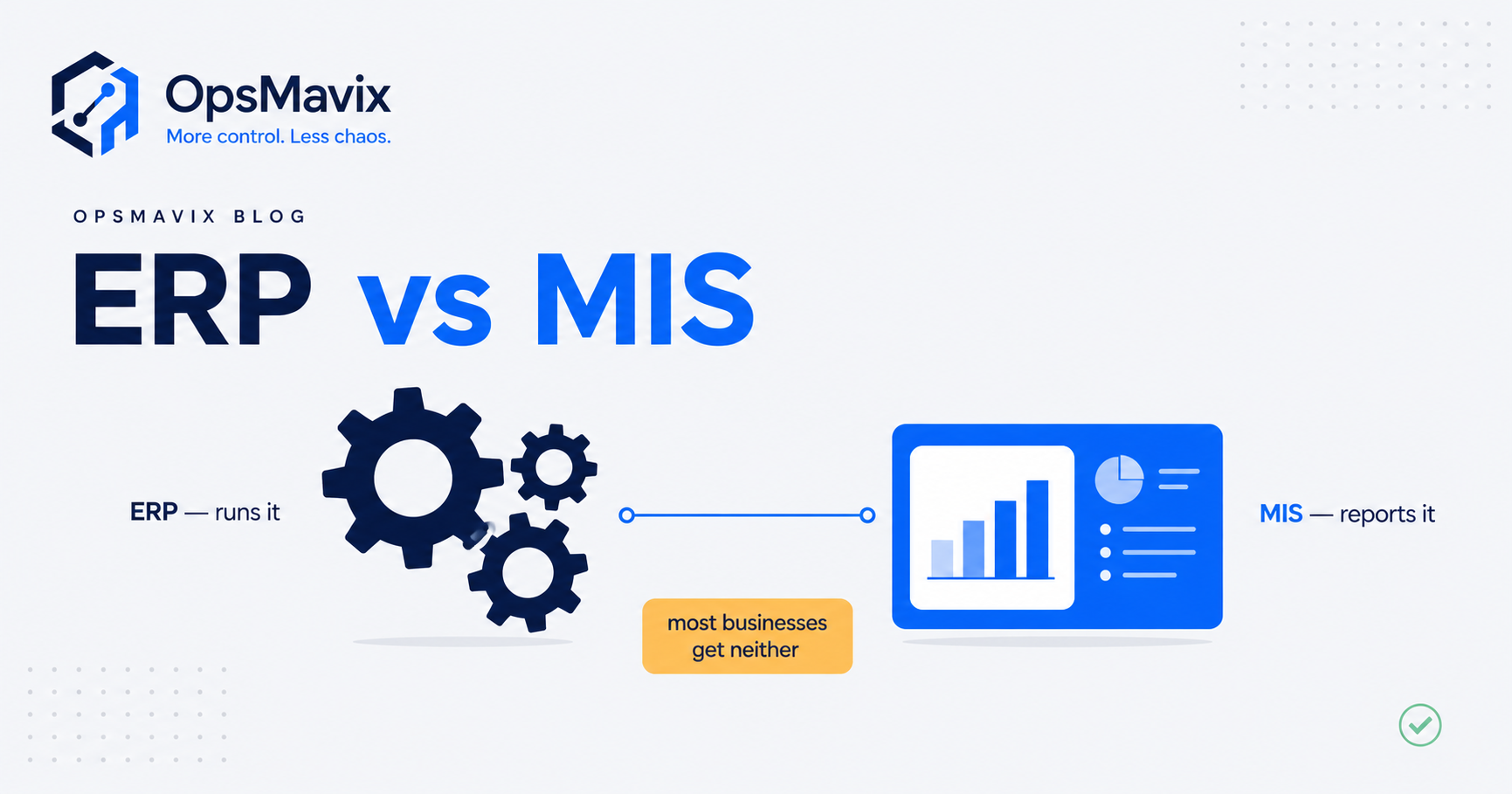
The confusion is understandable, because both acronyms get sold as “the system that gives you control of your business,” and the sales decks overlap heavily. But they answer two different questions. An ERP answers what is happening, and what happens next? It takes an order, reserves the stock, raises the purchase, books the receipt. An MIS answers how are we doing, and what should we change? It takes yesterday’s orders, receipts and margins and turns them into a number a manager can act on. One is the machinery. The other is the dashboard on the machinery.
This page defines each one plainly, sets them side by side, and then deals with the question that actually matters to a growing product or operations business: which do you need, and what happens when you try to run both from a spreadsheet. For the neighbouring buying question (the difference between finance and operational ERP, or ERP versus a focused operational system), the operational ERP guide is the better starting point. This post stays on the ERP-versus-MIS line specifically.
What an ERP actually is
An ERP — enterprise resource planning system — is the transactional backbone. Its job is to record what the business does as it does it, and to keep every function working off the same numbers. When a customer places an order, the ERP writes it down, reserves the stock, tells you what to buy to cover the shortfall, raises the purchase order, receives goods against it, issues stock to the job, and eventually raises the invoice. Every one of those is a transaction — a discrete event that changes the state of the business — and the ERP’s core purpose is to capture each once, accurately, so nobody re-keys it anywhere. OpenStax’s business textbook describes the effect in one line: ERP “consolidates a firm’s data from the various functional departments (such as marketing and production) into a unified platform” (OpenStax, Introduction to Business).
That is why ERP is called a “system of record.” It is the authoritative place a fact lives. Oracle puts the benefit this way: by collecting an organisation’s shared transactional data, ERP systems “eliminate data duplication and provide data integrity with a single source of truth” (Oracle). Ask it how many of a part you have and it should answer, because it recorded every movement in and out. Ask what a job cost and it should know, because it captured every material issue and labour booking against that job.
Note what an ERP is not primarily built for: telling you what it all means. It will happily produce a report, but reporting is a by-product of the recording. Its design centre is transaction integrity — making sure the order, the stock and the invoice all agree — not analysis. It is optimised to be right about individual facts, not illuminating about patterns across them. That gap is precisely the space an MIS exists to fill.
What an MIS actually is
An MIS — management information system — is a reporting and decision-support layer. It does not run the day-to-day work. It takes data that has already been captured (usually by an ERP, or by whatever transactional systems the business has) and turns it into information a manager uses to make a decision. Britannica’s entry on information systems describes management reporting systems as ones that “provide routine, detailed, and voluminous information reports specific to each manager’s areas of responsibility”, and notes that management support systems “rely on the data obtained by transaction processing systems” (Britannica). The classic MIS output is the periodic report: the weekly sales figure, the monthly margin by product line, the stock-turn number, the on-time-delivery percentage, the top ten slow-moving SKUs. In textbook terms, that first level of management support is an information-reporting system that “uses summary data collected by the TPS to produce both regularly scheduled and special reports” (OpenStax, Introduction to Business).
The distinction embedded in the name is old but still exact. Data is the raw transactions — a thousand order lines. Information is what an MIS produces from them — “wholesale margin fell four points this month, driven by two customers on old price lists.” Data records what happened; information tells you what to do about it. An OpenStax information systems textbook defines the two terms like this: data are the “raw facts and figures that are processed and turned into meaningful information”, and information is “raw data that have been processed and manipulated to give context and meaning” (OpenStax, Foundations of Information Systems). An MIS is the machine that makes the second out of the first.
Historically an MIS was a separate system you bought for reporting, fed by overnight extracts from the transactional systems. Britannica dates them to the 1960s, when computers were applied to managers’ routine decisions, and says these systems use “the raw (usually historical) data from data-processing systems to prepare management summaries” (Britannica). Today the same function turns up under a dozen labels — business intelligence, analytics, dashboards, reporting suites — but the role is unchanged: it is the layer that reads the operational data and presents it for decisions, without being the place the data is created. IBM, for example, defines business intelligence as “a set of technological processes for collecting, managing and analyzing organizational data to yield insights that inform business strategies and operations” (IBM). It sits downstream of the running of the business and points back at it. This is the same layer a modern operations management system builds in rather than bolts on.
ERP vs MIS: the plain difference
Strip away the jargon and the difference is one line: an ERP runs the business; an MIS reports on the business.
- An ERP is operational and transactional. It works at the level of the single event — this order, this receipt, this invoice — and its success is measured in accuracy and integrity: did every transaction get recorded once and correctly?
- An MIS is managerial and analytical. It works at the level of the aggregate — this month, this product line, this customer — and its success is measured in usefulness: did it surface the number that changed a decision?
They stand in a supplier-consumer relationship. The ERP is a source of data; the MIS is a consumer of it. Britannica puts the dependency plainly: transaction processing systems “accumulate the data in databases and data warehouses that are necessary for the higher-level information systems” (Britannica). You cannot have a useful MIS without a trustworthy transactional system underneath, because an MIS only ever reflects the quality of the data feeding it. The UK Government’s Data Quality Framework warns that poor or unknown quality data “weakens evidence, undermines trust, and ultimately leads to poor outcomes” and “impedes effective decision-making” (GOV.UK). Point a beautiful dashboard at a stock figure that is wrong and you get a beautiful, confident, wrong dashboard. This dependency is the single most important fact in the whole comparison, and it is the one most buyers miss: the reporting layer is never better than the recording layer beneath it.
That also explains why the two are not really alternatives. Asking “ERP or MIS?” is like asking “engine or dashboard?” for a car. You are not choosing between them — you are deciding how much of each you need, and whether you need to buy them as two separate things at all.
ERP vs MIS differences compared side by side
| Dimension | ERP (enterprise resource planning) | MIS (management information system) |
|---|---|---|
| Core job | Run the business — record and process transactions | Report on the business — turn data into decisions |
| Works at the level of | The single event (an order, a receipt, an invoice) | The aggregate (a month, a product line, a customer) |
| Primary users | Operational staff — sales, purchasing, warehouse, production | Managers and owners making decisions |
| Answers the question | What is happening, and what happens next? | How are we doing, and what should we change? |
| Data relationship | Source — creates and owns the transactions | Consumer — reads and summarises them |
| Measured by | Accuracy and integrity of every transaction | Usefulness and clarity of the information produced |
| Typical output | An order, a purchase, a stock movement, an invoice | A dashboard, a KPI, a trend, a management report |
| Fails when | Transactions are re-keyed, missed, or disagree | The data underneath it is wrong or incomplete |
| Timeframe | Real-time / as-it-happens | Periodic / after-the-fact (though increasingly live) |
Read the table as a whole and the relationship is clear. Every row on the MIS side depends on the corresponding row on the ERP side being solid first. That is why “which do I need?” almost always resolves to “the recording done properly, with the reporting built on top of it” — rather than two procurement exercises.
Why growing businesses conflate them — and end up with neither
Here is the failure pattern, and it is extremely common in businesses that have outgrown spreadsheets but not yet installed a full system.
A growing business feels two pains at once. Pain one: the work is chaotic — orders get missed, stock figures are wrong, purchasing is reactive, everything is re-keyed between tools. That is a missing ERP layer; the running is broken. Pain two: we’re flying blind — the owner cannot get a straight answer on margin, stock turn, or which customers are actually profitable. That is a missing MIS layer; the reporting is broken.
The trap is treating these as one problem with one solution, because they feel like one — “we need a system.” So the business does one of two things, and both fail:
- It buys a reporting tool first. A dashboard product, a BI subscription, a fancy spreadsheet template. It looks like progress. But the data underneath is the same chaotic, re-keyed, half-wrong operational mess, so the dashboards are confidently wrong. You have built the MIS on sand, and managers stop trusting it within a quarter.
- It buys a big ERP and assumes reporting comes free. It records transactions properly now — good — but the reporting is an afterthought, buried in menus, and nobody configures it. So the business has the recording layer but never gets the information layer working, and the owner is still exporting to a spreadsheet to answer basic questions. The adoption figures fit that pattern: in 2025, 46.45% of EU enterprises with 10 or more employees used ERP software but only 16.28% used business intelligence software (Eurostat).
Either way you spend money and still have not done both jobs. Treating “run the business” and “report on the business” as the same purchase, or assuming one delivers the other for free, is what produces the “we bought a system and I still can’t get a straight number” complaint. The two jobs are genuinely different and each has to be done deliberately — which is the whole of what an operations control system is meant to guarantee.
The reporting-versus-running distinction, made concrete
The abstract “runs vs reports” line becomes obvious the moment you attach it to a real operational moment.
Running is the warehouse picker scanning a location and the stock figure dropping by one in real time. It is the buyer seeing a fast-moving line cross its reorder point and raising a PO against the right supplier. It is the order that cannot be confirmed because the credit limit is breached. Each is the ERP layer working at the level of a single transaction, in the moment, to keep the work correct.
Reporting is the owner, on Monday morning, seeing stock-turn on a category has halved over two months and asking why. It is the finance lead spotting that two customers are dragging blended margin down on last year’s price list. It is the manager seeing on-time dispatch slip from 96% to 88% since a new picker started. Each is the MIS layer working at the level of the aggregate, after the fact, to change a decision.
The two are wired together in one direction. Good running produces clean data; clean data makes reporting trustworthy; trustworthy reporting drives better decisions about how to run. Break the running and the reporting inherits the break. This is exactly why buying a reporting tool to fix a running problem never works — you are trying to fix the picture without fixing the thing being pictured. The same forward dependency is why forecasting only works once the transaction data is clean: demand forecasting for a small business is an MIS-style output that is worthless if the sales and stock history feeding it is wrong.
A worked example: one wholesaler, both jobs
A UK wholesaler distributing to trade customers has both pains and, for a while, tries to solve them with the wrong halves.
The running problem (missing ERP layer). Orders arrive by email, phone and a webshop, and get re-typed into a stock spreadsheet and a separate accounts package. Two people can sell the same last unit — the classic oversell — because stock is not reserved at the point of order. Purchasing happens “when someone notices” a line is low. Receipts are booked against a delivery note that may or may not match the PO. Each is a transaction missed, duplicated or disagreeing between tools. This is what an ERP layer exists to fix.
The reporting problem (missing MIS layer). The owner cannot answer, without a half-day export exercise, which of 400 customers are actually profitable after carriage and discount, or which 30 SKUs are tying up cash by sitting for 200 days. The data exists — scattered across those same tools — but nothing turns it into information. This is what an MIS layer exists to fix.
Now watch the two failure modes bite. Buy a BI dashboard first, and it draws its numbers from the same stock spreadsheet already wrong from overselling and missed receipts — so the “profitable customer” report is built on inaccurate margins and nobody trusts it. Install a heavyweight ERP instead, and the overselling stops and receipts match, but the profitability and slow-stock questions still take a spreadsheet export because the reporting was never set up — the MIS job was assumed to come free and did not.
What the wholesaler needed was one system doing both jobs deliberately: reserve stock at order to kill the oversell (running), and show customer profitability and stock-age on a dashboard the owner opens on Monday (reporting), reading from the very same records the orders and receipts wrote. One recording layer, one reporting layer, no gap between them because there is no export in the middle. For a business at this stage that is the shape of a business operating system — running and reporting as two functions of one thing, not two purchases.
Which do you actually need?
Be honest about which pain is louder, because the answer is rarely “buy a big ERP and a big MIS.”
If only the running is broken — orders missed, stock wrong, endless re-keying, but you can more or less get the numbers you need by hand — your priority is the transactional layer. Fix the recording first. Any reporting you build before that is decoration on bad data.
If only the reporting is broken — the work runs fine, the data is genuinely clean, but you cannot get it into a shape managers can act on — then a reporting/MIS layer on top of your existing clean data is the cheaper, faster fix. This is the rarer case, and worth being honest about: most businesses that think they only have a reporting problem actually have a data-quality problem, which is a running problem in disguise.
If both are broken — the usual reality for a business that has outgrown spreadsheets and disconnected tools — you do not need two separate platforms and the integration headache between them. You need one right-sized owned operations system that records the work accurately and surfaces it clearly: the operational control of an ERP and the visibility of an MIS, built around how your business runs, without a full-ERP rollout or a bolted-on BI tool reading stale extracts.
That last option is the one the acronym debate obscures. “ERP vs MIS” frames it as a choice between two products. For most growing operations businesses the honest answer is neither, as a standalone purchase — the recording and the reporting are two jobs of one system, and buying them separately is how you end up with the integration gap where the numbers stop agreeing. That is the approach behind the OpsMavix Core System: one system you own, starting with the part of the operation that is leaking, with reporting built on the same records and more added as you grow.
Book a free Operations Leak Audit to find out which part to start with.
Where the ERP-plus-MIS combination falls apart in spreadsheets
Before any system, most businesses run this stack on spreadsheets and a couple of disconnected apps — and the ERP-versus-MIS split is exactly where it breaks.
- The recording and the reporting are the same file. The stock tab is the system of record and is the dashboard, so there is no independent check — the number that is wrong is also the number you report.
- No transaction integrity. Nothing reserves stock at order, so two people sell the same unit. The ERP job — record each event once, correctly — is not being done, so every report inherits the error.
- Reporting means a manual export every time. “Which customers are profitable?” is a half-day of copy-paste, so it gets done quarterly at best — the MIS job is effectively not being done either.
- The two never reconcile. The stock spreadsheet and the accounts package disagree, and nobody can say which is right, because there is no single source the reporting can trust.
The fix is not necessarily a full ERP alongside a separate BI platform. For a business that has outgrown spreadsheets and disconnected tools, a right-sized operations system holds a single set of records — orders, stock, purchases, jobs — that the work writes to as it happens (the ERP job), with the reporting reading straight off those same records (the MIS job), so the number on the dashboard is the same number the warehouse just changed. No export, no reconciliation, no gap. That is the practical resolution of “ERP vs MIS”: stop treating them as two systems to integrate and run them as two functions of one.
A project operations dashboard is the right-sized version of this combination: job cost, progress and billing in one owned record without a second system to reconcile.
FAQ
Is MIS the same as ERP?
No. An ERP is a transactional system that runs the business by recording every order, stock move, purchase and invoice as it happens. An MIS is a reporting layer that reads that recorded data and turns it into information managers use to make decisions. The ERP is the source of the data; the MIS is a consumer of it. They are complementary, not interchangeable — and an MIS is only ever as accurate as the transactional data feeding it.
Can an MIS work without an ERP?
An MIS can work without a branded ERP, but it cannot work without a trustworthy transactional data source of some kind — that source might be an ERP, a set of operational apps, or a well-disciplined system of record. What an MIS cannot do is manufacture accurate information out of inaccurate or incomplete transaction data. If the recording underneath is wrong, the reporting on top will be confidently wrong, which is worse than no report at all.
Which comes first, ERP or MIS?
The transactional layer comes first, because reporting depends on it. There is no point building dashboards on data that is missed, duplicated or disagreeing between tools — you will just automate the presentation of wrong numbers. Get the recording right, then build the reporting on top of it. In a right-sized owned operations system the two are built together, so the reporting reads directly off the records the work creates, and the “which comes first” question mostly disappears.
Do we need to buy both an ERP and an MIS?
Usually not as two separate platforms. Buying a heavyweight ERP and a separate BI/MIS tool leaves you with an integration gap where the numbers stop agreeing, plus two lots of cost and configuration. Most growing businesses are better served by one system that does both jobs deliberately — records the work accurately and reports on it clearly from the same records. That gives you the operational control of an ERP and the visibility of an MIS without a full-ERP rollout or a bolted-on reporting layer reading stale extracts.
What is the difference between data and information in an MIS?
Data is the raw record of what happened — a thousand individual order lines, stock movements and receipts. Information is what an MIS produces from that data to support a decision — “margin fell four points this month because two customers are on old price lists.” The transactional system (the ERP) owns the data; the MIS turns it into information. The whole value of an MIS is that transformation from “here is everything that happened” to “here is the one thing you should do about it.”
Sources
- OpenStax, Introduction to Business 2e, 10.4 Pulling It Together: Resource Planning: https://openstax.org/books/introduction-business-2e/pages/10-4-pulling-it-together-resource-planning
- Oracle, What Is ERP?: https://www.oracle.com/erp/what-is-erp/
- Britannica, Information system: management support: https://www.britannica.com/topic/information-system/Management-support
- OpenStax, Introduction to Business, 13.3 Management Information Systems: https://openstax.org/books/introduction-business/pages/13-3-management-information-systems
- OpenStax, Foundations of Information Systems, 1.1 Introduction to Information Systems: https://openstax.org/books/foundations-information-systems/pages/1-1-introduction-to-information-systems
- Britannica, Operations research: computers and operations research: https://www.britannica.com/topic/operations-research/Computers-and-operations-research
- IBM, What is business intelligence?: https://www.ibm.com/think/topics/business-intelligence
- Britannica, Information system: operational support and enterprise systems: https://www.britannica.com/topic/information-system/Operational-support-and-enterprise-systems
- GOV.UK, The Government Data Quality Framework: https://www.gov.uk/government/publications/the-government-data-quality-framework/the-government-data-quality-framework
- Eurostat, E-business integration: https://ec.europa.eu/eurostat/statistics-explained/index.php?title=E-business_integration
Keep reading
Getting value from OpsMavix? Add us as a preferred source on Google — you'll see more of our operations content in your AI Overviews, AI Mode and Search.