
Odoo vs Custom Software: The Buy-or-Build Decision
Odoo vs custom software isn't a fight between a good tool and a bad one — it's a trade between breadth you buy and fit you build. Odoo gives you a huge, mature suite and an ecosystem behind it; a custom operations system gives you an exact match to how you work and outright ownership. Here's an honest framework for the buy-or-build call — what each genuinely wins on, the costs and risks over time, and how to decide without over-buying or over-building.
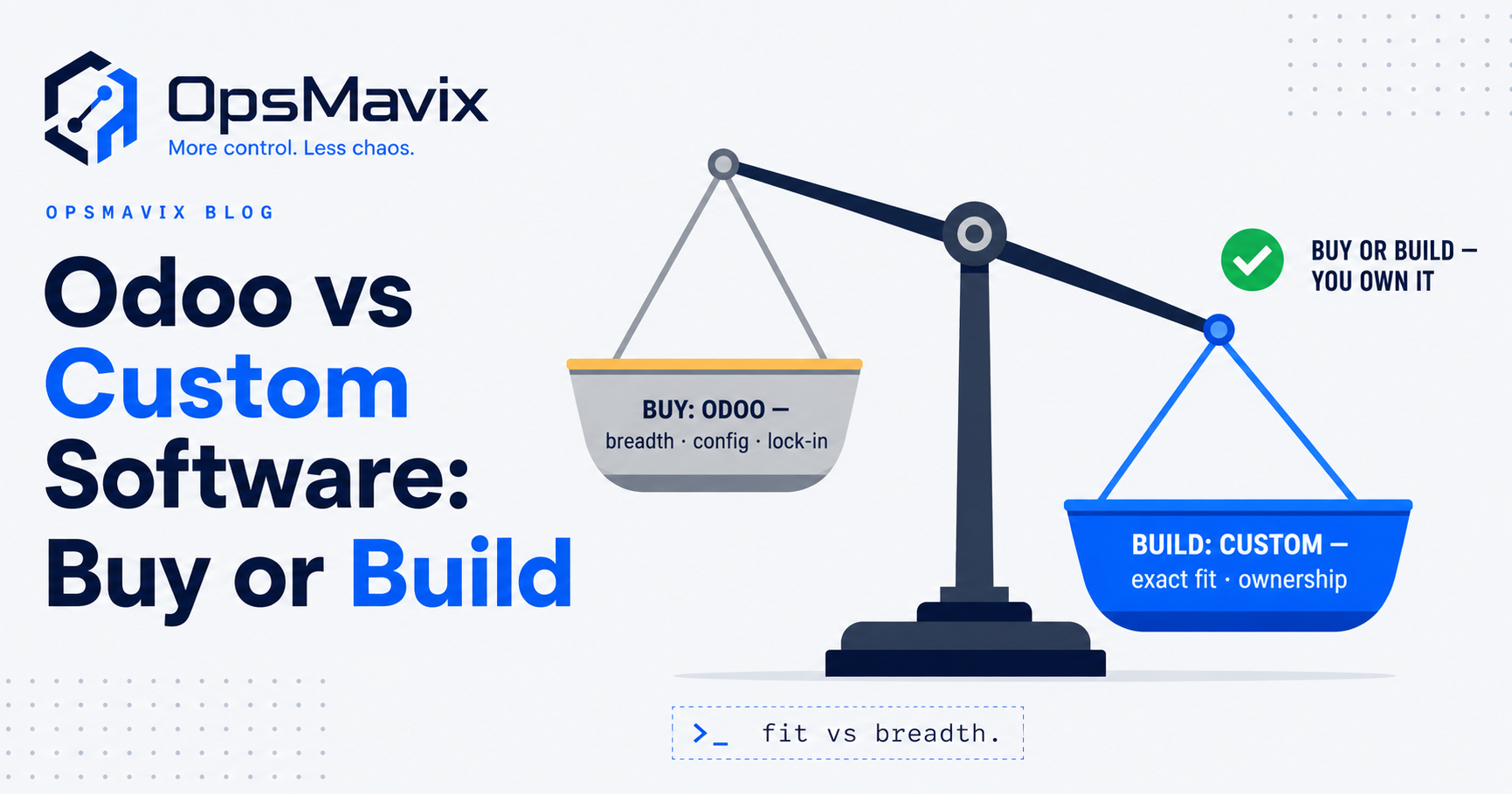
Odoo vs custom software is the buy-or-build question most growing businesses reach eventually, and it gets answered badly because people treat it as good-versus-bad instead of what it actually is: a trade between breadth you rent and fit you own. Odoo is a mature, open-source business suite from Belgium with dozens of integrated apps and a large partner ecosystem behind it — a serious product that runs real companies. A custom operations system is software built around your exact process, that you hold outright. Neither is the “smart” answer in the abstract. The right call depends on how standard your operation is, how much of a suite you’d genuinely use, and what you’re willing to own versus rent.
This post is the framework, not a pitch for one side. We’ll be fair to Odoo — there’s a clear set of businesses it’s the correct choice for, and we’ll name them. What we won’t do is pretend a custom system is “a cheaper Odoo”, because it isn’t the same thing: it’s a smaller, exact tool instead of a broad, general one. If you’ve already decided you’re moving off the suite, the Odoo alternative post covers the outgrown-it story; this one is the head-to-head you run before you commit either way.
Key Takeaways
- Odoo vs custom software is a fit-versus-breadth trade, not a quality contest — Odoo is a broad, mature suite you configure; a custom system is a narrow, exact tool you own.
- Odoo wins on breadth, maturity and speed to start — dozens of apps already built, a partner ecosystem, and a working system live in weeks rather than months.
- Custom wins on exact fit and ownership — it matches your real flow with no workarounds, carries no per-seat licence, and can’t be repriced or retired by a vendor.
- Cost and risk run opposite ways over time — Odoo starts cheaper and accrues subscription and upgrade cost; custom costs more up front and then stops charging you for growth.
- The customisation-lock-in trap is real — heavily customised Odoo can become expensive to upgrade and hard to leave, quietly erasing the “off-the-shelf” advantage you bought it for.
- Hybrid is often the honest answer — keep the finance suite you have and build a custom operations layer on top, so you’re not choosing breadth or fit but buying each where it’s strongest.
The Real Decision: Fit vs Breadth, Not Cheap vs Expensive
Strip the noise away and the choice is one axis: how much does your operation look like everybody else’s? Odoo, like any packaged suite, is built for the general case. It assumes a broadly standard shape — quotes become orders, orders draw stock, stock triggers purchasing, invoices follow — and it’s excellent at that shape because thousands of companies share it. The more your business matches the template, the more of Odoo’s breadth turns into value you didn’t have to build. Custom software runs the other way: it’s built for your specifics, so the more your process has genuine quirks a suite has no field for, the more a right-sized system earns its keep.
That’s why “which is cheaper” is the wrong opening question. A suite you use a fifth of is expensive at any price, and a custom build that reinvents standard accounting is a waste at any budget. Work out how much of what you do is standard enough to buy, and how much is specific enough that buying it means bending your operation to fit.
What Odoo Genuinely Wins On
Be fair to the tool. Odoo’s first advantage is that the work is already done. Dozens of apps — CRM, sales, inventory, manufacturing, accounting, HR, website — already exist, tested against a huge user base, with tens of thousands of third-party modules in its app store for the niches the core doesn’t cover. When your need is a common one, you’re switching on functionality that would take months to build, and getting a system live in weeks. Speed to start is a real, ownable win, and no honest custom-build pitch pretends otherwise.
The second advantage is the ecosystem. Odoo has a large network of certified partners, an active community, documentation, and a labour market of people who already know the product — if a team member leaves, you can hire another who knows Odoo. That maturity lowers the risk of being stranded with software only one person understands, and a custom system has to earn that trust deliberately rather than getting it for free from a crowd. There’s a third, quieter win too: breadth-as-insurance. If you can’t yet predict which departments will need software next, a suite gives you room to grow into apps you haven’t turned on — real value for a business genuinely heading toward multi-department, multi-entity complexity.
What Custom Software Genuinely Wins On
Now the other side, just as honestly. A custom operations system’s first win is exact fit — nothing to work around. A packaged suite handles the general case and fights you on the specific one: the customer-specific price tier it has no clean home for, the bundle drawn from three stock lines, the order that arrives by phone instead of a tidy feed. In a suite, those become configuration battles or side-spreadsheets; in a built-for-you system they’re just how the software works, because it was shaped around them from the start. When your quirks are your operation, that difference is the whole game.
The second win is ownership. A custom system carries no per-seat, per-user or per-app licence — the cost of adding your tenth or hundredth user is nothing, so the software never taxes your growth. And because you hold it outright, no vendor can reprice it, change the terms, or retire a module you depend on. What you build is yours to keep and change on your schedule, not a subscription that renews on someone else’s.
The third win is that you only carry what you use — no dormant apps, no menus to ignore, no admin overhead for functionality you’ll never switch on. For a business that needs a sharp tool for a real operational pain — a custom inventory system that stops stock drifting, orders that stop getting re-keyed by hand — that focus beats breadth it would never touch. This is the ground an operational system is built to hold: the day-to-day running of the business, done exactly, without the weight of a full finance suite around it.
Cost and Risk Over Time — the Curves Cross
The cost comparison only makes sense across years, because the two run in opposite directions. Odoo starts cheaper and lower-risk. Its Community edition is genuinely free and self-hosted, with no per-seat licence; the paid Enterprise edition is the per-user subscription, and either way you begin with a working system fast and no large up-front build. Then the line climbs — per-user fees that rise as you hire, per-app costs as you switch on more, partner fees to configure it to your reality, and an upgrade cost each time the platform moves forward (the layer-by-layer cost breakdown is in Odoo implementation cost). A custom build inverts that shape: a larger fixed cost up front to design and build the thing, then a flat, predictable line — no per-seat creep, no licence that grows with your headcount, running costs measured in hosting and maintenance rather than subscription.
Somewhere out in the three-to-five-year view, for many growing businesses, those lines cross. Before the crossover, the suite is plainly the cheaper, safer bet; after it — especially once you’re licensing a lot of users and keeping a customised install upgraded — the owned system can be the lower total cost. The honest work is modelling your curve, not quoting someone else’s. The point here is only that “Odoo is cheaper” is a statement about the first year, not the fifth.
The Customisation Lock-In Trap
Here’s the failure mode that catches the middle ground, because it’s where the buy-or-build choice quietly goes wrong. Businesses rarely fit a suite perfectly, so they customise it — extra fields, modified workflows, bolt-on modules, developer tweaks to make Odoo behave like their operation. Each change is reasonable on its own. Together, they slowly convert “off-the-shelf software” into a bespoke system that happens to sit on Odoo’s foundations — and now you’re carrying the costs of both worlds.
The bill arrives at upgrade time. A heavily customised install doesn’t move to the next version by clicking a button — every customisation has to be re-tested and often re-written against the new release, which is a project, not a maintenance task. Skip the upgrades to dodge the pain and you fall behind on support and security. The deeper the customisation, the harder it also becomes to leave, because your process logic is now tangled into a platform you don’t control. You bought a suite for the low-risk, standard-product advantage, and customised your way out of the very thing you paid for.
A Decision Checklist
You can usually settle the buy-or-build call by answering a handful of questions honestly. How standard is your operation? If your quotes, orders, stock and invoicing follow common patterns, buy; if your daily reality is full of specifics a template has no home for, that’s the signal to build. How much of a suite would you actually use? Genuinely running six, eight, ten apps across departments makes the breadth value; using two and ignoring the rest means you’re paying for a suite to get a tool. Do you have the appetite to run software? A suite still needs configuring, upgrading and administering; a custom system needs a build partner and a maintenance relationship — neither is zero-effort.
Then the honest disqualifiers. Is your budget below the custom threshold? A serious custom build starts in the low thousands and rises with scope; if you can’t fund that and your processes are standard, Odoo is the right, un-embarrassing answer — buy it. Are you heading into multi-entity finance, consolidation, statutory reporting soon? That’s suite territory; a focused operations system isn’t trying to be your finance backbone, and finance ERP versus operational ERP draws that line properly.
The Hybrid Path: Custom Ops on Top of Existing Finance
The framing that traps people is “Odoo or custom” as if it’s all-or-nothing. For a lot of businesses the strongest answer is both, in their right places. Keep the finance and accounting suite you already run — the standard, well-served part where buying makes sense — and build a custom operations layer on top for the specific part where fit matters: order intake, stock movements, production tracking, reporting. The finance system stays your book of record; the custom layer handles the daily operation exactly, and feeds the numbers across.
This is often the mature answer precisely because it refuses the false choice. You’re not paying for a suite’s operational modules you’d have to bend to fit, and you’re not rebuilding accounting you could have bought. It also lowers the stakes — you’re not betting the entire business on one platform, and you can replace either layer later without ripping out the other. If your instinct is that Odoo does most of what you need but keeps fighting you on the operational specifics, the hybrid path is usually the one to price before a full-suite commitment or a ground-up build.
Odoo vs Custom Software: a Fair Comparison
| Odoo (packaged suite) | Custom operations system | |
|---|---|---|
| Core strength | Breadth — dozens of apps, one platform | Fit — built around your exact flow |
| Speed to start | Fast — live in weeks | Slower — designed and built |
| Fit to your quirks | Configure or work around | Built the way you run |
| Cost shape | Lower up front, per-user/app over time | Higher up front, flat after |
| Growth | Costs rise with users and apps | No per-seat tax on scale |
| Ownership | Community free/self-hosted; Enterprise a per-user subscription; vendor controls the platform either way | You own it outright |
| Upgrades | Platform-driven; hard if customised | On your schedule |
| Ecosystem/hiring | Large — partners, community, docs | Built deliberately, not free |
| Best fit | Standard process, whole-suite need | Specific process, sharp tool need |
FAQ
Is custom software cheaper than Odoo?
Not up front — a packaged suite is almost always cheaper to start, because the software already exists and you’re paying a subscription rather than funding a build. The honest comparison is total cost over three to five years. Odoo’s per-user and per-app fees rise as you grow, and a heavily customised install adds upgrade cost; a custom system costs more to build but then carries no per-seat licence and doesn’t charge you for scaling. For a small team with standard needs, Odoo usually stays cheaper. For a growing business with specific processes, the owned system can win over time.
When is Odoo the right choice over custom software?
When your operation is broadly standard, you’d genuinely use much of the suite across departments, your budget is below the custom-build threshold, or you’re heading into multi-entity finance and consolidation soon. In those cases Odoo’s breadth, maturity and speed to start are real advantages, and building custom would mean reinventing software that already works. Buying the suite is the sensible, un-embarrassing answer — we’d tell you so.
Can I use Odoo and custom software together?
Yes, and for many businesses it’s the strongest option. Keep the finance and accounting suite you already run — the standard part where buying makes sense — and build a custom operations layer on top for the specific part where fit matters, such as order intake, stock and production. You buy breadth where it’s cheap and proven, build fit where it’s the whole point, and connect the two, without betting the business on a single platform.
How OpsMavix Can Help
OpsMavix builds right-sized operational systems for businesses caught in exactly this decision — too specific for a suite to fit cleanly, not standard enough to configure without workarounds, and unsure whether to buy Odoo or build. We’re not selling “a cheaper Odoo”: we build a sharp, exact tool for the operational part that actually matters — inventory, orders, production, reporting — shaped around how you genuinely work, owned by you, with no per-seat licence and nothing a vendor can switch off. Where a full suite is the honest answer, we’ll say so; where a custom operations layer on top of your existing finance system is the smart middle, that’s the operational system we build, distinct from the finance backbone it sits beside.
If you’re weighing Odoo against building, establish first what your current operation costs you — because that’s the number both options have to beat. Book a Free Operations Leak Audit and we’ll map where your operation leaks today, what it’s worth to close, and whether buying the suite, building a right-sized system, or running both together is the right fit for how you work now.
Keep reading
Getting value from OpsMavix? Add us as a preferred source on Google — you'll see more of our operations content in your AI Overviews, AI Mode and Search.