
What an Operations Control System Actually Is (and When You Need One)
An operations control system is the working layer that connects inventory, orders, purchasing and production into one place your team actually runs the business from. It sits between the spreadsheets you have outgrown and the ERP you are not ready for. Here is what it does, when you need one, and how to decide.
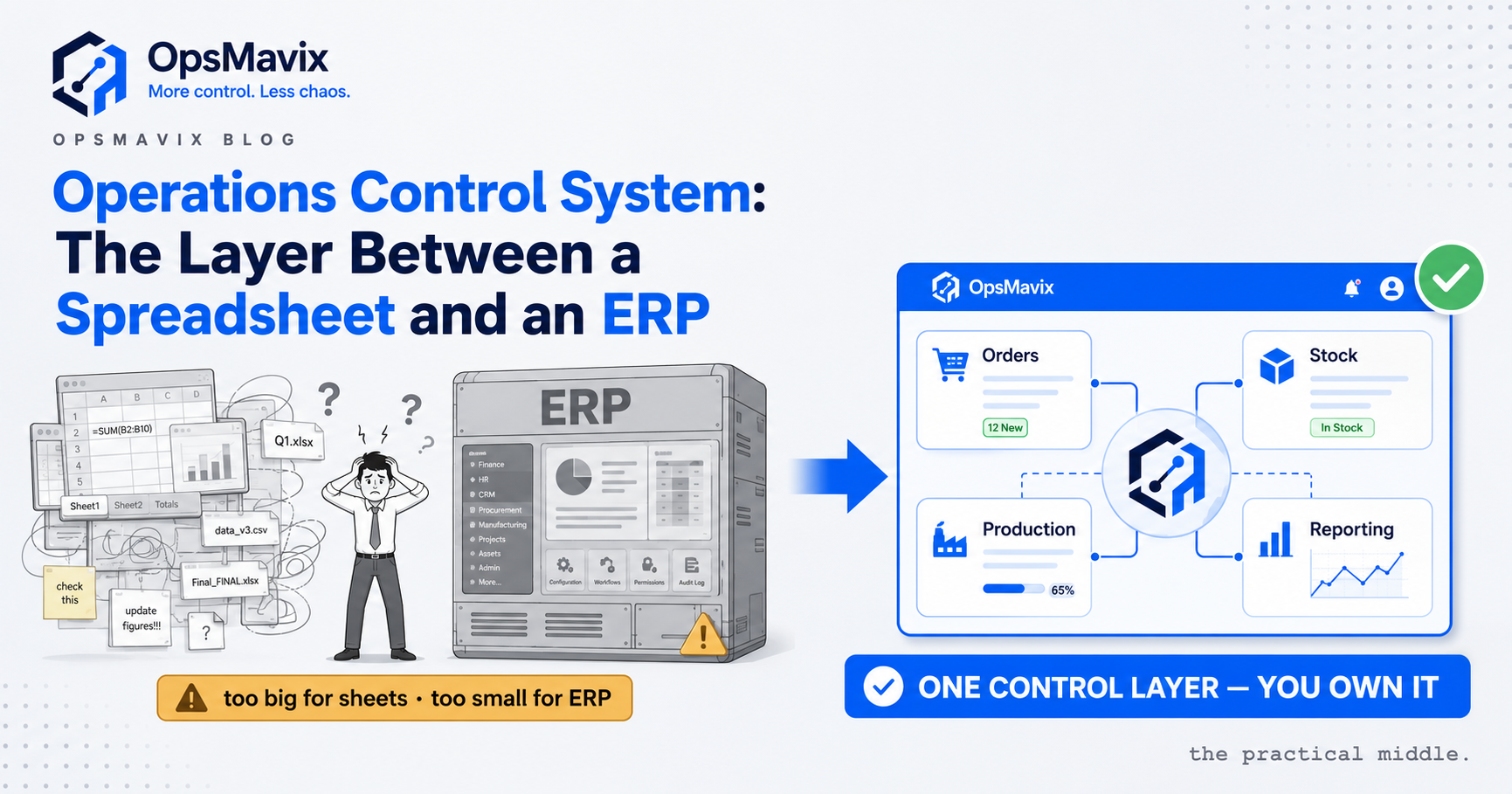
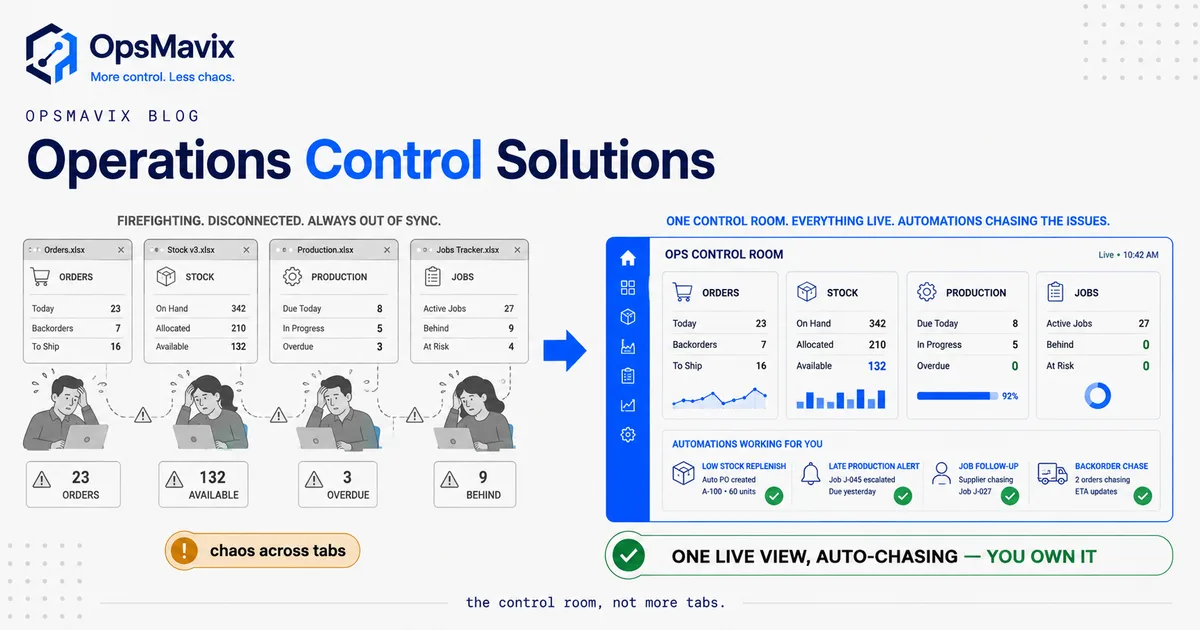
An operations control system is the single working layer that ties your inventory, orders, purchasing, production and reporting together so your team runs the business from one place instead of ten disconnected tabs. It is not a report you look at after the fact and it is not a full ERP. It is the layer you actually operate from day to day: stock levels, open orders, what needs buying, what is behind, and who owns the next action, all in one view that reflects reality.
Most growing businesses do not decide to build one. They arrive at the need. A spreadsheet becomes three spreadsheets, then a shared drive, then a WhatsApp thread that holds the “real” stock number nobody trusts. At that point the question stops being “which app do we bolt on next” and becomes “what do we all run from.” That is what an operations control system answers.
Key Takeaways
- An operations control system is the layer you operate from, not a dashboard you review. It shows live state and drives the next action across inventory, orders, purchasing and production.
- It sits between spreadsheets and a full ERP. You have outgrown the box the spreadsheet lives in, but a heavyweight ERP is more system than the problem needs.
- The value is one version of the truth. When stock, orders and purchasing read from the same place, the arguments about “whose number is right” disappear.
- It is shaped to how you actually run, not to how a generic product assumes you run. You keep your own process; the system enforces it.
- You own it. No per-seat tax that punishes growth, no vendor deciding when your workflow is allowed to change.
- The trigger is pain, not size. The moment re-keying, stockouts and “let me check and get back to you” become daily, you are ready.
What it actually controls
The word “control” is doing real work here. A reporting tool tells you what happened. A control system governs what happens next.
In practice that means four things running off one source of truth. Inventory that reflects real, live stock, not last Tuesday’s count. Orders that flow in and update stock and picking without anyone re-typing them. Purchasing that knows what to reorder before you run out, because it can see demand and lead times, not just a static minimum. And a reporting layer that reads the same data everyone else is acting on, so the number on the screen is the number on the floor.
The distinction matters because a lot of “operations software” is really just a nicer-looking report. It shows you the leak. It does not close it. For the wider category and where reporting fits, the operations management system overview lays out the full picture; this piece is specifically about the control layer inside it.
The gap it fills: past spreadsheets, short of ERP
Spreadsheets are brilliant right up to the point where more than one person needs the truth at the same time. Then they quietly break. Two people edit the same stock tab, one saves over the other, and now the “master” file is wrong and nobody knows when it went wrong.
The instinct is to jump to a full ERP. Sometimes that is correct. Often it is not. A full ERP assumes you want to reshape your business around finance-first, module-heavy software with a long implementation and a matching invoice. If your actual problem is “orders get re-keyed, stock is never trusted, and purchasing is guesswork,” an ERP is buying a cargo ship to cross a river.
An operations control system is the middle. It is the practical layer between a spreadsheet and a full ERP: enough structure to enforce one version of the truth, not so much that you spend a year and a six-figure budget bending your business to fit it. If you want the honest comparison of where operational software and finance-first ERP diverge, we wrote that up in operational ERP.
A real scenario: the wholesale distributor’s Monday
A wholesale distributor described their Monday like this. Weekend web orders sit in one inbox. Trade phone orders sit in a notebook. The warehouse count from Friday sits in a spreadsheet that is already out of date. Someone spends the morning reconciling all three before a single order ships, and by the time they finish, two lines have oversold because the stock they promised was already gone.
That is not a people problem. Nobody on that team is lazy. It is a systems problem: the truth lives in three places, so it lives in none.
With a control system, the same Monday looks different. Orders from every channel land in one queue and decrement stock as they arrive. Oversell is blocked at the point of promise, not discovered at the point of pick. Purchasing sees what the weekend actually consumed and flags the reorders before the buyer has finished their coffee. The morning of reconciliation becomes fifteen minutes of exceptions.
What it looks like when it is working
The tell of a working operations control system is boring. The drama goes away.
Nobody re-keys an order. The stock figure on the screen matches the shelf. When a customer asks “can you ship 40 by Thursday,” the answer comes back in seconds and is actually true, because the person answering is looking at live stock, open commitments and inbound purchasing in one view rather than guessing.
Operators tell us the change they notice first is not a feature. It is that they stop being the integration. For months the “system” was a person holding five tabs in their head and copying numbers between them. When the control layer does that joining, that person gets their week back.
The most mature version of this reaches into purchasing and replenishment automatically, so reorders trigger off real demand rather than a human remembering to check. We go deep on that end state in fully automated inventory system, but you do not need to start there. Most businesses get the majority of the relief just from one trusted view.
The £-cost of not having one
It is easy to treat the current mess as free because no invoice arrives for it. It is not free.
Count the hours. A morning of reconciliation every week is roughly half a day, call it four hours. At a modest loaded rate that is a few hundred pounds a week, several thousand a year, for one person doing work a system should do. Then add the invisible costs: the oversells that become refunds and apologies, the emergency reorders shipped at premium freight because nobody saw the shortage coming, the deals that stall because “let me check stock and get back to you” gives a competitor the opening.
None of those show up in a software budget line, which is exactly why they run for years. The point of a control system is to make the cost of staying the same visible, then remove it.
Build, buy, or own a system shaped to you
Honest take, because this is where most advice goes soft.
Off-the-shelf can be the right call. If your operation is genuinely standard, a packaged inventory or order tool may fit fine, and you should buy it rather than build anything. Do not build what you can buy.
The problem is the middle-sized business whose process is not standard, because it grew that way for good reasons. That business tries three off-the-shelf tools, bends its workflow to each one, and ends up with the disconnected-tools mess it was trying to escape, plus three subscriptions. Every tool assumes a slightly different version of how you should work, and none of them talk.
An operations control system is the third option: one system shaped to how you actually run, that you own. Not custom code as a scary open-ended project, but a system built around your real process, that stays yours as you grow, with no per-seat penalty for hiring and no vendor deciding when your workflow is allowed to change.
The right answer depends on you. If a box fits, buy the box. If you have tried the boxes and keep spilling out of them, that is the signal you have outgrown the category, not that you are using the boxes wrong. The next move is not another tool. It is deciding what your team runs from.
Keep reading
Getting value from OpsMavix? Add us as a preferred source on Google — you'll see more of our operations content in your AI Overviews, AI Mode and Search.