
Consignment Stock: How It Works and How to Manage It
Consignment stock is inventory that sits in one company's warehouse but stays owned by the supplier until it sells. This post explains who owns it, the cash-flow benefit for both sides, the UK VAT and accounting nuance most guides skip, and why mixing consigned and owned stock quietly wrecks your numbers — plus how an owned system tracks consignment separately without a second spreadsheet.
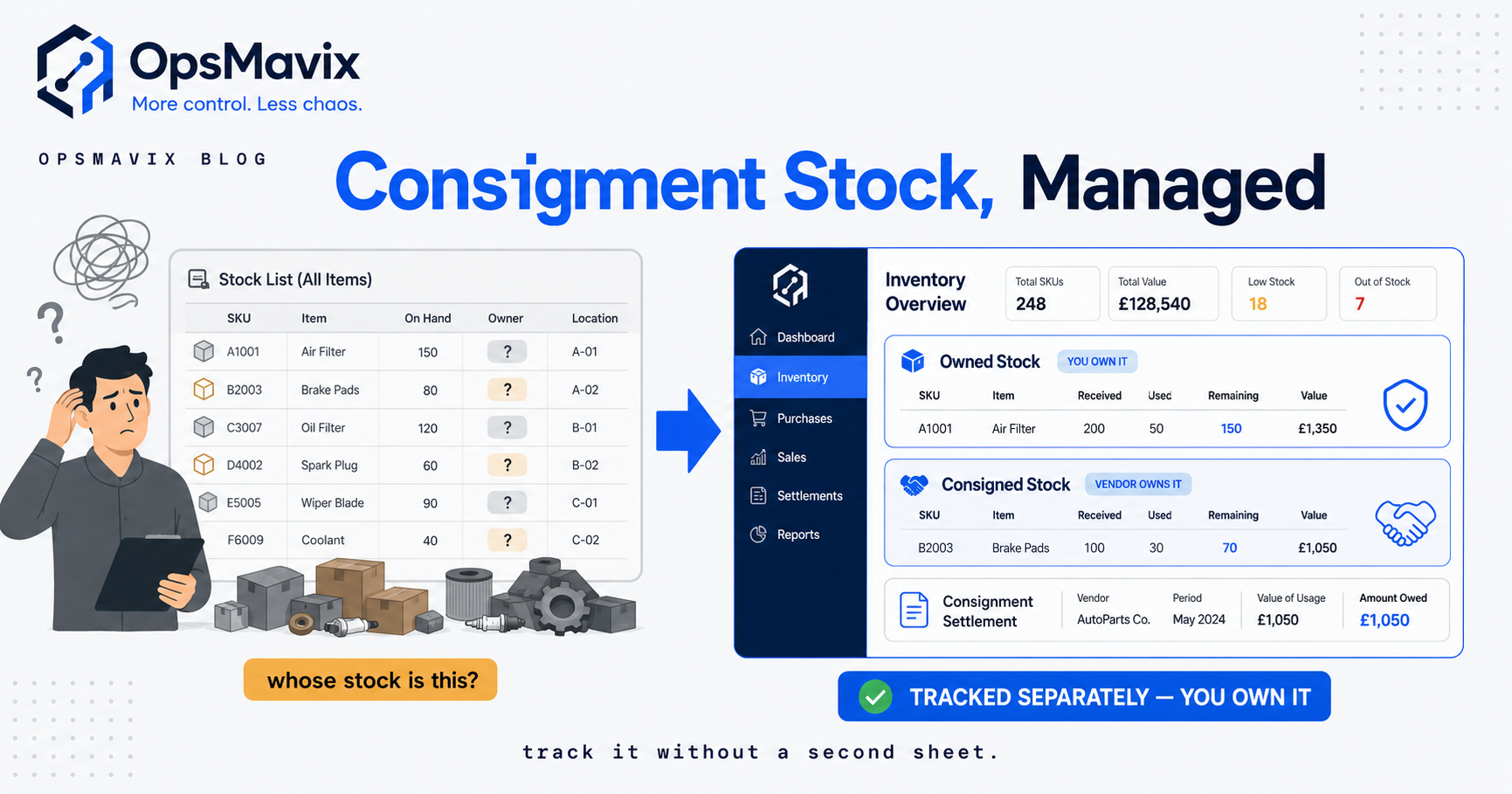
Consignment stock is an arrangement in which goods are held by another business while ownership remains with the supplier until an agreed event. That event may involve sale, use or another contractual trigger. The practical challenge is to keep physical custody, ownership, stock availability and settlement records aligned without assuming they always change together.
This guide explains the operational controls to agree before introducing consignment, the records to maintain and the tests a stock system should pass. Contract, accounting and tax treatment depend on the actual arrangement; the examples below illustrate stock control rather than prescribe those treatments.

Physical storage and recorded ownership must be distinguishable. Illustrative photograph, not an OpsMavix client.
Image credit: FIONASUN, CC0 1.0. Displayed at a reduced size; no additional edits.
Key Takeaways
- Record who owns goods separately from where they are stored.
- Agree the ownership and settlement triggers before configuring software.
- Track receipts, consumption, returns, damage and transfers as distinct events.
- Reconcile the supplier and holder records using a shared cut-off.
- Do not infer VAT or accounting treatment from the consignment label.
- Pilot exceptions as well as normal sales or consumption.
In this guide:
- 1. Define the Arrangement Before Moving Goods
- 2. Agree Commercial Rules and Responsibilities
- 3. Separate Stock by Owner and Status
- 4. Record Consumption and Ownership Changes
- 5. Handle Counts Returns and Damage
- 6. Connect Settlement Without Guessing Tax Treatment
- 7. Test Software and Integration Controls
- 8. Pilot With a Joint Reconciliation
- Frequently Asked Questions
- How OpsMavix Can Help
1. Define the Arrangement Before Moving Goods
Distinguish custody from ownership
The supplier is commonly called the consignor and the receiving holder the consignee. A supplier may place components at a customer’s factory or products with a reseller. Those arrangements can have different commercial terms even when both parties call them consignment.
Document the goods, permitted locations, eligible uses and the event that changes ownership or creates a reporting obligation. Specify who can authorise a transfer, return or disposal. Make sure warehouse instructions reflect the agreement rather than relying on what happened with another supplier.
Compare related arrangements
| Arrangement | Operational distinction to check |
|---|---|
| Consignment | Who owns the goods before and after the agreed trigger? |
| Ordinary purchase on credit | Has a purchase occurred even though payment is later? |
| Supplier-managed replenishment | Who decides replenishment, regardless of ownership? |
| Third-party storage | Is the provider holding goods without buying or selling them? |
A supplier managing the replenishment quantity does not, by itself, establish that the goods are consigned.
2. Agree Commercial Rules and Responsibilities
Make exceptions part of the agreement
Define reporting frequency, accepted evidence, settlement prices and the handling of price changes. Confirm minimum or maximum holdings, aged stock review, return rights and any restrictions on mixing stock. Assign responsibility for damage, loss, insurance and disputed quantities through the appropriate contract review.
| Question | Operational record needed |
|---|---|
| What triggers settlement? | A dated sale, use, adoption or other agreed event. |
| Which price applies? | The applicable agreement and price version. |
| Can unused goods be returned? | Approval, quantity, condition and receipt evidence. |
| Who handles differences? | Named contacts, investigation and resolution status. |
| What happens at termination? | Joint count, outstanding reports and return instructions. |
Avoid ambiguous shortcuts
A monthly invoice should not be the only record of what happened during the month. Retain the underlying events so each party can explain the billed quantity. Equally, do not assume a physical transfer automatically represents a sale. Write the agreed rule beside the relevant transaction type.
3. Separate Stock by Owner and Status
Keep identity through the movement
The relevant stock identity may include item, unit, location, owner, batch or serial and condition. Consignment stock should remain distinguishable from your own stock even where it shares a building. Physical labelling or separate bins can help operators apply the correct rule.
In a hypothetical example, 200 units are physically present: 120 belong to the supplier and 80 to the holder. Twenty of the supplier-owned units are held for inspection. Under a policy excluding held stock, usable quantities are 100 supplier-owned units and 80 holder-owned units. The held 20 are part of the 120, not an additional ownership pool.
Define eligibility
Specify which stock may be sold, consumed, transferred or reserved. A system should prevent or clearly flag an unauthorised owner change. Test two suppliers providing the same commercial item, including different units and prices, before relying on a single SKU balance.
Keep product identity stable through ownership changes. Creating unrelated duplicate product records can make traceability and reconciliation harder unless the mapping and purpose are clear.
4. Record Consumption and Ownership Changes
Hypothetical transaction sequence
Assume a supplier places 100 units with a customer. Under this example agreement, confirmed consumption transfers ownership and creates the quantity to settle. The customer consumes 25 and returns ten unused units with the supplier’s approval. No other movement occurs.
| Event | Supplier-owned units at customer | Consumed units to settle |
|---|---|---|
| Receive consignment | 100 | 0 |
| Consume 25 | 75 | 25 |
| Return ten unused | 65 | 25 |
The 65 units still held are not another 65 consumed. The returned ten are not a negative sale unless the agreed process specifically requires such a financial treatment. Physical movements and settlement records should remain linked but distinguishable.
Correct mistakes transparently
If the 25-unit consumption was entered twice, reverse or correct the duplicate with a reference to the original event. Do not silently overwrite the ending quantity. Record who approved the correction and ensure any downstream report or invoice process receives the correction only once.
5. Handle Counts Returns and Damage
Reconcile at the same point in time
Agree a cut-off and identify receipts, consumption and returns around it. Both parties need the same item, unit and ownership scope. If goods are in transit, establish which location or transit status holds them in each report.
In the hypothetical example, a count finds 63 units against the expected 65. Recount and review movements before deciding that two units are missing. The difference may be an unreported consumption, a misplaced carton or an entry error. Liability and settlement follow the agreement and investigation, not an automatic stock adjustment assumption.
Keep condition visible
Damage does not make goods vanish. Record the quantity and condition, isolate it where appropriate and request the required decision. A return should include authorisation, despatch and receipt evidence. Keep rejected returns and disputed losses open with an owner until resolved.
Review aged stock with the supplier so that slow-moving goods do not remain indefinitely without an agreed action.

Stock movements need traceable item, location and ownership records. Illustrative photograph, not an OpsMavix client.
Image credit: Nenad Stojković / Shixart1985, CC BY 2.0. Displayed at a reduced size; no additional edits.
6. Connect Settlement Without Guessing Tax Treatment
Use approved financial rules
Your finance team should establish the accounting and tax treatment for the agreement before software generates postings or invoices. The label consignment is insufficient to determine the answer, particularly for cross-border movements or arrangements with limited return rights.
HMRC’s guidance on sale or return and goods on approval distinguishes arrangements with an unequivocal right to return goods from cases that may instead operate on extended credit terms. It also explains that adoption depends on the facts. Do not assume VAT always waits until the eventual retail sale or cash payment.
Keep a settlement trail
Link reported consumption or sales to their agreement, quantity, price rule and reporting period. Record whether each event is unreported, reported, disputed or settled. Reconcile corrections and credits rather than exporting the same events again.
Separate the stock-control test from the financial-posting test. Both must pass, with finance confirming the latter against the actual arrangement.
7. Test Software and Integration Controls
Demonstrate the difficult cases
Ask your current supplier whether configuration can support ownership, locations and the required events. A dedicated module or integration may be sufficient. Consider custom development where important controls remain unmet, and a full ERP where the wider purchasing, stock and finance processes need a shared design.
- Receive the same SKU for two owners and keep quantities separate.
- Consume part of a consignment and trace the ownership change.
- Replay the consumption message without duplicating settlement.
- Return unused goods and preserve the required evidence.
- Hold damaged goods without making them available for ordinary use.
- Correct a previous reporting period with a visible audit trail.
- Export a complete owner-by-location reconciliation.
Assign interface ownership
Define unique event identifiers, retries, failed-message queues and a responsible investigator. The supplier’s portal and the holder’s stock system should not independently invent conflicting consumption totals. Specify which event is authoritative and how disagreements are resolved.
8. Pilot With a Joint Reconciliation
Start with a manageable agreement
Choose a limited set of items and one supplier or customer. Confirm opening balances together, including held goods and in-transit quantities. Record the agreed transaction, price and reporting rules before loading the opening position.
Train receiving, warehouse, purchasing and finance users on the same scenario. Explain what a receipt means, what changes ownership and what must happen when goods are damaged or returned. A technically correct module can still fail if operators use an ordinary purchase receipt for every delivery.
Acceptance checklist
- Opening stock agrees by item, owner, location and relevant status.
- Consumption produces the agreed quantity and ownership effects.
- Returns and damaged goods remain traceable.
- Duplicate and failed messages recover correctly.
- Settlement reports reconcile to their underlying events.
- Finance approves the configured treatment.
- Both parties can investigate and resolve a difference.
- Exit and final-count procedures are documented.
Expand only after the joint reconciliation works and exceptions have named owners.
Consignment reconciliation is far simpler when both parties read one movement record; see how an owned inventory automation system handles held-but-unowned stock.
Frequently Asked Questions
What is consignment stock?
It is stock held by another business while ownership remains with the supplier until an agreed event. The exact trigger and obligations depend on the arrangement.
Who owns goods in the customer warehouse?
Location alone does not determine ownership. Use the agreement and transaction history to identify the owner of each relevant quantity.
Is consignment the same as supplier-managed inventory?
No. Supplier-managed inventory describes replenishment responsibility. Ownership and settlement can follow different arrangements.
When does payment become due?
Follow the agreed commercial terms and relevant financial treatment. Consumption, reporting, invoicing and payment can occur on different dates.
Does VAT always wait until resale?
No. HMRC distinguishes different arrangements and tax-point rules. Finance should confirm the treatment from the actual facts and agreement.
Can owned and consigned goods share a bin?
Only if the process and system maintain unambiguous identification and permitted use. Separate storage or clear labelling may be more practical.
How should damaged consignment be recorded?
Keep the quantity and condition visible, prevent inappropriate use and follow the agreement for investigation, approval and disposal or return.
What should the supplier report contain?
Include opening stock, receipts, consumption or sales, returns, approved adjustments and closing stock with item, unit, location and event references.
Can our existing inventory software support it?
Possibly. Demonstrate ownership, consumption, returns, settlement and reconciliation in the proposed configuration before commissioning additional software.
How OpsMavix Can Help
OpsMavix can map consignment workflows, configure suitable tools, integrate supplier reporting or build a custom stock-control system. We can also build a full ERP where purchasing, inventory, production and finance need a broader shared design.
Explore our inventory automation systems and wholesale order management. Contact OpsMavix with one agreement and a sample reconciliation so we can define the controls a pilot must demonstrate.
Keep reading
Getting value from OpsMavix? Add us as a preferred source on Google — you'll see more of our operations content in your AI Overviews, AI Mode and Search.