
The Goods Receiving Process That Catches Errors at the Door
A weak goods receiving process is where stock accuracy dies before you ever pick an order. Here's how to book in deliveries against the PO, raise a clean GRN, catch short and damaged loads at the door, and put stock away so it's right from the moment it lands.
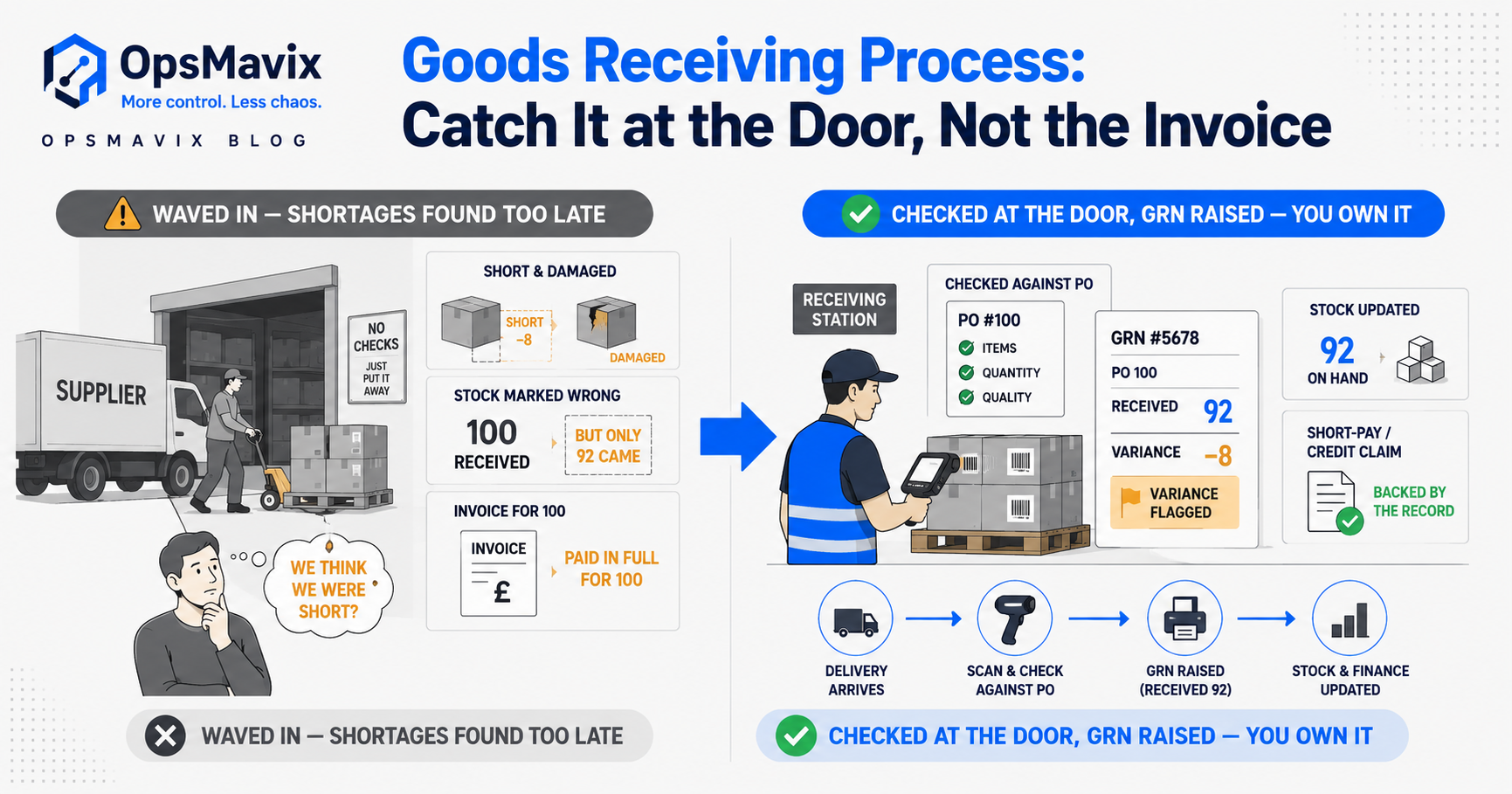
Your goods receiving process is the first place stock accuracy is either won or lost — before a single order is picked. If what arrives at the loading bay is checked properly against the purchase order, booked in accurately, and put away where the system says it is, everything downstream has a chance. If deliveries get signed for on trust and dumped in a corner, you’ve already started the day with numbers that lie. Most warehouses obsess over picking and counting and quietly wave goods in through the back door. That’s backwards. The gap between what you ordered and what actually landed is the cheapest error to catch and the most expensive one to miss.
This post is the inbound side of stock control: booking in a delivery, checking it against the PO, raising a goods received note, and getting it put away so it’s findable. It’s the sibling of the warehouse label system that makes put-away and picking accurate, and of the physical stocktaking procedure that audits the numbers later. Receiving is where those numbers are born.
Key Takeaways
- The goods receiving process is where stock accuracy starts — a delivery checked wrong at the door poisons every count and pick after it.
- Book in against the purchase order, not the supplier’s delivery note. Three things must agree: what you ordered, what the paperwork claims, and what’s physically there.
- The goods received note (GRN) is the record that turns a delivery into trusted stock — and the evidence you need to short-pay a supplier who under-delivered.
- Catch short, damaged and wrong deliveries at goods-in, not three weeks later at picking when it’s your problem to prove.
- Stock isn’t received until it’s put away where the system says it is — a booked-in pallet nobody can find is still a shortage.
1. What the Goods Receiving Process Actually Covers
Goods receiving is the sequence a delivery goes through between the lorry and the shelf: booking it in, checking it against the order that triggered it, recording what genuinely arrived, and putting it away in a known location. Four steps, and skipping any one of them breaks the number. Book in without checking and you trust the supplier blindly. Check without recording and you’ve no proof when they’ve short-shipped. Record without proper put-away and you’ve a stock figure pointing at thin air.
Most small warehouses do a loose version of this on a clipboard or a signature and a shrug. The delivery driver hands over a note, someone signs it, the pallet goes “over there,” and the system gets updated later from memory, if at all. That’s not a receiving process — it’s a hope. The discipline below is what turns goods-in from the leakiest part of your operation into the tightest.
2. Book In Against the PO — Not the Delivery Note
The single biggest receiving mistake is checking the delivery against the supplier’s own paperwork. The delivery note tells you what the supplier says they sent. It agrees with itself. What you need is a three-way match: the purchase order (what you ordered), the delivery note (what they claim), and the physical count (what’s actually on the pallet). All three have to line up, and the PO is the anchor — because it’s the only one that represents your intent.
When those three disagree, that’s the signal. Ordered 100, note says 100, count says 92 — you’ve an eight-unit short and the evidence to raise it now. Ordered 100, note says 80, and someone accepts it without flagging the shortfall against the PO — you’ll pay for 100 and never know. A receiving process that starts from the PO catches both. One that starts from the delivery note just rubber-stamps whatever turned up.
3. The Goods Received Note Is Where Accuracy Is Born
The goods received note is the record of what actually arrived — quantities, condition, batch or lot, date, who checked it. It’s small and it’s boring and it’s the most important document in your warehouse, because it’s the moment a delivery stops being a supplier’s claim and becomes your stock, at a quantity you can defend. Every downstream number — available stock, valuation, what you can promise a customer — inherits from the GRN. Get it wrong here and you’re reconciling the error for months.
It’s also your protection. When a supplier invoices for 100 and your GRN says 92 arrived, the GRN is what lets you short-pay or claim the credit without an argument. Without it, it’s your word against their invoice, and their invoice wins. A GRN raised at the point of check — not reconstructed later from memory — is the difference between “we think we were short” and “here’s the record, credit us for eight.”
4. Catch Short, Damaged and Wrong at the Door
Every receiving error you don’t catch at goods-in becomes a harder, more expensive problem later — and eventually it stops looking like the supplier’s fault and starts looking like yours. A short delivery caught at the bay is a credit note. The same short discovered three weeks later at picking is a phantom-stock mystery you can’t trace and can’t bill back. Damage spotted on the pallet is refused or claimed on the spot. Damage found after you’ve signed and shelved it is your write-off. Wrong item — right SKU on the note, wrong thing in the box — caught at check is a return; caught at dispatch is a customer complaint.
So the check has to be real: count it, look at it, confirm the SKU is what the PO says, note damage before you sign. The temptation on a busy goods-in bench is to wave it through and sort it later. Later is exactly when the trail goes cold, the supplier’s claim window closes, and a discrepancy that was theirs to fix quietly becomes yours to absorb.
5. Stock Isn’t Received Until It’s Put Away
Booking a delivery in is only half the job. A pallet that’s been receipted into the system but is sitting in the wrong aisle — or no known aisle — is a shortage with extra steps. The count says it’s there; the picker can’t find it; the order goes short anyway. Put-away is the step that closes the loop: the received stock goes to a specific, labelled location, and the system records where, not just how much.
This is where receiving hands off to your warehouse label system — every location scannable, every put-away confirmed against a real bin, so “received” and “findable” mean the same thing. Directed put-away (the system tells the person where it goes) beats memory every time, because memory is where “I put it somewhere in aisle 4” comes from. Received-but-lost is one of the quietest causes of phantom stock, and it’s entirely a put-away failure.
6. Why the Spreadsheet Receiving Process Leaks
The clipboard-and-spreadsheet version of goods-in fails in a specific, repeatable way. The PO lives in the accounts tool, the delivery note is a bit of paper, the count is in someone’s head, and the stock figure gets updated later — three tools and a memory that never quite agree. There’s no forced three-way match, so shortages slip through. There’s no GRN raised at the point of check, so you’ve no evidence when the invoice is wrong. There’s no link from receipt to location, so put-away is a guess. Each gap is small; together they’re the reason the stock never matches the shelf from the moment it lands.
The fix isn’t a £100k WMS you’ll use a tenth of. It’s a receiving process where the PO, the check, the GRN and the put-away are one connected flow instead of four disconnected steps — so a delivery can’t be booked in without being matched, and can’t be received without landing somewhere real. That’s the gap OpsMavix builds into: outgrowing spreadsheets and disconnected tools.
7. Build Receiving Around Your Goods-In Bench
A receiving process only sticks if it fits how your bench actually works. Off-the-shelf tools either can’t model your suppliers and POs the way you run them, or they bury the check under steps a busy goods-in team will skip the moment it’s raining and the lorry’s waiting. The result is the same every time: people fall back to the clipboard, and the system gets updated from memory hours later.
Our view at OpsMavix: a receiving system should pull up the open PO the moment a delivery arrives, force the three-way match, raise the GRN at the point of check, flag shorts and damage against the supplier automatically, and drive put-away to a real location that updates the live stock figure. Built around your goods-in bench, your suppliers and your bins — and owned outright, so no vendor can switch it off or price you out of your own receiving data. That’s the difference between a process that gets followed and one that dies the first busy morning.
FAQ
What is the goods receiving process?
The goods receiving process is the sequence a delivery goes through from arrival to shelf: booking it in, checking it against the purchase order, raising a goods received note that records what actually arrived, and putting it away in a known location. It’s the inbound half of stock control, and it’s where stock accuracy is either established or lost before any order is picked.
Should I check a delivery against the PO or the delivery note?
Against the purchase order, using both. The delivery note only tells you what the supplier claims they sent — it agrees with itself. A proper check is a three-way match: the PO (what you ordered), the delivery note (what they claim), and the physical count (what’s actually there). The PO is the anchor, because it’s the only document that represents your intent rather than the supplier’s.
What is a goods received note (GRN)?
A goods received note is the record of what genuinely arrived — quantities, condition, batch or lot, date, and who checked it. It turns a delivery from the supplier’s claim into your trusted stock at a defensible quantity, and it’s the evidence you need to short-pay or claim credit when a supplier under-delivers and over-invoices. Every downstream stock number inherits from it.
How do I stop short and damaged deliveries slipping through?
Catch them at goods-in, not later. Count and inspect against the PO before you sign, note any damage or shortfall on the spot, and raise the GRN at the point of check. A shortage caught at the door is a supplier credit; the same shortage found weeks later at picking is an untraceable phantom-stock problem you can’t bill back, because the supplier’s claim window has closed.
Why does my stock go wrong even though deliveries get booked in?
Usually because booking in and putting away have come apart. Stock that’s receipted into the system but sitting in the wrong place — or no recorded place — is a shortage the system hasn’t noticed. Received-but-lost stock is a quiet, common cause of phantom stock, and it’s a put-away failure. Receiving isn’t finished until the stock is findable where the system says it is.
How OpsMavix Can Help
OpsMavix builds custom inventory systems for small and mid-sized warehouses where goods-in is the leak: the open PO pulled up on arrival, a forced three-way match, a GRN raised at the point of check, shorts and damage flagged against the supplier, and directed put-away that updates the live stock figure — built around your bench, your suppliers and your bins, and yours to own outright. No £100k WMS, no per-seat fees, no vendor that can switch it off.
If deliveries get signed for on trust and reconciled from memory, you’re absorbing supplier shortages you can’t see and starting every day with numbers that already lie. Book a Free Operations Leak Audit and we’ll map where your receiving process leaks — and what it’s costing you.
Keep reading
Getting value from OpsMavix? Add us as a preferred source on Google — you'll see more of our operations content in your AI Overviews, AI Mode and Search.