
Why Your Stock Never Matches the System
You count the shelf, you check the system, and the two never agree. Here's why inventory discrepancies happen — and how to get a number you can trust.
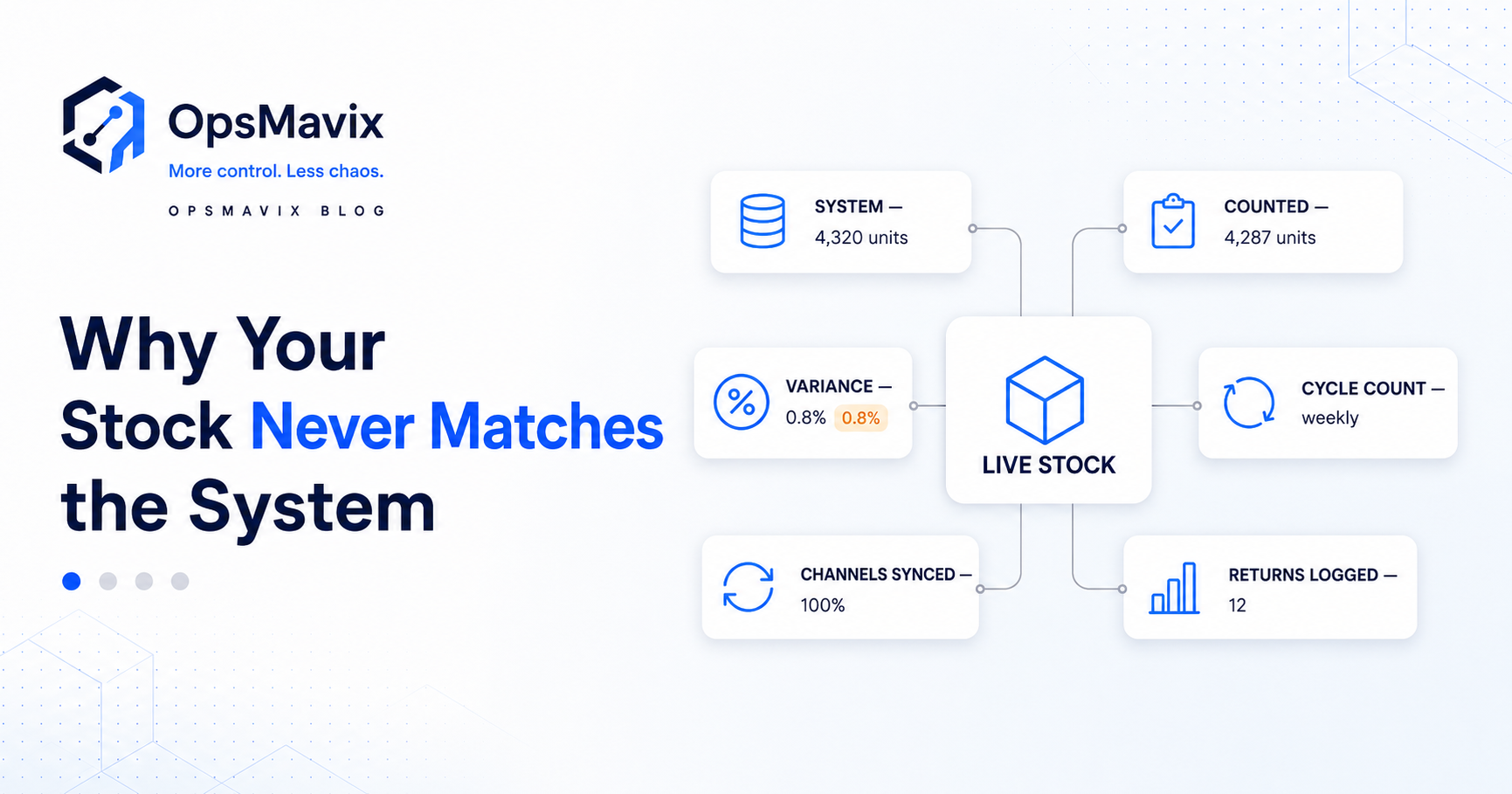
You count the shelf, you check the system, and the two never agree. So you stop trusting the number — and start “just checking” before you promise stock to a customer. That habit is the real cost of inventory discrepancies: not the miscount itself, but the fact that no figure in your business can be relied on.
This isn’t a sign your team can’t count. It’s a sign that stock is being tracked by hand, in more than one place, with nothing keeping those places in sync. As you grow, the gap between the shelf and the system gets wider, not smaller.
Here are the real causes of inventory discrepancies — and what it takes to get a stock figure you can actually trust.
Key Takeaways
- Inventory discrepancies come from manual tracking across disconnected places, not careless staff.
- The moment stock changes in one system but not another, every number downstream is wrong.
- Real-time updates on every movement (sale, receipt, return) are what keep the count true.
- Cycle counting catches drift early, instead of one painful annual stocktake.
- One connected source of truth is the difference between guessing and knowing.
1The Count and the System Drift Apart
Most discrepancies start with a delay. Stock moves — a sale, a delivery, a transfer — but the system isn’t updated until later, if at all. In that gap, the figure on screen is already wrong, and every decision made from it (reorder, promise, pick) inherits the error. The longer the delay between a movement and the record, the wider the drift.
2Stock Lives in More Than One Place
When you sell across a shop, a website, and a couple of marketplaces — or hold stock in two locations — each often has its own count. Nothing automatically tells the others when something sells. So the website shows ten, the warehouse has three, and you find out only when you oversell. Multiple unsynced counts guarantee disagreement.
3Manual Entry Quietly Introduces Errors
Typing quantities into a spreadsheet or re-keying them between tools is where a lot of drift creeps in: a transposed figure, a missed line, a count entered against the wrong SKU. None of it is laziness — it’s what happens when humans are the integration layer between systems. Every manual hop is another chance for the number to slip.
4There’s No Regular Moment of Truth
Many businesses only reconcile stock once a year, in a dreaded full stocktake. By then, months of small errors have compounded into a number nobody can explain. Without a routine check, discrepancies hide until they’re huge. Regular cycle counting — checking a small slice of stock often — catches drift while it’s still small and traceable. The mechanics of doing it are in the physical stocktaking procedure that actually reconciles.
5Returns, Damages and Samples Disappear
The sale gets recorded because it’s tied to money. The returned item, the damaged unit written off, the sample sent to a customer — those adjustments often don’t. Each untracked movement is a permanent gap between the shelf and the system. Stock accuracy depends on capturing every change, not just the ones with an invoice attached.
What Trustworthy Stock Looks Like
Reliable stock isn’t about counting harder — it’s about counting once and keeping it live. Every movement (sale across any channel, goods received, transfer, return, write-off) updates one shared figure the moment it happens, so the shelf and the system stay in step on their own. That’s the same connected approach behind not overselling across Shopify, Amazon and eBay.
When stock is tracked this way, the number stops being a guess. You can promise stock on a call without walking the floor, reorder from real figures instead of fear, and stop the quiet losses from dead stock and emergency buys. A connected inventory system makes the trustworthy number the default, not a thing you rebuild every quarter.
FAQ
What causes inventory discrepancies?
Mainly manual tracking across disconnected places: delays between a stock movement and the record, separate counts per channel or location, re-keying errors, untracked returns and write-offs, and no regular reconciliation. Each one widens the gap between the shelf and the system.
How do I fix stock that never matches the system?
Get every stock movement updating one shared figure in real time, sync counts across channels and locations, and add regular cycle counts to catch drift early. The goal is one source of truth instead of several lists that disagree.
What is cycle counting and why does it help?
Cycle counting means checking a small portion of your stock frequently rather than counting everything once a year. It catches errors while they’re small and easy to trace, and it keeps accuracy high without shutting the business down for a full stocktake.
How often should I count stock?
With a connected system updating in real time, a rolling cycle count of a small slice each week or month is usually enough to stay accurate. Relying only on one annual stocktake almost guarantees large, unexplained discrepancies.
Why does overselling keep happening if my numbers look fine?
Usually because each sales channel holds its own count and nothing syncs them. One channel sells the last unit, the others don’t know, and you promise stock you no longer have. A single shared figure across every channel removes the cause.
How OpsMavix Can Help
OpsMavix builds custom inventory systems where every movement — sales across each channel, receipts, transfers, returns and write-offs — updates one live stock figure, so the shelf and the system finally agree. No more re-keying counts between tools, no more “let me check and call you back.”
If you can’t trust your stock number, that’s a measurable operational leak — in lost sales, dead stock, and time spent double-checking. Book an Operations Leak Audit and we’ll map where your stock accuracy breaks down, and what it’s costing you.