
How to Prevent Stock Discrepancies Before They Cost You
Prevention beats reconciliation. This is the practical playbook for how to prevent stock discrepancies — accurate goods-in, scan capture instead of manual entry, cycle counting to catch drift early, locked-down adjustments, and one real-time source of truth. It covers why a spreadsheet structurally can't do it, and the honest exception where a tiny operation still can.
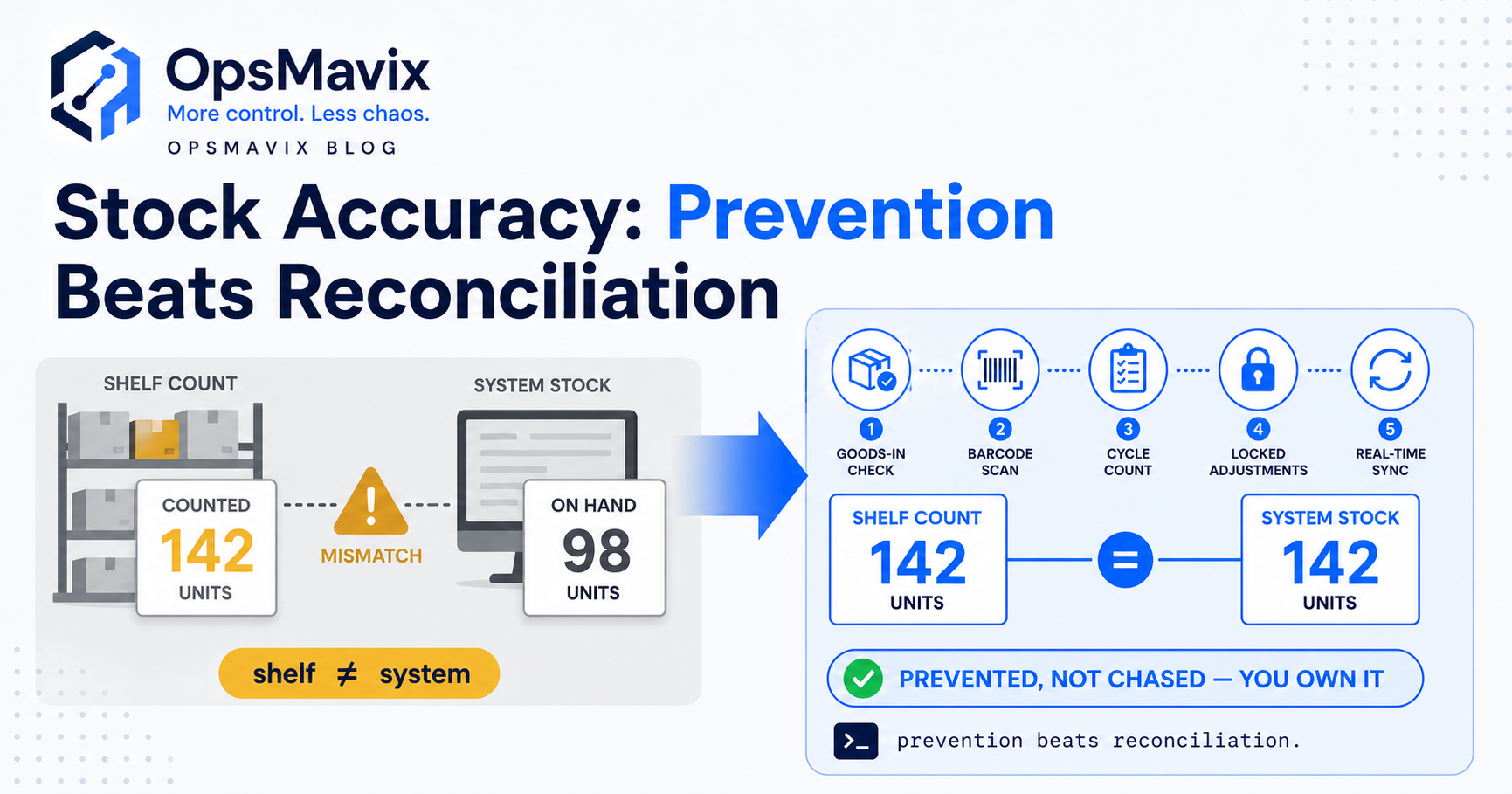
How to prevent stock discrepancies comes down to one shift in thinking: stop chasing the gap after it opens and close the doors it walks in through. A discrepancy is recorded quantity not matching physical quantity — the system says forty, the shelf holds thirty-seven — and by the time you find it the money is already gone: the oversell has annoyed a customer, the emergency reorder is placed, the cash is tied up in stock you didn’t know you had. Reconciliation is triage; it confirms the damage, it doesn’t stop the next one. Businesses that keep their stock accurate aren’t counting harder than everyone else — they’ve put controls at the handful of moments where the shelf and the system drift apart, so most gaps never form.
There are five of those moments, and they hold across manufacturing, warehousing and wholesale: goods coming in, movements being captured, drift going unnoticed, adjustments made without a trail, and a record that lags reality. Put a control on each and the discrepancy rate drops without anyone counting more often. This post walks the five in order, then covers why a spreadsheet structurally can’t hold them — and the honest exception where a small, low-SKU operation genuinely doesn’t need software yet. For the underlying story of why stock drifts in the first place, that’s the pillar this sits under: why your stock never matches the system.
Key Takeaways
- Prevention beats reconciliation — a control at the point of movement stops discrepancies forming; a count after the fact only tells you how much you’ve already lost.
- Goods-in is where accuracy is won or lost — receive against the pallet, not the paperwork, or every downstream control defends a number false from the first minute.
- Scan capture kills manual-entry error — a scanned SKU is validated at source; a typed one trusts eyes and fingers, and that’s where mislabelling and transposition creep in.
- Cycle counting catches drift while it’s small — find the one wrong bin before it ripples through six, without shutting the place down for a full count.
- Locked-down adjustments turn “someone changed it” into a trail — every correction records who, when and why, so the record can’t be quietly overwritten.
- A real-time single source removes the lag — every movement updates one live figure the moment it happens, so there’s no batch delay for a discrepancy to hide in.
Why Prevention Beats Chasing Discrepancies After the Fact
The instinct, when stock stops reconciling, is to count more — a stocktake, a spot-check, people on the shelves on a Saturday. It finds real gaps, but finding a gap isn’t preventing one. By the time a count exposes a shortage the units have been missing for days or weeks: you’ve already promised them to a customer, reordered on a wrong number, made a decision on fiction. The count is an autopsy.
Prevention works on a different clock. Instead of measuring the gap after it opens, you put a control at the moment it would open — the receipt, the pick, the transfer, the adjustment — so the record follows the movement automatically and the gap never forms. Each type of discrepancy maps to one of those moments; the types of stock discrepancies post names them one by one. And a recurring discrepancy isn’t a one-off write-off — it’s a leak running every week in oversells, expedited buys, recount hours and dead cash. Spend those hours on controls once and it closes; keep reconciling and you pay rent on the same problem forever.
Control 1: Accurate Goods-In
Everything downstream depends on the number that enters at receiving being true, because a discrepancy created at goods-in is invisible until it surfaces weeks later as an unexplained shortage. A supplier ships 90 against an order of 100, the delivery gets booked in as 100 because that’s what the docket says, and you have a phantom shortfall of ten that the system will confidently offer to customers. No downstream care catches it — the error was committed before the stock touched a shelf.
The control is simple to state and disciplined to hold: count what physically arrived, match it against the purchase order, and commit to stock only once the two agree. Receive against the pallet, not the paperwork. Where quantities differ, log the discrepancy and raise it with the supplier there and then, while the delivery is in front of you — not a month on when nobody can prove what came off the lorry. This is also where unit-of-measure errors are born or blocked: a case of 24 booked in as a single unit is an instant gap off by a multiple, and defining the units once — a case is 24 eaches everywhere — stops a receiver doing that maths in their head at 7am.
Control 2: Scan Capture Instead of Manual Entry
The single biggest source of everyday discrepancy is a human typing a number or reading a code. Manual entry doesn’t fail dramatically — it fails quietly, one transposed digit or one misread SKU at a time. Someone books a receipt against the wrong product or fat-fingers a quantity, and now two figures are wrong: a shortage on the real SKU and an overage on the one it got logged against. That single mistake is the leading cause of what later gets blamed on theft.
Scan capture removes the human from the identification step. When a receiver or picker scans the item, the SKU is validated at source — the system recognises it or refuses it, rather than trusting that the typed code matches the thing in the hand. The mechanics are in the barcode inventory system walkthrough; the prevention point is that validation-at-entry closes an entire category of error by design. Scanning also captures the quantity and the moment together — a scanned pick deducts stock as it’s picked, not at shift-end from a paper sheet and memory — which collapses the window in which the shelf and the system disagree.
Control 3: Cycle Counting to Catch Drift Early
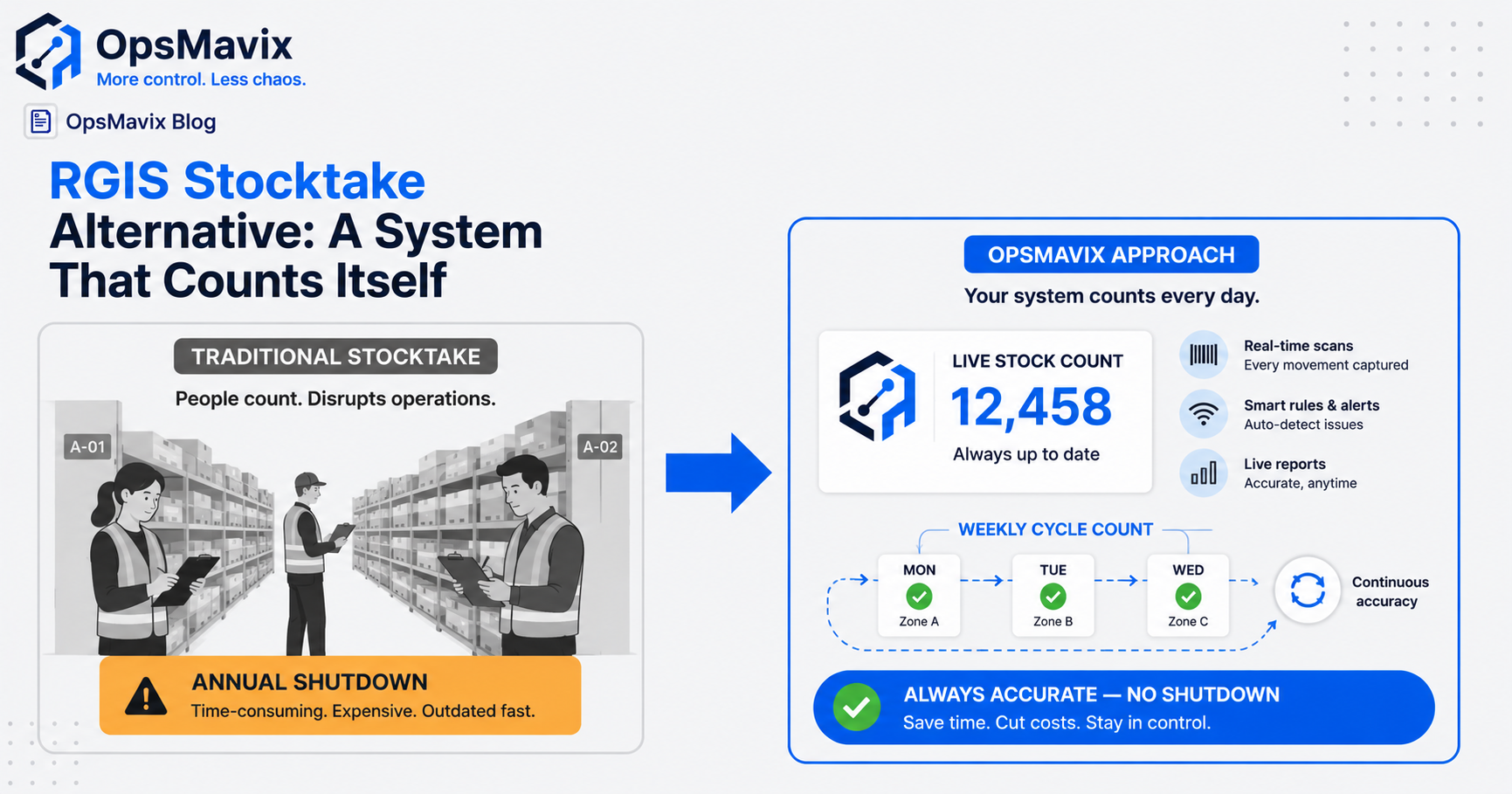
No set of controls is perfect, so prevention needs a way to catch the drift that slips through — early, while it’s cheap to fix. The wrong tool is the annual full stocktake: you shut everything down, count every SKU once a year, and discover twelve months of accumulated error in one painful weekend, by which point a small misplacement has rippled into six bins and nobody can reconstruct what happened.
Cycle counting is the prevention-grade alternative: you count a small, rotating slice of stock continuously — fast movers and high-value lines most often, slow ones less — so every SKU gets checked on a schedule without the place ever closing. A gap shows up as one wrong bin this week, traceable while the movement that caused it is still recent, not as a mountain of variance at year end. The method, including how to set count frequency by value and velocity, is in the inventory cycle count guide. It prevents rather than merely finds through speed of feedback: catch a mislabel in the week it happened and you can trace it and stop it recurring; catch it a year later and all you can do is write it off.
Control 4: Lock Down Adjustments and Access
Even with clean receiving and scan capture, there’s a back door: manual adjustments. When anyone can open the record and change a quantity to “make it match,” you don’t have a stock system — you have a suggestion. The classic pattern is a picker who finds the bin short, quietly edits the figure so the count reconciles, and buries the real problem. The number looks right and tells you nothing.
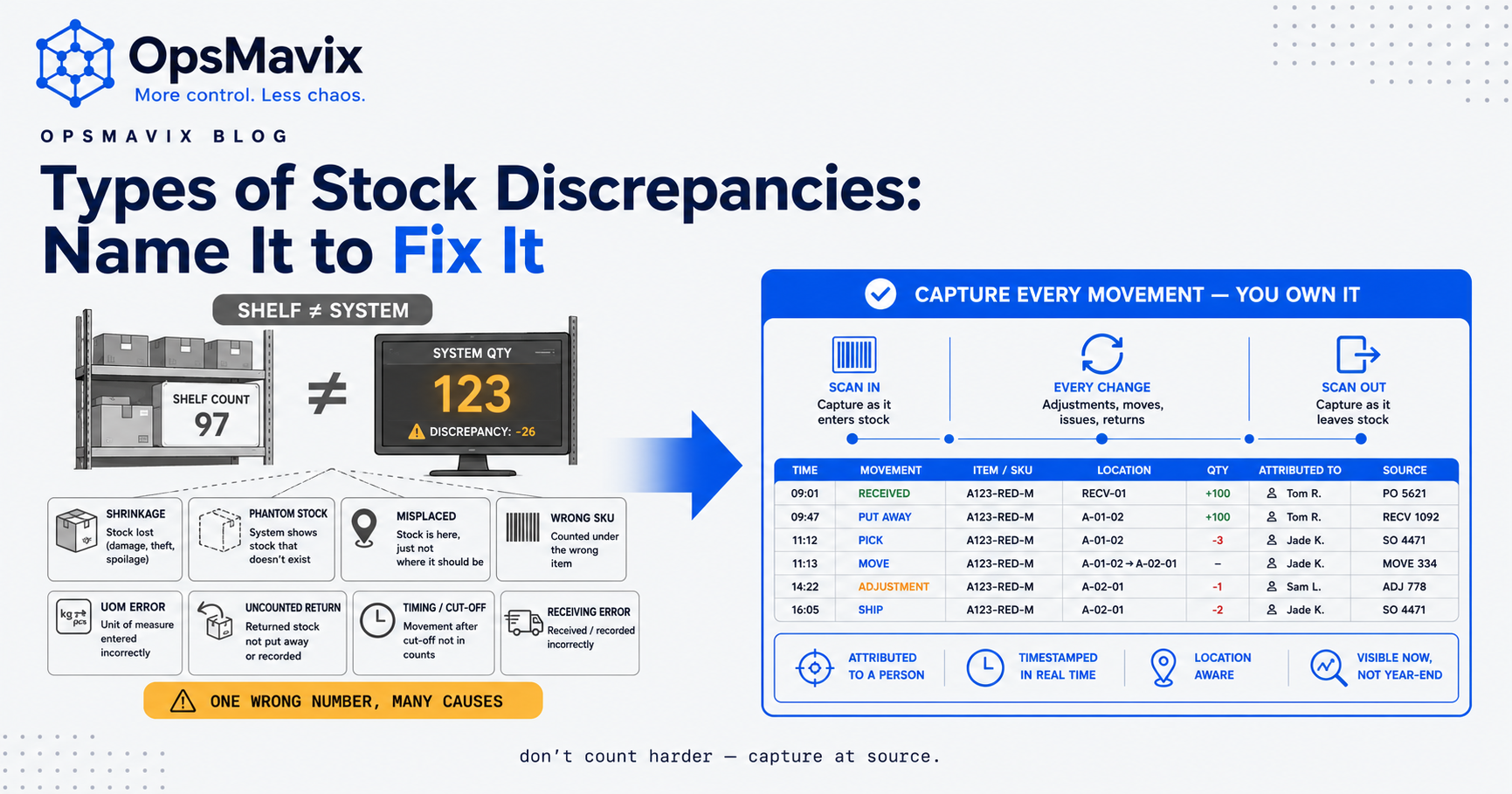
The control is to make every adjustment recorded and attributable — who changed it, when, from what to what, and why. Not to forbid corrections; genuine ones happen constantly. To ensure none are silent. An adjustment with a reason code and a name against it is data: if one SKU generates constant write-downs, that’s a pattern pointing at a receiving or picking fault upstream. Access matters alongside the trail — not everyone needs the power to change a stock figure, and high-value lines warrant tighter control. This is also what shrinks real shrinkage to something you can act on: once every legitimate movement and correction is logged, the genuinely unexplained loss is what’s left over, usually a much smaller number than the theft everyone assumed.
Control 5: A Real-Time Single Source of Truth
The four controls above all assume one thing: a single record they update, and it updates now. The moment stock lives in more than one place — a warehouse spreadsheet, a separate sales sheet, a channel that syncs overnight — you’ve built lag into the system, and lag is where discrepancies breed. A website sale at 2pm that doesn’t hit the stock figure until the nightly batch is a window in which you can oversell the same units to someone else.
A real-time single source closes that window. Every movement — a sale across any channel, a goods receipt, a transfer, a return, a write-off — updates the same on-hand figure the instant it happens. No second copy to fall out of step, no batch delay, no reconciliation between sheets because there’s only one sheet. The timing and cut-off errors that plague batch-lagged setups largely design themselves out. This is the control that ties the other four together — goods-in, scan capture, cycle counts and locked adjustments all feed one live number, and that number is what your reorder logic, dispatch and promises to customers run on.
Why a Spreadsheet Structurally Can’t Prevent This
A spreadsheet can record stock. It cannot prevent discrepancies, and the reason is structural, not a matter of discipline. It has no validation — you can type any code against any line, so mislabelling isn’t refused, it’s accepted. It has no real-time capture — a cell changes when a human remembers to change it, so the record trails reality by however long the human took. It has no enforced audit trail — anyone can overwrite any figure and leave no trace. And it has no single source when more than one person needs it — you end up with copies, versions and a nightly reconciliation that is itself a source of error. None of the five controls can be enforced in it, because a spreadsheet does exactly what you type, mistakes included.
Here’s the honest exception, because it’s real: a genuinely small, low-SKU operation with disciplined manual counts can keep discrepancies low without software. Hold a few dozen lines, have one person touch all the stock, keep movements few and slow, count carefully and often, and a spreadsheet is fine — the human is providing the validation, capture and trail. That holds right up until it doesn’t. It breaks the moment you add a second stock-touching person, a second channel, a second location, or enough SKU velocity that no one can hold the picture in their head. Past that point the discrepancies aren’t a discipline problem you can count your way out of — they’re structural, and only a tool that enforces the controls will close them.
Building the Controls In
Prevention isn’t five separate projects — it’s one connected record with the controls built into how it works: goods-in that counts received against ordered before committing, scan capture that validates SKU and quantity at the point of movement, cycle counting scheduled by value and velocity, adjustments that carry a name and a reason, all feeding one real-time number rather than a fleet of spreadsheets syncing overnight.
The reason this rarely comes off the shelf cleanly is that stock moves differently in every business. A wholesaler receiving in cases and picking in eaches needs unit-of-measure conversion enforced everywhere. A manufacturer consuming components into work orders needs those movements captured, not just finished-goods sales. A distributor selling across three channels needs all three deducting from one figure in real time. The controls are the same five; how they’re wired to your movements is what makes them hold — or leaves a gap a generic tool bolts a workaround over. That’s the practical middle ground: not a spreadsheet the controls can’t live in, and not a full ERP you configure around for six months, but a right-sized system built to the way your stock actually moves.
FAQ
What is the fastest way to prevent stock discrepancies?
Start at goods-in, because a wrong receipt poisons everything downstream and is the cheapest error to stop. Count what physically arrived against the purchase order before committing it to stock, and don’t book the docket figure on trust. Pair that with scan capture at picking so movements are validated and deducted in real time rather than typed from memory. Those two controls alone — accurate receiving and scanned movements — close the largest share of everyday discrepancies before you touch anything more advanced.
Can I prevent stock discrepancies without software?
Yes, but only within a narrow band. A very small, low-SKU operation where one disciplined person touches all the stock, movements are slow, and careful manual counts happen often can keep discrepancies low on a spreadsheet — the human is doing the validation and capture by hand. It stops holding the moment you add a second person, channel or location, or enough SKU velocity that no one can keep the picture in their head. Past that point the problem is structural, and only a tool that enforces the controls will close it.
How often should I cycle count to catch discrepancies early?
Count by value and velocity, not on a flat schedule. Fast-moving and high-value lines earn the most frequent counts — often weekly or monthly — because they carry the most risk and drift fastest; slow, low-value lines can be counted far less often. The aim is that every SKU is checked on a rotating schedule, so gaps surface as one traceable bin rather than a year of accumulated variance. The inventory cycle count guide covers how to set the frequencies.
Why does my stock keep drifting even though we count regularly?
Because counting finds discrepancies; it doesn’t prevent them. If the drift keeps returning, the doors are still open — you’re probably receiving against paperwork, capturing movements by hand, or letting adjustments happen without a trail, so the record keeps falling out of step between counts. The fix is a control at the point each discrepancy forms, so the record follows the movement automatically and there’s less for the next count to find.
How OpsMavix Can Help
OpsMavix builds custom inventory systems with the five controls enforced where your discrepancies actually form. Goods-in counts received against ordered before anything commits to stock. Movements are captured by scan, so SKUs are validated at source and quantities deduct the moment they move. Cycle counts run against live figures on a schedule set by value and velocity. Every adjustment carries a name and a reason, so corrections are data instead of silent overwrites. And all of it feeds one real-time on-hand figure — no second copy, no overnight batch. It’s the middle ground for a business outgrowing the spreadsheet and not looking for a full ERP: built to how your stock actually moves, owned by you outright.
The point of prevention is that the leak stops paying rent — no more oversells on stock you don’t have, no more expedited buys to cover a phantom shortfall, no more weekends lost to recounting. If your stock keeps drifting and counting harder hasn’t closed it, Book a Free Operations Leak Audit and we’ll map exactly which control points are open and what closing them is worth.
Keep reading
Getting value from OpsMavix? Add us as a preferred source on Google — you'll see more of our operations content in your AI Overviews, AI Mode and Search.