
Inventory Management Best Practices That Actually Move the Needle
The inventory management best practices worth doing (SKU hygiene, ABC analysis, cycle counting, reorder points) all depend on one thing: stock records you can trust. This guide is for growing UK operators who have outgrown spreadsheets and want the practices that move the needle rather than a longer to-do list.
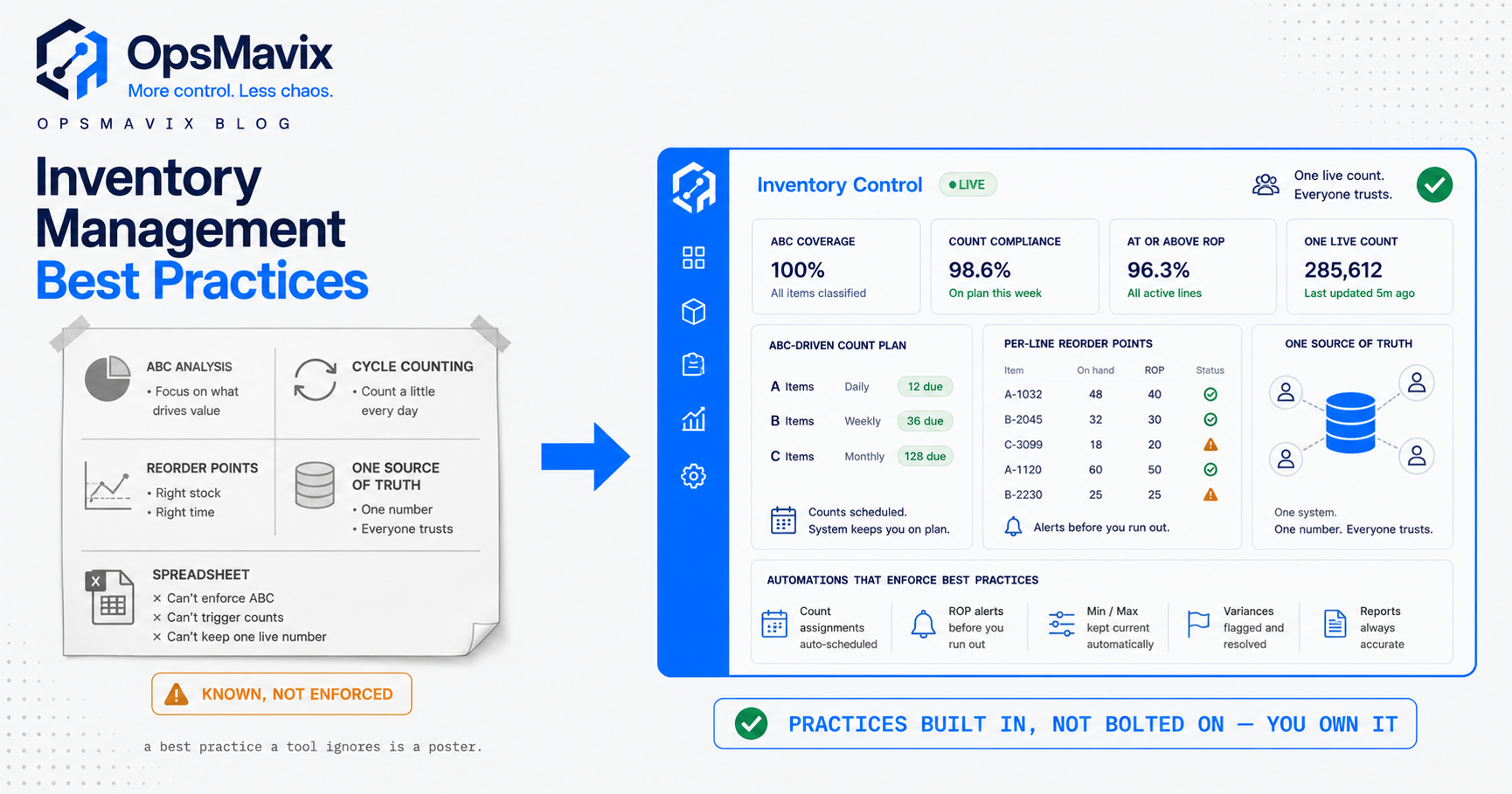
Search “inventory management best practices” and you get the same list on twenty different sites: do ABC analysis, run cycle counts, set reorder points, tidy your SKUs, keep one source of truth. All of it is correct. None of it explains why so many businesses do these things and still oversell, still overstock, still run out of their best lines at the worst moment. The practices are not wrong. They are just built on an assumption almost nobody checks: that the stock number they are working from is true.
That assumption is where most inventory effort quietly leaks away. You can classify your SKUs into perfect ABC bands, calculate reorder points to two decimal places, and schedule cycle counts on a neat rota, but if the on-hand figure feeding all of that has drifted from what is physically on the shelf, every one of those practices is optimising a fiction. This guide covers the best practices that genuinely move the needle for a growing UK business, in the order they pay off, and it is honest about the one that has to come first.
What “Best Practice” Actually Means Here
Strip away the jargon and inventory management does one job: it tells you how much of each thing you have, where it is, and how much is already promised, so you can buy, sell and plan without guessing. Best practice is simply the set of habits that keep that answer accurate and turn it into good decisions. Everything on the standard list serves one of two goals: making the count true, or acting well on a true count.
That framing matters because it sorts the practices into a sensible order. SKU hygiene and record accuracy are foundation work: they make the count mean something. Cycle counting keeps it true over time. ABC analysis tells you where to spend your limited attention. Reorder points and safety stock convert the trustworthy count into timely buying decisions. Do them out of order, or skip the foundation, and the later ones misfire in ways that look like bad luck but are really bad data.
A quick word on measurement, because you cannot manage what you do not track. Inventory record accuracy is a real number: physical count divided by recorded count, times 100. A single warehouse should be sitting between 95% and 100% on that measure, with well-run operations reaching 98% or 99%, and anything below that is the leak you fix before you touch anything else (Mecalux). If you have never calculated it, that is the first best practice: measure your accuracy, then decide what to improve. The discipline behind that number is covered in depth in our guide to the importance of stock control records.
SKU Hygiene: Clean the List Before You Manage It
SKU hygiene is the least glamorous practice and often the highest return, because it is upstream of everything else. If your product list is a mess, every technique built on top of it inherits the mess.
The common problems are dull and expensive. The same product exists under two codes because two people set it up, so its stock is split across both and neither shows the true total. Discontinued lines still sit as active SKUs, padding your reports and reorder logic with ghosts. Descriptions are inconsistent, so nobody can search reliably and pickers grab the wrong variant. Units of measure are muddled, so a case of twelve gets counted as one and the maths quietly breaks.
Cleaning this up is a one-off push with a permanent payoff:
- De-duplicate. Find every SKU that is really the same physical item and merge it, moving the stock and history onto one code.
- Retire the dead. Mark discontinued and obsolete items inactive so they stop distorting counts, reports and reorder suggestions.
- Standardise naming and units. One consistent format for descriptions, and one clear unit of measure per SKU with pack sizes defined explicitly.
- Set the rules for new SKUs. A short standard so the list does not drift back into chaos the moment someone adds a product in a hurry.
Do this before ABC analysis or reorder points, because both classify and calculate per SKU. Feed them a duplicated, ghost-ridden list and they produce confident nonsense. A clean list is the precondition for every practice that follows.
ABC Analysis: Put Attention Where the Value Is
You do not have the time to manage every SKU with equal care, and you should not try. ABC analysis is the practice of ranking your stock by value so you spend your attention where it actually matters. It is an application of the Pareto principle: roughly 80% of your value comes from about 20% of your items.
The bands are straightforward. Category A is the small group of high-value SKUs, often around 20% of your items accounting for something like 80% of value. Category C is the long tail, frequently around half your items but only a few percent of value. Category B sits in the middle (MRPeasy). The exact ratios vary by business, and the 80/20 split is a rule of thumb, not a law, so calculate it from your own numbers rather than assuming.
What you do with the bands is where the value lands. Class A items get tight control: frequent counts, careful reorder points, close supplier management, minimal buffer waste. Class C items get loose control: bigger order quantities, simpler rules, less counting effort, because the cost of managing them tightly exceeds the money at stake. This single distinction stops the classic mistake of lavishing attention on cheap fast-movers while a handful of high-value lines quietly stock out. ABC is not a filing exercise; it is a budget for where your inventory discipline goes.
Cycle Counting Instead of the Annual Shutdown
The traditional annual stocktake is a bad way to keep records accurate. You shut down operations, marshal everyone into counting for a day or two, find that the numbers are miles off, correct them all at once, and then watch accuracy decay for the next twelve months until you do it again. You learn about errors long after they happened, when the trail has gone cold.
Cycle counting replaces that with a rolling schedule: you count a small slice of stock on a regular cadence, without stopping the business, so records stay accurate all year and discrepancies surface while they are still traceable (Unleashed). Catch a short pick the same week it happened and you can find the cause. Catch it eleven months later and it is just an unexplained loss.
ABC analysis and cycle counting pair naturally. You count your high-value A items often, your B items less often, and your long-tail C items rarely, calibrating counting effort to what is at stake. A common cadence is A items monthly, B items quarterly, and C items once or twice a year, aiming to hold accuracy at 97% or higher (Unleashed). Many businesses keep a periodic full count as well for audit sign-off, but the day-to-day accuracy comes from the rolling counts, not the annual scramble. When cycle counts keep finding the same kind of error, treat that as a signal to fix the process, not just the number. Our guide on how to prevent stock discrepancies covers the root causes worth chasing.
Reorder Points and Safety Stock
Once your records are clean and accurate, reorder points turn them into timely buying. A reorder point is the stock level that should trigger a new order: hit it, and you reorder while enough stock remains to cover you until the delivery lands.
The formula is simple and worth knowing:
Reorder point = (average daily usage x average lead time in days) + safety stock
The first part is lead time demand, the quantity you will sell while you wait for the supplier. Safety stock is the buffer for the days demand spikes or the supplier runs late, often calculated as (maximum daily usage x maximum lead time) minus (average daily usage x average lead time) (Unleashed). Set the reorder point too low and you stock out; set it too high and you tie up cash in stock that just sits there.
Two cautions keep this practice honest. First, the inputs are not static. Usage rates and supplier lead times drift with seasons and with your suppliers’ own reliability, so reorder points need reviewing, not setting once and forgetting. Second, and this is the whole point of this article, the formula runs on your on-hand figure. If the count is wrong, the reorder point fires at the wrong moment regardless of how carefully you calculated it. A good reorder point on a bad count is worse than useless, because it gives you false confidence. This connects directly to how fast your stock actually moves, which is why the inventory turnover ratio is worth tracking alongside your reorder logic.
The Blind Spot: Every Practice Runs on the Same Data
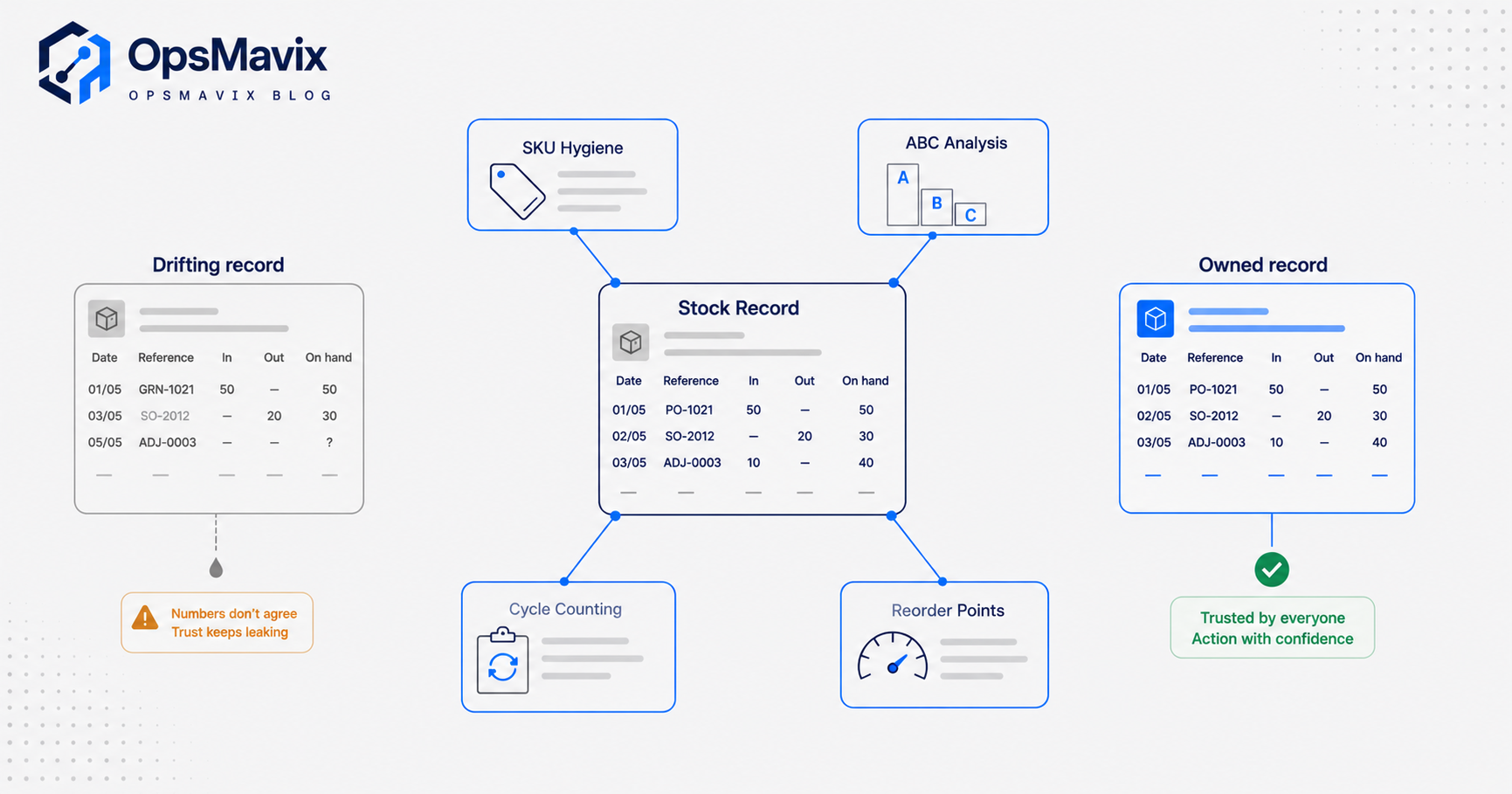
Here is the pattern that catches out businesses who do everything on the list and still struggle. Each best practice is usually taught in isolation, so it is easy to miss that they all draw from the same well: your stock record. ABC bands, cycle-count triggers, reorder points, available-to-promise figures for sales, they are all just different questions asked of one underlying count. Poison the well and every answer is off, in ways that are hard to trace back to the source.
The damage is well documented. Inventory record accuracy directly drives stockouts, excess stock and service performance, and ignoring discrepancies rather than correcting them can drive costs up by around 95% according to research from the University of Twente (Mecalux). The mechanism is not exotic. When the recorded number is higher than reality, you promise stock you do not have and disappoint customers. When it is lower than reality, you buy stock you already own and trap cash. Neither shows up as “record accuracy problem” on a report. They show up as short shipments, angry customers, dead stock and a cash-flow squeeze, so the fix gets aimed at symptoms instead of the cause.
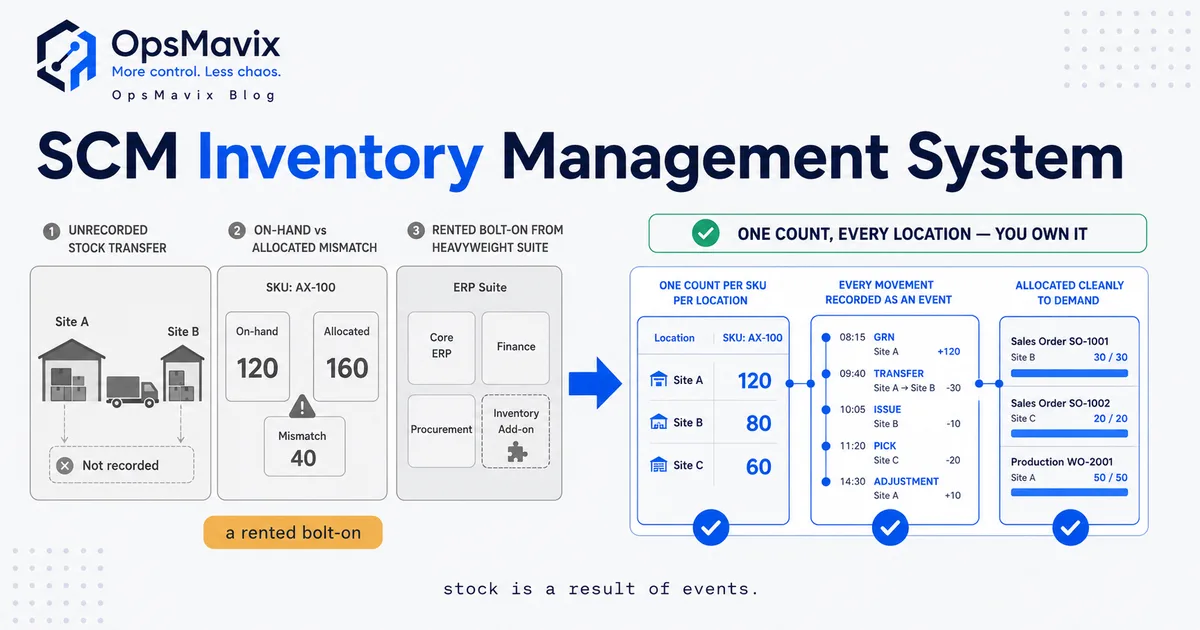
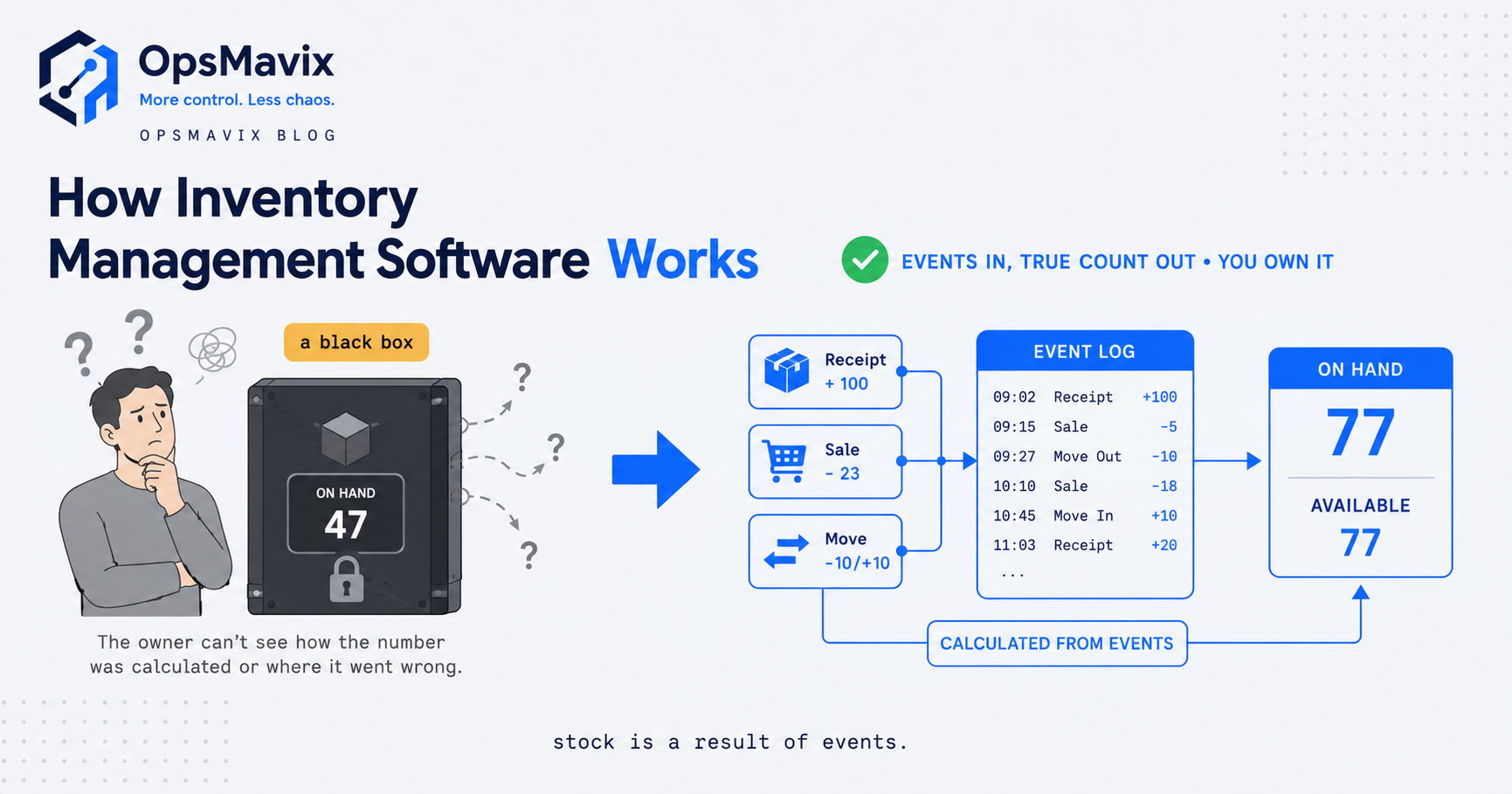
This is why “keep one source of truth” is the practice that makes the others possible rather than just another line item. It means one place where the count lives, updated by every real movement (goods in, picks, transfers, returns, adjustments) as it happens, so sales, purchasing and finance all read the same number instead of each keeping a private version in a spreadsheet. Where the count is a single figure people edit by hand, or synced overnight in a batch that flattens a day of activity into one guess, drift is not a risk, it is guaranteed. Making each movement update the record automatically is the core idea behind an inventory automation system, and it is what turns the rest of the best-practice list from theory into something that actually holds.
Choosing a System That Holds Your Records
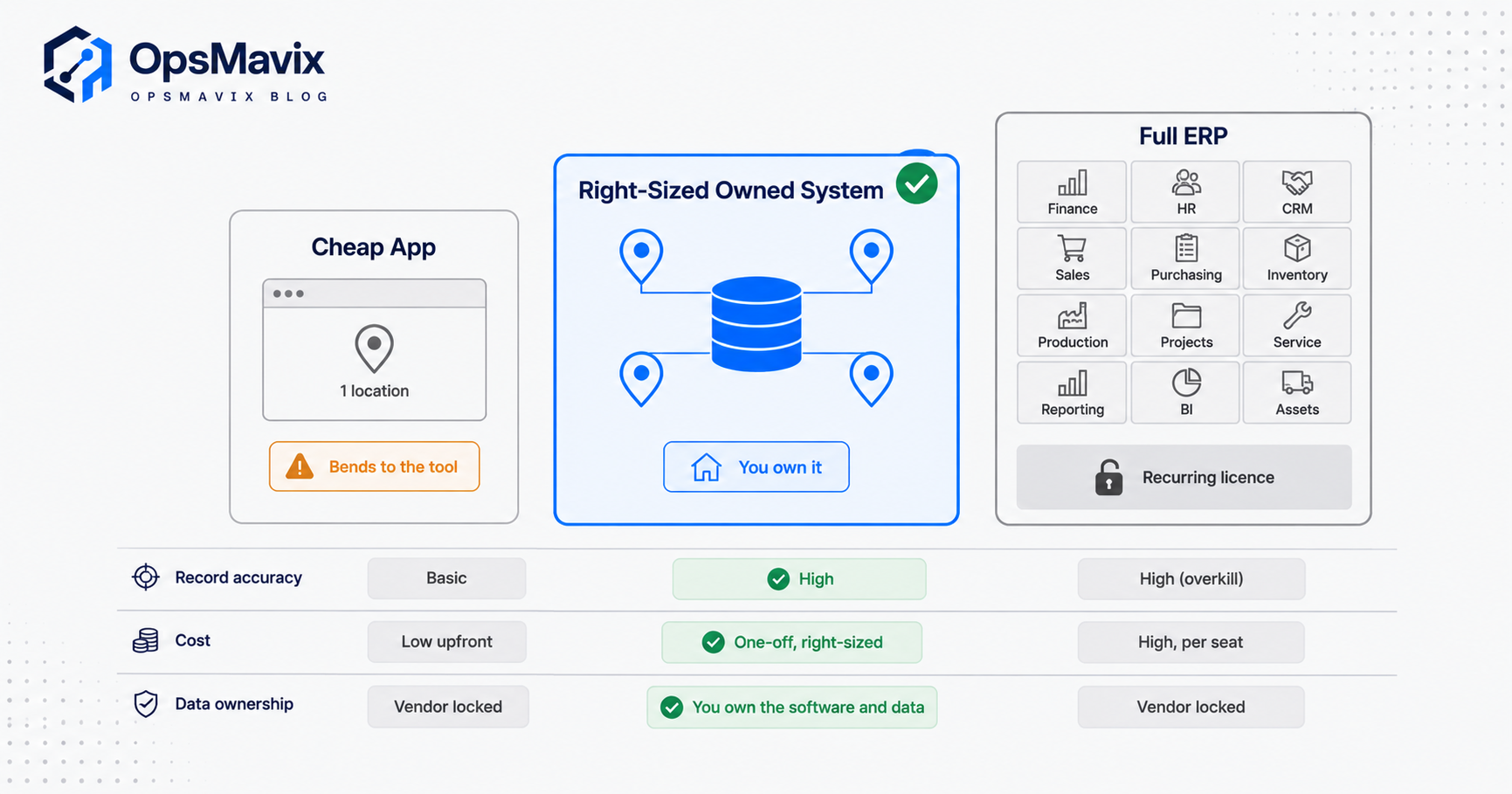
Best practices need somewhere to live, and the tool you pick decides how well they hold. There are three honest options, and the right one depends on where your business actually is, not on which vendor shouts loudest.
| Consideration | Cheap off-the-shelf tool | Full ERP suite | Right-sized owned system |
|---|---|---|---|
| Best when | One site, simple range, low volume | Genuine enterprise: many sites, deep finance and procurement needs | Growing business outgrowing the app, nowhere near enterprise scale |
| Record accuracy | Fine at small scale, weak multi-location logic | Strong event-based core, but generic and heavy | Event-based, modelled to your exact locations and flows |
| ABC and reorder logic | Basic or bolt-on, often manual | Full-featured but rigid, configured their way | Shaped to how you actually band and reorder |
| Cost model | Low monthly fee | High licence plus per-seat, forever, much unused | Build cost, then you own it, no rented core |
| Fit | You bend your process to the tool | You bend your business to the suite | The system fits how you already run |
| Implementation | Days | Months, consultant-led, migration-heavy | Scoped to the leak you actually have |
| Data ownership | Lives in their platform | Lives in their platform | Your database, queryable however you like |
Be fair to all three. The cheap tool is genuinely the right call if you run one site with a steady range, and overspending to solve a problem you do not have is its own mistake. A full ERP earns its keep at real enterprise scale, where you need inventory welded to finance, procurement and warehouse management across many sites and will use most of what you pay for. The trap is the middle, where most growing UK businesses live: past the app, which cannot hold your locations or your rules, but nowhere near needing to rent a twelve-module platform forever and bend your whole operation to it.
Why ownership matters for records specifically. Your stock count is the most integrated piece of data you have, touched by sales, purchasing, the warehouse and finance. When it lives in a rented platform, integrating your other tools means paying for their connectors, working within their limits, and accepting that your most important number is queryable only the way they allow. When you own the system, the records sit in your database, your movements update them by your rules, and connecting your accounting package, your shop or your suppliers is your decision, not a line on a licence renewal. Owning the records is what lets the practices in this guide fit your business instead of forcing your business to fit the tool.
A Worked Example: The Growing Wholesaler
These figures are illustrative, not a claim about a specific client, but the shape is one operators recognise instantly.
A UK wholesaler carries about 1,400 SKUs across a main warehouse and a small trade counter. They already “do best practice”: there is an ABC classification in a spreadsheet, reorder points set in their accounting package, and an annual stocktake every January. On paper, the list is ticked. In practice, three leaks run all year.
- The count they band and reorder from is soft. Goods-in and transfers get keyed in when the office catches up, so the on-hand figure drifts on roughly 50 SKUs at any time. Their ABC bands and reorder points are calculated from that drifting number, so class A lines still stock out and slow lines still get over-bought. Conservatively, £3,500 in cash sits in overstock that will not turn this season, while three bestsellers run dry mid-quarter.
- Overselling from on-hand. Sales quotes against the recorded figure with no split for stock already promised, so fast movers get sold to two customers at once. Across a quarter that is around 10 short-shipped orders, each needing a chase, a part-delivery or a goodwill discount. Call it £1,600 in emergency carriage, discounts and admin.
- The annual-stocktake blind spot. Errors introduced in February are not found until the following January, so nobody can trace them. The write-off just lands as an unexplained shrinkage line, and the same errors recur the next year.
Add the visible pieces and a single quarter clears £1,600 to £3,000 in avoidable loss, before the £3,500 trapped in the wrong stock. The practices are all present. They are just running on a count nobody keeps true.
The fix is not more practices. It is fixing the foundation the existing practices already depend on: one accurate record per SKU per location, every movement updating it as it happens, an on-hand-versus-promised split so nothing gets sold twice, cycle counts replacing the annual scramble so errors surface in days not months, and the ABC bands and reorder points recalculated from a count that is finally true. Same techniques, honest data, and they start paying off.
FAQ
What is the single most important inventory management best practice?
Keeping one accurate stock record that every part of the business reads from. It is not the most exciting item on the list, but ABC analysis, cycle counting and reorder points all draw from the count, so if the count is wrong they all misfire. Measure your inventory record accuracy first (physical count divided by recorded count), get it into the high 90s, and only then invest heavily in the practices built on top of it. Accurate records are the multiplier that makes every other technique worth doing.
How often should we do cycle counts?
Calibrate the frequency to value, using your ABC bands. A common cadence is high-value A items counted monthly, mid-value B items quarterly, and long-tail C items once or twice a year, aiming to keep accuracy at 97% or higher. The point is to count little and often instead of everything once, so errors surface while they are still traceable and the business never has to shut down for a full stocktake. Many operations keep a periodic full count for audit sign-off as well, but the day-to-day accuracy comes from the rolling counts.
Do we need to fix our SKUs before doing ABC analysis?
Yes. ABC analysis ranks each SKU by value, and reorder points calculate per SKU, so both inherit whatever mess is in your product list. Duplicated codes split one item’s value across two lines, ghost SKUs pad your reports with dead stock, and inconsistent units break the maths. Clean the list first (de-duplicate, retire discontinued items, standardise naming and units) and the analysis built on it is trustworthy. Skip that step and you get confident classifications of a list that does not reflect reality.
Can we do all this in a spreadsheet?
For a while, yes, and there is no shame in starting there. Spreadsheets fail at the point where multiple people update stock at once and edits silently overwrite each other, where the count is a single number nobody can audit, and where reorder logic ends up in macros only one person understands. That is usually the moment a growing business has outgrown the spreadsheet for good. The right next step is a system that records every movement as an event and keeps one accurate count, not a bigger, more fragile spreadsheet.
How do we know if our stock records are accurate enough?
Measure it. Pick a sample of SKUs, physically count them, and compare to the recorded figure: physical divided by recorded, times 100. A single warehouse should sit between 95% and 100%, with well-run operations at 98% or 99%. If you are below that, your accuracy is the leak, and fixing it will do more for your numbers than any amount of extra reorder-point tuning. If you have never measured it, that measurement is itself the first best practice worth doing.
How OpsMavix Can Help
OpsMavix builds right-sized, owned operations systems for growing UK businesses whose inventory best practices keep misfiring because the count underneath them has drifted. Instead of selling you a cheap app that cannot hold your locations, or a full ERP where inventory is one rented module of twelve, we map how your stock actually moves, find where soft records are quietly wrecking your ABC bands, reorder points and available-to-promise figures, and build the specific system that gives you one accurate record per SKU per location, every movement recorded as it happens, and cycle-count and reorder logic that finally runs on true data. It is the practical layer between a spreadsheet that has run out of road and a suite that is overkill, and it expands as you grow. If your best practices are running on numbers nobody trusts, start by seeing exactly where the records leak: Book a Free Operations Leak Audit
Sources
- MRPeasy: ABC Analysis (80/20 Rule) in Inventory Management - the ABC bands, with Category A around 20% of items at roughly 80% of value and Category C around 50% of items at a few percent of value.
- Unleashed: Guide to Cycle Counting - cycle counting versus full stocktakes, the A-monthly / B-quarterly / C-yearly cadence, and the 97%-plus accuracy target.
- Unleashed: The Reorder Point Formula - the reorder point formula and the safety stock calculation used in this guide.
- Mecalux: Inventory Record Accuracy - the 95% to 100% target accuracy range and the finding that ignoring discrepancies can drive costs up by around 95%.
Keep reading
Getting value from OpsMavix? Add us as a preferred source on Google — you'll see more of our operations content in your AI Overviews, AI Mode and Search.