
Warehouse Slotting: Do You Actually Need Slotting Optimisation?
Warehouse slotting is the practice of deciding where each SKU lives so pickers walk less, work stays balanced, and fast movers sit within easy reach. This post explains the principles behind it, how enterprise WMS vendors sell slotting as an AI optimisation engine, and the honest line for a growing warehouse: most of the benefit comes from a deliberate location layout keyed to real pick frequency — no dedicated slotting module required.
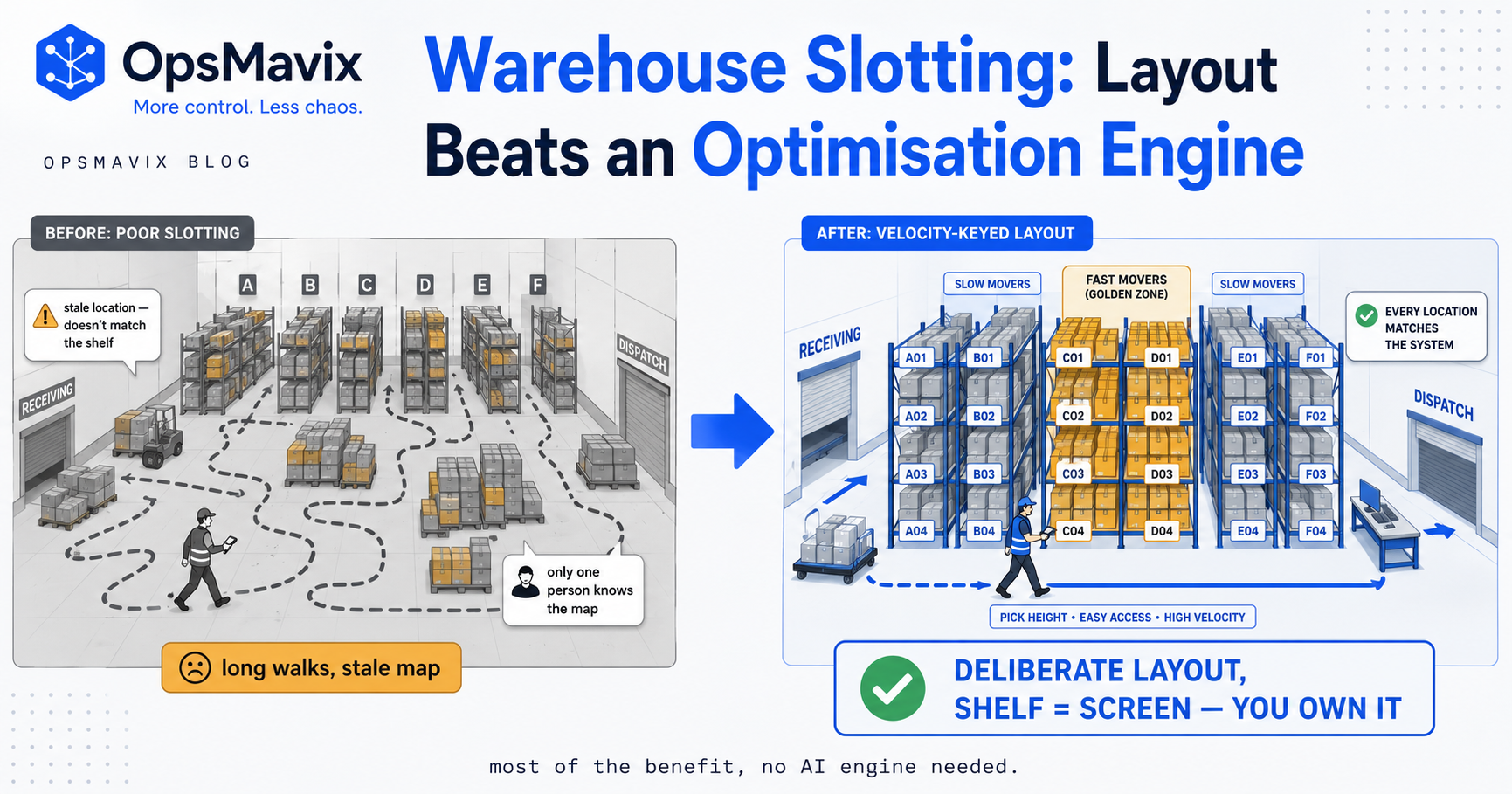
Warehouse slotting is the practice of deciding where each SKU physically lives so pickers walk less, the fastest-moving products sit within easy reach, and the workload spreads evenly across the building instead of piling up in one aisle. It’s not about labelling shelves or counting stock — it’s the placement decision underneath both: which item goes in which location, and why. Get it right and a picker fills an order in a short, logical loop. Get it wrong and the same order becomes a route march to the far corner and back for a single line.
This post is about warehouse slotting and whether you actually need slotting optimisation — the dedicated, algorithm-driven module enterprise WMS vendors sell as a headline feature. We’ll define the principles plainly, show how the big systems package it as an AI engine, and give the honest OpsMavix line: a growing warehouse gets most of the benefit from a deliberate location layout keyed to real pick frequency, inside a system that keeps the shelf and the screen in sync. We’ll also be straight about the point where you genuinely have outgrown slotting by hand and the algorithm starts to earn its keep.
Key Takeaways
- Warehouse slotting is deciding where each SKU lives to shorten pick paths and balance workload — the placement decision, distinct from labelling bins or picking method.
- The core principles are simple: put fast movers in the golden zone, group by velocity (ABC), respect cube and weight, and lay locations out so the common pick path is short.
- Slotting optimisation is the enterprise WMS version — an algorithm that re-slots continuously against demand, seasonality and travel cost. It’s real, and for very large operations it pays.
- For a growing warehouse, the large majority of the benefit comes from a deliberate, velocity-keyed layout you set once and revisit — not from a continuous optimisation engine.
- The failure mode isn’t a missing algorithm; it’s a location map that lives in someone’s head while the system either doesn’t track locations or shows locations that no longer match the shelf.
- You’ve outgrown manual slotting when SKU count, order volume, seasonality and churn make the by-hand layout stale faster than a person can maintain it — that’s when the engine earns its licence.
What Warehouse Slotting Actually Is
Strip away the jargon and slotting answers one question for every product you hold: where should this live? The answer isn’t arbitrary. A good slot puts the item where the total cost of handling it — walking to it, reaching it, picking it, replenishing it — is as low as it can be across all the orders that touch it. A bad slot is one chosen by accident: wherever there was space the day the stock arrived.
That distinction matters because slotting is easy to confuse with its neighbours. It isn’t the warehouse labelling system — labels tell a picker which bin they’re at; slotting decides what should be in that bin. It isn’t the picking method — single-order, batch, zone or wave picking is how you route the work; slotting is where the work sits before you route it. And it isn’t inventory accuracy: you can know your stock figure to the unit and still have every fast mover buried at the back. Slotting is the placement layer, and it quietly sets the ceiling on how efficient every pick above it can be.
The Principles: Velocity, the Golden Zone, Cube and Path
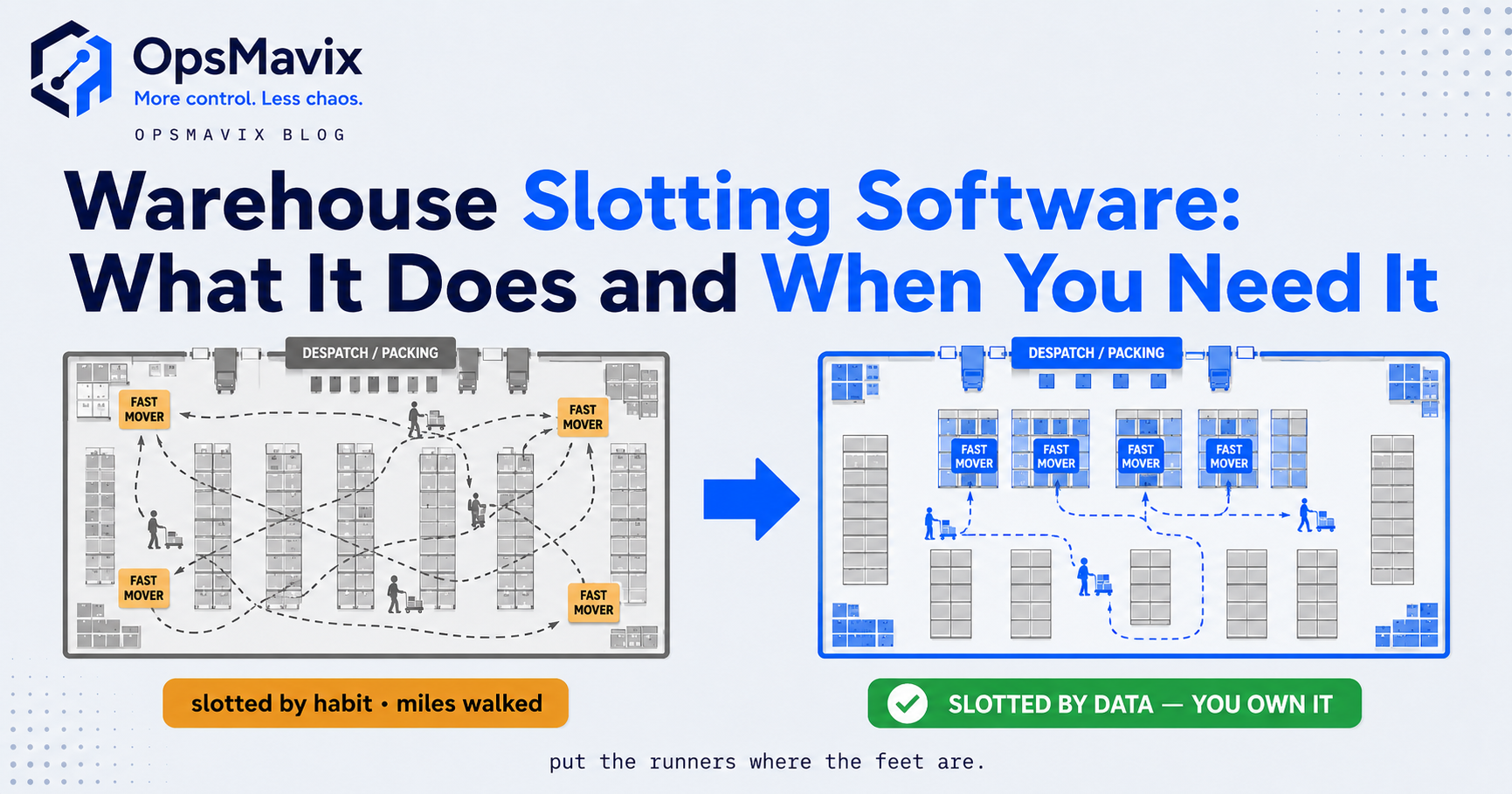
Almost all of slotting comes down to four ideas, and none of them needs a PhD. The first is velocity-based placement: rank your SKUs by how often they’re picked and put the busiest ones closest to dispatch and easiest to reach. This is where ABC analysis does the heavy lifting — your A items (the small share of SKUs driving most of the picks) belong in prime locations, your C items (the long tail picked rarely) can sit at the far end or up high. Slotting without a velocity ranking is guessing; ABC gives you the ranking for free.
The second is the golden zone — the band between roughly knee and shoulder height where a picker grabs an item without bending or stretching. Reaching high or crouching low costs seconds and stresses backs, so that band is prime real estate reserved for your fastest movers. The third is cube and weight: a bulky or heavy item wants a location that fits it and keeps the pick safe and low, and heavy things belong early in the pick sequence so nothing fragile gets crushed on top. The fourth is pick-path logic: locations laid out so the picker’s route through the building is a tight loop, not a zig-zag — items frequently ordered together placed near each other so the walk between them is short.
That’s the whole discipline. A warehouse that applies it deliberately — fast movers in the golden zone near dispatch, slow movers pushed back and up, heavy low, related items together, path kept tight — captures the large majority of what slotting has to offer. None of it requires an algorithm. It requires a decision and a place to record it.
How Enterprise WMS Sells Slotting Optimisation
Now the version the big vendors put on the slide. In an enterprise WMS, slotting becomes slotting optimisation — a dedicated module that treats placement as a continuous mathematical problem. It ingests every order line, weights each SKU by pick frequency, order affinity, seasonality, size, weight and replenishment cost, and computes the arrangement that minimises total travel across the whole building. Then it re-runs, because demand moves: what was an A item in November may be a C item in February, and the engine issues re-slotting moves to keep the layout matched to the demand it’s actually seeing.
Vendors like Manhattan and the other tier-one WMS suites market this as an AI-driven optimisation engine, and the framing is largely fair — at genuine scale, continuous re-slotting is a real edge. When you’re running hundreds of thousands of picks a day across a building measured in football pitches, a two-second saving per pick is a headcount line, and no human can hold that optimisation in their head or keep it current by hand.
The catch is what comes attached to the maths. Slotting optimisation doesn’t arrive on its own — it’s bundled inside a full enterprise WMS with the licence cost, the implementation project, the per-seat pricing and the vendor dependency that go with buying the whole warehouse management suite. You don’t buy the slotting engine; you buy the platform it lives in. For a warehouse that isn’t running at that volume, you’re paying enterprise price for an optimisation that solves a problem you don’t have yet.
The Honest Line: What a Growing Warehouse Actually Needs
Here’s the OpsMavix position, and it’s not the one the WMS demo gives you. A growing warehouse — thousands of SKUs, not hundreds of thousands; a handful of pickers, not a shift of a hundred — gets the large majority of its benefit from something far simpler than an optimisation engine: a deliberate location layout keyed to real pick frequency, held inside a system that keeps the shelf and the screen in sync.
That means three things working together. First, rank your SKUs by actual pick frequency — real counts from your order history, not gut feel — and place them by velocity: A items in the golden zone near dispatch, C items in the cheap seats. Second, record every location in the system, so the placement decision isn’t trapped in the memory of your longest-serving picker but written down where any new hire can follow it. Third — the part the standalone slotting module can’t give you — the system’s location data stays true to the physical shelf, because the same system that tells a picker where to go is the one that gets updated when stock moves. A slot is only useful if the screen and the shelf agree.
That last point is where most growing warehouses actually bleed, and it has nothing to do with algorithms. The layout might be fine. The problem is the map: locations in one person’s head, a spreadsheet that drifted out of date, or a WMS whose slotting says bin A-12 while the item’s been in D-04 since the summer reshuffle. You don’t fix that with an optimisation engine — you fix it by moving the location layer into an inventory system that keeps stock and location honest, so the deliberate layout you set actually gets followed and stays followed.
When You Have Genuinely Outgrown Manual Slotting
Being honest cuts both ways, so here’s when the algorithm is right. A deliberate layout you set and revisit works while it stays roughly stable between reviews. The moment it goes stale faster than a person can maintain it, you’ve crossed into territory where continuous optimisation stops being overkill and starts being the answer.
The signals are concrete. SKU count in the high tens of thousands, where no one holds the velocity ranking in their head. Order volume high enough that seconds saved per pick is a real labour number, not a rounding error. Sharp seasonality or churn, where the A/B/C mix reshuffles every few weeks and a quarterly re-slot by hand always chases last month’s demand. Shifting order affinity — the products that ship together this season aren’t last season’s — so “keep related items close” needs constant recomputing. Multiple pick faces, zones or a mezzanine, where the travel-cost maths across the building exceeds what a person can reason about. When several are true at once, the by-hand layout is stale before the ink dries, and an engine that re-slots against live demand pays for itself.
The point isn’t that optimisation is bad — it’s a tool with a scale where it fits. Below that scale, a deliberate velocity-keyed layout in a system that keeps locations honest beats it on cost every time, because you’re not paying for an engine to solve a problem your volume hasn’t created. Above it, the engine earns its licence and the manual layout can’t keep up. Most growing warehouses are well below that line, buying up out of fear rather than need.
Right-Sizing the Slotting Decision
Put the two ends together and the choice gets clear. You don’t want a busy, growing warehouse run on a slotting map in one picker’s head and a system that shows locations the stock has already left — that wastes steps on every order and breeds mis-picks the moment your best person is off. But you equally don’t want to buy a tier-one WMS with a continuous slotting engine to solve a placement problem a deliberate, velocity-keyed layout would handle at a fraction of the cost.
That middle — too big for a location map in someone’s head, not big enough for an enterprise optimisation engine — is where OpsMavix builds: a right-sized custom system that holds your locations as real data, ranks SKUs by actual pick frequency so the golden zone goes to the items that earn it, and keeps the shelf and the screen in agreement so the layout you set is the one that gets picked — the deliberate slotting benefit without the suite, the seat licences or the vendor lock-in. When your volume genuinely crosses into engine territory, you’ll know from the numbers, not a sales deck.
If pickers walking too far, stale locations, or a slotting map nobody but one person can read is costing you, a Free Operations Leak Audit will map exactly where — and tell you honestly whether the fix is a deliberate layout inside a system that matches your shelf, or the point where a real optimisation engine has finally earned its place.
FAQ
What is warehouse slotting?
Warehouse slotting is the practice of deciding where each SKU physically lives so pickers walk the shortest sensible path, the fastest movers sit within easy reach, and the workload spreads evenly across the building. It’s the placement decision — which item goes in which location and why — as distinct from labelling bins (which tells a picker where they are) or the picking method (how the work is routed). Good slotting lowers the total cost of handling every item across all the orders that touch it.
What is slotting optimisation?
Slotting optimisation is the enterprise-WMS version of slotting, where a dedicated module treats placement as a continuous mathematical problem. It weights each SKU by pick frequency, order affinity, seasonality, size and weight, computes the arrangement that minimises total travel across the whole warehouse, and re-runs as demand shifts. It’s genuinely valuable at very large scale, but it arrives bundled inside a full WMS with the licence cost, implementation and vendor dependency that come with it.
How do you slot a warehouse?
Rank your SKUs by actual pick frequency from your order history (ABC analysis does this for you), then place them by velocity: A items in the golden zone — knee to shoulder height, near dispatch — and C items pushed back and up high. Keep heavy and bulky items low and early in the pick sequence, put frequently co-ordered items near each other, and lay locations out so the common pick path is a tight loop, not a zig-zag. Finally, record every location in a system that stays in sync with the physical shelf, so the layout you set is the one that gets picked.
Do I need a dedicated slotting optimisation module?
Usually not, if you’re a growing warehouse rather than a giant one. Most of the benefit comes from a deliberate, velocity-keyed layout you set once and revisit, held in a system that keeps locations honest. A dedicated engine earns its cost only when SKU count runs to the tens of thousands, seconds-per-pick is a real labour number, seasonality reshuffles your A/B/C mix constantly, or you’re running multiple pick faces and zones. Below that scale, it solves a problem your volume hasn’t created yet.
How OpsMavix Can Help
OpsMavix builds right-sized operational systems for warehouses stuck between a slotting map in one person’s head and a tier-one WMS they don’t need. Instead of selling you a suite for a placement problem a deliberate layout would solve, we build a system that holds your locations as real data, ranks SKUs by actual pick frequency so the golden zone goes to the items that earn it, and keeps the shelf and the screen in agreement so the layout you set is the one your pickers follow. You own it outright — no per-seat licence, nothing a vendor can switch off — whether that’s inventory that stops drifting from the shelf or the location layer underneath a faster picking operation.
If walking too far, stale locations, or a slotting map only one person can read is costing you, start by seeing the leak. Book a Free Operations Leak Audit and we’ll map where your slotting costs you today — in extra steps per pick, mis-picks from locations that no longer match the shelf, and the key-person risk in a layout nobody else can maintain — and whether a deliberate layout or a genuine optimisation engine is the honest fit for how you run now.
Keep reading
Getting value from OpsMavix? Add us as a preferred source on Google — you'll see more of our operations content in your AI Overviews, AI Mode and Search.