
Warehouse Picking Solution: Cut Mis-Picks and Speed Fulfilment
A warehouse picking solution is the workflow that gets the right item into the right box, fast — not another stock report. Here's how single, batch, zone and wave picking actually differ, why scanners kill mis-picks, and when off-the-shelf software fights your floor versus a system built around the warehouse you already run.
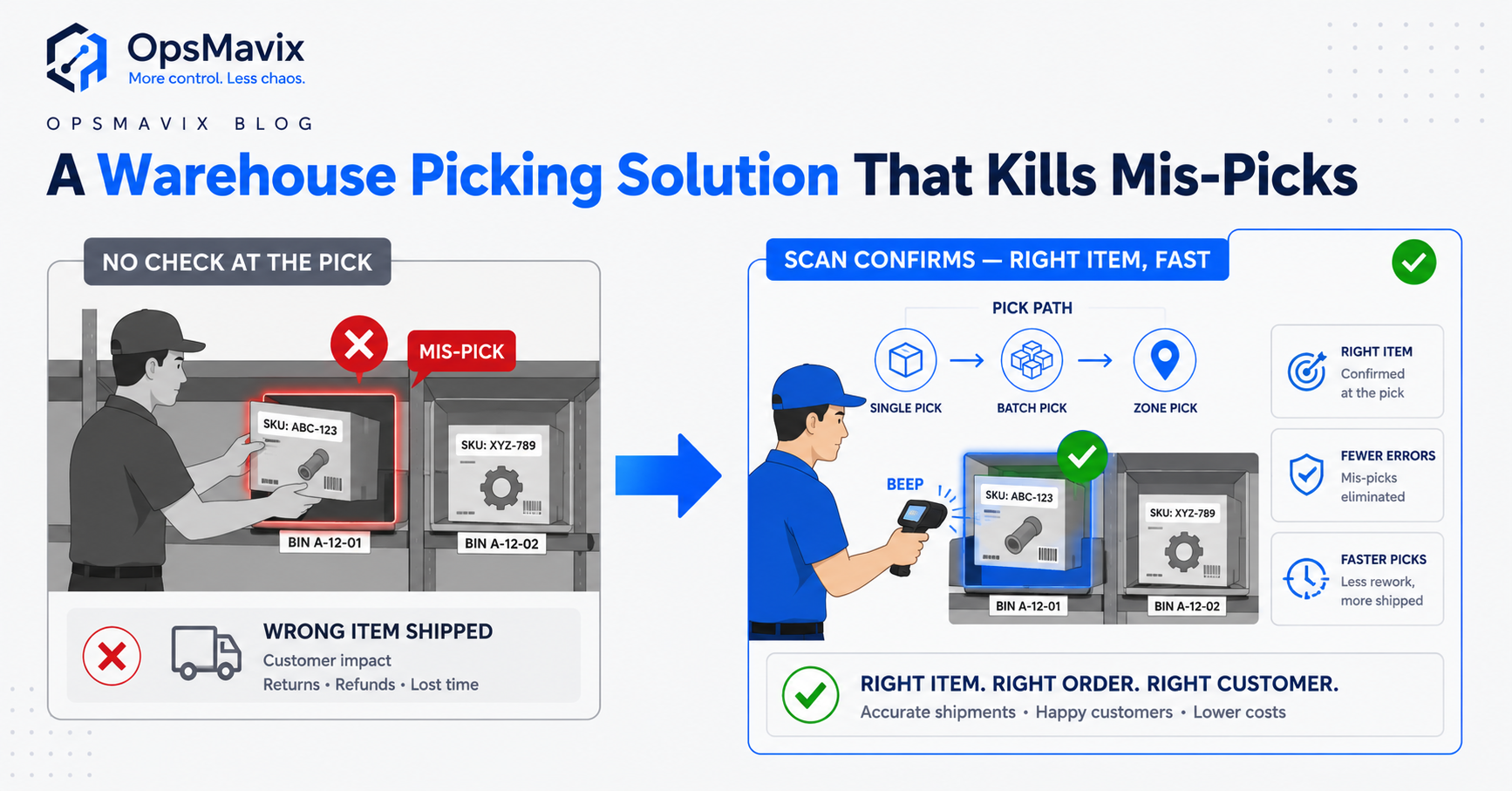
A warehouse picking solution is the part of your operation that turns an order into the right items, in the right quantities, in the right box — fast and without errors. It’s not a stock dashboard and it’s not a label printer; it’s the pick path, the method (single, batch, zone or wave), and the scanner in the picker’s hand that confirms every line before it leaves the shelf. Get it right and mis-picks drop, fulfilment speeds up, and you stop refunding customers for boxes that held the wrong thing. Get it wrong — or run it on paper and memory — and every busy day quietly leaks money in returns, re-picks and angry calls.
This post covers the picking methods and when each fits, how scanners and barcodes cut mis-picks, and the real choice: off-the-shelf picking software versus a solution built around your actual warehouse. The accuracy-of-the-count layer (does the number even match the shelf) lives in barcode inventory system; the bin and location labelling that picking depends on sits in warehouse label system. This is the workflow that sits on top of both.
Key Takeaways
- A picking solution is a workflow, not a report — the method, the pick path, and the scanner that confirms each line, not just a screen showing stock.
- Mis-picks are the expensive failure: a wrong item shipped costs the pick, the return shipping, the re-pick, the re-ship and often the customer. Picking scanners catch the error before it leaves the building.
- The method has to match your order profile. Single-order picking suits low volume; batch, zone and wave only pay off at the volume and SKU spread that justify them.
- Off-the-shelf picking apps assume a generic warehouse. If your layout, your multichannel orders or your packing rules don’t fit, the floor routes around the software.
- A right-sized built-for-you solution is shaped to your real pick paths and order mix, runs on cheap scanners or phones, and is owned by you — no per-seat fee on every picker.
1What a “Warehouse Picking Solution” Actually Is
The phrase gets used loosely, so pin it down. A warehouse picking solution is the system and workflow that takes a confirmed order and walks a picker through getting it off the shelves correctly and quickly: which orders to pick, in what sequence, along what route, with a scan confirming each item. Stock accuracy and bin labelling feed into it, but they aren’t it. You can have a perfect stock count and perfectly labelled bins and still ship the wrong item because the picking step itself is “grab the sheet, walk the aisle, hope.”
That “hope” is where the cost hides. Picking is the single most labour-intensive activity in most warehouses and the one where a small error rate does the most damage downstream. One operator’s whole problem was visibility at exactly this layer: “Can’t see what’s on my warehouse like an excel sheet.” A picking solution is what turns “I think it’s in aisle 4” into a route and a scan that’s right every time.
2Mis-Picks: the Quiet, Expensive Failure
A mis-pick — wrong item, wrong quantity, wrong variant — is the most expensive mistake a warehouse makes per occurrence, because one error multiplies. You pay to pick it, pack it and ship it. The customer returns it, so you pay return shipping. You re-pick, re-pack and re-ship the correct one. Someone fields the complaint. And a share of those customers don’t reorder. A handful of mis-picks a day on busy weeks is a steady, invisible drain that never shows up as a line item called “mis-picks.”
It also corrupts the very stock numbers you worked to fix. Ship the wrong SKU and now two counts are wrong — the one you under-shipped and the one you over-shipped — which is how a warehouse ends up where one operator did: “our spreadsheet counts wind up being off, sometimes wildly so.” Picking errors aren’t just a fulfilment problem; they’re an accuracy problem that re-pollutes the count you’re trying to trust.
3Picking Scanners and Barcodes: Catch the Error Before It Ships
The cheapest place to catch a wrong item is on the shelf, before it’s in the box. That’s the entire job of picking scanners: the picker scans the bin and the item barcode, and the system confirms it’s the right line of the right order — or stops them. The error gets caught the instant it happens, not three days later when the customer opens the box. You don’t need a fortune in hardware either; modern picking runs perfectly well on a cheap Bluetooth scanner or even a phone camera, which keeps the per-picker cost low.
This is the operational complement to the accuracy work, not a duplicate of it. A barcode inventory system makes the count trustworthy; picking scanners make the dispatch trustworthy — they verify the right thing physically left the building. Scan-to-confirm also kills the “looks close enough” mis-pick on similar SKUs (same product, different size or colour) that paper sheets miss every time. The contrarian point: most warehouses chasing accuracy buy more counting and more software when the bigger error source is the unconfirmed pick. Fix the pick and the count stops getting re-broken.
4The Picking Methods, and When Each One Fits
There’s no “best” picking method — there’s the one that fits your order volume and SKU spread. Pick the wrong method and you add motion instead of removing it. Here’s the honest version of each.
Single-order (discrete) picking — one picker, one order, start to finish. Simplest, hardest to mess up, easy to train. It’s the right call at low order volume, for large or fragile orders, or where each order is genuinely different. It stops paying off when volume rises and pickers walk the same aisles over and over for separate orders.
Batch picking — one picker grabs the same SKU for several orders in one pass, then orders are split at packing. Slashes walking when many orders share items. Pays off with high order volume and overlapping SKUs (typical eCommerce); needs a sort step and a system to keep the split straight, which is exactly where paper falls apart.
Zone picking — each picker owns a zone; an order is picked across zones and consolidated. Suits large warehouses with lots of SKUs spread out, where one picker walking the whole floor is the bottleneck. Adds a consolidation/hand-off step that has to be tightly tracked.
Wave picking — orders are released in timed “waves” aligned to dispatch (carrier cut-offs, production runs). Best for high volume with hard shipping deadlines. It’s the most coordination-heavy and the one most dependent on a system telling the floor what to release when — effectively impossible to run well on a clipboard.
| Method | How it works | Best for | Watch out for |
|---|---|---|---|
| Single-order | One picker, one full order | Low volume, large/fragile/bespoke orders | Wasted walking as volume grows |
| Batch | Same SKU picked for many orders, split at pack | High volume, overlapping SKUs (eCommerce) | Needs a sort/split step + system to track it |
| Zone | Picker owns a zone, order consolidated across zones | Big warehouses, wide SKU spread | Consolidation hand-off must be tracked tightly |
| Wave | Orders released in timed waves to dispatch | High volume + hard carrier/production deadlines | Most coordination; needs a system to drive it |
5Off-the-Shelf Picking Software vs Built Around Your Floor
Most generic picking apps assume a generic warehouse: standard bin scheme, one sales channel, one packing flow. Real warehouses aren’t generic. You might pick for a website, a marketplace and trade phone orders out of the same shelves, with different packing rules for each. You might have an aisle order no algorithm knows about, kit assembly, or a returns line feeding stock back in. When the software assumes one shape and you’re another, the floor does what floors always do — works around it on paper, and you’ve paid for an app that slows the fast pickers down.
Warehouse operators describe exactly this collision with rigid tools: software “as flexible as a wooden door” that “forced [them] to change almost every procedure because [it] only has ‘One’ way of doing things.” A picking solution that forces a generic flow onto your floor doesn’t reduce errors; it just moves them. The opposite approach is to shape the workflow to the warehouse you already run — your zones, your pick path, your channels, your packing checks — so the scanner guides the route that’s actually fastest in your building. That’s the difference between off-the-shelf warehouse management software and a custom inventory system: one bends your floor to fit it, the other is built around the floor.
6What a Right-Sized Picking Solution Covers (and Costs)
A right-sized picking solution isn’t a stripped-down WMS — it’s the picking workflow your floor will actually use, built around your real layout. Concretely: orders pulled from every channel into one pick queue; the picking method that fits your volume (and the sort/consolidate/wave logic to run it); a scan-confirmed pick on cheap scanners or phones so wrong items are caught on the shelf; a packing check before dispatch; and the picked quantities writing straight back to stock so the count stops drifting. It connects to the order side too — picking is downstream of orders, so it ties into wholesale order management rather than living in its own silo.
The cost framing matters because of how the alternatives price. Enterprise WMS is “way too overkill and outrageously expensive,” and per-seat picking apps charge you again for every picker you add — the busier you get, the more it costs. A built-for-you solution is a fixed build (OpsMavix’s range is £3k–£25k) that you own outright: no per-picker fee, no vendor that can sunset it or hike the price. You’re not renting your fulfilment back from a vendor every month; you own the thing your warehouse runs on.
FAQ
What is a warehouse picking solution?
It’s the system and workflow that turns a confirmed order into the right items, picked correctly and quickly — the picking method, the pick path, and the scanner that confirms each line before it leaves the shelf. It’s distinct from a stock dashboard (which tells you what you have) and from bin labelling (which tells you where it is); the picking solution is what gets the right thing off the shelf and into the box, and proves it did.
How do picking scanners reduce mis-picks?
The picker scans the bin and the item barcode, and the system confirms it’s the correct line of the correct order — or stops them. The error is caught on the shelf, the instant it happens, instead of days later when the customer opens the box. It also kills the “looks close enough” mistake on similar SKUs that paper pick sheets miss. You don’t need expensive hardware: a cheap Bluetooth scanner or a phone camera does the job.
Which picking method is best — single, batch, zone or wave?
There’s no universal best; it depends on your order volume and SKU spread. Single-order picking suits low volume and large or bespoke orders. Batch picking pays off at high volume with overlapping SKUs (typical eCommerce). Zone picking suits big warehouses with widely spread SKUs. Wave picking suits high volume with hard dispatch deadlines. Matching the method to your real order profile matters more than the method itself.
Do I need a full WMS or just a picking solution?
Often just the picking workflow done right, shaped to your floor. A full WMS bundles slotting, yard, labour management and more — most growing SMEs don’t need or won’t use most of it, and it tends to be overkill and expensive. A right-sized picking solution covers the part you actually use (pick queue, method, scan-confirm, packing check, write-back to stock) without the enterprise price or the per-seat picker fees.
How much does a custom warehouse picking solution cost?
A built-for-you solution is a fixed build rather than a per-seat subscription — OpsMavix’s range is £3k–£25k depending on scope, and you own it outright. Compared with per-picker SaaS that charges you more as you grow, or enterprise WMS that runs into six figures, a right-sized build usually wins on total cost for a growing warehouse, because there’s no recurring fee on every picker and no vendor that can hike the price or switch it off.
How OpsMavix Can Help
OpsMavix builds right-sized warehouse picking solutions for growing operations that are losing money to mis-picks and slow fulfilment but don’t need — or want to pay for — an enterprise WMS. We build the part you’ll actually use: orders from every channel into one pick queue, the picking method that fits your volume, scan-confirmed picks on cheap scanners or phones so wrong items are caught on the shelf, a packing check before dispatch, and picked quantities writing straight back to stock. It’s shaped to your real layout and pick paths, ties into your order management, and you own it outright — no per-picker fee, nothing a vendor can sunset.
If picking errors and re-ships are leaking money every busy week, start by seeing exactly where the pick path breaks. Book an Operations Leak Audit and we’ll map where mis-picks happen, what they’re costing you in returns and re-picks, and whether off-the-shelf or a built-for-you picking solution is the genuine fit for your floor.