
A Warehouse Label System That Ends Pick Errors
Wrong item, wrong bin, wrong customer. A warehouse label system is the cheapest fix for pick errors — here's how bin labelling actually ends them.
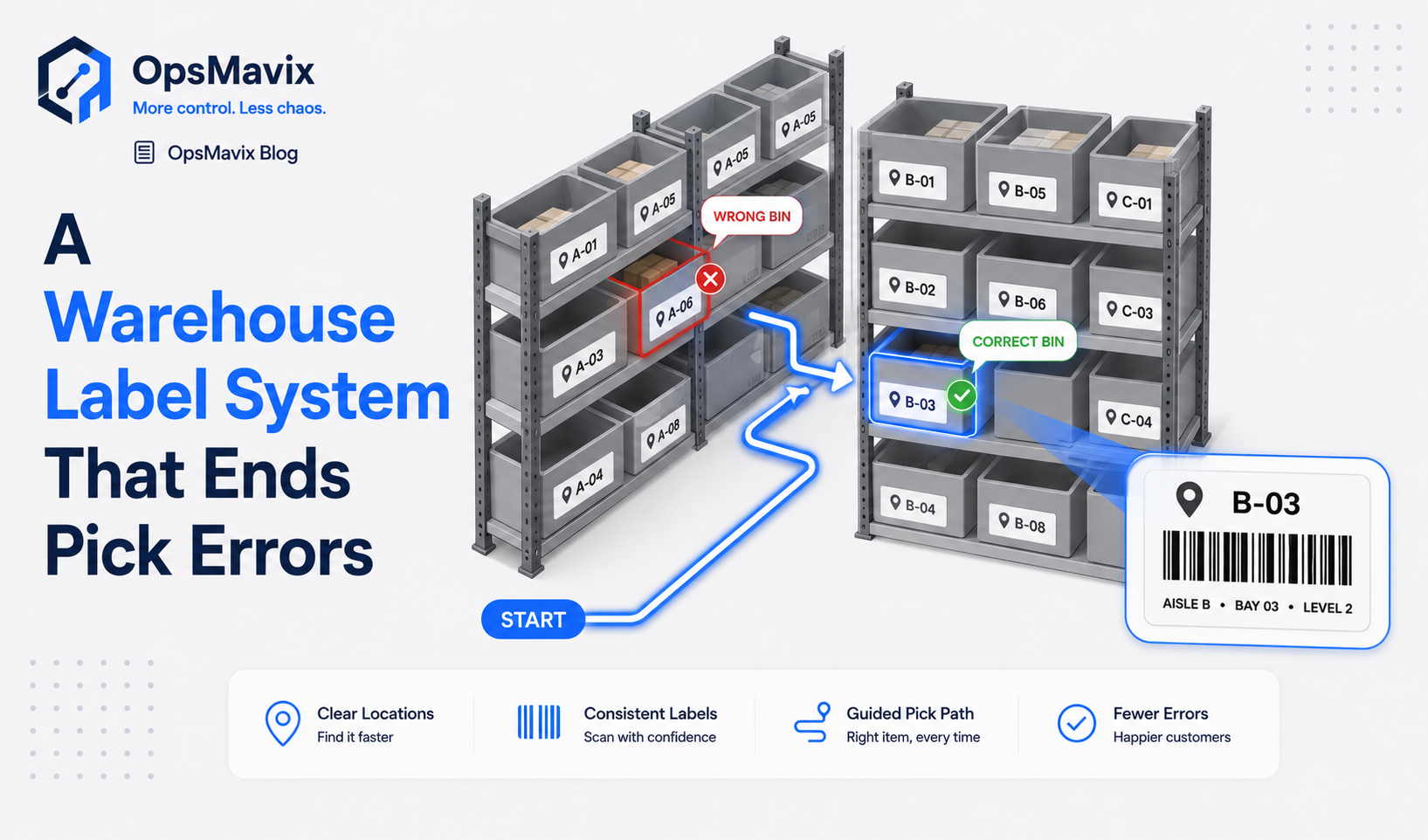
A pick error almost never starts with a careless picker. It starts with a shelf that doesn’t tell anyone what’s on it. When bins aren’t labelled to a system, your team picks from memory — and memory is wrong often enough to cost you cancelled orders, refunds, and a customer who doesn’t come back.
A warehouse label system is the cheapest fix you’ll find for pick accuracy. Every location and every product carries a scannable label tied to your stock record, so the right item reaches the right order without anyone guessing. It’s also the quiet foundation for ending phantom stock: if you can’t say where something is, you can never be sure how much you have.
Here’s how bin labelling actually ends pick errors in a growing warehouse, and what separates a label system that works from a wall of stickers nobody scans.
Key Takeaways
- Pick errors come from picking by memory, not careless staff — labels remove the guessing.
- Every bin location and every product needs a scannable label tied to one stock record.
- The scan at the pick is the real safeguard — it verifies the item against the order before it ships.
- Scanned movements at labelled bins are what kill phantom stock.
- A label system only works if it’s built around your real receiving-to-dispatch flow.
1Pick Errors Are a Labelling Problem, Not a People Problem
When a picker grabs the wrong item, the instinct is to blame the picker. Walk the floor, though, and you’ll usually find the real cause: two near-identical SKUs sat side by side, an unlabelled bin, or a location that moved last month and nobody updated the record. The picker did exactly what the shelf told them to.
It’s the same root cause behind the pain we hear constantly from warehouse managers — “we would consistently oversell items we didn’t even have on hand” and “the stock never matches the system.” A warehouse where locations aren’t labelled to the system is a warehouse run on memory, and memory doesn’t scale past a few hundred SKUs.
2Label the Location, Not Just the Product
The most common half-measure is labelling the products and skipping the bins. It feels like progress and changes almost nothing, because the picker still has to find the location by eye.
A real warehouse label system labels both:
- Locations — every aisle, rack, shelf and bin gets a unique, scannable code.
- Products — every SKU carries a label that matches the stock record exactly.
- The link between them — the system knows SKU A12 lives in bin C-04-03, and updates that link the moment stock moves.
The location label is what turns “go find it” into “go to C-04-03 and scan it.” The picker stops hunting and starts confirming.
3The Scan at the Pick Is the Actual Safeguard
Labels alone don’t stop errors. The scan does. When a picker scans the location and the product against the order line, the system either confirms the match or stops them. Wrong bin, wrong SKU, wrong quantity — caught before it’s boxed, not after it’s on a van.
This is the checkpoint most spreadsheet-run warehouses don’t have at all. There’s nothing sitting between “pick something that looks right” and “ship it.” A scan-verified pick swaps trust for proof, which is exactly what a stock-burned ops manager has stopped believing in: “our spreadsheet counts wind up being off, sometimes wildly so.”
4Labels Are How You Finally Kill Phantom Stock
Phantom stock — “inventory numbers change for no reason” — usually isn’t a glitch. It’s the build-up of movements nobody recorded against a location: a transfer between bins, a unit pulled and put back in the wrong slot, a return that never made it home.
Once every movement is scanned at a labelled location, those silent movements become recorded ones. You get an auditable trail of what entered a bin and what left it. So when the count drifts, you can trace why instead of writing off an “$80k value difference that cannot be explained.” Our view on this is blunt: you don’t fix phantom stock with a better forecast. You fix it by making every physical movement leave a digital fingerprint — and the label is the fingerprint.
5A Label System Has to Match Your Real Flow
A label system bought off the shelf assumes a warehouse that doesn’t exist: yours. The reason so many sites end up with “a million messy spreadsheets” running alongside their software is that the tool never fit how goods actually move from goods-in to dispatch.
A label system worth running maps your real path. Receiving: label and put away on arrival. Picking: scan-verified against the order. Packing: a checklist tied to the pick. Dispatch: scan out, stock down. That’s the difference between a warehouse inventory system and a label printer. The labels are the easy part. The flow they enforce is the value.
FAQ
What is a warehouse label system?
It’s scannable labels on every storage location and every product, tied to one stock record, plus the scanning steps that use them. Together they let staff pick, put away and dispatch by scanning to confirm — rather than picking from memory — which is what removes pick errors.
How does bin labelling improve pick accuracy?
It gives every item a known, scannable home. The picker is directed to a specific labelled location and scans both the bin and the product against the order line, so a wrong item or wrong bin is caught at the shelf instead of at the customer’s door.
Do I need barcode scanners, or are labels enough?
Labels alone help people find things faster, but the accuracy gain comes from scanning. A scan checks the picked item against the order in real time and updates stock as it moves. Without the scan you’ve improved navigation but kept the guessing.
Will a label system fix my stock counts too?
Yes — indirectly and powerfully. When every movement is scanned to a labelled location, your count updates from real events instead of memory. That’s the mechanism that ends stock that never matches the system and the phantom stock that comes with it.
Isn’t this overkill for a mid-size warehouse?
That’s the trap most growing warehouses fall into: assuming labelling and scanning belong only to enterprise WMS. You don’t need a six-figure platform. You need your locations labelled to one stock record and a scan at the pick — that delivers the accuracy without the enterprise bill.
How OpsMavix Can Help
OpsMavix builds custom warehouse inventory systems where every bin and product is labelled to one live stock record, and every pick, put-away and dispatch is scan-verified. The right item reaches the right order, and your count updates from what actually moved. No generic app to babysit, no per-seat fees, and you own it outright — no vendor can price-hike it or switch it off.
If pickers are grabbing the wrong bin and your stock figure can’t be trusted, that’s a measurable operational leak: in refunds, cancelled orders and time spent double-checking. Book an Operations Leak Audit and we’ll map exactly where your pick accuracy breaks down, and what it’s costing you.