
Supply Chain Quality Management Software: What Good Looks Like
Quality doesn't stop at your own four walls — you inherit every defect your suppliers ship. This is what supply chain quality management software has to do across supplier approval, incoming inspection, non-conformance, corrective action, audits and traceability, and why the best version builds those records into the workflow instead of parking them in a separate QMS nobody opens.
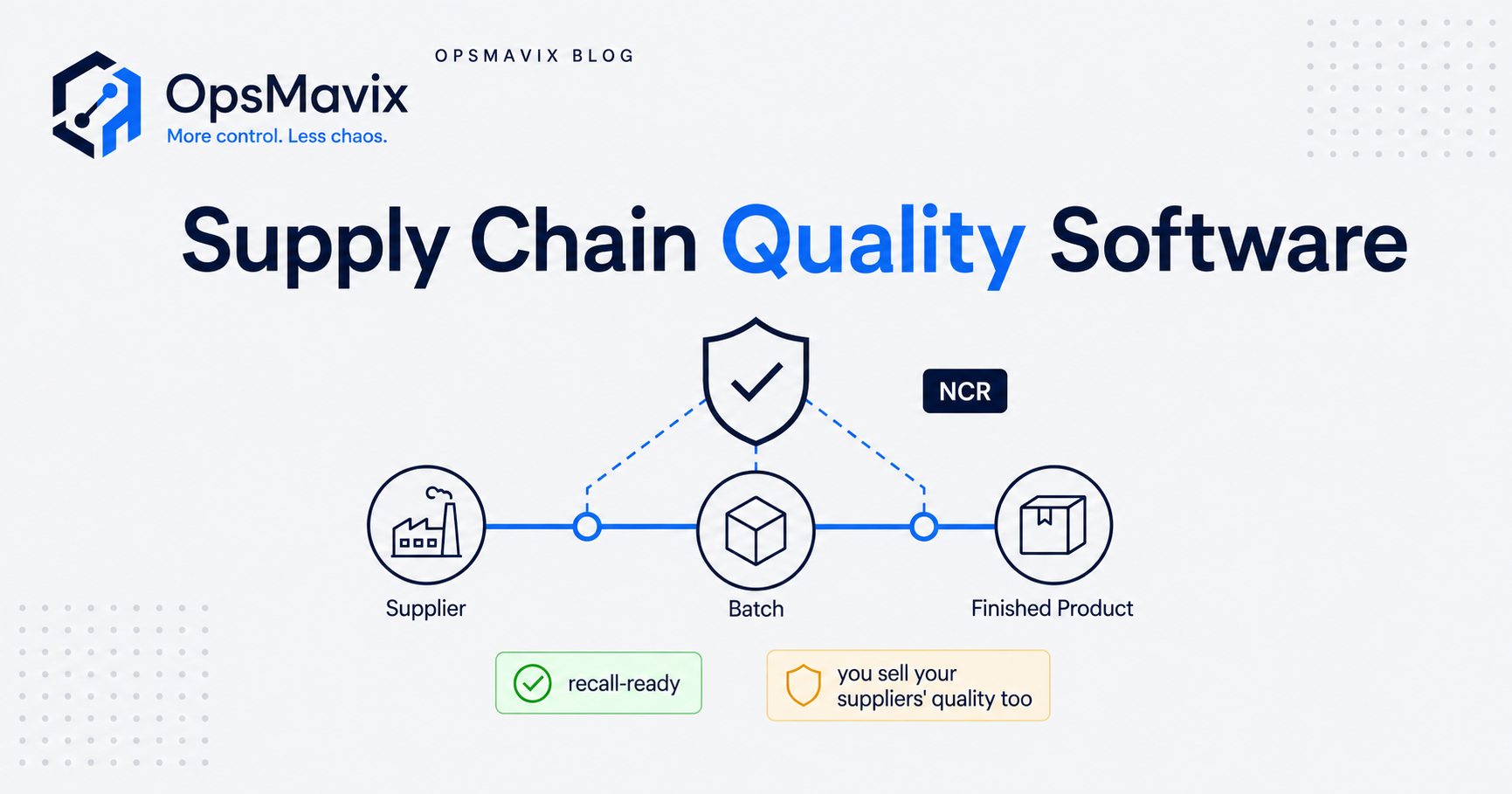
Supply chain quality management software is the system that records and controls quality across everyone who touches your product before it reaches the customer — approving suppliers, inspecting goods at receipt, logging non-conformances, driving corrective actions, running audits, and holding the traceability that ties a finished batch back to the raw materials and the supplier who provided them. It is not a certificate on the wall or a folder of PDFs; it is the set of records that prove, on the day someone asks, that what you shipped met specification — and that when it didn’t, you caught it, contained it and fixed the cause. The reason it matters is blunt: you sell your suppliers’ quality too, and a defect that arrives on your loading bay becomes your recall unless something is watching for it.
Most growing businesses have quality habits — a manager who eyeballs deliveries, a spreadsheet of supplier problems, an email thread when something goes wrong. What they don’t have is a system: quality records that live where the work happens, connect to the batch and supplier, and can’t be quietly skipped when everyone’s busy. This post walks through what that system has to do, function by function, and why building quality into the operational workflow usually beats bolting on a separate quality-management suite. It’s one function within the wider category of supply chain management software.
Quick summary: Good supply chain quality management software makes supplier approval, incoming inspection, non-conformance (NCR) and corrective action (CAPA) unskippable steps in the daily workflow, with traceability tying every finished item back to its inputs — the discipline that formal quality standards like ISO 9001 are built around. The best version for a growing business isn’t a standalone QMS your team logs into separately; it’s quality records embedded in the same system that already runs receiving, production and dispatch.
Contents
- What supply chain quality management software actually covers
- Why quality across the supply chain matters
- Supplier quality: you inherit your suppliers’ defects
- Incoming inspection: catching it at the door
- Non-conformance and NCRs: one place, not an email thread
- Corrective action (CAPA): closing the loop
- Audits and traceability: proving it when asked
- Worked example: tracing a supplier quality issue
- Separate QMS vs quality built into the workflow
- What right-sized looks like
- FAQ
What Supply Chain Quality Management Software Actually Covers
The phrase covers more ground than it first appears. Internal quality — is your process making good product? — is only half of it. Supply chain quality management is the wider job of controlling quality across everyone upstream and downstream: the suppliers you buy from, the goods that arrive, how non-conformances are resolved, and the traceability that lets you follow a problem in either direction. Professional bodies like the Chartered Quality Institute frame quality assurance as exactly this — building confidence that requirements will be met, not just inspecting after the fact.
In practice, a system worth the name handles: an approved-supplier list with certificates and expiry dates; incoming inspection against a spec, with pass, fail and quarantine outcomes; non-conformance reports tied to batch and supplier; corrective actions with an owner and due date; audit records for your process and suppliers; and traceability connecting a finished item to its inputs. Miss any one and a defect walks straight through.
Why Quality Across the Supply Chain Matters
Three pressures make this a business problem, not a paperwork problem. The first is recalls. When a product has to be pulled, the cost isn’t the units — it’s the scramble to work out which units, and every batch you can’t rule out gets pulled too. In regulated food, that traceability is a legal duty: under UK general food law you must keep records that let you trace one step back and one step forward, so unsafe product can be withdrawn or recalled quickly (Food Standards Agency).
The second is compliance. Customers, auditors and standards want evidence, not assurances. An ISO 9001-style quality management system is built on documented control of suppliers, non-conformities and corrective action, and your bigger customers increasingly run their own supplier audits and expect records on demand. The third is supplier accountability: if you can’t show a supplier the defect rate on their deliveries, batch by batch, you can’t hold them to it — “your last few loads have been rough” is a feeling; a measured non-conformance rate is a conversation they have to answer.
Supplier Quality: You Inherit Your Suppliers’ Defects
Quality management starts before a single order is placed. The approved-supplier list is the front door, and in most growing businesses it’s a mess — a supplier “approved” three years ago on a certificate that lapsed eighteen months ago, still on the buying list because nobody’s job is to check. A real system holds each supplier’s approval status, the certificates you rely on with expiry dates, and the quality history that justifies keeping them or flags them for review.
That history is the point. Every rejected delivery and non-conformance is a data point about a supplier, and when those live in one place they become a scorecard: incoming defect rate, on-time rate, open corrective actions. Now supplier reviews run off evidence — you tighten inspection on the ones that keep failing and make sourcing decisions on facts. This is the quality layer sitting on top of supplier order management — the same suppliers and orders, now with a quality record on each.
Incoming Inspection: Catching It at the Door
The cheapest place to catch a defect is at goods-in. A non-conforming component caught on the loading bay costs you a rejected delivery; the same component fitted into a finished assembly costs you the assembly, the labour, and possibly a customer. Incoming inspection is the checkpoint that decides which of those you’re paying for.
A proper incoming-inspection step does three things the eyeball-and-sign approach can’t. It checks against a defined specification, so “looks fine” becomes “measured, in tolerance”. It records the outcome — pass, fail, or quarantine — against the specific delivery and batch. And it controls what happens next: passed stock goes to usable inventory, quarantined stock is held where it can’t be picked, failed stock triggers a non-conformance and a return. Quarantine is the control people underrate — the failure mode isn’t missing a bad delivery, it’s spotting it and someone using it anyway because nothing stopped them. Sitting the check on top of your goods receiving and three-way match means the quality gate and the commercial gate close together: you don’t pay for, and don’t consume, what didn’t pass.
Non-Conformance and NCRs: One Place, Not an Email Thread
When something is wrong — a failed inspection, a customer complaint, a defect found in production — that’s a non-conformance, and how you capture it decides whether you ever learn from it. The common failure is that non-conformances live in email or in a spreadsheet nobody reviews. An NCR that isn’t linked to the batch and supplier, and that no one owns, is just a record of a bad day.
A good system makes the NCR a structured, linked record: the defect, where it was found, which batch and supplier it came from, how it was contained (quarantined, returned, scrapped, reworked), and what it cost. Linked, those records answer questions the spreadsheet can’t — how many NCRs against this supplier this quarter, how many still open:
| Aspect | Email / spreadsheet | Built into the system |
|---|---|---|
| Where the NCR lives | Inbox thread or tab | Linked to batch, supplier, order |
| Ownership | Whoever remembers | Named owner + due date |
| Containment | Verbal (“don’t use those”) | Stock quarantined in the system |
| Supplier pattern | Invisible until it’s a crisis | Defect rate per supplier, live |
| Closing it out | It just goes quiet | Corrective action required to close |
| Audit evidence | Reconstructed from memory | Produced on demand |
Corrective Action (CAPA): Closing the Loop
Catching and containing a defect stops the bleeding; it doesn’t stop it recurring. That’s what corrective action is for. The distinction quality people draw is worth keeping: the non-conformance is reactive — fix the problem in front of you — while corrective and preventive action (CAPA) is about the cause, so it doesn’t come back. An NCR with no corrective action behind it is a business quietly agreeing to hit the same wall next month.
The mechanics are unglamorous and that’s the point: a corrective action needs an owner, a root cause (not “supplier error” but why — wrong spec sent, no incoming check, a drifting process), an action, a due date, and a verification that it worked. A system’s job is to make sure the action exists, is assigned, and is chased until it’s closed and checked. Tie the action to the NCR and the NCR to the supplier, and you get the thing that changes supplier behaviour: a documented pattern and a documented demand to fix it, with dates.
Audits and Traceability: Proving It When Someone Asks
Two capabilities turn all of the above from housekeeping into something you can stand behind. Audits — internal checks that your process is being followed, and supplier audits that theirs is — stop quality drifting once the initial push fades. A system holds the audit schedule, findings and resulting actions, so an audit is a tracked cycle, not a one-off day that gets forgotten.
Traceability is the one that earns its keep in a crisis. Two-way traceability means you can go backward — this batch was made from these material lots, from these suppliers, received on these dates — and forward — this suspect supplier lot went into these batches, which shipped to these customers. That trail is the difference between recalling three batches and recalling three months. It’s the same batch and lot tracking discipline that underpins regulated manufacturing, and for food businesses the one-step-back, one-step-forward record is a legal requirement (GOV.UK). In frameworks like the ASCM SCOR model, the source and return processes — receiving, verifying and returning defective supply — are core activities: supplier quality isn’t a bolt-on to the supply chain, it’s part of the machine.
Worked Example: Tracing a Supplier Quality Issue
Take a small food manufacturer making sauces. A customer complains that jars from a recent delivery have separated — an ingredient problem. Here’s how it runs with quality built into the workflow versus without.
Without a system. Someone remembers the complaint but can’t be sure which raw materials went into the affected jars. The emulsifier came from one of three suppliers and nobody logged which lot went into which batch. To be safe, they pull every batch made in a three-week window — most of it perfectly good. The supplier shrugs; there’s no record tying their lot to the fault.
With quality records in the workflow. The complaint is logged as an NCR against the batch number on the jar. Traceability walks backward: that batch used emulsifier lot 4471, received on the 12th, from Supplier B. Forward from lot 4471: it went into two production batches, shipped to four customers. Only those two are suspect — the recall is narrow and provable. The NCR links to Supplier B’s record, which now shows a second separation defect from their material this quarter. A corrective action is raised: quarantine remaining lot 4471, add a stability check to incoming inspection, and put the pattern to Supplier B with dates. The same event costs a fraction of the units and produces a supplier conversation backed by evidence — because the batch link, the supplier link and the inspection record existed before the problem, captured as a by-product of normal work rather than reconstructed in a panic.
Separate QMS vs Quality Built Into the Workflow
Here’s where the software choice bites. A standalone quality-management system is a separate application your team logs into to record quality things. It can be excellent — for a large, heavily-regulated manufacturer with a dedicated quality department, it’s the right tool. The problem for a growing business is the seam. The QMS knows about NCRs but not your live stock; your operational system knows about stock but not quality. So quality becomes a second set of records maintained in parallel, and the moment things get busy, that’s what slips. You end up with a certificate you paid for and records that don’t reflect what happened on the floor.
The alternative is to build quality into the operational system that already runs receiving, production and dispatch. Incoming inspection is a step in goods-in, not a separate login. An NCR is raised against the batch that’s already in the system. Quarantine actually holds the stock because it’s the same record the pickers use. Traceability comes free because the batch and material links are already there. This is the logic of treating quality as one function of an operations system rather than a walled-off app — the records live where the work is, so they get made. It’s the same reason quality belongs inside production tracking rather than beside it: the batch is being recorded anyway, so attaching the quality result costs almost nothing, and skipping it becomes the harder path.
What Right-Sized Looks Like
None of this argues for the biggest quality platform you can buy. A growing business doesn’t need statistical process control dashboards, a pharmaceutical GMP validation module, or a supplier portal for a thousand vendors. It needs the specific chain that matches its risk: approved suppliers with live certificate dates; an incoming-inspection step that can quarantine; NCRs linked to batch and supplier; corrective actions chased to closed; and two-way traceability that survives an audit or a recall. That’s a focused set of capabilities shaped to how one business makes and receives product — and because it’s built into the system you already run, you own it, with no per-seat quality licence and no seam to fall through. The design goal is to make the quality step the path of least resistance, so it happens by default: quality you have to remember to do gets skipped under pressure; quality that’s part of the workflow gets done because doing the work is recording it.
FAQ
What is supply chain quality management software?
It records and controls product quality across your suppliers and your own process — approving suppliers, inspecting incoming goods against a spec, logging non-conformances, driving corrective actions, running audits, and holding traceability from finished product back to raw materials. The aim is to catch defects early, prove compliance, and hold suppliers accountable with evidence.
Do I need a separate QMS, or can quality live in my operations system?
For most growing businesses, quality is better built into the system that already runs receiving, production and dispatch. A standalone QMS creates a second set of records to maintain in parallel, which slips when things get busy. Records built into the workflow get made because making them is part of the work. A dedicated QMS earns its place at large, heavily-regulated scale.
What’s the difference between a non-conformance (NCR) and a corrective action (CAPA)?
An NCR is reactive — it captures and contains a specific defect. A corrective action (CAPA) addresses the cause so the defect doesn’t recur. An NCR with no corrective action behind it fixes today’s problem and guarantees you’ll meet it again. Good software links the two and chases the corrective action to verified closure.
Why does traceability matter for quality?
Two-way traceability lets you trace backward (which materials and suppliers went into a batch) and forward (which batches and customers a suspect supplier lot reached). In a recall, that’s the difference between pulling a few provable batches and pulling months of good product. For UK food businesses, one-step-back, one-step-forward traceability is a legal requirement.
How does this improve supplier accountability?
Every rejected delivery and non-conformance logged against the supplier and batch builds a defect rate over time. That turns supplier reviews from “your loads have felt rough lately” into a measured pattern with dates — evidence a supplier has to answer, and a basis for tightening inspection or changing source.
How OpsMavix Can Help
OpsMavix builds right-sized operational systems for businesses outgrowing spreadsheets but not ready for — or well served by — a full enterprise QMS. Instead of selling a separate quality application, we build quality records into the system that already runs your receiving, production and dispatch: incoming inspection as a step in goods-in, NCRs linked to batch and supplier, corrective actions chased to closure, and two-way traceability that holds up in an audit or a recall. You own the system, it’s shaped to how you make and receive product, and it comes with a delivery guarantee. To find where quality is leaking before it becomes a recall, start here: Book a Free Operations Leak Audit.