
Warehouse Slotting Software: What It Does and How to Choose It
Warehouse slotting software works out where each SKU should physically live so pickers walk less and fast movers stay within reach. This post is a buyer's guide — what the software actually does, the features that separate a real tool from a spreadsheet with a logo, and the honest line on when you need a dedicated engine versus a location layer inside the system you already run.
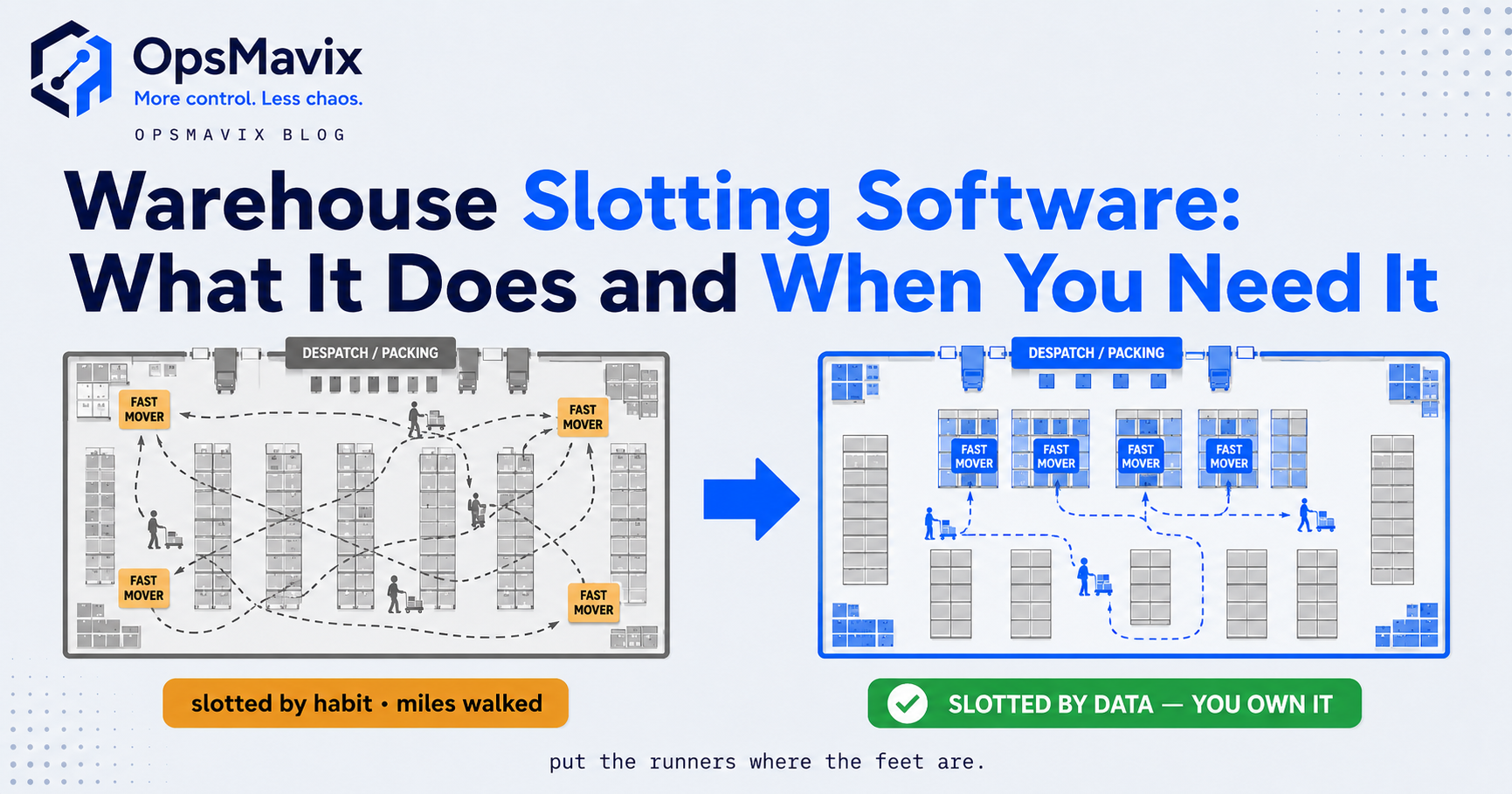
Warehouse slotting software is a tool that decides where each SKU should physically live in your building, ranking products by how often they’re picked, matching them to locations by size, weight and reach, and keeping that placement map current as demand shifts. That’s the job. Where a spreadsheet freezes a layout the day you build it, slotting software treats placement as a live decision it can recompute, record and hand to a picker as a route rather than a guess.
This is a buyer’s guide, not a definition of the concept. If you want the principles behind slotting itself, start with the hub on warehouse slotting. Here we’re answering the buyer’s questions: what warehouse slotting software actually does under the marketing, which features separate a real tool from a spreadsheet with a login, and the honest OpsMavix line on when you need a dedicated slotting engine versus a location layer built into the system you already run your stock on.
Key Takeaways
- Warehouse slotting software ranks SKUs by pick frequency, assigns them to locations by velocity, size and weight, and keeps that map live: the placement decision, automated and recorded.
- The features that matter are boring and load-bearing: real location data, a velocity ranking from your own order history, re-slotting suggestions, and sync between the screen and the shelf.
- Most “slotting” pain isn’t a missing algorithm. It’s a location map living in one picker’s head while the system shows a bin the stock left months ago.
- A standalone slotting module and slotting built into your inventory system solve different-sized problems. The module optimises; the built-in layer keeps the map honest. Growing warehouses usually need the second.
- Continuous optimisation engines are real and worth it at scale (tens of thousands of SKUs, sharp seasonality, multiple pick faces) and overkill below it.
- Buy for the problem your volume has actually created, not the one the demo shows you at a hundred times your size.
What Warehouse Slotting Software Actually Does
Strip the sales slide away and the software does four concrete things. It ingests your order history and ranks every SKU by how often it’s picked, so placement is driven by real demand rather than whatever was true when the shelving went in. It holds a map of your locations as data — every bin, its height band, its cube capacity, its distance from dispatch. It matches the two: fast movers to the golden zone near the door, slow movers to the back and the top shelves, heavy items low and early in the pick sequence. And it produces moves — a list of “shift SKU X from bin D-04 to A-12” that a person can actually execute.
The better tools add a fifth thing: they watch demand drift and flag when a slot has gone stale. A product that was an A-mover in November and a C-mover by February is sitting in prime real estate it no longer earns, and the software surfaces that before a human would have noticed.
The distinction worth holding: slotting software decides where stock should be. It’s not the same as deciding how you route the pick — that’s your picking method, and single-order, batch or zone picking is a separate choice that sits on top of the layout slotting sets.
The Features That Actually Matter
Vendor feature lists are long. The ones that decide whether the software earns its keep are short.
A velocity ranking from your own data. If the tool can’t pull pick frequency from your real order history and rank SKUs by it, it’s guessing, and you’re back to gut feel with a nicer interface. This is the engine of the whole thing.
Location data that reflects the physical building. The software needs to know each bin’s height band, capacity and travel cost, not just its label. A tool that treats every location as identical can’t put a heavy item low or a bulky one where it fits.
Re-slotting suggestions, not just an initial layout. Any tool can produce a one-off arrangement. The value is in the software telling you when and what to move as demand shifts — and doing it in batches small enough that your team can execute them without shutting the aisle.
Sync with the system that runs your stock. This is the one buyers underweight and regret. A slot is only useful if the screen and the shelf agree. If your slotting software says A-12 and the item’s been in D-04 since the summer reshuffle, the optimisation is worse than useless — it sends pickers to empty bins.
One warehouse manager told us the tool they’d bought produced a beautiful slotting plan that nobody followed, “because by the time we’d finished the moves, the stock had shifted and the plan was already wrong.” That’s not a bad algorithm. That’s software that couldn’t stay in sync with reality.
Standalone Module vs Built Into Your System
Here’s the fork most buyers don’t see clearly. Slotting software comes in two shapes, and they solve different-sized problems.
A standalone slotting module (often a component of a tier-one WMS, sometimes a bolt-on) treats placement as a continuous optimisation problem. It weights every SKU by pick frequency, order affinity, seasonality, size and travel cost, and recomputes the arrangement that minimises total walking across the whole building. At genuine scale, this is real maths doing real work no human can hold in their head. It’s also priced, implemented and licensed like the enterprise platform it usually lives inside.
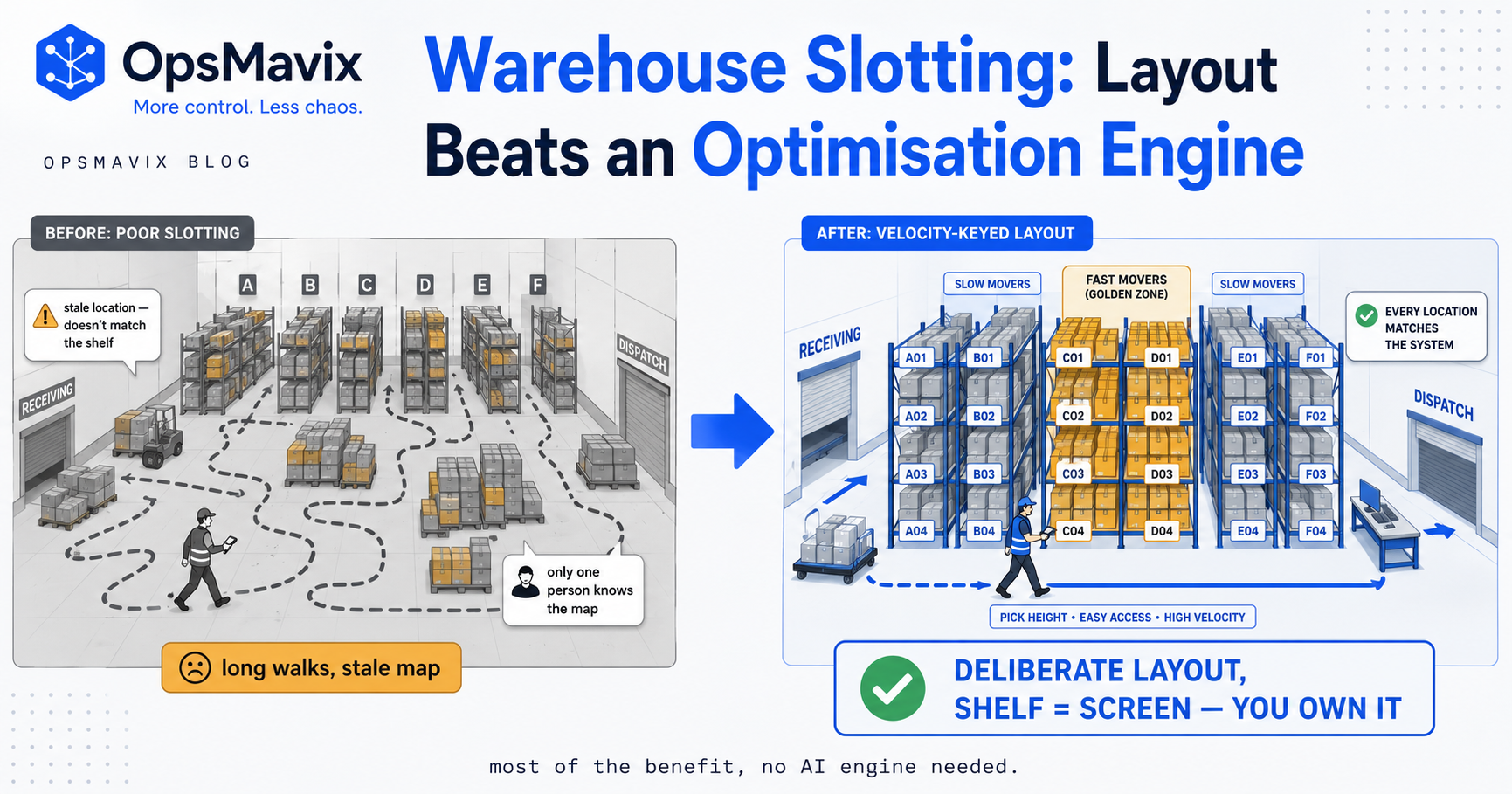
Slotting built into your inventory system is a different animal. It doesn’t run a continuous optimisation engine. It does the load-bearing part: holds your locations as real data, ranks SKUs by actual pick frequency, and, critically, keeps that location map honest because the same system that tells a picker where to go is the one that gets updated when stock moves. You set a deliberate, velocity-keyed layout and the system keeps it followed.
The mismatch costs money. Buy the enterprise optimisation engine when your real issue was a location map in one person’s head, and you’ve paid platform prices to solve a problem a deliberate layout inside your stock system would have handled at a fraction of the cost.
The Leak Slotting Software Is Really Fixing
Under the pick-path efficiency pitch, warehouse slotting software is fixing a specific, measurable leak — and it helps to put a number on it.
A picker walking to the far corner for a fast mover that should have been by the door wastes seconds on every order that touches it. Multiply by pick volume and it’s not seconds, it’s hours, then a headcount line. A stale location, the screen showing a bin the stock left months ago, costs worse: a mis-pick, a re-pick, sometimes a short-ship that surfaces later as one of the uglier types of stock discrepancies you spend a Friday reconciling. And a slotting map that only your longest-serving picker carries in their head is a key-person risk that turns every holiday into a bad week.
The Honest Line: How to Choose
Here’s the OpsMavix position, and it’s not the one the WMS demo gives you. Choose warehouse slotting software by the problem your volume has created, not the one you’re shown at a hundred times your scale.
If you’re a growing warehouse (thousands of SKUs, a handful of pickers, a layout that stays roughly stable between reviews) you don’t need a continuous optimisation engine. You need a system that holds your locations as real data, ranks SKUs by actual pick frequency so the golden zone goes to the products that earn it, and keeps the shelf and the screen in agreement. That’s most of the benefit of slotting, and it usually belongs inside your inventory system rather than in a separate module you have to keep in sync with everything else.
You’ve genuinely outgrown that, and a dedicated engine earns its licence, when SKU count runs to the tens of thousands, seconds-per-pick is a real labour number, seasonality reshuffles your A/B/C mix every few weeks, or you’re running multiple pick faces, zones and a mezzanine where the travel maths exceeds what a person can reason about. When several of those are true at once, a by-hand layout is stale before the ink dries, and continuous re-slotting stops being overkill and starts being the answer.
Build, Buy, or Build It In
So which do you buy? Buy a standalone slotting engine if your volume has genuinely crossed into optimisation territory — you’ll know from the numbers, not a sales deck. Buy a full WMS if you need the whole warehouse suite and slotting comes along inside it. But if your real problem is that a good-enough layout isn’t being followed because the map lives in someone’s head and the system doesn’t match the shelf, the honest answer is neither — it’s a location layer built into the system that already runs your stock, one you own outright with no per-seat licence and nothing a vendor can switch off.
That middle ground, too big for a location map in one picker’s memory, not big enough for an enterprise optimisation engine, is where the software decision usually gets made wrong, and it’s the exact gap OpsMavix builds for. If pickers walking too far or slots that don’t match the shelf are costing you, the first move isn’t choosing a tool. It’s seeing the number.
Keep reading
Getting value from OpsMavix? Add us as a preferred source on Google — you'll see more of our operations content in your AI Overviews, AI Mode and Search.