
Warehouse Management Software: Do You Need a WMS or a Right-Sized System?
Most growing warehouses don't need a full WMS — they need the 20% of it they actually use, built around their real flow. Here's how to tell which side of that line you're on, and what a right-sized system covers that an enterprise WMS makes you pay for whether you use it or not.
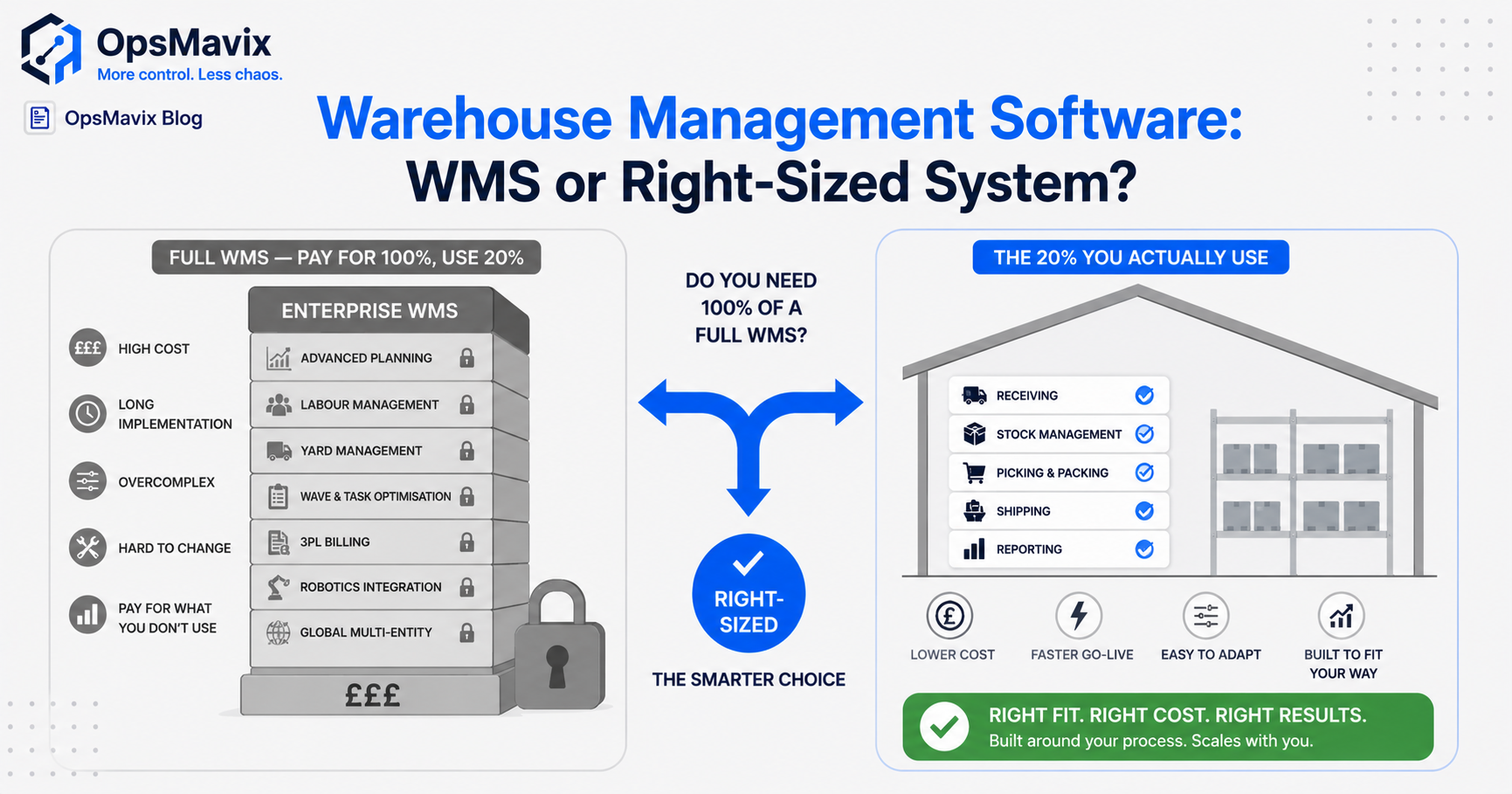
Most growing warehouses don’t need full warehouse management software. They need the slice of a WMS they actually use — accurate stock, receiving, picking, dispatch, reorder logic — built around their real flow and owned outright. A full WMS earns its keep when you run multiple sites, deep slotting and wave-picking, labour management, and high SKU velocity. Below that, an enterprise WMS makes you pay for, configure, and maintain features you’ll never touch.
This post is about that decision. Where the line sits between “you genuinely need warehouse management software” and “a right-sized custom system covers the 20% you use,” what each side actually buys you, and when switching is the wrong call. It’s not about pick accuracy or barcode labels specifically — that’s a separate problem covered in our piece on warehouse label systems. This is the build-vs-buy, big-vs-right-sized layer above it.
Key Takeaways
- A full WMS is built for scale you may not have: multi-site, wave-picking, slotting optimisation, labour management. Most SMB warehouses use a fraction of it.
- The real cost of enterprise warehouse management software isn’t the licence — it’s configuration, the implementation partner, and paying yearly for modules you never switch on.
- A right-sized system covers the parts you actually run — receiving, stock accuracy, picking, dispatch, reorder alerts — shaped to your flow, and you own it.
- “We’re not big enough for a WMS, too big for spreadsheets” is the exact gap a custom operations system fills.
- Don’t build for scale you don’t have, and don’t buy a WMS for scale you’ll reach in five years. Size the system to the warehouse you run now plus a little headroom.
1What Full Warehouse Management Software Actually Does (and Who It’s For)
Warehouse management software, in its full enterprise form, is a heavy machine: directed put-away, slotting optimisation, wave and batch picking, labour management, yard and dock scheduling, multi-site stock balancing, and deep integration into an ERP. When you run a 200,000-sq-ft distribution centre with hundreds of pickers and thousands of order lines an hour, every one of those modules saves real money. The complexity is the point.
The trouble starts when a £5m-turnover warehouse buys the same machine. One inventory manager at a mid-size distributor lands in the gap exactly: “QBO is too small, Netsuite is too expensive. What’s a middle ground?” He’s not rejecting capability — he’s rejecting capability he’ll never use, sold at a price that assumes he will. A WMS designed for a national 3PL is the wrong tool for a regional distributor the same way an articulated lorry is the wrong tool for a school run.
2The 20% Rule — You Use a Sliver of the Feature List
Open any enterprise WMS feature list and watch how much of it your warehouse touches. For most growing stock businesses, the daily reality is a handful of jobs: receive goods accurately, know what’s on the shelf, pick and pack the right things, dispatch them, and reorder before you run out. That’s the 20% that runs the business. The other 80% — slotting algorithms, labour standards, cross-docking, wave optimisation — sits there configured, maintained, and unused.
It’s the same maths plenty of over-bought warehouses run only after the fact: a six-figure implementation, tens of thousands a year in licence and support, and half the modules never switched on. That’s the enterprise-software tax in one line. A right-sized system inverts it — you build the jobs you actually do, well, and you don’t carry the rest. The win isn’t fewer features for the sake of it. It’s that everything in the system earns its place, so the floor team will actually use it.
3The Real Cost Is Implementation and Lock-In, Not the Licence
The sticker price on warehouse management software is the least of it. The expensive part is everything around the licence: the implementation partner, the configuration months, the per-seat creep as the team grows, and the dependency on a vendor or VAR you can’t leave. One operator put the partner model bluntly: “this whole partner driven industry is a robbery really!!” That’s not licence cost — that’s the cost of never owning the thing your operation runs on.
Plenty get burned the other direction too: a previous platform sunset “by a banner on the vendor’s website,” which “invalidates two years worth of work” and forced a scramble to replace it. Whether it’s a partner billing by the hour or a vendor pulling the rug, the underlying risk is the same — you’re renting your operations layer. A custom system flips that: no per-seat fees, no implementation partner on retainer, and nothing a vendor can switch off, because you hold it. That ownership question is the honest reframe behind whether you need an operations system or a full ERP.
4What a Right-Sized Warehouse System Actually Covers
A right-sized system isn’t a stripped-down WMS — it’s a system built around how your warehouse genuinely moves goods. Receiving against purchase orders. One stock figure that the shelf and the screen both agree on. A picking view the floor can follow. A dispatch step that closes the loop. Reorder alerts that fire before a bestseller runs dry. For the businesses we serve, that set covers the work without the enterprise overhead — see our inventory automation system for the shape of it.
The difference from off-the-shelf is that nothing has to be bent to fit. One warehouse manager’s daily complaint is the cost of the mismatch: “the stock never matches the system, and I’m running a million messy spreadsheets for the warehouse.” That sprawl is what appears when a tool watches one count but the business runs on many — channels, locations, returns. A system shaped to the real flow treats each of those as a movement against one shared number, which is why the spreadsheets stop multiplying and the count starts matching. This is the operations layer; labels and scan accuracy sit one level down inside it.
5When a Full WMS Is the Right Call (the Honest Bit)
Sometimes the big machine is correct, and we’ll say so. If you run multiple distribution centres that need stock balanced between them, if pick volumes are high enough that wave-picking and slotting optimisation move real labour cost, if you need formal labour management or dock scheduling, or if a major customer mandates a specific WMS integration — buy the WMS. At that scale, the modules you’d dismiss as overkill become the things that pay for the system.
The decision isn’t “custom good, WMS bad.” It’s matching the tool to the warehouse you actually run. The mistake cuts both ways: don’t build a lightweight system for a true enterprise operation, and don’t buy enterprise warehouse management software for a warehouse that uses a fifth of it. If you’re genuinely on the line, the same build-vs-buy logic plays out in our comparison of Kardex versus a custom inventory system — heavy automation against a right-sized fit.
WMS vs Right-Sized Custom System
| Enterprise WMS | Right-Sized Custom System | |
|---|---|---|
| Built for | Multi-site, high-velocity, hundreds of pickers | Single or few sites, growing SMB volume |
| Feature use | You run ~20%, maintain 100% | You run what’s built; nothing spare |
| Upfront cost | High licence + implementation partner | Fixed build (£3k–£25k range) |
| Ongoing cost | Per-seat fees, annual modules, VAR hours | You own it — no per-seat, no partner retainer |
| Fits your process? | You configure your flow to the product | Built around your actual flow |
| Lock-in / sunset risk | Vendor or partner controls it | You hold it; nothing to switch off |
| Right when | True scale, slotting/wave/labour mgmt | “Too big for spreadsheets, too small for a WMS” |
FAQ
Do I need warehouse management software or just better inventory control?
It depends on what’s breaking. If your problem is stock that never matches the shelf, overselling, manual counting, and spreadsheet sprawl, you need accurate inventory control — which a right-sized custom system delivers without a full WMS. You need true warehouse management software when scale forces it: multiple sites, wave-picking, slotting optimisation, or formal labour management. Most growing SMB warehouses are in the first group, not the second.
What’s the difference between a WMS and a right-sized custom system?
A WMS is a packaged product built for enterprise-scale warehouses; you configure your process to fit it and pay for the full feature set whether you use it or not. A right-sized custom system is built around your actual flow — receiving, stock accuracy, picking, dispatch, reorder logic — covering the part you run and nothing you don’t, and you own it outright instead of renting it.
Is custom warehouse software cheaper than a WMS?
The honest answer is total cost, not sticker price. A custom build is a fixed cost you own. Enterprise warehouse management software adds an implementation partner, per-seat fees, and annual modules you may never use — one distribution owner described spending six figures upfront then tens of thousands a year for features his team didn’t touch. When you only use a fraction of a WMS, right-sized usually wins on total cost over a few years.
We’re too big for spreadsheets but not ready for a WMS — what do we do?
That gap is exactly what a right-sized custom operations system is for. You don’t have to choose between a count you can’t trust and a six-figure WMS you’ll barely use. A system shaped to your receiving-to-dispatch flow covers the jobs you actually run, scales with you, and avoids both the spreadsheet mess and the enterprise overhead.
Will a custom system handle barcodes and picking accuracy?
Yes — scanning and pick accuracy live inside a right-sized system rather than replacing it. The labelling and scan-accuracy layer is a distinct topic worth its own read; we cover it in our warehouse label system piece. The point of this article is the layer above it: whether you need a full WMS or a right-sized operations system in the first place.
How OpsMavix Can Help
OpsMavix builds right-sized warehouse and inventory systems for businesses stuck in the gap — too big for spreadsheets, too small to justify a full WMS. We build the part you actually run: receiving, one stock figure the shelf and the screen agree on, picking, dispatch, and reorder alerts that fire before you run out. No enterprise modules to configure and maintain, no implementation partner on retainer, and nothing a vendor can switch off, because you own it.
If you’re weighing warehouse management software against building the right thing once, start by seeing where the leak actually is. Book an Operations Leak Audit and we’ll map where your stock accuracy and warehouse flow break down today, what it’s costing you, and whether a full WMS or a right-sized system is the genuine fit.