
Manhattan Warehouse Management System Alternative: Right-Sized For You
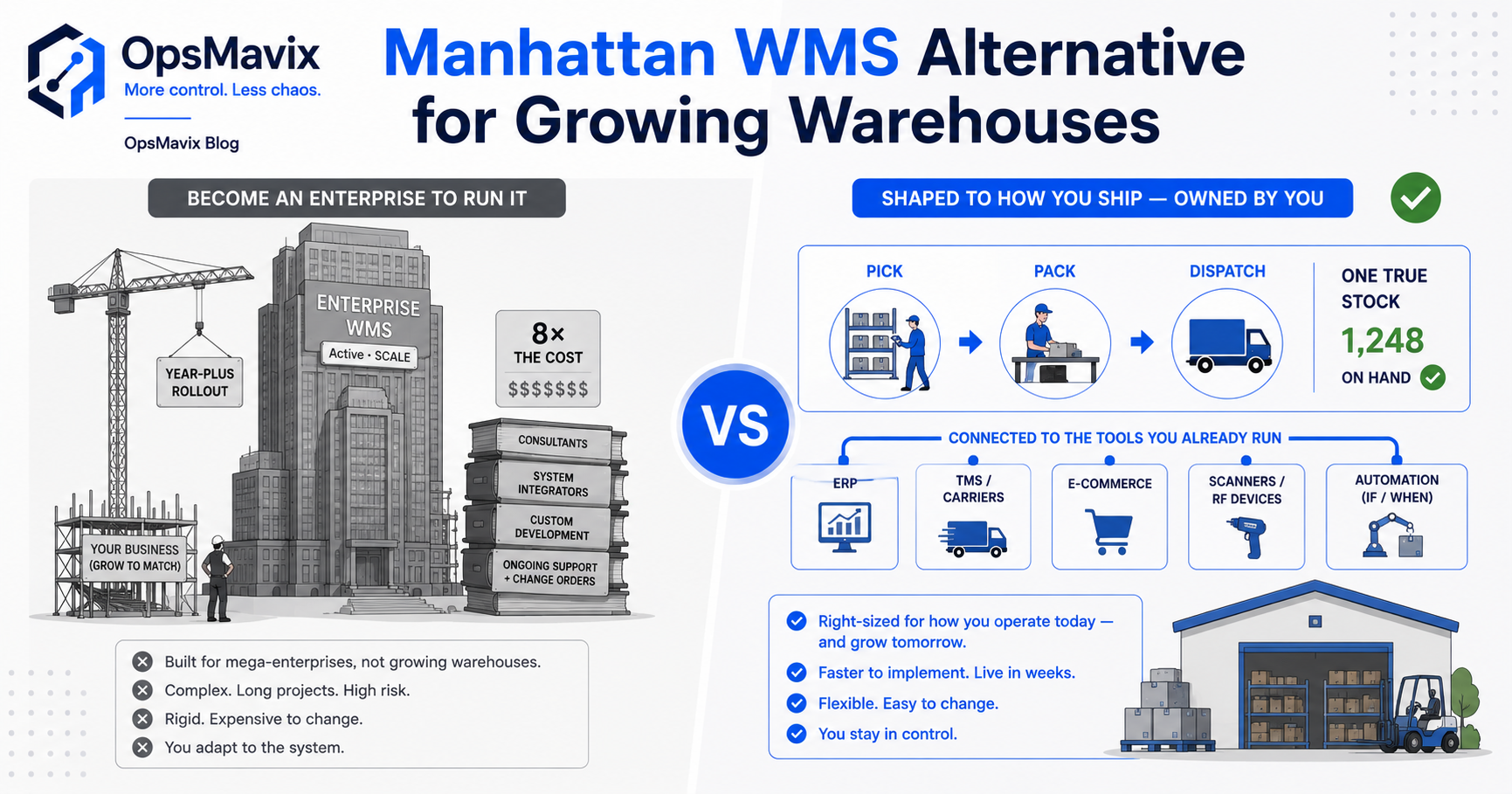
A Manhattan warehouse management system is enterprise-grade — built for the largest distributors and 3PLs. The depth is real, and so is the price, the year-plus implementation, and the org you have to become to run it. Here's what Manhattan WMS is built for, the signs it's overkill for a growing operation, and what a right-sized system you own does instead.
By OpsMavix. Vendor pricing checked September 2026. Manhattan and other tier-1 platforms are quoted on request; we have not fabricated a figure for any of them.
You’ve just come off a call with a Manhattan reseller. The demo was genuinely impressive: labour management, slotting optimisation, wave picking tuned to the second. Then the scope document lands: a project team, a systems integrator, a go-live measured in quarters, and a licence number that will not be confirmed until someone has scoped your whole operation. You run a warehouse turning over a few million pounds a year, not a national distribution network, and the gap between what you asked for and what you were shown is now the problem.
That gap is what a search for a Manhattan warehouse management system alternative is really about. Manhattan Associates, through its Manhattan Active and SCALE products, is one of the most capable warehouse platforms that exists. It is built for very large distributors, retailers and third-party logistics operators running fulfilment as the business itself. This guide is for UK product and distribution businesses somewhere between a spreadsheet and that scale: it covers what Manhattan is genuinely built for, who should stay with it, realistic mid-market alternatives with honest pricing, and what a right-sized system built around your actual pick, pack and dispatch flow does differently.
What is a Manhattan warehouse management system?
A Manhattan warehouse management system is enterprise software from Manhattan Associates that runs receiving, putaway, picking, packing, labour and dispatch for large-scale warehouse operations. The current products are Manhattan Active, a cloud-native suite, and SCALE, aimed at mid-to-large operations that still want a strong feature set without the largest deployments. Both cover wave and zone picking, slotting optimisation, labour management, automation and conveyor orchestration, and multi-site visibility, sold and implemented through Manhattan directly or through certified partners and systems integrators.
The platform exists because there genuinely are warehouses too large and too intricate for anything lighter. Hundreds of staff across multiple sites, automated material handling, order volumes where a one percent efficiency gain is worth real money, that is the operation Manhattan is engineered for. The trouble is not the software. It is that the name and the feature list draw in businesses that are not that operation yet, on the belief that the most capable tool must also be the safest choice.
Manhattan warehouse management system alternatives compared
If Manhattan is more than your warehouse needs, the honest next step is not a slightly smaller enterprise suite that brings the same weight in a cheaper box. It is matching the tool to the operation you actually run. The table below sets out realistic alternatives across the market, from mid-market WMS platforms to a right-sized owned system, with what each is genuinely worth considering for and where the real cost sits.
| Option | Worth considering when… | Pricing approach | Important buying detail |
|---|---|---|---|
| Manhattan Associates (Manhattan Active / SCALE) | You run a genuinely large, multi-site distribution or 3PL operation with automation, labour management and complex wave picking at scale | Quoted on request; enterprise licence plus systems integrator and internal staffing costs on top | Implementation runs multi-quarter to year-plus and needs a dedicated project team and someone to own the platform afterwards |
| Cin7 Core (formerly DEAR Systems) | You need inventory, order management and light warehouse tracking in one subscription for a product business, not a dedicated fulfilment operator | Published from $349/month for the Standard tier, 5 users, excluding tax (checked September 2026) | Warehouse features sit inside a wider inventory suite rather than a purpose-built WMS; check multi-warehouse and order-volume limits before you buy |
| Fishbowl Advanced (Warehouse) | You want warehouse and manufacturing modules together, and are comfortable with a more traditional, deployment-based vendor | Published from $595/month, priced by users and deployment (checked September 2026); final figure confirmed by their sales team | Strongest on manufacturing-adjacent stock control, lighter on the multi-client fulfilment logic a 3PL needs |
| Extensiv (3PL Warehouse Manager) | You run a 3PL or multi-client warehouse and need client billing, portals and multi-tenant stock separation | Quoted on request, scoped to SKU count and order volume | Built around the 3PL business model; a single-brand warehouse ends up paying for client-management features it will never use |
| Logiwa | You are a high-SKU ecommerce or omnichannel operation that wants a cloud-native WMS with a faster deployment than a tier-1 suite | Quoted on request | Lighter to implement than Manhattan, but still integrator-led, and still a platform you rent rather than own |
| OpsMavix | Your warehouse supports the business rather than being the business, and the leak is a handful of specific picking, stock accuracy or dispatch problems | Starter Fix £3,000 to £10,000, Growth System £10,000 to £25,000, Operations Platform from £25,000 | An owned system built around your specific warehouse workflows. This is a different scope from a WMS licence, not a smaller version of the same thing |
Figures for Cin7 and Fishbowl are their own published starting rates in USD, current as of September 2026 and excluding tax or currency conversion; confirm the exact figure and any UK pricing on their sites before you rely on it. Manhattan, Extensiv and Logiwa do not publish pricing, so nothing here is a stated number for them, only what to expect from their quoting process.
Who should genuinely stay with Manhattan
This is not an argument against Manhattan. It is an argument for being honest about which businesses it is for. Manhattan earns its cost and its implementation length when the warehouse genuinely is the business: several large sites, hundreds of pickers, automation and conveyor systems that need orchestrating, and order volumes high enough that shaving seconds off a pick path is worth serious money across a shift. A national distributor or a 3PL running fulfilment as its core product, with the internal structure to run a systems integrator relationship and a dedicated platform team, is the operation Manhattan was built for. If that is genuinely you, a mid-market alternative will not hold, and the comparison in this guide is not really for you.
The sign it’s overkill: you’d have to become the customer it was built for
Most businesses feel this rather than reason it through: the software itself is only half the cost. To get real value from a tier-1 platform you typically need a project team, a certified implementation partner, floor-level change management, infrastructure commitments, and someone on staff afterwards who owns the platform full time. None of that shows up in the licence quote. If running the tool means hiring and restructuring for the tool, you are not buying software, you are buying a project to turn your operation into the business the software assumes you already are.
The test is simple. Write down what you would need to hire, change or rebuild before Manhattan starts paying for itself. If that list runs to a project team and a year, the platform is sized for an operation larger than yours.
Implementation length is a risk in itself, not just a bigger bill
Tier-1 WMS rollouts are measured in quarters and years: discovery, configuration, integration with your ERP and carriers, data migration, testing, and a phased go-live so the whole warehouse is not gambled on one cutover. None of that is Manhattan being difficult, it is the genuine weight of any platform built for enormous complexity. But length is its own risk, separate from price. A long implementation has a failure mode of its own, you get far enough in that backing out feels wasteful, but not far enough to see the payoff. Scale that across a multi-quarter enterprise programme and you have a plausible reason why so many large rollouts stall or quietly deliver less than promised. For a growing warehouse, months of disruption can cost more than the leak the project was meant to fix.
Tier-1 depth assumes tier-1 scale
Labour management, slotting optimisation, automation orchestration and complex wave planning are built for volumes where a small efficiency gain multiplies into real money across thousands of picks an hour. Below that scale, most of that machinery is capability you licence, configure and maintain but rarely switch on. You are paying to run the whole engine at a fraction of its throttle. Manhattan can do almost everything a warehouse might need; the real question is whether your order volume generates enough repetition to turn those features into a return rather than a recurring cost. For most growing operations, it does not yet, and may not for years.
Worked example: a Midlands 3PL that looked at Manhattan and chose differently
A third-party logistics operator in the Midlands, handling roughly £8 million of throughput a year across two warehouses for a handful of retail clients, had outgrown its original spreadsheet-and-shared-drive stock process. Picking errors were creeping up, client billing was reconciled by hand at month end, and the operations manager could not see live stock across both sites without phoning the other one. A Manhattan reseller quoted a scoped implementation in the low hundreds of thousands, spread over an eighteen-month rollout, with a dedicated internal project lead expected for the duration.
The team separated the actual problems from the platform’s full feature list. They did not need slotting optimisation or automation orchestration, they had no conveyors and no plans for any. What they needed was one live stock view across both sites, a picking flow matching the aisles their pickers actually walked, and client billing pulled from real dispatch data instead of a hand-reconciled spreadsheet. A right-sized system covering those three things, connected to their existing accounting software and courier accounts, went live in weeks rather than months, for a cost in the tens of thousands rather than six figures, and the business owns it outright. Two years later, with volume roughly double, they added a client portal rather than replatforming, because the system was built to extend.
Manhattan was not the wrong platform in the abstract. It was the wrong platform for the business asking the question. The 3PL that genuinely needs Manhattan’s depth is real, it is just a bigger, more automated operation than most of the businesses evaluating it.
How much does a Manhattan warehouse management system alternative cost?
Manhattan itself does not publish pricing. Total cost of ownership for a tier-1 WMS spans licensing, a systems integrator, data migration and internal staffing, which is why total project costs for genuinely large operations often reach six or seven figures once implementation is counted. Mid-market platforms such as Cin7 Core and Fishbowl Advanced do publish starting rates ($349/month and $595/month respectively, September 2026), though those are US list prices and the final UK figure depends on user count, integrations and deployment choices confirmed by the vendor. Extensiv and Logiwa, like Manhattan, quote on request.
A right-sized system sits differently again. Rather than a per-seat or per-order meter, OpsMavix scopes a fixed project against the specific problem: Starter Fix runs £3,000 to £10,000, Growth System £10,000 to £25,000, and Operations Platform from £25,000 for wider, multi-part builds. The number that actually matters when comparing any of these options is not the headline licence or the first quote, it is the all-in cost over two to three years set against what the leak is currently costing you in errors, chased stock and manual reconciliation.
A practical checklist for choosing
Work through these before you commit to Manhattan, a mid-market platform, or a right-sized system.
- Write down the specific jobs going wrong today in plain terms: picking errors, stock that does not match the shelf, client billing done by hand, no live cross-site visibility. Avoid vague statements like “we need a proper WMS”.
- Count your sites, headcount on the floor, and whether you run automation or conveyors. That combination, not turnover alone, is what actually points toward tier-1 scale.
- Ask what proportion of a tier-1 platform’s feature list you would genuinely use in year one. If it is a small fraction, you are paying for headroom you may never reach.
- Get the all-in cost over two to three years for every option under consideration, not the first number you are quoted.
- Check what you own at the end of the project: a licensed seat you keep paying for, or a system that is genuinely yours.
- Confirm what each option connects to already, your accounting software, your couriers, your sales channels, mapped before anything is promised.
- If your problem is genuinely warehouse-scale rather than tool-fit, the warehouse management software breakdown covers that decision in more depth, and the Blue Yonder WMS alternative guide covers the other major tier-1 suite if you are weighing both.
Frequently asked questions
What is the best Manhattan warehouse management system alternative?
It depends on whether your problem is genuinely tier-1 scale or a mismatch between the tool and your operation. If you truly run large, multi-site, highly automated fulfilment, another enterprise platform may be the fair comparison. If you are a growing warehouse that found Manhattan impressive but oversized, a mid-market platform such as Cin7 Core or Fishbowl covers lighter needs, and a right-sized system built around your actual receiving, picking, packing and dispatch flow removes the year-plus rollout and the staffing altogether.
Is Manhattan overkill for a small or mid-sized warehouse?
Often, yes, and that is not a criticism of Manhattan. It is built for operations where the warehouse is the product and throughput is high enough that fractional efficiency gains pay for themselves. Below that scale, most of the platform’s depth goes unused while you still carry the cost and complexity of running it. If you would need to hire and restructure before the software earns its keep, it is sized for a bigger business than yours.
How much does Manhattan Active or SCALE cost?
Manhattan does not publish pricing publicly. Costs are quoted on request and scoped to your sites, users and complexity, typically including the licence, a systems integrator and implementation services. Ask any reseller for the all-in figure over the first three years, not just the initial licence quote, since integration, migration and internal staffing usually add substantially to the headline number.
Are mid-market platforms like Cin7 or Fishbowl a real substitute for a WMS?
For a business that needs inventory and order management with reasonable warehouse features, yes, and they are considerably cheaper and faster to deploy than a tier-1 suite. What they generally do not replicate is the depth a 3PL or high-automation site needs, complex client billing, slotting optimisation, or orchestrating conveyor systems. If your operation genuinely needs those, look at Extensiv or Logiwa before Manhattan, and reserve the tier-1 platforms for the largest, most automated sites.
Will a right-sized system handle picking, packing and dispatch properly?
For a growing warehouse, yes, the parts you actually use. Receiving and putaway matched to your real bins and locations, a picking view that follows the routes your team actually walks, packing checks tuned to the errors you actually make, and a dispatch tracker tied to the couriers you use. What it deliberately leaves out is tier-1 machinery, automation orchestration and slotting optimisation at volumes you do not yet run, and it can grow toward that if you genuinely reach it.
How long does it take to move off spreadsheets without going straight to Manhattan?
A scoped, right-sized system typically goes live in weeks rather than the multi-quarter timeline of a tier-1 implementation, because it is built for the specific jobs going wrong rather than an entire operating model. Mid-market platforms such as Cin7 or Fishbowl also deploy faster than Manhattan, generally in a matter of weeks to a couple of months depending on data migration and integrations.
What happens if we outgrow a right-sized system later?
You extend it. Because it is built around your actual workflow and you own it outright, adding a new module, a client portal, or a second warehouse is a scoped change to your own system rather than a fresh procurement process. If you genuinely reach tier-1 scale, that is a real possibility worth planning for honestly rather than assuming it will never happen.
How OpsMavix can help
OpsMavix builds right-sized warehouse and inventory systems for operations that have outgrown spreadsheets but are not a tier-1 distributor or 3PL, the businesses stuck in the gap between a free app and a platform like Manhattan. We build around how your warehouse actually runs: receiving and putaway against your real locations, a picking flow that matches the routes your team walks, packing and dispatch tied to the couriers you use, and one stock figure that matches the shelf so you stop overselling what you do not have.
Start with the same question this guide opened with: when a supplier slips a date, a count comes back wrong, or an order is amended, can your team see it immediately, or does it take a phone call between sites and a spreadsheet reconciliation to find out? If it takes the phone call, bring that example to an Operations Leak Audit. We map how your warehouse actually works, show where picking, stock accuracy or dispatch is leaking time and money, and give you an honest read on whether a right-sized inventory system, a connected order management system, or a genuinely larger platform is the correct move for the operation you actually run, not the one a reseller assumed you were. You can also review current project price bands before getting in touch.
Whichever way the decision goes, it should be sized to the warehouse you run today, not the one you are being sold a five-year forecast for.
Sources
- Manhattan Associates
- Cin7 pricing, checked September 2026
- Fishbowl pricing, checked September 2026