
Perpetual vs Periodic Inventory: Which Is Right for Your Business?
Perpetual vs periodic inventory is a choice about when your stock figure is true — continuously, or only at a count. This guide compares both on cost, accuracy and effort, shows which fits which business size, and counts the hidden cost of flying blind between counts.
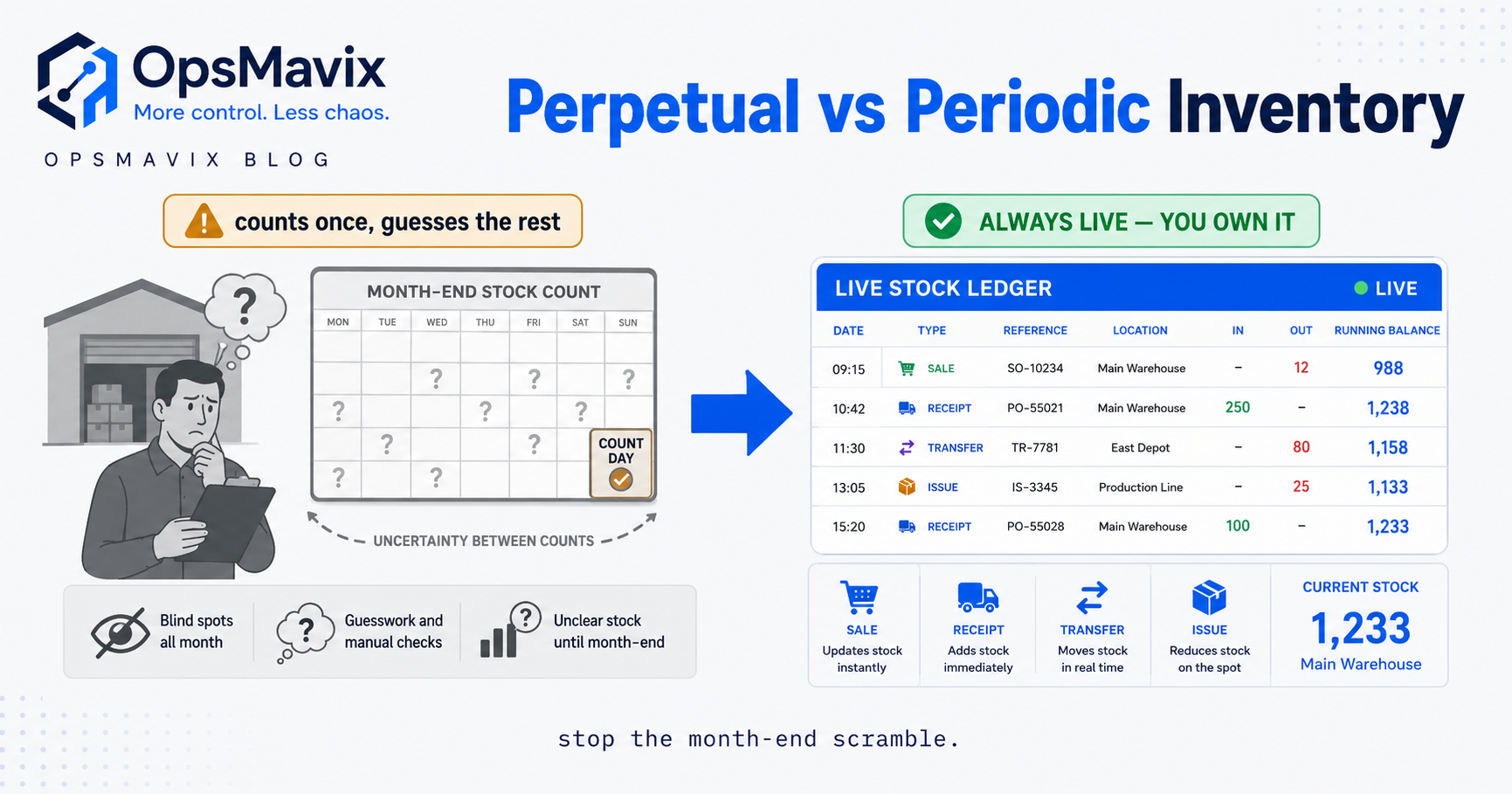
The distinction sounds like accounting trivia. It is not. It decides whether, on any given Tuesday afternoon, the number on your screen is the number on your shelf — or a guess that was last true weeks ago. This guide defines both systems plainly, compares them where it matters, and answers the question the page-1 results skirt: which one is right for a growing UK operation, and what the cheaper option quietly costs you between counts.
What perpetual inventory means
A perpetual inventory system updates the stock record the moment stock moves. Receive twelve units, the balance goes up by twelve. Sell one, it comes down by one. Transfer a case between sites, scrap a damaged item, pull components into production — each event changes the recorded quantity as it happens, so the record is meant to be live at all times. Cost of goods sold is recognised at the point of each sale rather than worked out later.
The defining feature is continuity. There is no “as of” date on a perpetual figure — or rather, the “as of” is always now. That is only possible when the update is mechanical: a scan, a picked order, a booked-in delivery, each one moving the count without anyone sitting down to reconcile. As AccountingTools puts it, the perpetual system keeps a running total continuously, which is exactly why it needs technology to carry the load rather than a person with a pen.
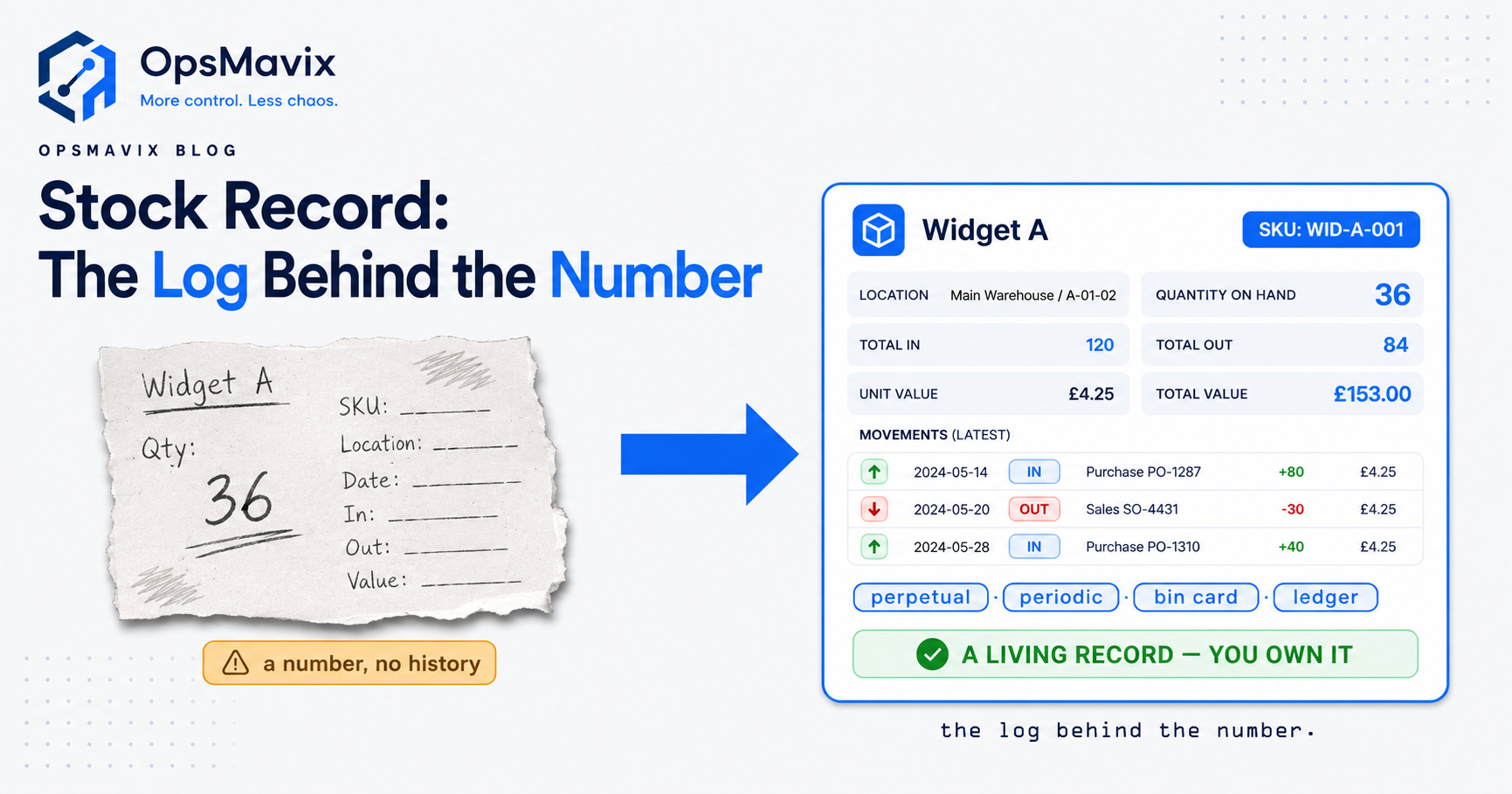
This is the layer a stock record lives on when it is done well: perpetual is simply the “when” of updating — continuously, as opposed to occasionally.
What periodic inventory means
A periodic inventory system does not track each movement against the record. Purchases go into a holding account through the period, sales are recorded as revenue, but the inventory balance itself is only established at set intervals — month-end, quarter-end, year-end — by physically counting what is on the shelf. Between counts, the recorded inventory figure is frozen at whatever the last count said. Cost of goods sold is a calculation done after the fact: opening stock, plus purchases, minus the closing count.
The Penn State managerial accounting text frames it cleanly — periodic updates the inventory account only at scheduled times at the end of an operating cycle. So the system’s view of your stock is accurate on count day and decays from there. Nobody is doing anything wrong; the design simply does not attempt to know the in-between.
Periodic is cheap and simple precisely because it asks nothing of you day to day. That is its whole appeal, and, as we will see, its whole problem once the operation grows.
Perpetual vs periodic inventory: the comparison table
Here is the honest side-by-side. Note that neither column is “the good one” — they are fit for different scales.
| Dimension | Perpetual | Periodic |
|---|---|---|
| When the record is true | Continuously — updated at every movement | Only at each physical count; decays in between |
| Cost of goods sold | Recognised at each sale, in real time | Calculated at period end (opening + purchases − closing) |
| Stock figure at any moment | Available on demand | Estimated from the last count |
| Accuracy driver | Depends on movements being captured (usually by scan/system) | Depends on the count being done well |
| Setup cost | Higher — needs a system and disciplined data capture | Very low — a spreadsheet and a count |
| Ongoing effort | Low per transaction, but continuous | Concentrated into periodic count events |
| Best for | Multi-person, multi-channel, multi-location, higher volume | Small, single-location, low-line-count operations |
| Fails when | Movements go uncaptured (drift creeps in silently) | The gap between counts hides problems until they are expensive |
| Supports reorder points, availability, forecasting | Yes — live data makes these possible | Weakly — figures too stale to trust for decisions |
The table shows the real trade. Periodic wins on cost and simplicity. Perpetual wins on everything that depends on knowing where you stand right now — which, past a certain size, is most things.
A worked example: the same week under both systems
Take a small UK wholesaler with 400 SKUs across one warehouse, moving perhaps 150 order lines a day. It is Wednesday. A customer wants 60 units of a fast line for dispatch tomorrow.
Under periodic: the last count was on the 1st. It is now the 17th. The spreadsheet says 74 in stock, but that figure is sixteen days and roughly 2,400 movements old. Sales, returns, a breakage and a supplier short-delivery have all happened since, none of them against the record. To answer the customer honestly, someone walks to the aisle and counts. They find 41. The system was wrong by 33 units — not through error, but by design. Multiply that walk-and-count across every promise the team makes, and you have a full-time job hidden inside “we run lean”.
Under perpetual: the record shows 41 because it has been moving with every scan since the 1st. The salesperson sees available stock (on hand minus what is already committed to open orders) reads 41, and knows immediately they can promise 41 today and the rest on the next delivery. No walk. No guess. The decision takes seconds and is right.
Same business, same shelf. The only difference is whether the record was maintained continuously or left to go stale — and that difference is the entire cost case for perpetual. It is also why a live figure makes a reorder point system actually work: a trigger is only useful if the number it watches is true.
Which system fits which business size
Ignore anyone who tells you every business needs perpetual. Fit is about pressure, not prestige.
Periodic is genuinely fine when: you have a small, single-location catalogue; one or two people handle stock; movement volume is low enough that an occasional count keeps you honest; and no decision you make daily depends on a live figure. A café stockroom, a small maker with 30 lines, a service firm with a cupboard of consumables — periodic is the right, proportionate answer. Buying software here is over-engineering.
You have outgrown periodic when several of these are true: more than one person moves stock, so the record depends on many people remembering; you sell across more than one channel, and overselling is a live risk; stock sits across more than one location; volume has climbed past the point where a monthly count reflects reality; or you have started making promises — dispatch dates, quotes, reorders — on figures you no longer fully trust. This is the “outgrowing spreadsheets and disconnected tools” middle, and it is where perpetual stops being a luxury.
The tell is behavioural, not numerical: when your team counts the shelf before they trust the system, periodic has failed, whatever your line count. That same signal is what pushes operations towards a fully automated inventory system — not the count itself, but the loss of faith in the record.
The hidden cost of periodic: flying blind between counts
The headline cost of periodic is low. The hidden cost is the gap. Between counts, you are operating on a figure that gets less true every day, and every decision made on it inherits that decay.
Concretely, the blind period costs you in four ways:
Oversells and stockouts. You promise stock you do not have, or refuse stock you do, because the figure lied. In a multi-channel setup this is how you end up cancelling a customer’s order after taking their money — the failure mode a business fights when it tries to stop overselling across Shopify, Amazon and eBay.
Emergency buying. Discovering at count time that a line ran out three weeks ago means panic reorders, express shipping, and paying a premium to fix a problem a live figure would have flagged at the reorder point.
Dead and slow stock hiding in plain sight. Periodic tells you the total on count day; it does not surface the line that has not moved in five months. That stock ties up cash silently until a count — and a hard look — finally catches it, the exact rot that slow-moving stock management exists to stop.
Decisions made on fiction. Every forecast, every purchase, every “can we take this job” made between counts rests on a number nobody can defend. The cost is not one big error; it is a thousand small ones you never attribute to the record because you never see the counterfactual.
The uncomfortable truth: periodic does not remove the cost of not knowing your stock. It moves that cost into daily firefighting, where it is harder to see and easier to tolerate.
The month-end scramble — and how an owned perpetual system removes it
There is a specific ritual periodic imposes: the period-end count. Everything stops, or half-stops. Staff walk aisles with clipboards, the warehouse freezes or works around the count, discrepancies surface all at once, and the finance close waits on numbers that arrive late and rarely reconcile first time. The bigger the operation, the more the scramble costs in overtime, disruption and error-under-pressure — because a rushed count is itself a source of the inaccuracy it is meant to fix.
A perpetual system removes the scramble by making the count continuous instead of episodic. The record is already live, so month-end is a confirmation, not a reconstruction. And rather than one enormous annual stop-the-warehouse count, accuracy is maintained by a rolling cycle count — a small slice of stock checked continuously, high-value and fast-moving lines more often, so errors are caught while they are days old and cheap, not months old and expensive.
The phrase to hold onto is owned operations system, not “software”. An off-the-shelf tool gives you perpetual mechanics but often forces your process to bend to its assumptions. A right-sized system built around how your stock actually moves makes the update a by-product of the work — a scan on receipt, a picked order, a booked transfer — so the record stays true because staying true is not a separate task anyone has to remember. That is the design intent behind an inventory automation system: the month-end number is right because every day’s numbers were right, not because someone rebuilt them under deadline.
Perpetual doesn’t mean accurate on its own
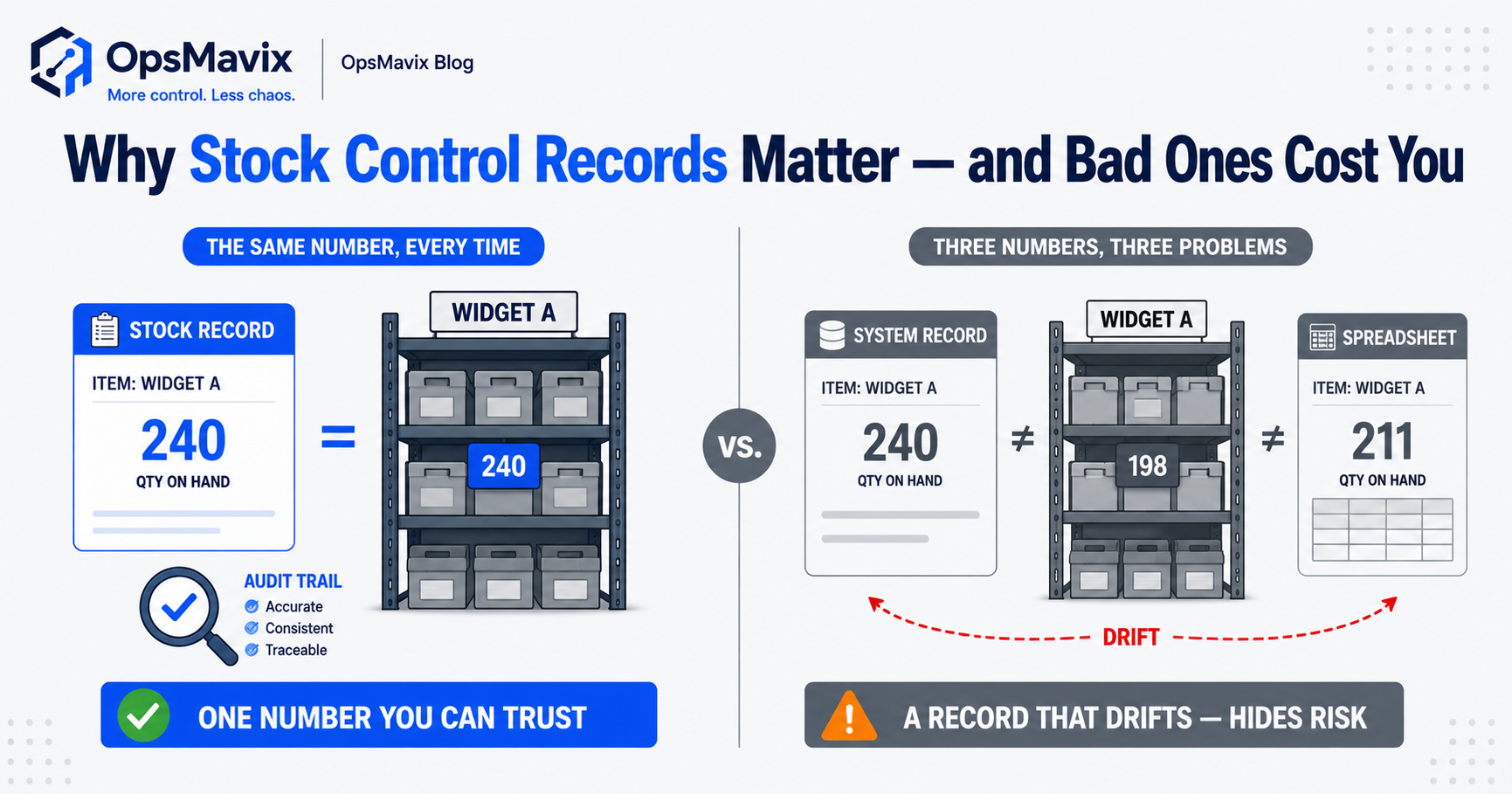
A fair warning, because the vendors skip it. Perpetual is a system for staying accurate; it is not a guarantee of accuracy. A perpetual record is only as true as the movements feeding it. Miss a movement — a breakage nobody logs, a return that goes back on the shelf but not the count — and the record drifts silently, exactly as periodic does, but with the added danger that everyone trusts a perpetual figure and acts on it without checking.
That is why perpetual and cycle counting are a pair, not alternatives. The perpetual system keeps the record live; the rolling count keeps the live record honest by catching the movements that slipped through. Skip the count and a perpetual system slowly becomes a confidently wrong one — the state described in why stock never matches the system. Neither IFRS nor UK practice mandates one method over the other; as the standard-setters note in IAS 2 Inventories, the requirement is a reliable inventory figure, not a particular way of arriving at it. Perpetual is the better road to a reliable figure at scale — but only if you also verify it.
How to choose
Strip it to three questions:
- Do daily decisions depend on knowing your stock right now? If promises, reorders and channel availability hinge on a live figure, you need perpetual. If nothing you do today breaks when the figure is a few weeks stale, periodic is proportionate.
- How many hands and channels touch the stock? One person, one location, one channel tolerates periodic well. Several of any of those, and the record needs to update itself, because it can no longer depend on everyone remembering.
- What is the blind period already costing you? Add up the oversells, the express shipping, the dead stock found late, and the hours spent walking aisles to verify. If that number is uncomfortable, you have already outgrown periodic — you are just paying for perpetual accuracy without getting it.
For most growing UK operations past the very smallest, the answer lands on perpetual — implemented as an owned, right-sized system that maintains itself, verified by a rolling cycle count. Not because perpetual is fashionable, but because past a certain scale the cost of not knowing quietly exceeds the cost of a system that always does.
FAQ
What is the main difference between perpetual and periodic inventory?
Timing. A perpetual system updates the stock record continuously, at every movement, so the figure is live at all times and cost of goods sold is recognised at each sale. A periodic system only updates the inventory balance at scheduled physical counts (month, quarter or year end) and works out cost of goods sold afterwards. Between counts, a periodic record is frozen at its last count while a perpetual one keeps moving.
Is perpetual inventory more accurate than periodic?
Usually, but not automatically. Perpetual is more accurate because it captures each movement as it happens, so there is no long blind period for errors to accumulate unseen. But a perpetual record is only as good as the movements fed into it — miss a breakage or an unlogged return and it drifts too. That is why perpetual systems pair with a rolling cycle count, which verifies the live figure and catches whatever slipped through.
Which inventory system is cheaper?
Periodic is cheaper to set up and run day to day — it needs little more than a spreadsheet and a count. But that low headline cost hides the price of flying blind between counts: oversells, emergency buying, dead stock found late, and hours spent walking aisles to verify figures. For a small, low-line, single-location operation that saving is real. Past that size, the hidden cost of periodic typically exceeds the cost of a perpetual system.
Do I need software for perpetual inventory?
In practice, yes. Perpetual means the record updates at every movement, which is only sustainable when the update is mechanical — a scan on receipt, a picked order, a booked transfer — rather than a person manually logging each event. For a growing operation the right answer is usually not a bloated ERP but a right-sized system built around how your stock actually moves, so the record stays true as a by-product of the work.
Which system does UK and IFRS accounting require?
Neither is mandated. IAS 2 Inventories governs how inventory is measured and valued, but does not dictate whether you track it perpetually or periodically — it requires a reliable inventory figure, however you arrive at it. The choice is an operational one, driven by your size, volume and how much your daily decisions depend on knowing your stock in real time.
How OpsMavix can help
Knowing the difference between perpetual and periodic is the easy part. The hard part is running a perpetual record that stays true once real work — busy floors, multiple channels, several people, month-end pressure — runs over it. That is what OpsMavix builds: an owned operations system that maintains a live stock record as a by-product of the jobs your team already does, verified by a rolling cycle count, so the number on the screen is the number on the shelf without anyone rebuilding it under deadline. Right-sized for the middle ground — outgrowing spreadsheets and disconnected tools.
If your team counts before they trust the system, or your month-end close waits on a count that never reconciles first time, you are already paying the cost of periodic. Book a Free Operations Leak Audit and we will map where your record drifts from your shelf, and what it is costing you.
Sources
Keep reading
Getting value from OpsMavix? Add us as a preferred source on Google — you'll see more of our operations content in your AI Overviews, AI Mode and Search.