
Inventory Cycle Count: Accuracy Without the Shutdown
An inventory cycle count keeps your numbers right without shutting the warehouse for a full count. Here's how to run one — ABC tiers, frequency, variance chasing — so the system finally matches the shelf.
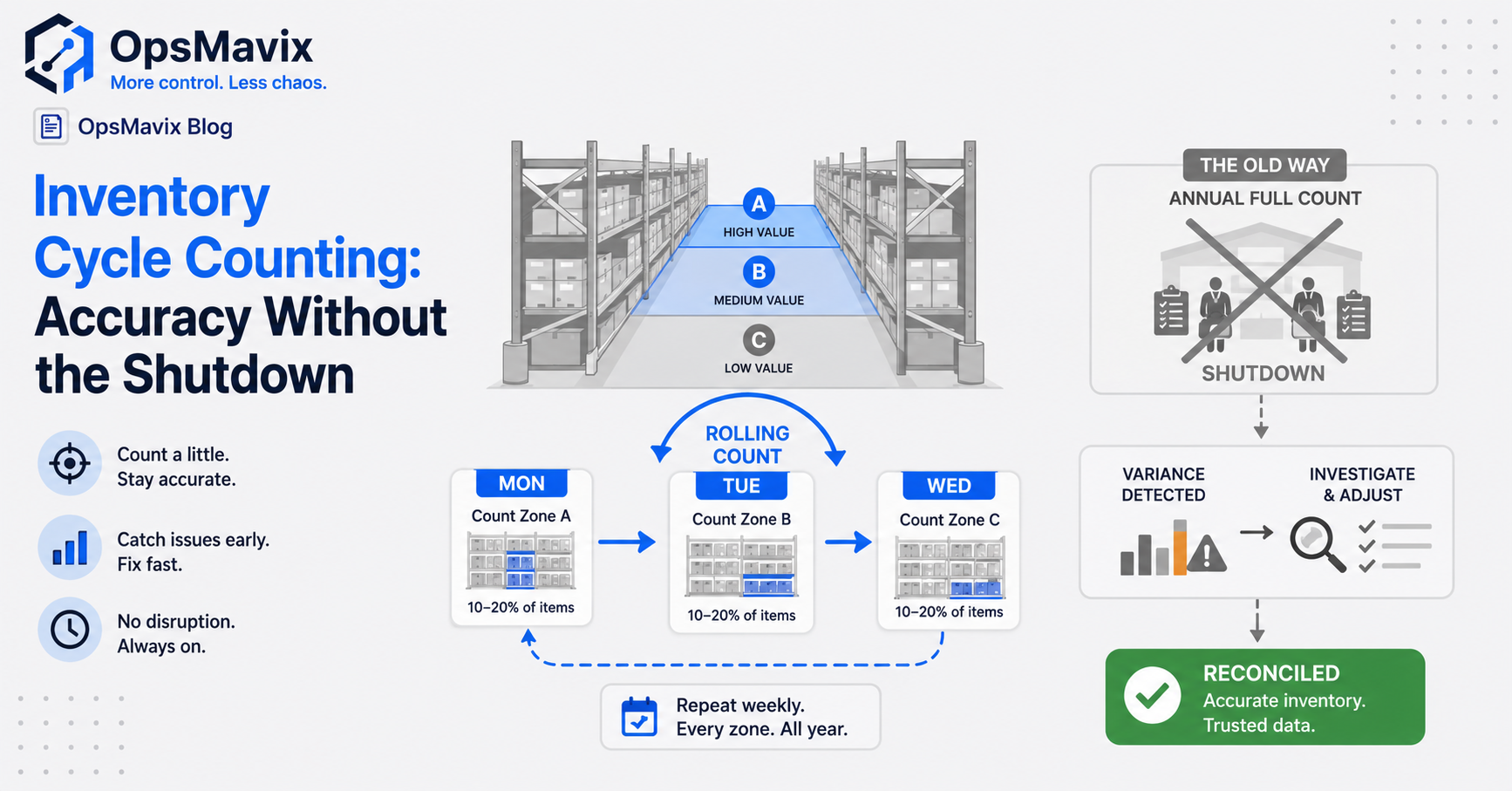
An inventory cycle count is a rolling method where you count a small slice of your stock every day or week, instead of shutting the warehouse for one big count once a year. Done right, it keeps your numbers accurate all year round, catches errors while they’re still cheap to fix, and never costs you a day of dispatch. The catch: a cycle count only works if it’s built into how the warehouse already runs, and if someone actually chases the variances it finds.
This is the method — the rolling discipline that keeps stock honest week to week. It’s the sibling of the full physical stocktaking procedure, which is the once-a-year, count-everything-and-reconcile event. Get cycle counting right and the annual stocktake stops being a fire drill, because the numbers are already close.
Here’s how to run one without the shutdown.
Key Takeaways
- An inventory cycle count counts a slice of stock on a rolling schedule, so you stay accurate without ever closing the warehouse.
- Count the items that matter most, most often: use ABC tiers so your fast-movers and high-value lines get counted far more than the dead stock.
- The count is the easy part. The value is in chasing every variance to root cause — pick errors, mis-receipts, phantom stock — not just adjusting the number and moving on.
- Build it into the daily flow (count a few bins each morning), not as a special event people dread.
- A cycle count makes the annual full stocktake a formality instead of a shutdown.
1What an Inventory Cycle Count Actually Is
An inventory cycle count is partial and continuous: every day or every week you count a defined subset of locations or SKUs, reconcile any difference, and move on. Over a quarter or a year, everything gets counted — but no single day stops the warehouse.
Compare that to the full physical count, where you freeze receiving and dispatch, throw the whole team at the shelves, and reconcile the lot in one go. The full count is the audit. The cycle count is the maintenance that means the audit never surprises you. They’re not competing methods — you run both, but the cycle count is what does the day-to-day work.
The operators who need this most are the ones drowning in manual reconciliation. As one put it: “our spreadsheet counts wind up being off, sometimes wildly so.” A cycle count is how you stop “wildly off” from ever building up in the first place.
2Why Cycle Counting Beats the Annual Shutdown
The annual count has two problems. First, it’s a shutdown: a day or a weekend of no picking, no dispatch, often paid overtime. Second, and worse, it’s a year-late diagnosis. If a bin’s been wrong since March, you find out in December, by which point you’ve oversold, refunded, and lost the trail back to the cause.
For a lot of warehouse operators, the whole day runs on numbers they can’t trust: “we would consistently oversell items we didn’t even have on hand — the stock never matches the system, and I’m running a million messy spreadsheets for the warehouse.” The annual count doesn’t fix that — it just confirms the damage. A cycle count catches the drift in days, while you can still trace it to the pick, the receipt, or the keying error that caused it.
The point isn’t to count more. It’s to catch errors when they’re a single transaction old instead of a year of compounding noise. That’s also why your stock keeps lying to you between counts — see why your stock never matches the system.
3Use ABC Tiers — Count What Matters, More Often
Counting every SKU at the same frequency is a waste. Most of your value sits in a small fraction of your lines. ABC analysis sorts stock by importance so your counting effort lands where the money is:
- A items — your top ~20% of SKUs by value or velocity (often ~80% of the action). Count these frequently: weekly, or even daily for the fastest movers.
- B items — the middle tier. Count monthly or quarterly.
- C items — the long tail: low-value, slow-moving, easy. Count once or twice a year.
The logic is simple: an error on a fast-moving, high-value A item costs you a cancelled order and an angry customer this week. An error on a dusty C item costs almost nothing and can wait. So you spend your counting hours where the leak actually is.
This is the difference between “count everything once a year” and “keep the items that drive the business accurate all the time.” It’s also what makes cycle counting fit into a normal workday rather than a special event.
4Set a Frequency You’ll Actually Keep
A cycle-count schedule that’s too ambitious dies in week three. The trick is a cadence that survives a busy Monday.
A workable pattern for an SME warehouse:
- Count a fixed handful of A-item bins every morning before picking ramps up: ten minutes, one person, scanner in hand.
- Roll B items through on a monthly rotation so the whole tier gets covered.
- Sweep C items in larger batches once or twice a year.
Tie counts to triggers, not just the calendar. Count a location when it hits zero (easiest count there is — it should be empty), when a pick comes up short, or right after a big receipt. Event-driven counts catch errors at the exact moment they’re created.
The enemy here is friction. If counting a bin means walking back to a PC and typing into a spreadsheet, it won’t happen on a busy day. If it’s a scan-and-confirm at the shelf that takes seconds, it sticks. Adoption lives or dies on that.
5Chase the Variance — Don’t Just Adjust the Number
This is where most cycle-count programmes leak value. You count, the system says 40, the shelf says 37, and the lazy move is to overwrite 40 with 37 and walk away. You just hid the problem instead of fixing it.
Every variance is a clue. Three short on an A item usually means a pick error, a mis-keyed receipt, a return that never got logged, or theft. If you only ever adjust the number, you’ll be adjusting the same bin next month, because the process that caused the gap is still running. Cin7 users describe exactly this — “inventory numbers change for no reason — phantom stock” and an “$80k value difference that cannot be explained.” “Cannot be explained” is what happens when nobody chases variance to root cause.
So: set a tolerance (a few units on a C item is noise; one unit on a high-value A item is a fire), investigate anything over it, log the cause, and fix the process. Over a few months the recurring causes show up in the log, and you fix them at source. That’s how accuracy actually climbs — not from counting, from learning what the counts are telling you.
6Cycle Count vs Full Stocktake — When to Use Each
| Inventory cycle count | Full physical stocktake | |
|---|---|---|
| Frequency | Daily / weekly, continuous | Once or twice a year |
| Coverage per session | A small slice (ABC-prioritised) | Everything, all at once |
| Warehouse shutdown | None — runs during normal ops | Usually freeze receiving + dispatch |
| Catches errors | Days after they happen | Up to a year later |
| Main purpose | Keep accuracy high all year | Audit + reconcile the books |
| Best for | Day-to-day stock truth | Year-end / compliance sign-off |
You don’t pick one. The cycle count is the engine that keeps numbers right; the full stocktake is the periodic audit that signs off the books. Run cycle counts well and the annual count becomes a quiet formality — most bins match on the first pass, because they’ve never been allowed to drift far.
7Build It Around the Warehouse, Not a Generic Tool
Cycle counting only sticks if it fits the floor. The reason so many warehouse managers end up back in spreadsheets is that the off-the-shelf tools either can’t see the warehouse — “Can’t see what’s on my warehouse like an excel sheet, which is almost free” — or bury the count under workarounds and per-seat fees they can’t justify: “costs us 8 times more than Xero and realistically isn’t giving us 8 times the value.”
Our view at OpsMavix: a cycle-count system should encode your ABC tiers, your bin layout, your count triggers, and your variance tolerances — and feed straight into the live stock figure so a count corrects the number everyone else is working from. Counting on a scanner at the shelf, variances flagged automatically, root-cause logged against the SKU, and you own the whole thing outright. No vendor can sunset it, hike it, or hold your stock data hostage. That’s the difference between a count that gets done and one that quietly dies.
FAQ
What is an inventory cycle count?
An inventory cycle count is a method where you count a small portion of your stock on a rolling schedule — daily or weekly — instead of counting everything at once. Over time the whole warehouse gets covered, but you never have to shut down for a single big count. The goal is keeping stock accurate all year, not just at year-end.
How is a cycle count different from a full stocktake?
A cycle count is continuous and partial: a slice each day, prioritised by value. A full physical stocktake is a single event where you count everything and reconcile the books, usually freezing receiving and dispatch to do it. You run both — the cycle count keeps numbers right day to day, the stocktake audits them periodically.
How often should you cycle count?
Use ABC tiers. Count high-value, fast-moving A items frequently (weekly or daily), B items monthly or quarterly, and slow C items once or twice a year. Add event triggers — count a bin when it hits zero, when a pick comes up short, or after a large receipt. Pick a cadence you can keep in peak season, not just a quiet one.
What is ABC analysis in cycle counting?
ABC analysis sorts your SKUs by value or velocity into three tiers. A items are the small group driving most of your value and get counted most often; C items are the low-value long tail counted rarely. It focuses your counting effort where errors actually cost money, so the count fits a normal workday instead of being a special event.
Why does my stock still drift even though I count?
Usually because you’re adjusting numbers without chasing the cause. If you overwrite the system figure with the counted figure and move on, the process that created the gap — a pick error, a mis-keyed receipt, an unlogged return — is still running, so the same bin drifts again. Chasing variance to root cause is what actually raises accuracy. See why your stock never matches the system.
How OpsMavix Can Help
OpsMavix builds custom inventory systems for small and mid-sized warehouses: ABC-tiered cycle counting on a scanner, variances flagged and root-caused automatically, and counts that correct the live stock figure everyone works from — built around your bins and your flow, and yours to own outright. No annual shutdown, no £100k WMS, no vendor that can switch it off.
If your spreadsheet counts still wind up “off, sometimes wildly so,” and you only find out when you oversell, that’s an accuracy leak costing you cancelled orders and refunds. Book an Operations Leak Audit and we’ll map where your stock numbers go wrong.