
Reorder Point System: Knowing When and How Much to Reorder
A reorder point system decides when to reorder each line and how much — so you never run out of a seller and never tie up cash in stock that won't move. Here's the formula behind it, how safety stock really works, and why a spreadsheet version quietly rots.
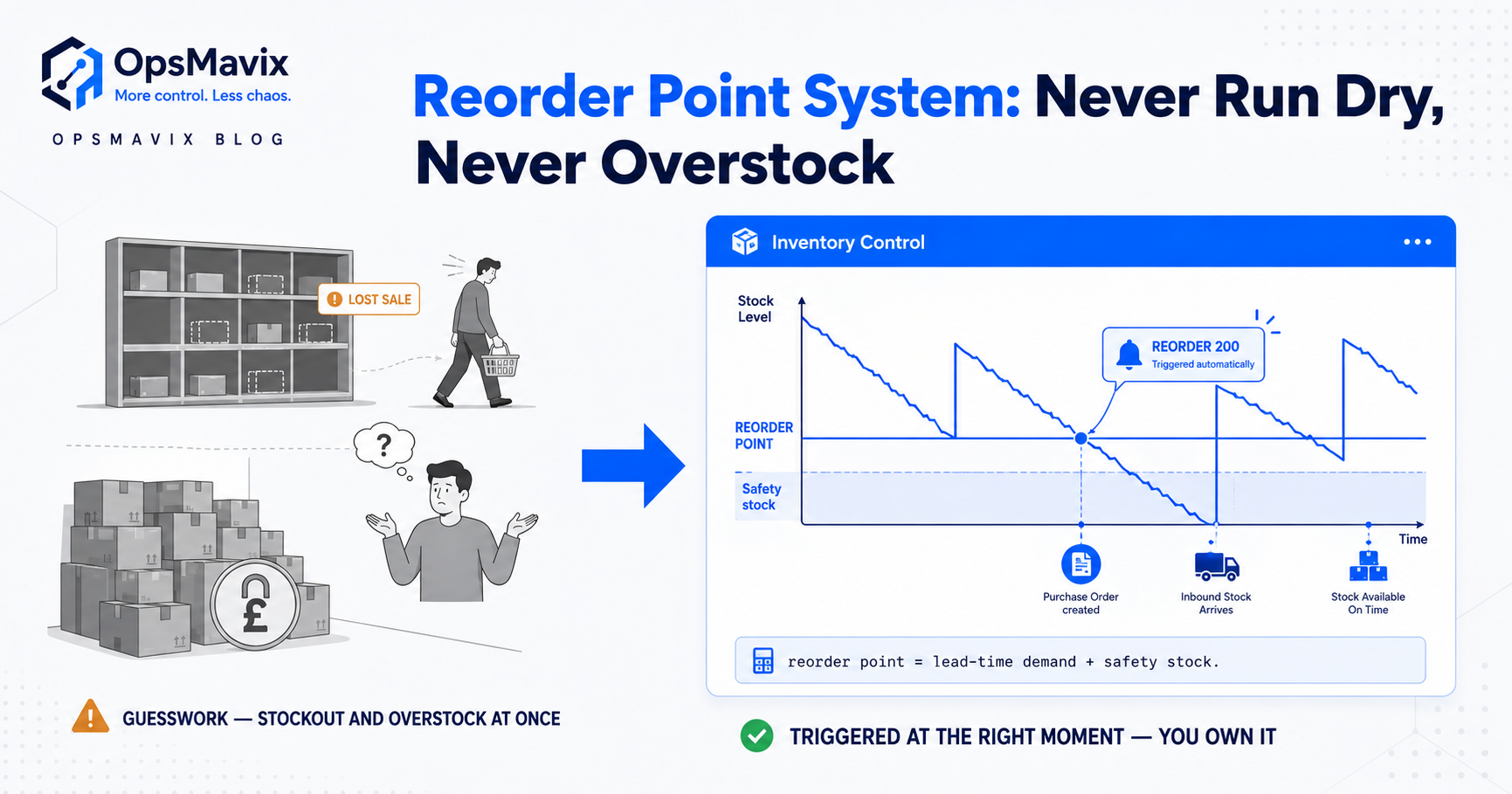
A reorder point system answers two questions you’re currently answering by gut: when do I reorder this line, and how much do I bring in? Get it right and you stop the two most expensive mistakes in stock control at the same time — running out of the thing customers actually want, and burying cash in shelves of stuff that won’t move for months. This isn’t about counting accuracy (that’s a different problem) — it’s about the trigger. The moment a line drops to a set level, the system flags it, tells you the order quantity, and you buy before the shelf hits zero, not after.
Most growing businesses run this on memory and a bad Friday-afternoon spreadsheet. It works until it doesn’t — until a supplier’s lead time slips, a line unexpectedly sells out, or the person who “just knew” when to reorder goes on holiday. A proper reorder point system takes the decision off a person’s head and puts it into the numbers.
Key Takeaways
- A reorder point system decides when to reorder each line and how much — the two calls that keep you from stockouts and overstock at once.
- The core formula is simple and real: reorder point = (average daily demand × lead time) + safety stock.
- Safety stock is the buffer for the surprises — demand spikes and late suppliers — sized per line, not one blanket number.
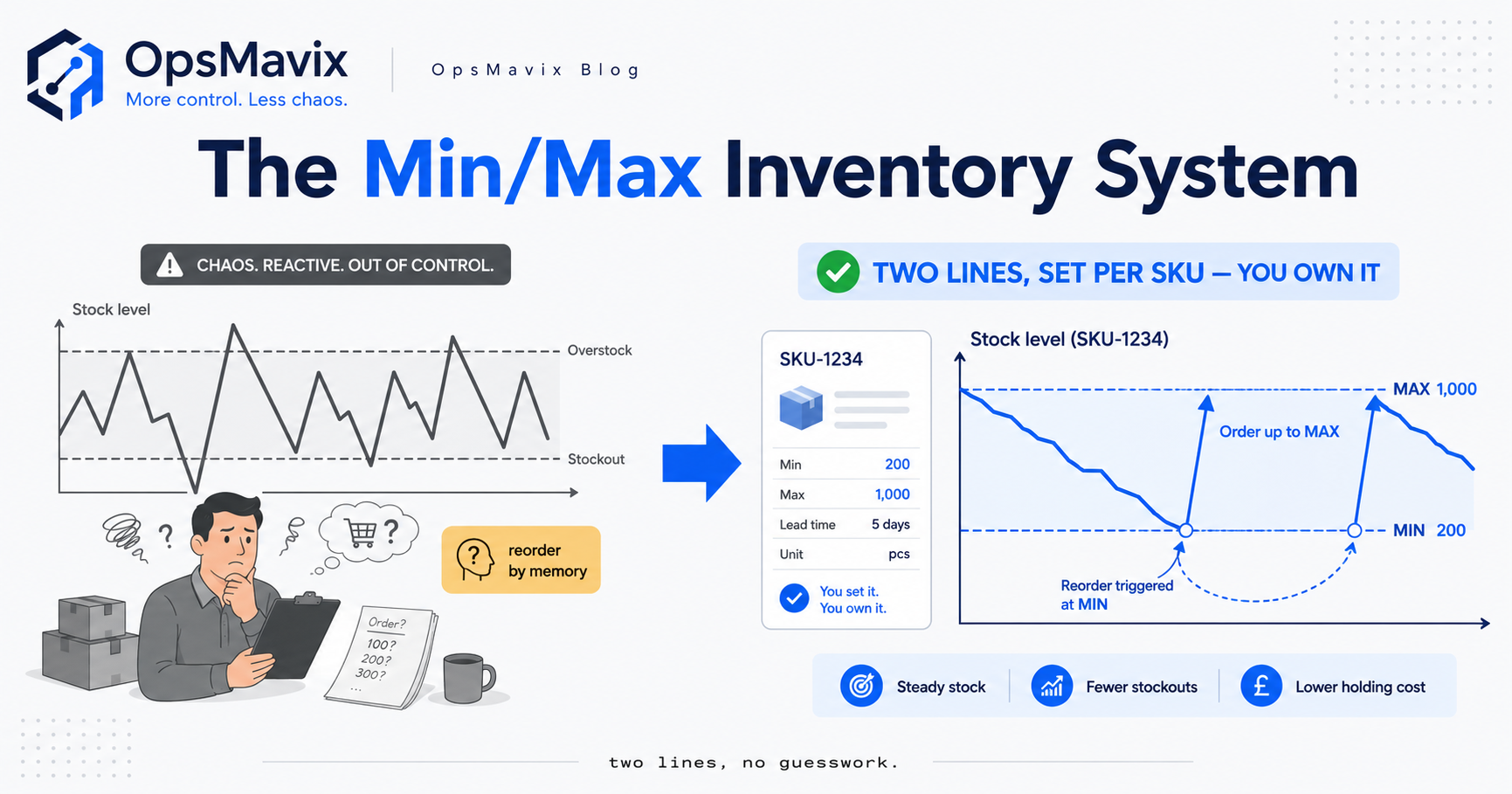
- Min/max levels turn the trigger into an order: hit the minimum, top back up to the maximum.
- A spreadsheet version rots because demand, lead times and prices move and nobody re-tunes it. A live system re-checks every line, every day.
- Built around your suppliers and your sales, it fires the alert (or the draft PO) before you run out — no one watching stock all day.
1. What a Reorder Point System Actually Does
A reorder point is the stock level at which you place a new order. Sit above it, do nothing. Cross it, and it’s time to buy — because the quantity you have left is just enough to cover demand while the new stock is in transit. The system watches every line’s live quantity against its own reorder point and raises the flag the moment one drops through the line.
That’s the whole job: convert “I think we’re getting low on that” into a dated, quantified signal per SKU. No single person has to hold hundreds of lines in their head, remember which supplier is slow this quarter, or notice a fast-mover slipping before it’s gone. The reorder point does the noticing. You do the buying.
The reason this matters is that both failure modes cost real money. Run out of a seller and you lose the sale, sometimes the customer, and you train them to check a competitor. Overbuy to feel safe and you’ve turned working capital into shelf-clutter you’ll discount to shift. A reorder point system is how you stay in the narrow band between the two.
2. The Formula: Lead-Time Demand Plus Safety Stock
The reorder point is not a round number someone picked. It’s built from two things:
Reorder point = (average daily demand × lead time in days) + safety stock.
The first part is lead-time demand — how much you’ll sell while you wait for the supplier to deliver. If you shift 20 units a day and the supplier takes 7 days from order to shelf, you’ll burn 140 units before the new stock lands. So you have to reorder while you still have at least 140 on hand, or you run dry mid-wait.
The second part, safety stock, is the cushion for everything that doesn’t run to average — a busy week, or a delivery that turns up late. Add the two and you get a reorder point that covers the normal wait plus a margin for the wait going wrong. Lead time is the number people most often get wrong here: it’s not “how long the courier takes,” it’s the full clock from the moment you decide to order to the moment it’s sellable on the shelf — supplier processing, transit, goods-in, put-away, the lot.
3. Safety Stock — the Buffer for the Surprises
Safety stock is the part people either skip or overdo. Skip it and every late delivery or good week becomes a stockout. Overdo it — a blanket “keep two weeks of everything” — and you’ve quietly overstocked your whole catalogue. The right amount is sized per line, off the two things that actually vary: demand and lead time.
A practical way to set it: safety stock = (max daily demand × max lead time) − (average daily demand × average lead time). That covers the realistic bad case — your busiest days landing on your supplier’s slowest delivery — rather than a number plucked from nerves. Lines with steady demand and a reliable supplier need very little buffer. Lines that spike, or come from a supplier who’s late half the time, need more. The variability decides it, not a gut feeling applied evenly.
The trap to avoid is treating safety stock as free insurance. Every buffer unit is cash on a shelf and space in the building, so you don’t want a fortnight’s cushion on a line that never surprises you. Size it to the actual risk on that line and you protect the sellers that matter without drowning slow movers in spare stock.
4. Min/Max Levels: Turning the Trigger Into an Order
The reorder point tells you when. Min/max levels tell you how much. Your minimum is effectively the reorder point — the floor you don’t want to drop below. Your maximum is the level you top back up to. Order quantity is simply the gap: bring the line from where it is now back up to its max.
Setting the max is where you balance two costs. Order in bigger batches and you cut how often you place orders and often earn a price break — but you carry more stock and tie up more cash. Order little and often and you keep stock lean but rack up ordering effort, delivery fees and the risk of a gap. The max sits where those two settle for that line: fast, cheap-to-hold movers can run leaner; lines with a high delivery minimum or a real price break for volume want a higher top-up. This is the “economic order quantity” idea in plain terms — order enough to be worth the trip, not so much you’re funding a warehouse of it.
5. Why a Spreadsheet Reorder Point Quietly Rots
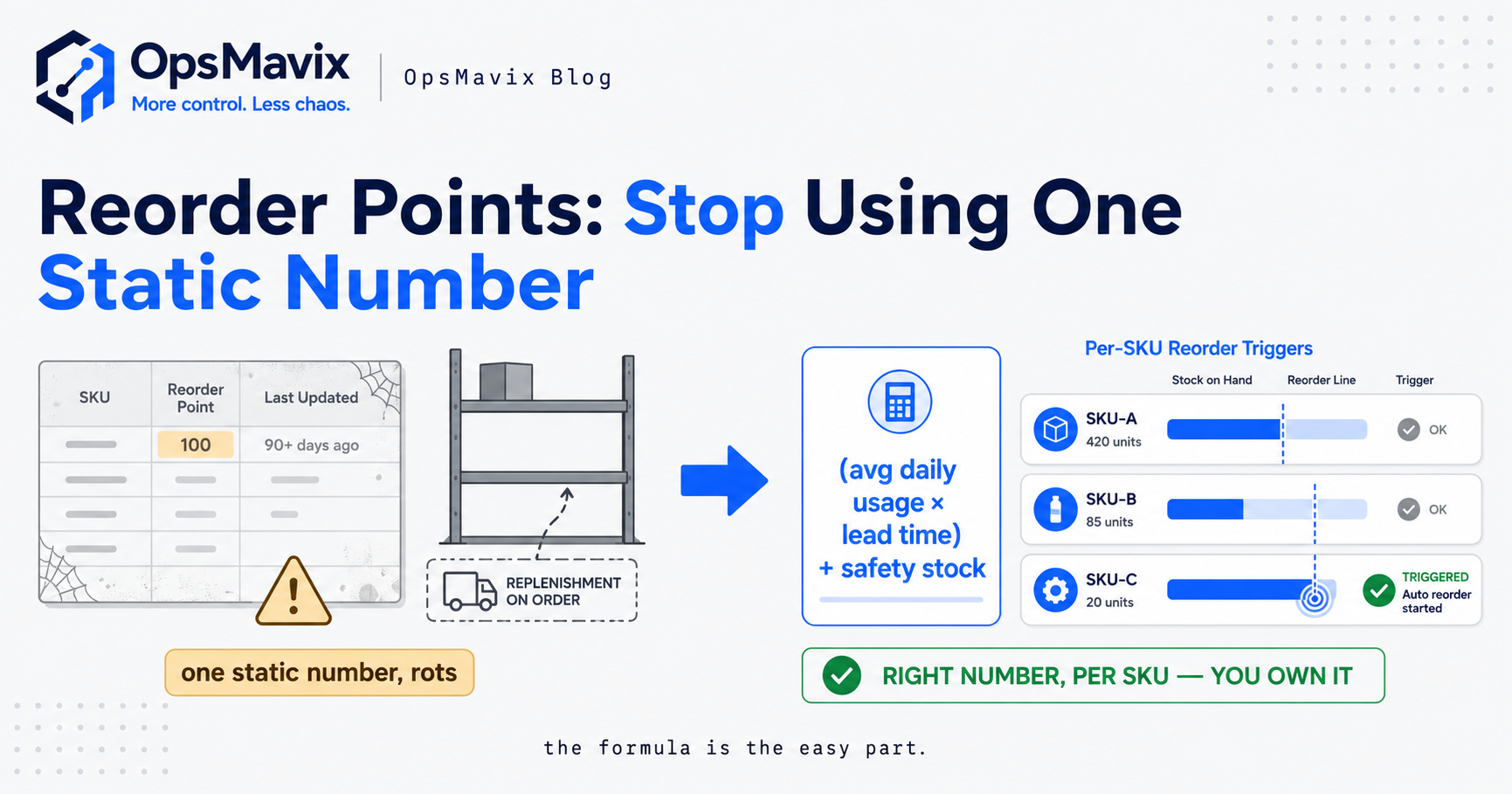
Plenty of businesses do set reorder points once — in a spreadsheet, by hand, on a good day. Then reality moves and the spreadsheet doesn’t. Demand climbs into a season and the old point is now too low, so you stock out on your best lines at the worst time. A supplier’s lead time creeps from 5 days to 12 and nobody re-runs the maths, so the trigger fires too late every time. A line dies off and its reorder point keeps quietly pulling in stock you’ll never sell.
The deeper problem is that a static reorder point is only right on the day you set it. Demand, lead times and prices all drift, and a spreadsheet has no way to notice or re-tune itself. Worse, it can’t watch your live stock — someone has to remember to open it, cross-check today’s quantities, and spot which lines have dropped through. On a busy week that check is the first thing to get skipped, and the first stockout follows a week later.
6. Automatic Reorder Alerts, Built Around Your Suppliers
The point of the system is that you stop watching stock. Instead of someone scanning levels and reacting, the system watches every line’s live quantity against its reorder point and raises the alert the moment one drops through — or, where you want it, drafts the purchase order ready to send. The decision is made for you; you’re just approving it.
Built around your setup, that alert knows more than “you’re low.” It knows the right supplier for the line, that supplier’s real lead time, the order quantity to bring you back to max, and any minimum-order or price-break you should hit while you’re buying. It can group lines by supplier so one order covers everything due from them, instead of three separate deliveries this week. That’s the difference between a generic “low stock” badge and a reorder system that actually does the purchasing legwork — the sort of thing a right-sized inventory automation system is built to handle.
7. Build vs Buy: A Reorder System Shaped to Your Stock
Reorder points only work if they fit how you actually buy. Off-the-shelf tools tend to offer one blanket rule, ignore that your suppliers have wildly different lead times, or bury the feature under per-seat fees and modules you’ll never touch. Meanwhile the businesses in the gap — outgrowing a spreadsheet, not looking for a full ERP — end up back on memory and Friday guesswork.
A right-sized system encodes your reality: per-line demand pulled from your real sales, each supplier’s true lead time, safety stock sized to how much each line actually varies, and min/max levels set to your order economics. It watches your live stock figure, fires the alert or the draft PO before you run dry, and it’s yours to own outright — no vendor can price-hike it or switch it off. This sits next to the accuracy question — your reorder points are only as good as the stock number they read, so why your stock never matches the system and keeping that number honest with an inventory cycle count are the foundation the reorder logic stands on.
FAQ
What is a reorder point system?
A reorder point system tracks each stock line’s live quantity against a set trigger level — its reorder point — and flags when it’s time to buy, along with how much to order. The reorder point is calculated from how fast the line sells and how long the supplier takes to deliver, plus a safety-stock buffer. The goal is to reorder before you run out, without over-ordering, and without a person having to watch every line by hand.
How do you calculate a reorder point?
Reorder point = (average daily demand × lead time in days) + safety stock. The first part covers what you’ll sell while waiting for the delivery; the second is a cushion for demand spikes and late suppliers. The number that trips people up is lead time — measure it as the full clock from placing the order to the stock being sellable on the shelf, not just the courier’s transit time.
What is safety stock and how much should I hold?
Safety stock is the buffer that absorbs the surprises — busier-than-average demand and slower-than-average deliveries. A practical formula is (max daily demand × max lead time) − (average daily demand × average lead time), sized per line. Steady lines with reliable suppliers need very little; volatile lines or unreliable suppliers need more. Don’t apply one blanket buffer to everything — that’s how you quietly overstock the whole catalogue.
How is this different from cycle counting or stock discrepancies?
Cycle counting keeps your stock number accurate; reorder points decide when and how much to buy off that number. They’re linked — a reorder point is only as reliable as the stock figure it reads — but they solve different problems. If your counts are drifting, start with an inventory cycle count and why your stock never matches the system; once the number is trustworthy, the reorder logic sits on top of it.
Can reorder alerts be automatic?
Yes — that’s the main reason to build the system. Instead of someone scanning stock levels, it watches every line’s live quantity and raises an alert (or drafts a purchase order) the moment one crosses its reorder point. Built around your setup, that alert already knows the right supplier, their lead time, the order quantity, and any minimum-order or price-break to hit — so the purchasing decision is made for you, and you’re just approving it.
How OpsMavix Can Help
OpsMavix builds custom inventory systems for businesses stuck between spreadsheets and a full ERP — including the reorder logic that keeps you off both rocks. Per-line reorder points off your real sales, safety stock sized to each line’s actual variability, min/max levels set to your order economics, and alerts (or draft POs) that fire before you run out — grouped by supplier, with real lead times built in. It reads your live stock figure, so the trigger is honest, and you own the whole thing outright, with nothing a vendor can switch off.
If you’re losing sales to stockouts one month and sitting on dead stock the next, that swing is money leaking from both ends. Book a Free Operations Leak Audit and we’ll map where your reordering breaks down today, what it’s costing you, and what a right-sized system would decide for you instead.
Keep reading
Getting value from OpsMavix? Add us as a preferred source on Google — you'll see more of our operations content in your AI Overviews, AI Mode and Search.