
The Importance of Keeping Stock Control Records (and What Bad Ones Cost You)
Stock control records exist to answer one question with confidence: what do we actually have, and what did it cost? Here's why that matters — for cash, customers and every buying decision — and the catch most guides skip: a record you can't trust does more damage than no record at all.
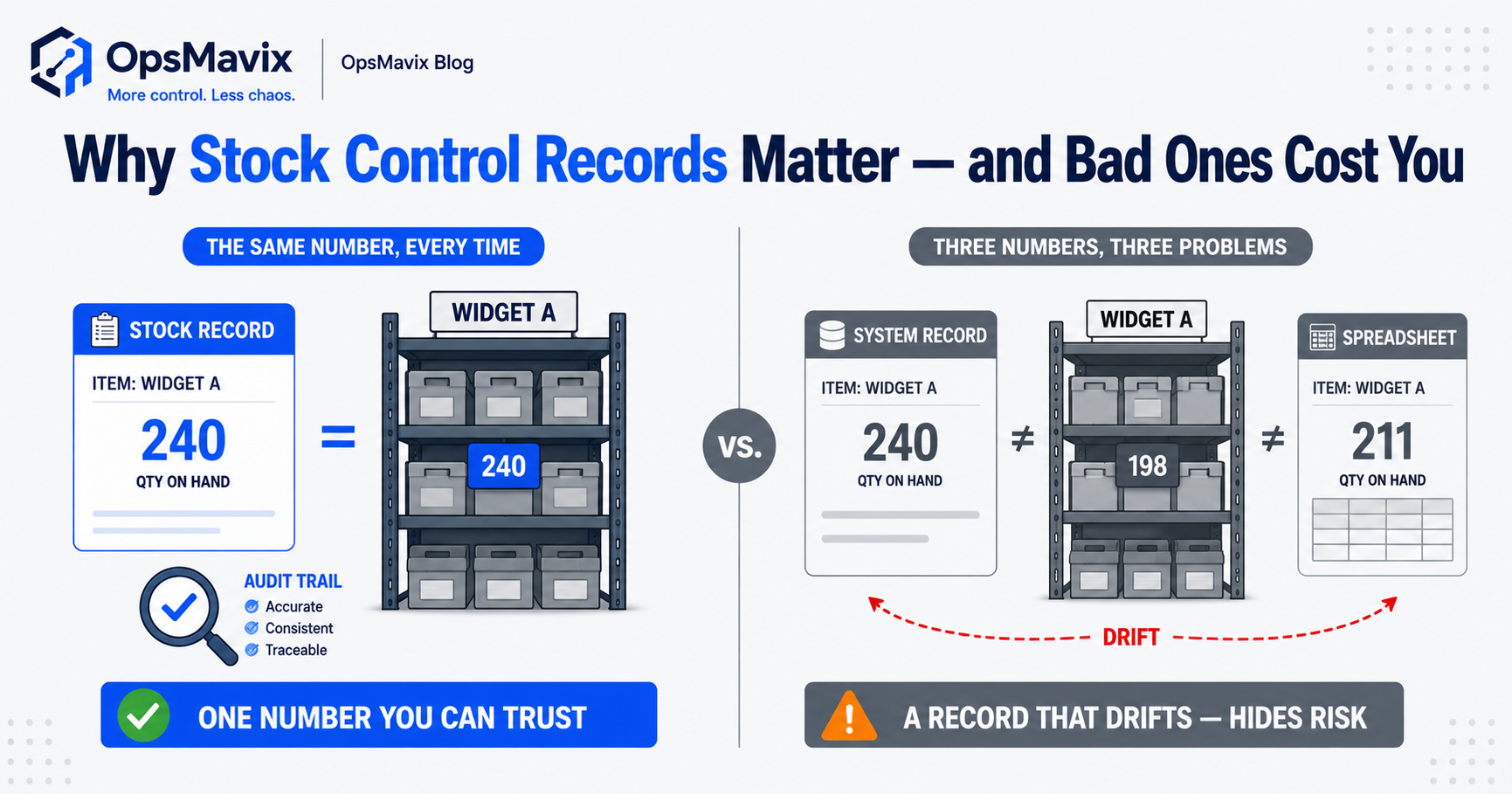
Stock control records matter because they answer one question with confidence: what do we actually have, what did it cost, and what’s moving — without walking the warehouse to check. Good records protect cash (you don’t over-buy or run dry), protect customers (you don’t sell what you can’t ship), and make every buying, pricing and planning decision something you can stand behind instead of guess. The catch most guides skip: a stock record you can’t trust is worse than no record at all, because people act on it as if it were true.
This post explains why keeping stock control records is important — and the part that actually decides whether they help you: accuracy. A perfect ledger that quietly drifts from the shelf doesn’t reduce risk; it hides it. If your records and reality have already parted ways, that specific problem is covered in why the stock never matches the system; this is the why-it-matters layer underneath it.
Key Takeaways
- Stock control records exist to answer “what do we have, what did it cost, what’s moving” with confidence, not a warehouse walk.
- They protect three things: cash (no over-buying or stockouts), customers (no overselling), and decisions (you buy and price on fact).
- The point isn’t having records — it’s having records you can trust. A drifting one is worse than none, because people act on it.
- Bad records cost real money: oversells, dead stock, emergency buys, and wrong-priced jobs — quietly, every week.
- Records only stay accurate when they update as a by-product of the work, not as a separate task someone has to remember.
What Stock Control Records Are Actually For
A stock control record is the running account of what you hold, what it cost, and how it’s moving — receipts in, sales and usage out, adjustments, and the balance left. Its job is to let anyone answer “do we have this, how many, and what’s it worth” without physically checking. That single capability is what lets a business buy on time, quote with confidence, fulfil orders it actually can, and close its books on real numbers.
The reason it matters more as you grow is simple: you can hold the whole picture in your head when there are forty lines and one location. At four hundred lines across two sites, channels and returns, you can’t — and the record becomes the only version of the truth there is. The question stops being “should we keep records” and becomes “can we trust the ones we keep.”
1They Protect Cash — Both Ends of It
Stock is cash you’ve converted into things on shelves. Bad records bleed it from both directions. Under-count and you buy what you already have, or place an emergency order at a premium because the system said you were short. Over-count and the cash sits frozen in dead stock that never sells. Either way the money’s tied up where it shouldn’t be, and you only find out at a count or a year-end.
Operators describe living on the wrong side of this exactly — “guessing and manually counting material” because the records can’t be relied on, then watching the spreadsheet figures come back “off, sometimes wildly so.” When the record is trustworthy, buying becomes a decision instead of a gamble: you reorder on a real number, before a bestseller runs dry and after the slow movers have cleared.
2They Protect Customers — You Can Only Sell What You Have
The fastest way to lose a customer is to sell them something you can’t ship. Accurate stock records are what stand between an order and that broken promise — they tell you the unit is genuinely there before you confirm it. When the record drifts, you oversell: the screen says yes, the shelf says no, and now there’s a cancellation, a refund and a customer who won’t be back.
This is the daily wound for stock-holding businesses — “we would consistently oversell items we didn’t even have on hand.” It’s not a software problem at root; it’s a records problem. A record that matches reality lets you fulfil with confidence; one that doesn’t turns every confirmed order into a coin toss. The discipline of one figure the shelf and the screen agree on is what a real inventory system is built to hold.
3They Make Decisions Defensible Instead of Guessed
Every meaningful operations decision leans on stock records: what to buy, what to discount, what to make, how to price the next job. When the records are trustworthy, those decisions rest on fact. When they’re not, they rest on the most confident person’s gut — and the business inherits whatever that gut got wrong.
The damage is worst when records are confidently wrong rather than obviously missing. People act on a clean-looking figure that’s quietly false — the “inventory numbers change for no reason” problem, where a phantom figure leads to an “$80k value difference that cannot be explained.” A missing record makes you check; a wrong record makes you act. That’s why accuracy, not existence, is the real measure of a stock control record.
4They’re Your Audit Trail and Your Traceability
Stock records aren’t just a live count — they’re the history of how the count got there. That trail matters when something goes wrong: a recall that needs to know which batch went where, a discrepancy that needs explaining, an auditor who needs to see that the numbers tie. Without a movement history, every one of those becomes a forensic exercise across spreadsheets and memory.
Good records turn those questions into queries. Which lot went into which order, who adjusted a figure and when, why the count changed last Tuesday — answerable, because each movement was logged as it happened. For regulated or batch-driven operations that trail isn’t optional, and it’s the same engine described in batch-and-lot tracking. The record’s value isn’t only “how many now” — it’s “how do we know.”
5The Real Test Isn’t Keeping Records — It’s Keeping Accurate Ones
Here’s the part most advice on the importance of keeping stock control records skips. Having records is easy; everyone has a spreadsheet. Keeping them accurate is the entire game, and it’s where manual systems fail. A record updated by hand, as a separate task someone has to remember after the real work, drifts the moment the floor gets busy — a movement missed here, a count entered late there — until the ledger and the shelf are two different stories.
Accurate records stay accurate when the update is a by-product of the work, not an extra chore: the count changes because the sale, the receipt, the pick already changed it, against one shared figure. That’s the difference between a record that reduces your risk and one that hides it. If your stocktake is currently the only time records meet reality, a tighter physical stocktaking procedure and a rolling inventory cycle count both help — but the durable fix is records that don’t drift in the first place.
Trustworthy Stock Records vs Records That Drift
| Records You Can Trust | Records That Drift | |
|---|---|---|
| Updated | As a by-product of the work | By hand, as a separate task |
| Match the shelf | Yes — one shared figure | Diverge between counts |
| Buying decisions | On a real number | On a guess that looks like data |
| Overselling risk | Low — you sell what you have | High — screen says yes, shelf says no |
| Audit / traceability | Full movement history | Reconstructed from memory |
| Net effect | Reduces risk | Hides risk until a count finds it |
FAQ
Why is keeping stock control records important?
Because they let you answer “what do we have, what did it cost, what’s moving” with confidence instead of a warehouse walk. That protects cash (you don’t over-buy or run dry), protects customers (you don’t sell what you can’t ship), gives you an audit trail when something goes wrong, and lets you buy, price and plan on fact. As you grow past what one person can hold in their head, the record becomes the only version of the truth you have.
What happens if stock control records are inaccurate?
You get the worst of both worlds: people act on numbers that are quietly wrong. Inaccurate records cause overselling and cancellations, emergency buys for stock you already had, cash frozen in dead stock, and jobs priced on the wrong cost. The danger is that a confidently-wrong record looks trustworthy, so nobody checks until a count, an audit or an angry customer surfaces the gap.
Is a spreadsheet enough for stock control records?
For a small, single-location operation, a spreadsheet can be enough. It stops being enough when the count has to stay accurate across multiple locations, channels or people — because a manual record updated as a separate task drifts the moment things get busy. The failure isn’t the spreadsheet itself; it’s that the update depends on someone remembering, rather than happening as a by-product of the work.
How do you keep stock records accurate?
Make the record update as a by-product of the work, not a separate chore. The count should change because the sale, receipt, transfer or pick already changed it — against one shared figure, with each movement logged. Combine that with periodic counting (cycle counts or stocktakes) to catch the rare drift, rather than relying on the count as the only moment records meet reality.
What’s the difference between having stock records and having good ones?
Having records means there’s a ledger somewhere. Having good ones means the ledger matches the shelf, updates itself as work happens, and carries a movement history you can audit. The first reduces risk only if it’s accurate; an inaccurate record actively increases risk because people trust it. Accuracy, not existence, is what makes stock control records worth keeping.
How OpsMavix Can Help
OpsMavix builds inventory systems where the stock record stays accurate because it updates as a by-product of the work — every sale, receipt, transfer and pick moves one shared figure the shelf and the screen both agree on. Each movement is logged, so you get a real audit trail instead of a balance with no history, and reorder decisions rest on a number you can trust instead of a guess.
If your stock records and your shelves have stopped agreeing, start by seeing where they part ways. Book an Operations Leak Audit and we’ll map where your records drift today, what that’s costing you in oversells, dead stock and wrong buys, and what it takes to keep records you can actually act on.