
Palms System Alternative: Packaged WMS or a Right-Sized Custom System?
A packaged WMS like Palms does a real job — until your workflows stop fitting its template and you're paying for modules you don't touch. Here's when to buy it, the signs a right-sized custom system fits better, and how to tell which one your warehouse actually needs.
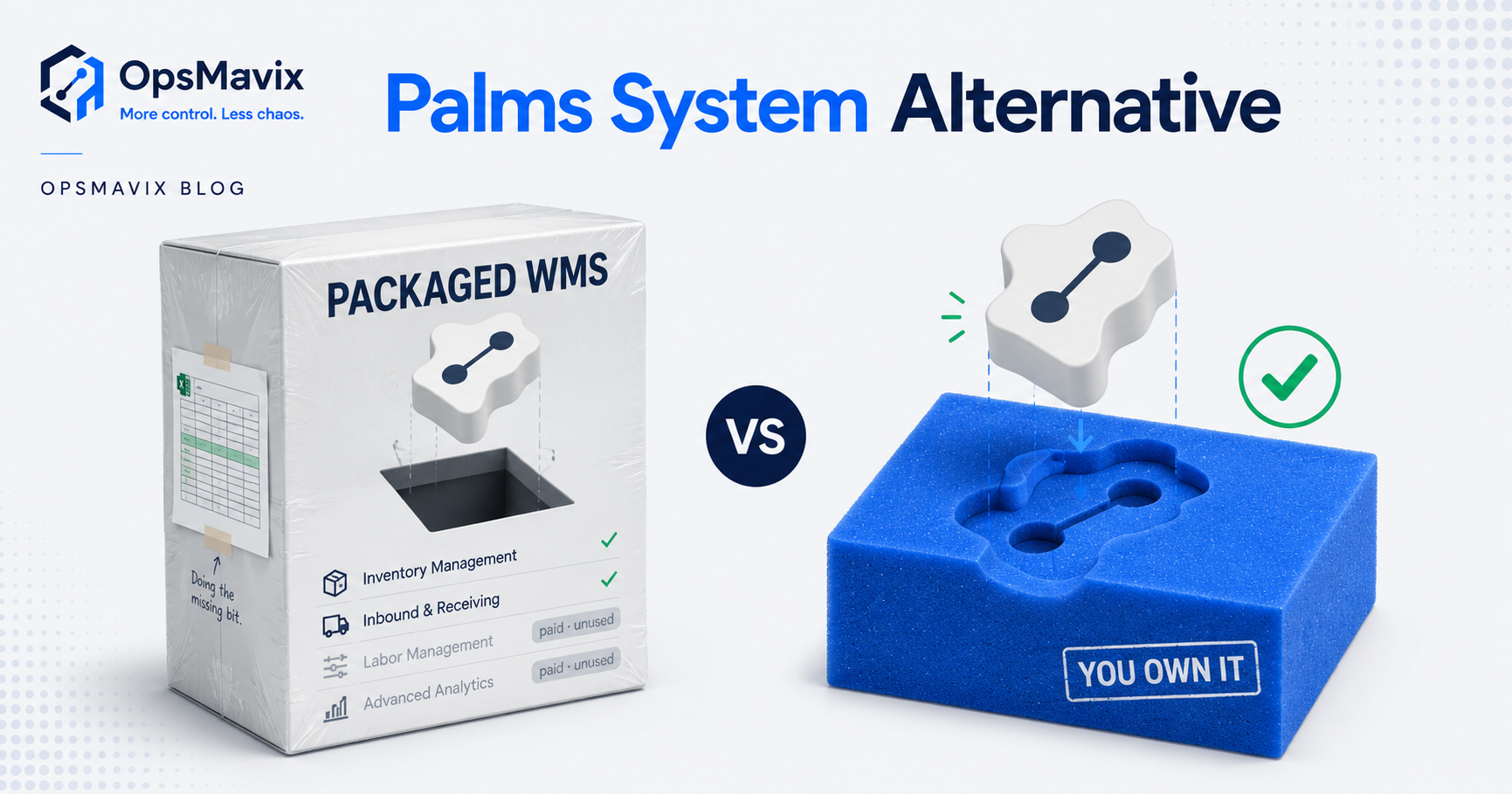
The best Palms system alternative depends entirely on why you’re looking. If you need a standard warehouse management system to receive, store, pick and ship — and your warehouse runs the way a packaged WMS expects — then another product in that class will do the same job, and a custom build would be money wasted. The alternative only becomes a custom system once your workflows have stopped fitting the template: when you’re paying for modules you never open, bending your process to suit the software, and patching the rest with spreadsheets on the side.
Most people searching for a Palms WMS alternative aren’t unhappy with the idea of a WMS. They’ve hit a narrower wall. The software does most of what they need but fights them on the specifics, or the licence costs more than the value it returns at their size. This post covers when a packaged WMS like Palms is genuinely the right call, the concrete signs you’ve outgrown one, and what a built-for-you system changes. It’s honest both ways: sometimes the answer is “buy the WMS,” and we’ll say so.
Key Takeaways
- A packaged WMS like Palms does a real, well-scoped job. If your warehouse fits its shape, buy it — a custom build would be overkill.
- The clearest sign you’ve outgrown one: you keep side-spreadsheets to cover the workflows the software won’t bend to.
- Paying for modules you never open is the quiet tax; packaged WMS platforms price for the average warehouse, not yours.
- A custom system is shaped to your actual receive → pick → dispatch flow and owned by you, with no per-seat creep and no vendor that can sunset it.
- Don’t switch on principle. Move only when the workarounds, the fees, and the fighting cost more than the build would.
When a Packaged WMS Like Palms Is the Right Call
Start with the case for buying, because it’s real. A packaged WMS like Palms typically gives a warehouse a standard, proven way to run the core loop (receive stock in, put it away, locate it, pick it, pack it, dispatch it) with barcode scanning and reporting bolted on. For a warehouse whose processes match that shape, that’s genuinely enough. You get something tested by other operators, supported, and live in weeks rather than built from scratch.
If your flow is standard, your SKU count is stable, and the off-the-shelf modules map cleanly onto how you already work, buy the product. Building a custom system to replicate what a packaged WMS already does well is the expensive mistake in the other direction. The honest version of this decision — packaged tool versus a right-sized build — is laid out in warehouse management software, and most of the time for a textbook warehouse the packaged tool wins.
1. The Tell You’ve Outgrown It: Spreadsheets on the Side
A packaged WMS assumes a standard shape. Your warehouse probably has at least one thing that doesn’t fit it — a consignment-stock arrangement, a kitting step, a goods-in stage with its own quality check, or a customer who needs stock allocated a particular way. When the software has no field for that, you don’t stop doing it. You do it in a spreadsheet next to the WMS.
That’s the clearest signal. The platform handles 80% of the warehouse and you’ve quietly built a shadow system for the other 20%. One warehouse manager described the underlying state plainly: “the stock never matches the system, and I’m running a million messy spreadsheets for the warehouse.” Every side-spreadsheet is a place the number can drift and a tax you pay forever. When the thing the WMS won’t do is your normal operation, you’ve outgrown the template; you haven’t failed to configure it.
2. Paying for Modules You Never Open
Packaged WMS platforms are priced for the average warehouse, which means they’re priced for features your warehouse may never touch. You buy the suite, you use a third of it, and you pay for the rest because it’s bundled. That’s not a flaw in the product — it’s the economics of selling one system to thousands of different warehouses. But it lands as cost without value at your specific size.
The mismatch is something operators feel sharply with stock tools generally. One put it as a platform that “costs us 8 times more than Xero and realistically isn’t giving us 8 times the value.” When the licence climbs and the value doesn’t, that gap is the leak. A custom system inverts it: you build the modules you actually use and none of the ones you don’t. It starts smaller because it’s scoped to your warehouse rather than the market’s average warehouse.
3. The “Too Big for a Spreadsheet, Too Small for Enterprise” Trap
There’s a specific stuck point a lot of growing warehouses land in. The spreadsheet has stopped coping — counts are off, overselling has started — but the enterprise WMS quotes look absurd for the size of the operation. Operators say it almost word for word: “QBO is too small, NetSuite is too expensive. What’s a middle ground?” and dismiss the heavy options as “way too overkill and outrageously expensive for us.”
A packaged WMS like Palms is one answer to that middle ground, and for some warehouses it’s the right one. But “middle ground” doesn’t only mean “a cheaper packaged product.” It can also mean a system sized to exactly your flow, the receive, pick and dispatch you actually run, and nothing beyond it. That’s the other middle path, and it’s the one we build at inventory automation system: not enterprise scope, not a spreadsheet, just the warehouse you have now.
4. Fighting the Software Is a Cost, Even When It “Works”
A WMS can technically work and still cost you every day. If your team has to remember which workaround applies to which exception, which screen to avoid because it does the wrong thing, which step to do outside the system entirely — that friction is real money in errors and slow training, even though the software is “running fine.” The danger sign is when the workarounds become tribal knowledge: only the people who’ve been there two years know how to make the WMS behave.
This is where the ownership question stops being abstract. A packaged platform is shaped by its vendor for its whole customer base, so you adapt to it. There’s also the sharper risk operators have lived through — a tool “broken by a banner on the vendor’s website” that “invalidates two years worth of work,” or price hikes that make a working setup suddenly unviable. A custom system is shaped to your floor and owned outright, with nothing to fight, no per-seat creep for growing, and nothing a vendor can switch off. For where stock meets order fulfilment, that same logic carries into wholesale order management.
5. What a Built-For-You Warehouse System Actually Covers
A custom system isn’t a stripped-down WMS. It’s the core loop built around how your warehouse genuinely moves stock. Receiving captured at goods-in, with your quality check if you have one. Put-away and picking shaped to your real bin layout, not a generic grid. One true stock figure that updates as movements happen, so on-hand matches the shelf instead of drifting between counts. Reorder alerts on a number you can trust. The exceptions a packaged tool has no field for — kitting, consignment, odd allocation rules — built as first-class parts of the flow rather than spreadsheet patches.
The difference from off-the-shelf is that nothing has to be bent to fit. Where a packaged WMS makes you choose between its way and a workaround, a built-for-you system treats every step, including the awkward ones, as a movement against one shared number. That single trustworthy figure is the whole point. It’s the same problem a trustworthy inventory dashboard solves on the reporting side, fed by movements captured properly instead of typed in after the fact.
6. When NOT to Switch (the Honest Bit)
Be fair to Palms and to packaged WMS generally: these are capable, well-scoped products, and for plenty of warehouses they’re exactly right. Ripping out working software costs real money and time — migration, retraining, the risk of a rough month while stock data moves. So don’t switch because custom sounds better. If the platform fits your flow, nothing important is being done by hand on the side, and the licence isn’t punishing you for growing, keep it. Adding complexity you don’t need is its own leak.
The switch earns its place when the maths tips — when the side-spreadsheets, the unused modules you’re paying for, the daily fighting, and the dread of a vendor changing terms cost you more, month after month, than building the right thing once. That’s our plain test: move when staying the same costs more than the fix, not before. The same fair framing runs through our Anchanto WMS alternative piece for multichannel sellers; the call is identical, only the warehouse changes.
Palms (Packaged WMS) vs a Custom Warehouse System
| Packaged WMS like Palms | Custom warehouse system (built for you) | |
|---|---|---|
| Core job | Receive, store, pick, ship — standard shape | The same — shaped to your real flow and exceptions |
| Odd workflows (kitting, consignment) | Workarounds or unsupported | Built as part of the flow |
| Modules | Bundled; you pay for what you don’t use | Only what your warehouse actually needs |
| Pricing | Per-seat / licence, climbs as you grow | Fixed build (£3k–£25k range), you own it |
| Lock-in / sunset | Vendor controls price and off-switch | You hold it; nothing to switch off |
| Best fit | Standard warehouse that fits the template | Specific flow, or paying for fit you don’t get |
FAQ
What is the best Palms system alternative?
There’s no single best one — it depends on whether your problem is “I need a standard WMS” or “the WMS doesn’t fit how my warehouse runs.” If your flow is standard and the modules map onto how you work, another packaged WMS may do the same job. If you’re keeping side-spreadsheets for workflows the software won’t bend to, paying for modules you never open, or fighting the system daily, a custom system built around your actual receive → pick → dispatch flow addresses the real cause.
Is a custom system cheaper than a packaged WMS like Palms?
The licence is usually cheaper to start with a packaged product. The honest comparison is total cost over time. A custom build is a fixed cost you own, with no per-seat creep and nothing bundled that you don’t use; a packaged WMS keeps charging — and can charge more as you grow. For a warehouse the packaged tool genuinely fits, buying is the better value. For one paying for fit it doesn’t get, a build often wins over a few years.
How do I know I’ve outgrown a packaged WMS?
The tells: you run spreadsheets alongside it for kitting, consignment or odd allocation; only long-tenured staff know the workarounds that make it behave; you’re paying for modules nobody opens; and the licence rises faster than the value as you grow. Those are signs your operation has outgrown the template, not that you’re running the warehouse badly.
Will a custom system fix stock that doesn’t match the shelf?
That’s a core reason to build one. The drift usually comes from movements being captured late or outside the system. A custom system captures receiving, picking and dispatch where they happen, against one shared stock figure, so on-hand stays true instead of going stale between counts. The deeper fix lives in how the movements are captured — covered in our inventory management dashboard piece.
Should I just keep my packaged WMS?
Often, yes. If it fits your flow, nothing important is being patched by hand, and the pricing isn’t punishing your growth, keep it — switching costs real money and time. The case for a custom system only opens up when the workarounds, unused modules and daily friction cost more than building the right thing once. We’d rather tell you to keep what works than sell you a build you don’t need.
How OpsMavix Can Help
OpsMavix builds right-sized warehouse and inventory systems for stock-holding SMEs stuck between a spreadsheet that’s stopped coping and an enterprise WMS that’s overkill. We build your actual flow — receiving, put-away, picking, dispatch, reorder alerts — shaped to your real bins and exceptions, against one true stock figure that matches the shelf because the movements behind it are captured properly. You own it outright: no per-seat fees, no modules you pay for and never open, nothing a vendor can sunset.
If a packaged WMS like Palms fits your warehouse, we’ll tell you to buy it — that’s the cheaper right answer. If it doesn’t, the middle ground between Excel and enterprise is exactly what we build. Book a Free Operations Leak Audit and we’ll map where your warehouse leaks today, what it’s costing you, and whether off-the-shelf or a built-for-you system is the honest fit.
Keep reading
Getting value from OpsMavix? Add us as a preferred source on Google — you'll see more of our operations content in your AI Overviews, AI Mode and Search.