
Output Control in Management: What It Is and How to Apply It
Output control is managing by measurable results rather than by supervising every step. This guide defines it, sets it against behaviour and input control, shows where it fits in operations — targets, KPIs, exception thresholds — and covers the trap that ruins it: measuring the wrong output. Then it looks at what it takes to make output control live rather than a monthly spreadsheet post-mortem.
Output control in management means holding a person or team accountable for a measurable result, such as orders shipped complete and on time, while leaving them reasonable freedom over the method. The manager sets the standard, measures the actual result against it and acts when the gap passes an agreed limit.
The practical problem is that many businesses believe they already do this because they have targets and a monthly report. If the number arrives weeks after the work, measures something easy to count rather than something that matters, or belongs to nobody in particular, it is reporting rather than control. This guide explains how to set, measure and act on output standards so they actually steer the work.

Output control judges a warehouse team by the orders it ships correctly, not by the route each picker walks. Illustrative photograph, not an OpsMavix project.
Image credit: Adrian Sulyok, Unsplash License. No edits.
Key Takeaways
- Output control manages by measured results; behaviour control manages the method; input control manages what and who enters the process.
- It fits best where results can be measured reliably and promptly but the best method varies.
- A useful output standard has a definition, a target, a tolerance, an owner and a review period.
- Pair each output measure with a guardrail measure so the target cannot be met by damaging something else.
- Corrective action should follow an agreed threshold and fix the cause, not only the number.
- Most operations need a blend of all three control modes rather than output control alone.
In this guide:
- 1. Define Output Control in Management
- 2. Compare Output Behaviour and Input Control
- 3. Decide When Output Control Fits
- 4. Set Output Standards That Mean Something
- 5. Measure Results Without Distorting Them
- 6. Take Corrective Action on Exceptions
- 7. Recognise the Limitations of Output Control
- 8. Work Through a Hypothetical Warehouse Example
- Frequently Asked Questions
- How OpsMavix Can Help
1. Define Output Control in Management
A direct definition
Output control is a management control approach in which performance is judged by the results a person, team or unit produces. The manager defines the expected output, measures what was actually produced and intervenes when the difference is significant. How the work gets done is left largely to the people doing it, within any safety, legal or quality rules that still apply.
The idea is well established in organisation theory. William Ouchi’s paper A Conceptual Framework for the Design of Organizational Control Mechanisms (Management Science, 1979) contrasts control based on monitoring behaviour with control based on measuring outputs, and links the choice to two conditions: how well the transformation process is understood and how well outputs can be measured.
The control loop behind it
Output control runs as a simple loop:
- Set the output standard.
- Measure the actual result.
- Compare the result with the standard.
- Take corrective action when the gap exceeds the tolerance.
- Review whether the standard itself is still right.
This loop is the same one that sits under wider operations control. Output control is the version of it that focuses on results rather than on supervising each step.
Two conditions that must hold
- The output is measurable. “Orders shipped complete and on time” can be counted. “Better teamwork” cannot be controlled this way without a weak proxy.
- The output is attributable. You need to know whose result it is. A number shared by everyone tends to be owned by no one.
2. Compare Output Behaviour and Input Control
Three ways to control work
Management textbooks commonly describe three control modes. Ouchi’s paper discusses behaviour and output control directly and treats careful selection and training of people as a related approach; many later texts call that input control.
| Control mode | What it governs | Typical tools | Fits best when |
|---|---|---|---|
| Input control | Who and what enters the process | Recruitment criteria, training, supplier approval, material specifications | Results are hard to measure, so quality is controlled at the start |
| Behaviour control | How the work is done | Procedures, checklists, supervision, sign-offs | The right method is known and following it matters in itself |
| Output control | What the work produces | Targets, KPIs, tolerances, exception reports | Results are measurable and attributable but the best method varies |
What Ouchi’s framework suggests
Ouchi sets out four combinations. Where outputs can be measured well and the process is well understood, either behaviour or output control can work, so the lower-cost option is usually preferred. Where outputs are measurable but the process is not well understood, output control fits. Where the process is understood but outputs are hard to measure, behaviour control fits. Where neither holds, organisations rely on selection, socialisation and shared values.
Use them together
In a real operation the three modes sit side by side. A warehouse might use input control when it checks supplier labelling, behaviour control at goods-in through a fixed goods receiving process, and output control over dispatch performance. The skill is choosing the right mode for each part of the work.
3. Decide When Output Control Fits
Signs it is the right tool
- The result can be measured consistently, using the same definition every period.
- The measurement arrives soon enough to act on, ideally daily or weekly for operational work.
- The result can be attributed to a named owner or a team with a named lead.
- Different people use different methods successfully, so prescribing one method adds cost without adding value.
- Supervising every step would cost more than measuring the result.
Signs it should not stand alone
- The work is safety-critical or legally regulated, so the method must be followed regardless of result.
- The output can only be measured through a proxy that is easy to manipulate.
- The result only becomes visible months later, after the chance to correct it has passed.
- The real problem is that a known method is not being followed, which is a training and behaviour control issue.
- Inputs are poor, for example inaccurate stock records, so the team cannot hit the output however they work.
A quick decision table
| Situation | Primary control | Supporting control |
|---|---|---|
| Pick and pack performance in a stable warehouse | Output | Behaviour on scanning steps |
| Forklift operation and loading | Behaviour | Input through licensing and training |
| Production cell with experienced operators | Output | Behaviour on quality checks |
| New starter in the first weeks | Behaviour | Input through training |
| Supplier deliveries | Input | Output through supplier scorecards |
4. Set Output Standards That Mean Something
The five parts of a standard
A target on its own is not a standard. Each output standard needs:
- Definition. Exactly what counts, for example “an order dispatched with every line in full by the promised date”.
- Target. The level expected, for example 97% of orders due.
- Tolerance. The point at which action is required, for example below 95% in any week.
- Owner. The named person accountable for the result and for the response.
- Period. How often it is measured and reviewed.
Measure outcomes, not activity
Activity measures such as units picked per hour or machine utilisation are easy to count but can rise while the real goal falls. Outcome measures, such as orders shipped complete and on time or good units produced to plan, sit closer to what the customer and the business actually need. For a factory, the formulas in our guide to manufacturing KPIs can help define those outputs consistently.
Add guardrail measures
Every output target should have at least one guardrail measure that would worsen if the target were being met the wrong way.
| Primary output | Risk if measured alone | Guardrail measure |
|---|---|---|
| Orders dispatched on time | Rushed, inaccurate picking | Pick error rate |
| Units produced per shift | Rising scrap or rework | Scrap rate per run |
| Purchase orders raised within a day | Unchecked spending | Orders raised outside approved suppliers |
| Margin per job | Cutting essential scope | Customer complaints or rework hours |
Margin per job is only a trustworthy output if job costs are captured properly; our explanation of job costing covers the components.
Standards checklist
- Written definition agreed by the owner and the manager.
- Data source named, with any exclusions stated.
- Target and tolerance set from recent actual performance, not guesswork.
- At most a handful of standards per team.
- A date to review whether the standard still reflects the goal.
5. Measure Results Without Distorting Them
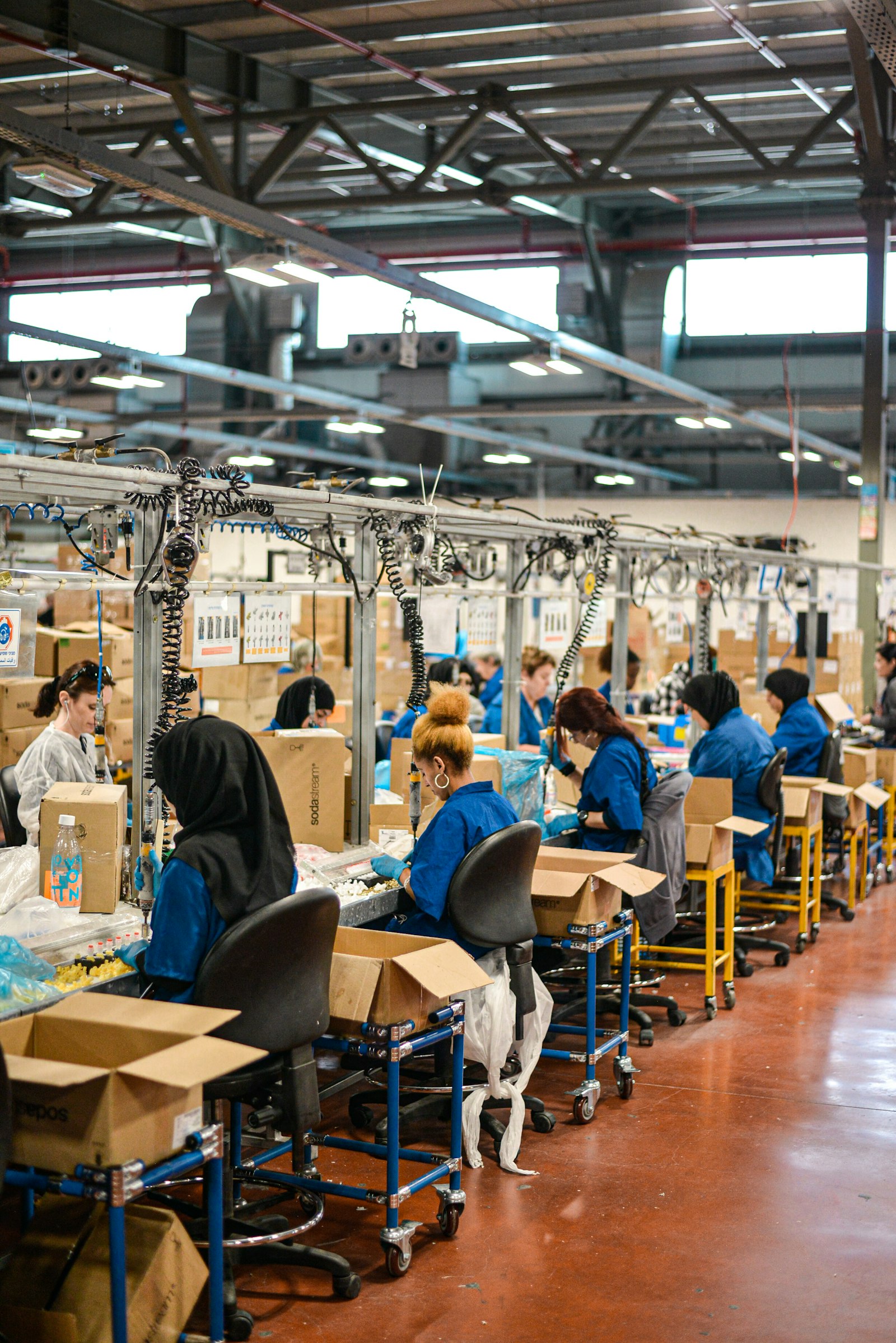
On a production line, output control looks at good units delivered to plan while operators keep reasonable freedom over method. Illustrative photograph, not an OpsMavix project.
Image credit: Remy Gieling, Unsplash License. No edits.
Capture the result where the work happens
Measurement is most reliable when the result is recorded as part of the work itself: a dispatch scan, a completed works order, an approved invoice. Numbers typed into a spreadsheet from several systems at month-end arrive late, carry errors and drift in definition each time a different person builds them.
Watch for timing and definition problems
- Latency. A monthly figure shows what went wrong weeks ago. For daily operations, weekly or daily measurement is usually needed.
- Changing definitions. If “on time” means the promised date one month and the requested date the next, the trend is meaningless.
- Hidden exclusions. Removing “exceptional” orders can make performance look better than customers experience it.
- Numbers that only improve. A measure that never has a bad week deserves a check of how it is calculated.
Choose the right tooling for measurement
| Approach | When it fits | What to check |
|---|---|---|
| Configure current tools | Existing systems already hold the data and can report it | Whether reports use agreed definitions and refresh often enough |
| Integrate existing systems | Data sits in separate tools that work individually | Shared identifiers, error handling and who fixes failed transfers |
| Packaged software | A standard product covers the process well | Exact edition, configuration effort and reporting limits |
| Focused custom application | A specific gap has clear boundaries | Ownership, support, maintenance and integration scope |
| Full ERP, packaged or custom | Wider coordination needs justify a broader change | Fit across finance and operations, migration and delivery capacity |
Many businesses can start output control with the tools they have. A dedicated system becomes worthwhile when measuring results by hand is too slow to run the loop at the frequency the work needs. Our guide to an operations control system covers that decision in more depth.
6. Take Corrective Action on Exceptions
Act on thresholds, not on every number
Management by exception is what makes output control efficient. Instead of reviewing every measure every day, the owner is alerted when a result crosses its tolerance. Attention goes where the standard has been breached.
Diagnose before correcting
A missed output is a symptom. Before acting, ask which of the three control modes failed:
| Finding | Likely cause | Corrective action |
|---|---|---|
| Inputs were wrong, such as inaccurate stock or late supplier deliveries | Input control gap | Fix records or supplier terms |
| A known method was not followed | Behaviour control gap | Retrain, simplify or enforce the step |
| Method was followed and inputs were sound, yet the result missed | Standard or capacity issue | Review capacity, process design or the target itself |
| The measure was wrong or miscalculated | Measurement issue | Correct the definition or data source |
Corrective action checklist
- Confirm the breach using the agreed definition.
- Record the owner and the date the breach was identified.
- Identify the cause category from the table above.
- Agree one or two actions with a named person and a date.
- Check the next period’s result to confirm the action worked.
- Escalate repeated breaches to a change in process, resources or plan.
When the same breach keeps recurring, the problem is usually in the plan rather than the people. That link between daily correction and planning is covered in operations planning and control.
7. Recognise the Limitations of Output Control
Measuring the wrong output
The most serious risk is precise measurement of the wrong thing. People will reasonably optimise what they are measured and judged on. If that measure drifts away from the real goal, effort follows the measure. Guardrails and outcome-based definitions reduce this risk but do not remove it.
Other limitations
- Short-term focus. Weekly targets can discourage work that pays back later, such as maintenance or training.
- Shared results. Where several teams contribute to one output, attributing a miss fairly is difficult.
- External factors. Carrier failures or supplier shortages can move a team’s result without any change in its performance.
- Unmeasured quality. Some aspects of good work, such as how a customer call was handled, are hard to capture as a number.
- Lag. Some outputs only become visible after the opportunity to correct them has gone.
- Data quality. Output control is only as good as the records behind it. Inaccurate stock records, for example, undermine dispatch measures; preventing stock discrepancies is often a precondition.
How to manage the limitations
Combine output control with behaviour control on critical steps and input control on key resources. Review standards periodically, separate controllable causes from external ones when assessing a breach, and keep a small number of qualitative checks alongside the numbers.
8. Work Through a Hypothetical Warehouse Example
The setting
This is a hypothetical example. A distribution warehouse dispatches trade orders. The operations manager wants control over dispatch performance without prescribing how each picker works. All figures below are illustrative.
The standard
| Element | Primary output | Guardrail |
|---|---|---|
| Definition | Orders dispatched complete and on the promised date | Orders with a wrong item or quantity |
| Target | 97% of orders due | Below 0.5% of orders due |
| Tolerance | Action if below 95% in any week | Action if above 0.8% in any week |
| Owner | Dispatch team leader | Dispatch team leader |
| Period | Weekly, with a daily view | Weekly |
Week 1 result
In week 1, 2,400 orders were due and 2,256 were dispatched complete and on time.
- Primary output: 2,256 ÷ 2,400 = 0.94, so 94.0%. This is below the 95% tolerance, so action is required.
- Failed orders: 2,400 - 2,256 = 144.
- The team leader analysed the 144 failures: 84 were short because the system showed stock that was not on the shelf, 36 missed a carrier collection and 24 contained a wrong item.
- Check: 84 + 36 + 24 = 144.
- Guardrail: 24 ÷ 2,400 = 0.01, so 1.0%, which is above the 0.8% tolerance.
If each failed order cost an assumed £18 to put right through re-picking, re-delivery and handling, the week’s cost of failure would be 144 × £18 = £2,592. The £18 is an assumption for illustration only.
Diagnosis and corrective action
| Cause | Orders | Share of failures | Control mode | Action |
|---|---|---|---|---|
| Stock record inaccurate | 84 | 58.3% | Input | Cycle count the affected locations and fix adjustment controls |
| Missed carrier collection | 36 | 25.0% | Output and capacity | Move the pick cut-off 30 minutes earlier |
| Wrong item picked | 24 | 16.7% | Behaviour | Enforce scan confirmation on similar-looking items |
Shares: 84 ÷ 144 = 58.3%, 36 ÷ 144 = 25.0% and 24 ÷ 144 = 16.7%. Together they total 100%.
The largest share of failures came from inputs, not from how the team worked. Pushing the pickers harder would not have fixed it, which is exactly why diagnosis comes before correction.
Week 3 result
Two weeks after the actions, 2,500 orders were due and 2,435 were dispatched complete and on time.
- Primary output: 2,435 ÷ 2,500 = 0.974, so 97.4%, above the 97% target.
- Failed orders: 2,500 - 2,435 = 65.
- Wrong items: 10, so 10 ÷ 2,500 = 0.4%, within the guardrail target.
- At the same assumed £18 per failure: 65 × £18 = £1,170, compared with £2,592 in week 1, a difference of £1,422.
The example shows the whole method on a small scale: a defined standard, a tolerance that triggers action, a guardrail that catches gaming, diagnosis across all three control modes and a follow-up measure to confirm the correction worked.
Frequently Asked Questions
What is output control in management?
It is managing by measured results. The manager sets an output standard, measures actual results against it and acts when the gap exceeds an agreed tolerance, while the people doing the work keep reasonable freedom over method.
What is the difference between output control and behaviour control?
Behaviour control manages how work is done through procedures, supervision and sign-offs. Output control manages what the work produces through targets and measurement. Behaviour control fits when the correct method is known and matters; output control fits when results are measurable but the best method varies.
What is input control?
Input control manages what and who enters a process, such as recruitment, training, supplier approval and material specifications. It aims to prevent problems at the start rather than detect them in the results.
What are examples of output control in operations?
Examples include orders dispatched complete and on time, good units produced against plan, scrap rate per run, invoices approved within an agreed period and margin per job, each with a target, tolerance and owner.
What are the main limitations of output control?
It can reward the wrong behaviour if the measure is a poor proxy, it can encourage short-term thinking, it struggles where results are shared or affected by external factors, and it depends on accurate, timely data.
How often should output be measured?
Often enough to act before the result is fixed. For daily operational work that usually means daily or weekly measurement; monthly reviews suit slower, strategic outputs.
Is a monthly KPI spreadsheet a form of output control?
It can support it, but on its own it is usually closer to reporting. Control needs a tolerance that triggers action, a named owner and measurement frequent enough to correct the result while it can still change.
Can OpsMavix build an output control system?
Yes. OpsMavix can build focused applications or a full custom ERP, and can configure or integrate suitable existing tools where those approaches fit the requirements.
How OpsMavix Can Help
OpsMavix can help define the output standards that matter in your operation, then make sure the results are captured where the work happens and reach the right owner when a tolerance is breached.
Depending on the gap, that may mean a project operations dashboard for live targets and exceptions, manufacturing production tracking for output against plan, an inventory automation system to fix the stock inputs behind dispatch performance, or a wholesale order management system for order fulfilment measures. Where an existing tool already does the job, configuring or connecting it may be the better answer. For a wider view, see our guide to choosing an operations management system.
Contact OpsMavix with one recent missed target, the records behind it and the handoff that creates the most rework. We can use that evidence to define requirements and a practical pilot.
Keep reading


Getting value from OpsMavix? Add us as a preferred source on Google — you'll see more of our operations content in your AI Overviews, AI Mode and Search.