
What Is Operations Control? A Guide to Controlling Operations
Operations control is the practice of monitoring what your daily operations are actually doing and steering them back on track when they drift. This post defines it as a discipline — not a piece of software — walks the loop it runs on, and shows why most growing businesses do it badly without realising.
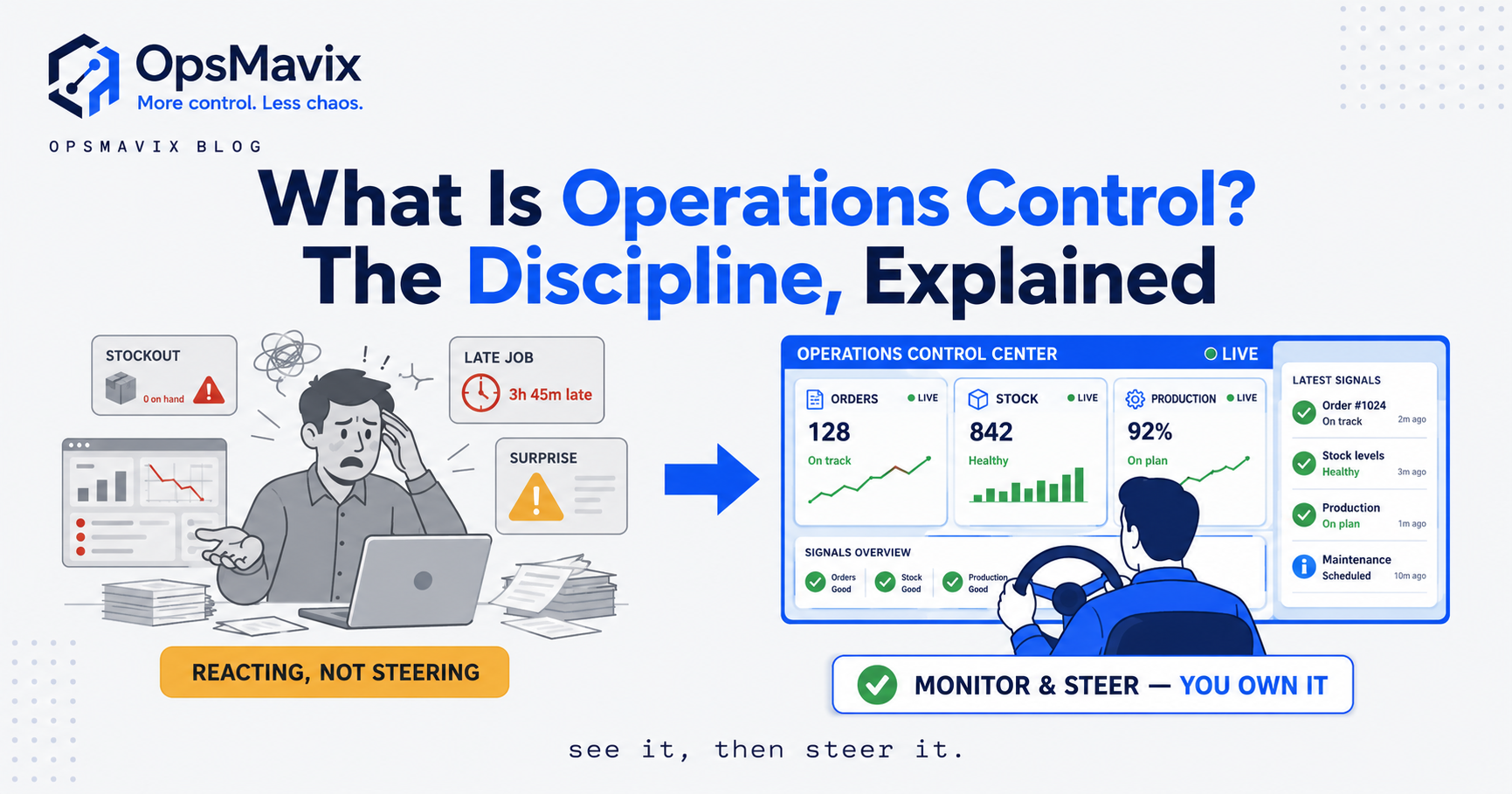
What is operations control? It’s the discipline of monitoring what your daily operations are doing and steering them back on track when they drift from the plan. This is a management practice, not a product: the ongoing work of setting a target for how the operation should run, measuring what’s actually happening, spotting the gap early, and correcting it before it becomes a problem you can’t recover from. Stock levels, order flow, production output, purchasing, service response: operations control is how you keep all of it doing what it’s meant to, day after day, instead of finding out at month-end that it didn’t.
This post defines operations control as a concept. We’ll walk the loop it runs on, separate it from operations management and from the software that claims the name, and get to the honest bit underneath: most growing businesses think they’re in control when they’re really just reacting to whatever went wrong most recently.
Key Takeaways
- Operations control is the practice of monitoring daily operations against a plan and correcting drift early: a discipline, not a piece of software.
- It runs as a loop: set the target, measure reality, compare, correct, then repeat continuously, not once a quarter.
- Control is about steering, not just watching: monitoring plus the correction that actually follows.
- Most drift is cheap to fix early and expensive to fix late. The whole value of control is catching the gap while it’s still small.
- Operations control and operations management are different jobs: management sets direction and structure; control keeps the day-to-day running to it.
- Growing businesses usually lose control not from bad decisions but from bad visibility: they can’t see the drift until it’s already cost them.
The Loop That Defines Operations Control
Strip operations control back to its mechanism and it’s a feedback loop, the same idea an engineer means by “control” in any system: you have a target, you measure the actual, you compare the two, and you act on the difference. A thermostat is the textbook version: set 20 degrees, read the room, and switch the heating on or off based on the gap. Operations control is that same loop applied to the running of a business.
Set the target: this is what “on plan” looks like, the stock level you want held, the order turnaround you promise, the production output the schedule assumes, the purchasing trigger points. Measure reality: what’s actually on the shelf, how long orders are really taking, what the floor genuinely produced, where suppliers actually are. Compare: where does reality differ from the target, and by how much. Correct: do something about the gap (expedite, reallocate, reorder, reschedule, escalate) before it compounds.
The word that matters is steering. Watching a number go wrong is not control; it’s spectating.
The loop has to be continuous, and that’s where most businesses fall down. A gap you catch on the day is a small correction. The same gap caught at month-end is a stockout that already lost the sale, a late order that already lost the customer, a production run that already consumed the wrong materials. The interval between “it drifted” and “you noticed” is the single biggest driver of what losing control costs.
Control vs Monitoring — Why the Difference Is the Whole Point
A lot of businesses have monitoring and think they have control. They’re not the same thing. Monitoring is the measure-and-compare part of the loop; control is monitoring plus the correction that actually follows. A dashboard that shows stock drifting, orders slipping and output falling short is useful only if someone acts on it. If the numbers are visible but nobody’s job is to close the gap, that’s not control; it’s a very well-documented account of losing.
Operators describe the trap the same way again and again: loads of reports and no reflexes. Everything is measured, nothing is steered, and the reports tell you at the end of the week what you could have fixed on Monday. A dashboard nobody acts on isn’t control; it’s a well-lit view of the problem.
This is why operations control is a discipline before it’s a tool. You can buy the best visibility software on the market and still have no control, because control lives in the response: who watches the gap, who owns the correction, how fast the loop turns.
Operations Control vs Operations Management
These get used interchangeably and they shouldn’t be. Operations management is the wider job: deciding how the operation is structured, what the processes are, what capacity you build, which suppliers you use, how work is organised. It sets the plan and the direction. Operations control is the narrower, faster discipline of keeping the day-to-day running to that plan, the tight feedback loop inside the bigger picture management sets.
Put simply: management decides what “good” looks like and builds the system to deliver it; control keeps the system delivering it once it’s running. Management is quarterly and structural; control is daily and corrective. A business can have excellent operations management, a sound plan and good processes, and still have poor operations control, because nobody’s steering the day to keep reality matching the plan.
The two feed each other. When control keeps surfacing the same gap (the same SKU always short, the same supplier always late, the same stage always the bottleneck) that’s a signal for management to change the plan, not just correct the drift again. Control catches the symptom daily; management fixes the cause.
What Operations Control Looks Like Across Different Businesses
The loop is universal; what you’re steering isn’t.
In a warehouse or inventory business, operations control is keeping the recorded stock matched to the physical shelf, catching the drift the day it happens rather than at the annual count, and reacting to reorder triggers before a line goes to zero. Lose control here and you’re either stocked out on your best sellers or drowning in cash tied up in stock you can’t shift.
In manufacturing, it’s tracking actual output against the schedule, catching a run that’s behind or consuming materials faster than the bill of materials assumed, and reacting while the run is still on the floor, not discovering the shortfall when the order was due to ship.
In a wholesale or distribution business, it’s steering order flow: catching orders stuck between “received” and “picked”, spotting a lengthening turnaround before customers start chasing, keeping purchasing ahead of demand instead of scrambling behind it.
Same discipline, different targets. In every case the failure mode is identical: reality drifts from the plan, nobody sees it early, and the correction that would have been trivial on the day becomes expensive by the time it’s visible.
Why Growing Businesses Lose Operations Control
Here’s the OpsMavix take, and it’s slightly contrarian: most businesses that lose control of their operations don’t lose it through bad decisions. They lose it through bad visibility. The people are capable and the plan is fine; they just can’t see the gap in time to close it, because the information that would show them is scattered across spreadsheets, inboxes and tools that don’t talk to each other.
Think about what running the loop actually requires. To compare reality against the plan, you need reality in front of you, current, in one place. When stock lives in one spreadsheet, orders in an inbox, production on a whiteboard and purchasing in someone’s head, assembling “what’s actually happening right now” is a half-day job, so nobody does it daily. The loop stretches from hourly to weekly to whenever-something-breaks, and control degrades into reaction. You’re not steering; you’re firefighting the last thing that drifted far enough to hurt.
The £-cost of a slow loop is rarely one big number. It’s the accumulation: the sale lost to a stockout that a same-day reorder trigger would have prevented, the hours spent every week reconstructing what’s happening by hand, the customer who left after the third late order, the cash sitting in stock nobody noticed was overbought. None of it shows up as a line item called “lost control”, which is exactly why it runs unchecked.
How Businesses Actually Build Operations Control
Because control is a discipline, building it starts with the loop, not the software. Decide what “on plan” means for each part of the operation: the stock levels, the turnaround times, the output targets, the reorder points. Decide who owns each gap and how fast it should be closed. That’s the human half, and no tool replaces it.
Then the tooling exists to make the loop fast and cheap enough to actually run daily. This is where an operations dashboard earns its place, not as decoration but as the “measure and compare” step made instant: one current view of stock, orders, production and purchasing against their targets, so the gap is visible the moment it opens instead of at month-end. Make the measurement instant and the correction cheap, and the loop that was weekly becomes daily.
For growing businesses the honest sequencing is: fix the visibility first. You can’t control what you can’t see, and most control problems are visibility problems wearing a costume.
Build, Buy, or Run It on What You Have
You don’t need to buy anything to start doing operations control. The discipline is free: pick your targets, run the loop, own the corrections. Plenty of small operations run genuine control on nothing but a shared spreadsheet and a daily habit. Don’t buy a system to impose a discipline you haven’t proven you’ll practise.
The spreadsheet-and-habit approach breaks with scale, though. More SKUs, more orders, more moving parts, and the “measure and compare” step gets slow enough that the loop can’t run daily, which is the point where the discipline needs tooling to survive. A generic operations management system can supply that, or an operations control system built to fit exactly how your operation runs: the right-sized middle between a spreadsheet that’s stopped coping and a full ERP that’s more than the problem.
Wherever you land on tooling, operations control stays the discipline, not the dashboard. The screen makes the loop fast; the loop still has to be yours to run. Start by getting honest about how long it currently takes you to notice when something’s drifted, because that interval, more than any tool, is the real measure of how much control you have.
Keep reading

Getting value from OpsMavix? Add us as a preferred source on Google — you'll see more of our operations content in your AI Overviews, AI Mode and Search.