ERP and Supply Chain Management: How They Fit Together
ERP and supply chain management get sold as the same thing, but one is a system of record and the other is a discipline that spans several tools. This guide sets ERP against dedicated SCM software, shows where an ERP's supply chain modules run out, and explains when a growing business needs standalone SCM, when an ERP module is enough, and when the honest answer is neither.
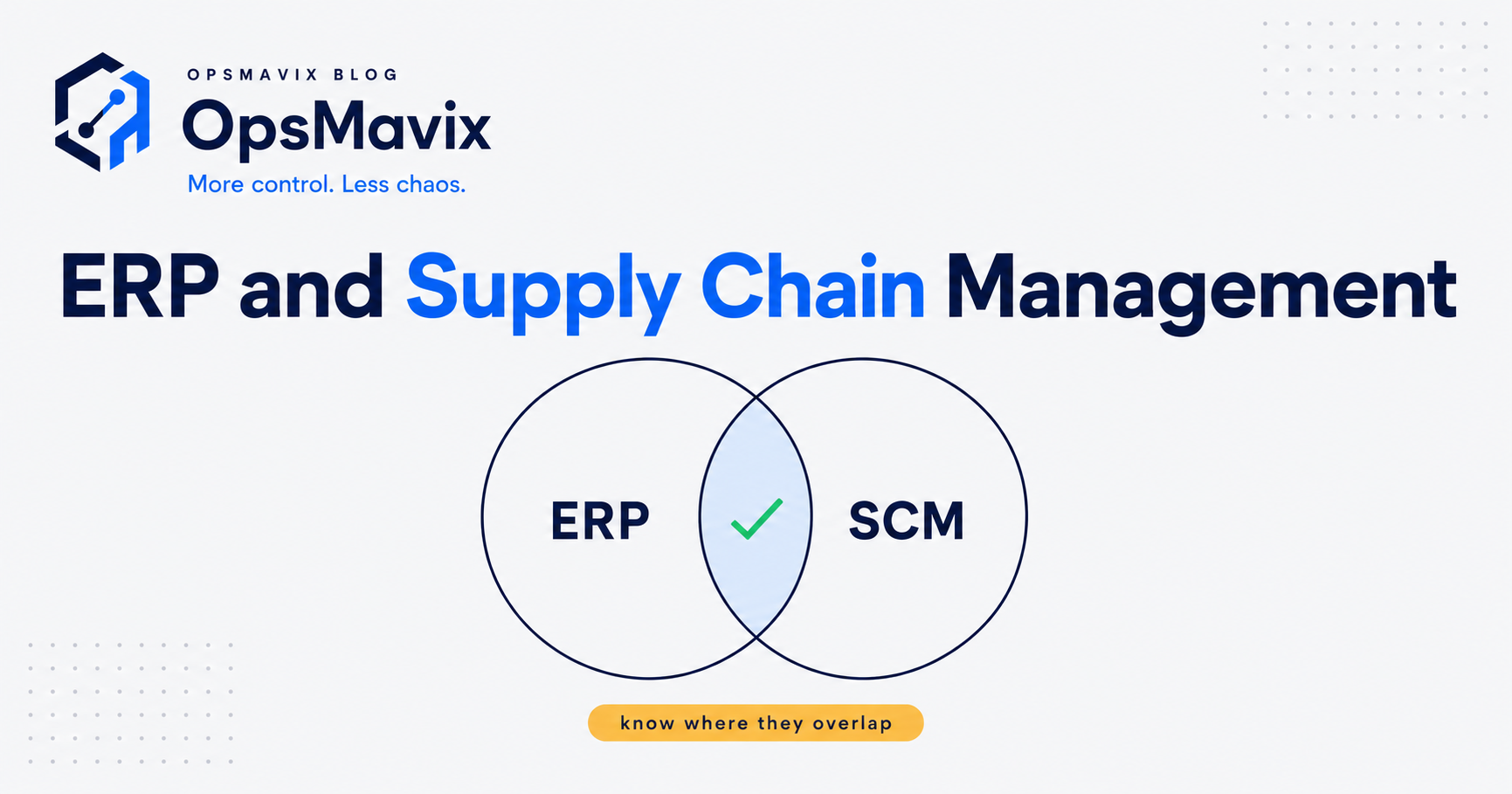
ERP and supply chain management are not two names for the same product: an ERP is the transactional system of record that runs your business end to end, while supply chain management is the wider discipline of planning, sourcing, making and delivering goods — a discipline an ERP partly covers, dedicated SCM software goes deeper on, and most growing businesses do not need to buy twice. The confusion is understandable, because every ERP vendor advertises “supply chain” modules and every SCM vendor talks about “resource planning.” This guide separates them cleanly and answers the question that actually decides your spend: where does your ERP’s supply chain capability run out, and do you need a dedicated tool, a module, or neither?
Quick summary: Gartner defines ERP as an integrated suite sharing a common data model across finance, HR, distribution, manufacturing and the supply chain (Gartner), while supply chain management is the broader set of processes for creating and fulfilling demand for goods and services (Gartner). So an ERP is one system that includes some supply chain functions; SCM is a discipline that spans several — and knowing where one ends and the other begins is what stops a growing business over-buying.
Contents
- What an ERP actually does
- What supply chain management actually is
- Why the two categories get confused
- ERP vs dedicated SCM software, side by side
- Where an ERP’s supply chain modules end
- Standalone SCM vs an ERP module vs neither
- A worked example: one UK wholesaler
- The right-sized middle ground for SMBs
- FAQ
- How OpsMavix Can Help
- Sources
What an ERP actually does
An ERP — enterprise resource planning system — is a single integrated suite that runs the business off one shared data model. Gartner’s definition is worth reading slowly: ERP tools “share a common process and data model, covering broad and deep operational end-to-end processes, such as those found in finance, HR, distribution, manufacturing, service and the supply chain.” An ERP exists so that the sales order, the stock movement, the purchase order, the works order and the invoice all live in one place and agree, so nobody re-keys a number between disconnected tools.
Note where the supply chain sits in that list: it is one of the areas an ERP covers, alongside finance and HR. An ERP includes supply chain functionality — purchasing, inventory, sometimes production planning — but is not built primarily to optimise the supply chain. It is built to record every transaction once, accurately, and keep the whole business working off the same figures. Its design centre is integrity across functions, not depth in any single one.
What supply chain management actually is
Supply chain management is not a product — it is a discipline. Gartner defines SCM as “the processes of creating and fulfilling demands for goods and services,” encompassing “a trading partner community engaged in the common goal of satisfying end customers.” The Chartered Institute of Procurement & Supply (CIPS) frames it as looking “holistically at the entire supply chain, from the supplier through to the consumer.”
The clearest way to see the scope is the SCOR model — the Supply Chain Operations Reference framework maintained by ASCM (formerly APICS). SCOR breaks supply chain into six top-level processes: plan, source, make, deliver, return and enable — forecasting demand, sourcing from suppliers, making goods, delivering to customers, handling returns, and the enabling activities behind all of it.
Compare that to what an ERP does out of the box and the gap appears. An ERP is strong on source (purchasing), make (works orders) and deliver (dispatch and invoicing) as transactions — it records them. It is typically much weaker on plan (demand forecasting, network optimisation) and on the analytics that tie the six processes together. Those are the areas dedicated SCM software goes deeper on.
Why the two categories get confused
The confusion is manufactured by the market, not by the buyer being slow. Three things drive it.
First, every ERP vendor sells “supply chain” modules. So an SMB sees a supply chain tab and assumes the discipline is covered. Sometimes it is, at a basic level. Often the module records transactions but does not plan or optimise.
Second, every SCM vendor borrows ERP language. Dedicated planning tools talk about “resource planning” and “one version of the truth,” so buyers cannot tell from the marketing whether they are looking at a system of record or a planning layer on top of one.
Third, both get sold as “the system that gives you control.” The outcome — fewer stockouts, less cash tied up, orders out on time — is described identically by both, even though an ERP achieves it by recording the work correctly and an SCM tool by planning it better. Read only the outcome and they look interchangeable.
The practical consequence: businesses buy two overlapping systems and spend more integrating them than either cost, or they buy one and discover a year in that the half they needed most was the shallow half. Separating “system of record” from “planning discipline” is the first defence — the same clarity that separates operational systems from ERP generally.
ERP vs dedicated SCM software, side by side
| Dimension | ERP (enterprise resource planning) | Dedicated SCM software |
|---|---|---|
| What it is | Integrated system of record across the business | Specialist tool for one or more supply chain processes |
| Primary job | Record every transaction once, across functions | Plan and optimise supply chain decisions |
| Scope | Finance, HR, distribution, manufacturing and supply chain | Plan, source, make, deliver, return (SCOR) — in depth |
| Strongest at | Transaction integrity across orders, stock, purchases, invoices | Forecasting, planning, network and inventory optimisation |
| Weakest at | Advanced planning, demand forecasting, optimisation | Being the single source of cross-function financial truth |
| Data relationship | Owns the transactions (source of record) | Reads ERP data, then plans against it |
| Typical buyer | Any business needing one joined-up system | One whose supply chain has outgrown the ERP module |
| Failure mode | Supply chain module too shallow for real planning | Bought before transaction data was clean |
| Right for SMBs? | Often, if right-sized — full ERP is frequently too heavy | Rarely as a standalone purchase; usually premature |
Read the table whole and the relationship is clear: dedicated SCM software almost always sits on top of a system of record, planning against data the ERP owns. That is why “ERP or SCM?” is usually the wrong question. You are not choosing between rivals — you are deciding how deep your planning needs to be, and whether your system of record already covers it.
Where an ERP’s supply chain modules end
An ERP’s supply chain capability is real but bounded. Here is where a typical mid-market ERP is strong and where it thins out.
Where it holds up: recording purchase orders and receipts; tracking inventory levels and movements; basic reorder-point and min/max rules; issuing stock to works orders; dispatch against sales orders; landed-cost capture. These are transactional supply chain jobs — the ERP records the event and keeps the numbers consistent. For many SMBs, this is genuinely all the “supply chain” they need, because the real problem is that recording is broken, not that planning is unsophisticated. If reorder points and material requirements are the actual gap, that is MRP territory, which sits inside most operational ERPs.
Where it runs out: statistical demand forecasting across seasonality and trends; multi-echelon inventory optimisation; supply-and-demand balancing across sites; transport and route optimisation; supplier collaboration portals; scenario planning. These are the plan and advanced-deliver parts of SCOR, and they are what dedicated SCM software specialises in. A standard ERP either does not attempt them or does them crudely.
The honest test: if your pain is “we keep getting the numbers wrong and re-keying between tools,” you have an ERP-shaped (system-of-record) problem. If it is “our numbers are clean but our forecasting and planning decisions are still bad,” you have an SCM-shaped (planning-depth) problem. Most SMBs have the first, not the second.
Standalone SCM vs an ERP module vs neither
The decision, stripped to three honest cases:
You need dedicated standalone SCM software when your transaction data is already clean and your supply chain complexity genuinely exceeds what an ERP module can plan — many SKUs with volatile demand, multiple sites to balance, or margins thin enough that a few points of forecast accuracy pays for the tool. This is real, but it is the minority case among SMBs, and it comes after a solid system of record, never instead of one.
An ERP supply chain module is enough when you need the transactional jobs done properly — purchasing, inventory, reorder points, receipts, dispatch — and your planning needs are served by good reporting rather than optimisation algorithms. This covers a large share of growing product businesses. The mistake is buying a separate SCM tool for planning you have no volume to justify.
You need neither as a standalone purchase when you are “outgrowing spreadsheets and disconnected tools.” The real problem is that orders, stock and purchasing live in disconnected tools and nothing agrees — and neither a heavyweight ERP nor a specialist SCM platform is the right-sized fix. What you need is one owned operations system that records the work accurately and shows it back clearly. For a deeper treatment, the supply chain management software guide is the pillar to start from.
A worked example: one UK wholesaler
A UK wholesaler distributes to trade customers from one warehouse, turning over roughly £6m a year across 900 SKUs. Three vendors have told the owner three different things: buy a full ERP, buy a dedicated SCM/planning platform, or bolt an inventory app onto the accounts package.
The actual pain. Orders arrive by email, phone and a webshop and get re-typed into a stock spreadsheet and a separate accounts package. Two salespeople can sell the same last unit because stock is not reserved at order — the classic oversell. Purchasing happens “when someone notices” a line is low. Nobody can say, without a half-day export, which SKUs are tying up cash sitting for 200 days.
Testing each pitch against SCOR. The wholesaler’s problems live almost entirely in source (reactive purchasing) and deliver (overselling, no reservation) — recording problems, not planning problems. Demand is fairly stable; forecasting is not the weak link. So the dedicated SCM/planning platform solves a problem the business does not have: bought first, it draws its numbers from the same oversold stock spreadsheet and plans confidently off bad figures.
The full ERP would fix the recording — stock reserved at order, purchasing driven by reorder points, receipts matched to POs — but it brings a heavy rollout, months of implementation and modules for HR and multi-entity finance the wholesaler will never switch on. Right shape of fix, massively oversized.
What the wholesaler actually needed was the transactional jobs done properly — reserve stock at order to kill the oversell, drive purchasing off reorder points, match receipts to POs, and surface stock-age and slow-movers on a dashboard the owner opens on Monday. That is an ERP-module-depth job, delivered as a right-sized owned system rather than a full ERP or a premature planning platform. The wholesale order management system is exactly that shape of build. Dedicated SCM planning can come later, if demand volatility ever makes forecasting the real constraint — but it was never the first purchase.
The right-sized middle ground for SMBs
The “ERP and supply chain management” debate is framed by vendors as a choice between two big purchases. For most growing operations businesses, the honest answer is neither, as a standalone platform.
A full ERP gives you the integrated system of record but arrives with the weight, cost and unused modules of a system built for large enterprises. Dedicated SCM software gives you planning depth you usually do not need yet, on top of a system of record you may not have solid. In the gap between them sits the reality of most SMBs: the transactions are a mess, the planning is fine for now, and what is needed is one owned operations system that does the supply chain jobs that actually hurt — recording orders, stock, purchasing and dispatch accurately, and reporting on them clearly.
That is the right-sized middle ground. It gives you the operational control of an ERP’s supply chain module without a full-ERP rollout, and leaves room to add real SCM planning later if complexity ever demands it. Match the tool to where the pain actually is on the plan-source-make-deliver span, not to the biggest label. For the wider category, the what is an operations system explainer covers it in full.
FAQ
Is supply chain management part of ERP?
Partly. An ERP includes supply chain functionality — Gartner’s definition explicitly lists “the supply chain” among the areas an ERP covers, alongside finance, HR, distribution and manufacturing. But an ERP covers the transactional parts of the supply chain (purchasing, inventory, dispatch) and is typically shallow on the planning parts (demand forecasting, optimisation). Supply chain management as a full discipline — the plan-source-make-deliver-return span of the SCOR model — is wider than what any single ERP module does out of the box.
Do I need dedicated SCM software if I already have an ERP?
Usually not, unless your supply chain complexity genuinely exceeds what the ERP module can plan — many volatile SKUs, multiple sites to balance, or margins thin enough that better forecasting pays for the tool. And even then, only once your transaction data is clean. Most SMBs find their ERP’s supply chain module does the transactional jobs they actually need, and their remaining gap is reporting, not optimisation. Buying a specialist planning platform on top of shaky data just plans confidently off wrong numbers.
What is the difference between ERP and SCM software?
An ERP is one integrated system of record that runs the whole business off a shared data model; SCM software is a specialist tool (or suite) that plans and optimises supply chain decisions, usually reading data the ERP owns. Put simply: the ERP records the work across every function; dedicated SCM software plans the supply chain part of it more deeply. They are complementary layers, not rivals — which is why “ERP or SCM?” is usually the wrong framing.
Which comes first, ERP or SCM?
The system of record comes first, because planning depends on it. There is no value in optimising a forecast that draws from stock and sales figures that are wrong at the point of capture — you would just automate better-looking bad decisions. Get the transactions recorded accurately first (the ERP job), then add dedicated SCM planning later if and when complexity justifies it. For most SMBs, the recording is the whole problem and the planning layer never becomes necessary.
How OpsMavix Can Help
OpsMavix is not an ERP vendor and not an SCM vendor. We build right-sized, owned operations systems for businesses that have outgrown spreadsheets and disconnected tools — the middle ground between a heavyweight ERP rollout and a premature dedicated SCM platform.
We start by mapping your supply chain across plan, source, make and deliver, and tell you honestly where the pain is: whether you need the transactional jobs done properly (an ERP-module-depth fix), genuine planning depth (dedicated SCM), or one system that records the work and shows it back clearly. Then we build it around how your business runs — orders reserved at the point of sale, purchasing driven off real reorder points, receipts matched to POs, and stock-age and slow-movers on a dashboard you own outright, with a delivery guarantee on the build. No unused modules, no per-seat licence creep, no integration gap between two platforms.
If you cannot get a straight answer on where your stock, orders or cash are leaking, that is the place to start. Book a Free Operations Leak Audit.