
What a Business Operating System Really Is (Framework vs Software)
Business operating system" means two completely different things — a management framework like EOS, and a giant enterprise software suite. Most growing businesses need neither in full. Here's the honest breakdown, and what actually runs your operation day to day.
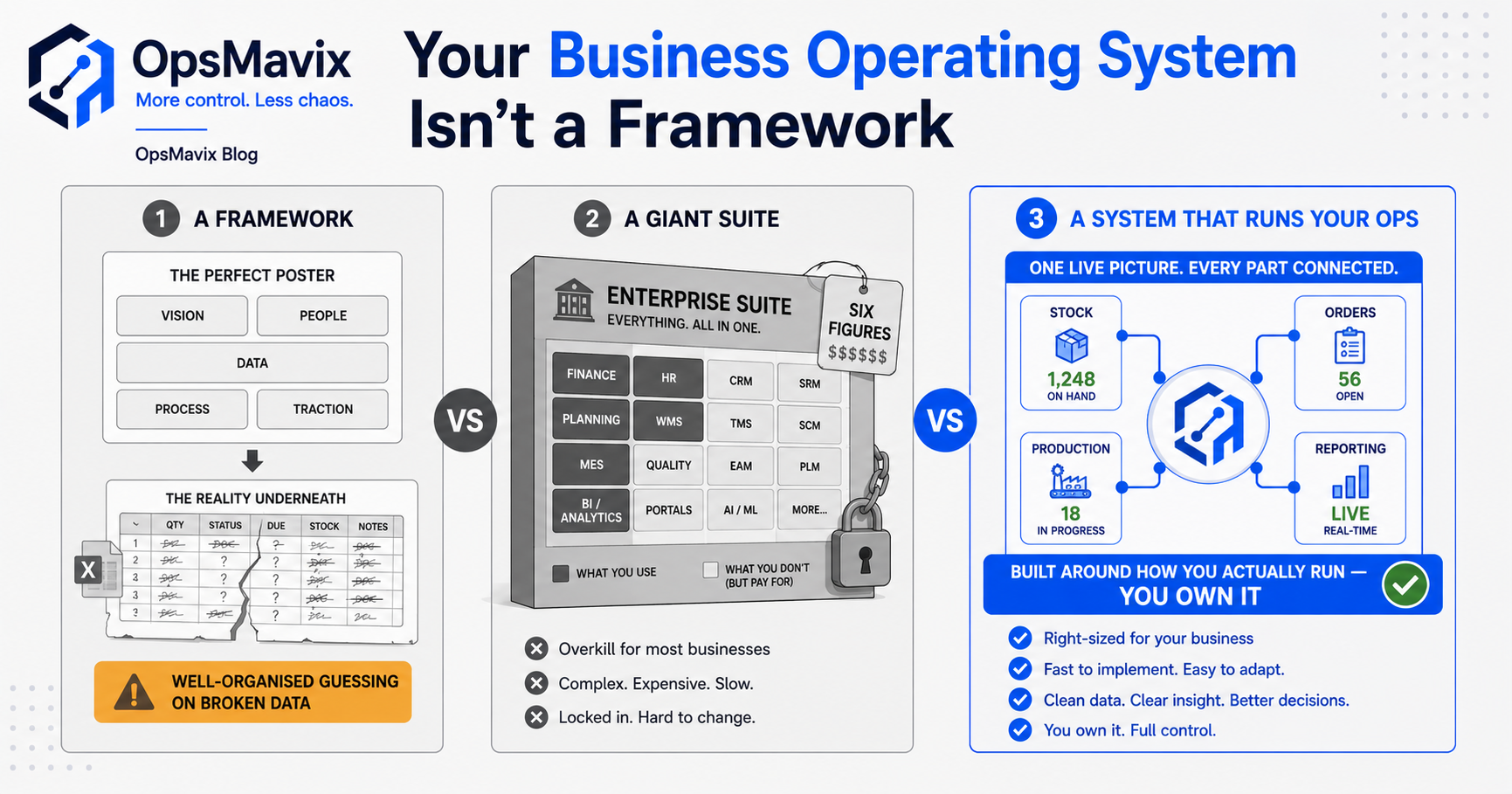
A business operating system is supposed to make your company run on its own — without you holding it together in your head. The trouble is the term means two completely different things depending on who’s selling it. To one camp it’s a management framework: meetings, scorecards and roles (the EOS-style vision-people-data-process-traction model). To another it’s software — a sprawling enterprise suite that promises to run every department from one login. Both call themselves your “operating system.” Neither, on its own, is what most growing businesses actually need.
Here’s the honest version. A framework gives you language and rhythm, but it changes nothing if the daily operation still runs on disconnected spreadsheets and a person re-typing numbers between screens. A giant enterprise suite gives you software, but it’s usually more than the problem — you bend your business to fit it, pay for modules you’ll never open, and rent it forever. The real operating system for a business that has outgrown spreadsheets and disconnected tools is narrower than both: a right-sized system that runs the actual operation — stock, orders, production, approvals, reporting — built around how you work, that you own.
Key Takeaways
- “Business operating system” is two things wearing one name: a management framework (EOS-style meetings, scorecards, roles) and a giant software suite. They solve different problems.
- A framework changes nothing on its own if the daily work still runs on disconnected spreadsheets and manual re-keying. It organises decisions, not data.
- A full enterprise suite is usually overkill you bend your business to — modules you won’t use, renting it forever, reshaping proven workflows to fit it.
- For most growing businesses the real operating system is narrower: a right-sized custom system that runs the actual operation off one set of numbers.
- The tell that you need an operational layer, not a framework: your problem is wrong numbers and re-typing, not unclear priorities or meeting rhythm.
- A built-for-you system is shaped to how you work, lives in weeks not years, and is yours to own — no per-seat tax, no lock-in.
1The Two Things “Business Operating System” Actually Means
The phrase gets used as if everyone means the same thing. They don’t. There are two distinct products hiding under one label, and most of the confusion in this topic comes from mixing them up.
The first is a management framework — the EOS / “Traction” lineage and its cousins. It’s a way to run the company: a vision document, a small set of measurable numbers (the scorecard), defined roles, a weekly meeting cadence, and a rhythm for hitting goals. It’s about decisions, focus and people — the conductor, not the orchestra.
The second is software — usually a large enterprise suite (or its lighter “all-in-one platform” cousins) marketed as the operating system for your business: one place for finance, inventory, HR, sales, the lot. It’s about data and tasks — the machinery, not the management. When someone sells you a “business operating system,” your first job is to ask which one they mean, because neither is automatically the thing you’re missing.
2Why a Framework Alone Changes Nothing on the Floor
A framework is genuinely useful. If your leadership team has no shared priorities, no clear owner for each function, and meetings that wander, a vision-people-data-process-traction model can bring order. But notice what it doesn’t touch. A scorecard tells you the stock-accuracy number is bad — it doesn’t make the stock number right. A framework says “this person owns inventory”; it doesn’t stop that person re-typing the same figure into a website, an accounts package and a stock sheet that never agree. It organises who decides and how often you meet. The leak is in the doing, not the deciding.
This is the contrarian bit, and the one that saves money: if your real problem is that the daily operation runs on disconnected spreadsheets and manual admin, a framework won’t fix it — it’ll give you a tidier way to discuss the same broken numbers. You’ll have a beautiful scorecard built on figures you can’t trust. The management layer assumes a working operational layer underneath it, and for many growing businesses that layer is the thing that doesn’t exist yet.
3Why a Giant Enterprise Suite Is Usually the Wrong “OS”
The other answer — buy the all-in-one suite that runs everything — fails growing businesses for the opposite reason. It’s not too little; it’s too much, in the wrong shape. The breadth that sounds reassuring in the demo is the problem you live with afterward. You pay for finance, HR, supply-chain and CRM modules when your actual pain is stock and orders. You reshape proven workflows to match the software’s rigid template. And the cost rarely stops at the quote — implementation, consultants, per-seat fees and annual increases stack up past the number you signed for. Operators who’ve been through it say it plainly. One described a major rollout as six figures up front and then “$38,000 a year for a system where we don’t even use half the functions.” Another put the model bluntly: “this whole partner driven industry is a robbery really.”
That’s not a fault in any one vendor — it’s a category mismatch. An enterprise suite is the right operating system for a genuinely large, multi-entity organisation with deep needs across every department. Reached for early, as the only “real” option, it’s a system you rent forever and bend your business around. Full comparison: operational systems vs a full ERP.
4The Real Operating System: the Layer That Runs the Operation
Strip both extremes away and what’s left is the thing that actually runs a business day to day — not the management rhythm on top, not the platform you bend to, but the operational layer in the middle that captures what’s happening and keeps the numbers straight. For most growing companies that layer is a handful of core flows: what you have (stock), what’s been ordered (orders), what’s being made (production), what needs sign-off (approvals), and what it all adds up to (reporting). In a healthy business those flows share one set of live numbers — a sale drops the stock, the picker sees it, the reorder figure updates, the report reflects it, all from a single entry. In a business that’s outgrown its tools, each flow lives in a separate spreadsheet that knows nothing about the others, and a person is the only thing connecting them. That’s what an operating system means in practice for a business that has outgrown spreadsheets and disconnected tools: the connected operational core, sized to what you run now — not a philosophy, not a 12-module suite, the working machinery underneath. Full breakdown in what an operations system is.
5How to Tell You Need an Operational Layer (Not a Framework)
The two camps solve different problems, so the diagnosis matters. You need an operational layer — not a framework, not a giant suite — when the symptoms are about data and doing rather than focus and deciding.
Signs the gap is operational:
- You re-type the same data into more than one tool, and they still disagree.
- You don’t fully trust your own stock, order or production numbers.
- A simple status question, or month-end, means rebuilding a report by hand.
- One person is the only one who understands the master spreadsheet — and the business quietly depends on them.
- You’re overselling, sitting on dead stock, or finding out a job slipped from the customer, not the system.
Signs the gap is genuinely a framework one (be honest):
- Your leadership team has no shared priorities and meetings wander.
- Nobody clearly owns each function, and accountability is fuzzy.
- The numbers are fine; the focus and decisions aren’t.
Most growing businesses that go looking for a “business operating system” have the first list, not the second — and get sold a framework or a suite because that’s what the term returns, when the actual leak is in the connected machinery underneath. More tells in the signs you need operational systems, and which to put in first in the operational systems every growing business needs.
6The Honest Order: Framework and Software Aren’t Rivals
None of this is anti-framework. The mistake is treating these as competing answers to one question when they answer different questions — and getting the order wrong.
A framework manages the business. An operational layer runs it. A framework on top of a trustworthy operation is powerful: the scorecard means something because the numbers feeding it are real. A framework on top of disconnected spreadsheets is decoration — a confident rhythm around figures nobody can stand behind. So get the operational numbers trustworthy first, then a framework has something solid to organise. This also kills the false binary that you must pick between “a framework” and “a six-figure suite”: for most growing businesses the answer is neither in full, but a right-sized operational system that makes the daily numbers true — after which a lightweight framework, if you want one, finally has a foundation.
7What a Built-For-You Operational System Actually Is
So what does the middle layer look like when it’s done right? Not a product you log into and bend around — a system built around how you already work, that you own outright. It’s shaped to your process, not a generic template — stock tracked the way your warehouse actually moves it, approvals routed the way your team actually signs things off. It connects the tools you already run (Shopify, Xero, QuickBooks, suppliers) so data syncs instead of being re-typed. It’s scoped to a fixed price — typically a few thousand to low tens of thousands, not six figures with an open meter. It’s live in weeks, not the 12–24 months an ERP rollout takes. And it’s yours — no per-seat tax that climbs as you grow, no vendor that can sunset it, no partner you’re hostage to. More on that in custom software built around your business.
OpsMavix’s view is plain: don’t adopt a system on principle, and don’t buy more system than the problem. Start with the one operational area leaking the most — usually stock or reporting — connect it so the numbers are trustworthy, prove it, then expand. That’s a real operating system without the cost of a suite or the emptiness of a framework with nothing underneath it.
A Framework / Big Suite vs a Built-For-You System
| Management Framework (EOS-style) | Enterprise Software Suite | Built-For-You Operational System | |
|---|---|---|---|
| What it is | Meetings, scorecard, roles, rhythm | All-in-one platform for every department | Connected system for your operational core |
| Solves | Focus, priorities, accountability | Big, multi-entity complexity | Wrong numbers, re-keying, no visibility |
| Touches the daily numbers? | No — organises decisions, not data | Yes, but you bend to its shape | Yes — built around how you work |
| Cost | Coaching / licence + your time | Six figures + consultants + per-seat | Fixed scope, typically £3k–£25k |
| Time to value | Quarters of adoption | 12–24 months | Weeks |
| Fit | Generic management model | Rigid template you reshape to | Shaped to your actual process |
| Ownership | Methodology you follow | Rented; vendor lock-in | You own it outright |
| Right when | Decisions/focus are the problem | Genuinely enterprise-scale | outgrowing spreadsheets, not looking for ERP |
Common Questions
Is a business operating system a framework or software?
Both, which is the confusion. The term is used for management frameworks (the EOS / Traction model: vision, people, data, process, traction) and for software suites that claim to run every department. A framework organises decisions and focus; software runs data and tasks. Most growing businesses are missing the operational software layer that keeps daily numbers trustworthy, not the management rhythm.
Do I need EOS or an enterprise operating system to scale?
Not necessarily either, in full. A framework like EOS helps if your real problem is unclear priorities and wandering meetings. A heavyweight enterprise suite earns its cost only at genuine multi-entity scale. If your problem is disconnected spreadsheets, re-typed data and numbers nobody trusts, what unblocks scaling is a right-sized operational system that makes those numbers true.
What’s the difference between a growth operating system and an operations system?
“Growth operating system” and “enterprise operating system” are mostly marketing names for the same two ideas — a management framework or a big software suite. An operations system is the narrower, concrete thing: the connected layer that runs stock, orders, production, approvals and reporting off one set of live numbers. It’s the machinery the grander terms assume you already have.
Can a framework and a custom system work together?
Yes, in the right order. Get the operational numbers trustworthy first with a system built around how you work, then a lightweight framework has real data to organise — leadership instead of well-organised guessing.
How OpsMavix Can Help
OpsMavix builds the operational layer most “business operating system” pitches skip — custom systems for businesses that have outgrown spreadsheets and disconnected tools. Not a framework you adopt, not a suite you bend to: we map how you already work, then connect the parts that are leaking — stock, orders, production, approvals and reporting — into one system that runs off a single set of numbers you trust and own outright.
If you’re weighing a framework or a giant suite but the real problem is daily numbers that are wrong and re-typed across tools, that’s a measurable operational leak. Book an Operations Leak Audit and we’ll map where your numbers break down, and whether you need a system, a framework, or just one area fixed first.