
Demand Forecasting for Small Business: Buy the Right Amount, Not a Guess
Demand forecasting for a small business isn't a crystal ball — it's a disciplined guess at what you'll sell, so you buy the right amount ahead of time. Here's how to do it with methods simple enough to actually keep up, without the over-engineering that gets abandoned by week three.
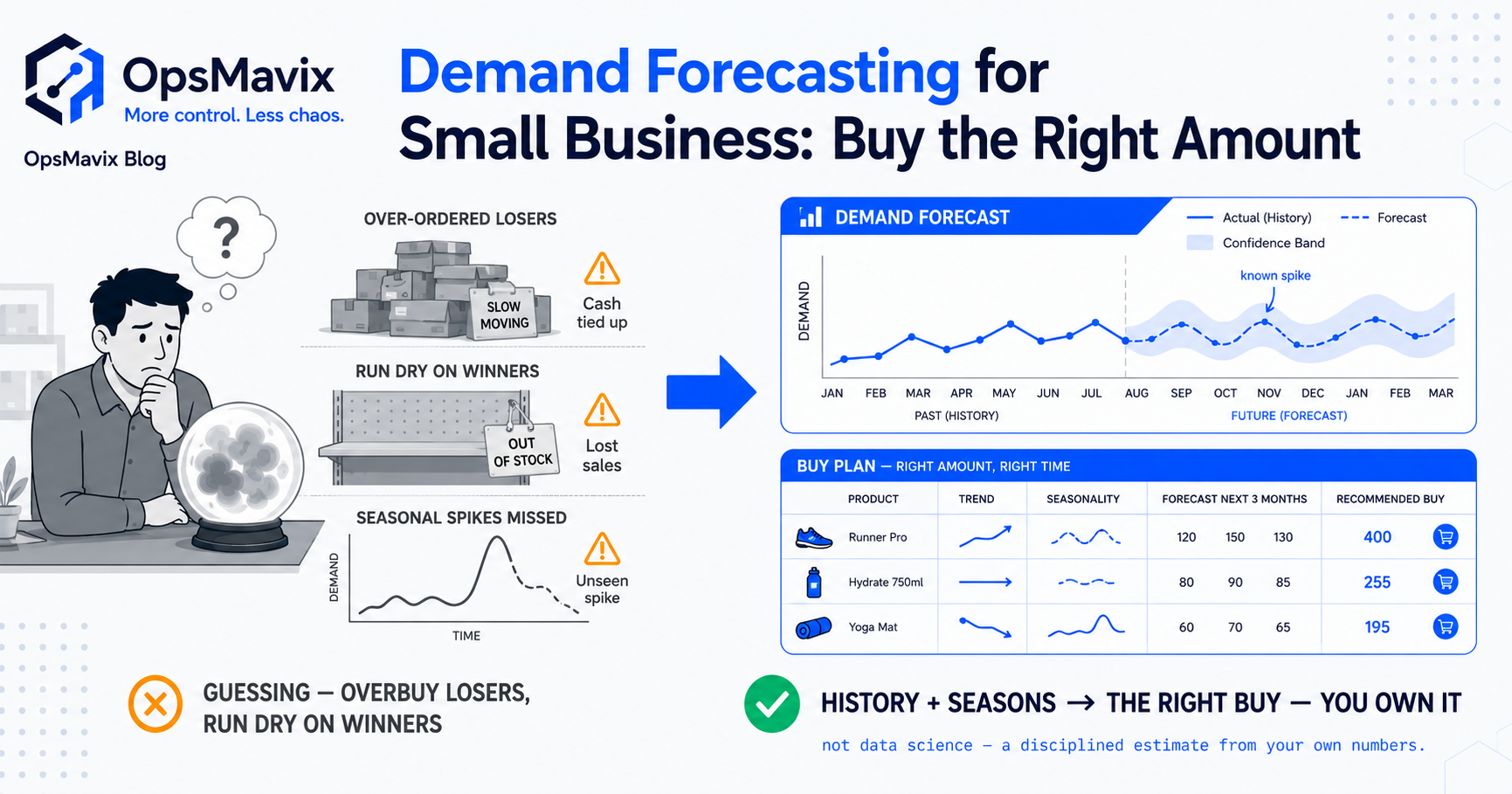
Demand forecasting for small business owners is the practice of predicting how much you’ll sell in the weeks and months ahead, so you buy the right amount instead of guessing. Not a data-science project — a disciplined estimate built from your own sales history, the seasons you already know, and the things you know are coming that the numbers can’t see. Done well, it means less cash frozen in stock that won’t move, and fewer stockouts on the lines that actually make you money. Done badly — or not at all — you overbuy the losers, run dry on the winners, and blame the market for a planning problem.
The honest bit up front: nobody forecasts perfectly, and a small business least of all. The goal isn’t accuracy to the unit. It’s a forecast good enough to buy better than a gut feeling — and simple enough that you’ll still be running it in six months.
Key Takeaways
- Demand forecasting for a small business predicts what you’ll sell so you buy ahead of it — it’s about buying the right amount, not calling the future perfectly.
- The payoff is money: less cash tied up in dead stock, fewer lost sales when a winner runs out.
- Your own sales history is the starting point. Most small businesses have the data and never use it.
- Seasonality and trend are the two patterns worth getting right first — they explain most of the swing.
- The numbers can’t see a promotion, a big customer, or a new listing. You add those by hand.
- Don’t over-engineer it. A simple method you keep beats a clever model you abandon.
- A forecast is only worth building if it turns into a buying decision — a reorder quantity, not a chart nobody acts on.
1. What Demand Forecasting Really Means for a Small Business
Strip away the jargon and demand forecasting is one question: how many of each thing will I sell before my next order arrives, and how many should I have on hand to cover it? Everything else is method. You’re not trying to predict the economy. You’re trying to answer “how much do I buy this month” with something better than a hunch or last month’s copy-paste.
For a small business, the enemy isn’t a bad model — it’s no forecast at all. Buying gets done reactively: reorder when the shelf looks low, panic-buy when a customer asks for something you’re out of, and let cash pile up in whatever you over-ordered last time. That’s not forecasting; that’s reacting. A basic forecast, even a rough one, moves you from reacting to planning — and planning is where the money is.
2. Start With Your Own Sales History
The best forecast for most small businesses is hiding in data they already have: what they’ve sold, by line, over the last year or two. Before any clever method, pull the actual sales history per SKU and look at it. How many units a week does this line really move? That number — the plain average of recent demand — is your baseline, and for a lot of steady products it’s already good enough to buy against.
The mistake is forecasting off feel when the history is sitting right there. “It sells well” is not a number. “It sold 38, 41, and 35 units the last three months” is. A simple moving average — the mean of your last few periods — smooths out the noise and gives you a defensible starting figure. You refine from there, but you start from what actually happened, not what you remember happening.
3. Seasonality and Trend: The Two Patterns That Matter Most
A flat average is fine for a steady line and wrong for everything else, because two patterns bend real demand: seasonality and trend. Seasonality is the predictable swing — the garden line that triples in spring, the gift product that does half its year in December, the slow August every year. Trend is the slower drift: a line growing 10% a quarter, or one quietly dying. Miss either and your average will over-buy the down months and starve the peaks.
You don’t need statistics software to catch these. Lay this year’s monthly sales next to last year’s and the shape jumps out. If December is always double November, don’t buy December off a November average — build the seasonal lift in. If a line has climbed every quarter for a year, don’t forecast flat. For a small business, eyeballing a year-on-year comparison per line catches most of the seasonality and trend that matter, and that’s most of the accuracy worth having.
4. Add What the Numbers Can’t See
History tells you what happened under normal conditions. It has no idea you’re running a promotion next month, landed a wholesale account that’ll order in bulk, or listed a product on a new channel. This is where the small business has an edge over any model: you know things the data doesn’t, and you can adjust the forecast by hand.
So after the maths, walk the calendar. A planned discount will pull demand forward and up — plan the stock for it or the promotion sells out day one and annoys everyone. A new big customer is a step change the history can’t predict. A supplier price rise coming, a trade show, a seasonal event, a line you’re discontinuing — all of it overrides the average. The number from history is the starting draft; your knowledge of what’s coming is the edit. Neither alone is the forecast.
5. Don’t Over-Engineer It
Here’s where small businesses waste the most effort: reaching for complexity they don’t need. Exponential smoothing, machine-learning demand models, twelve-tab forecasting spreadsheets with formulas nobody else can maintain — most of it is precision the business can’t use and won’t keep up. A model that’s 3% more accurate but takes three hours a week to run gets abandoned by week three, and an abandoned forecast is worth nothing.
The rule of thumb: match the method to what you’ll actually maintain. A moving average plus a seasonal adjustment plus your manual overrides covers the vast majority of small-business lines, and you can run it in an afternoon. Get that habit solid before you even think about anything fancier. The businesses that forecast well aren’t the ones with the cleverest model — they’re the ones who still run their simple one every month.
A forecast you rerun every month at 80% accuracy beats a genius model you ran once and quietly dropped. Consistency is the accuracy that actually pays.
6. Turn the Forecast Into a Buying Decision
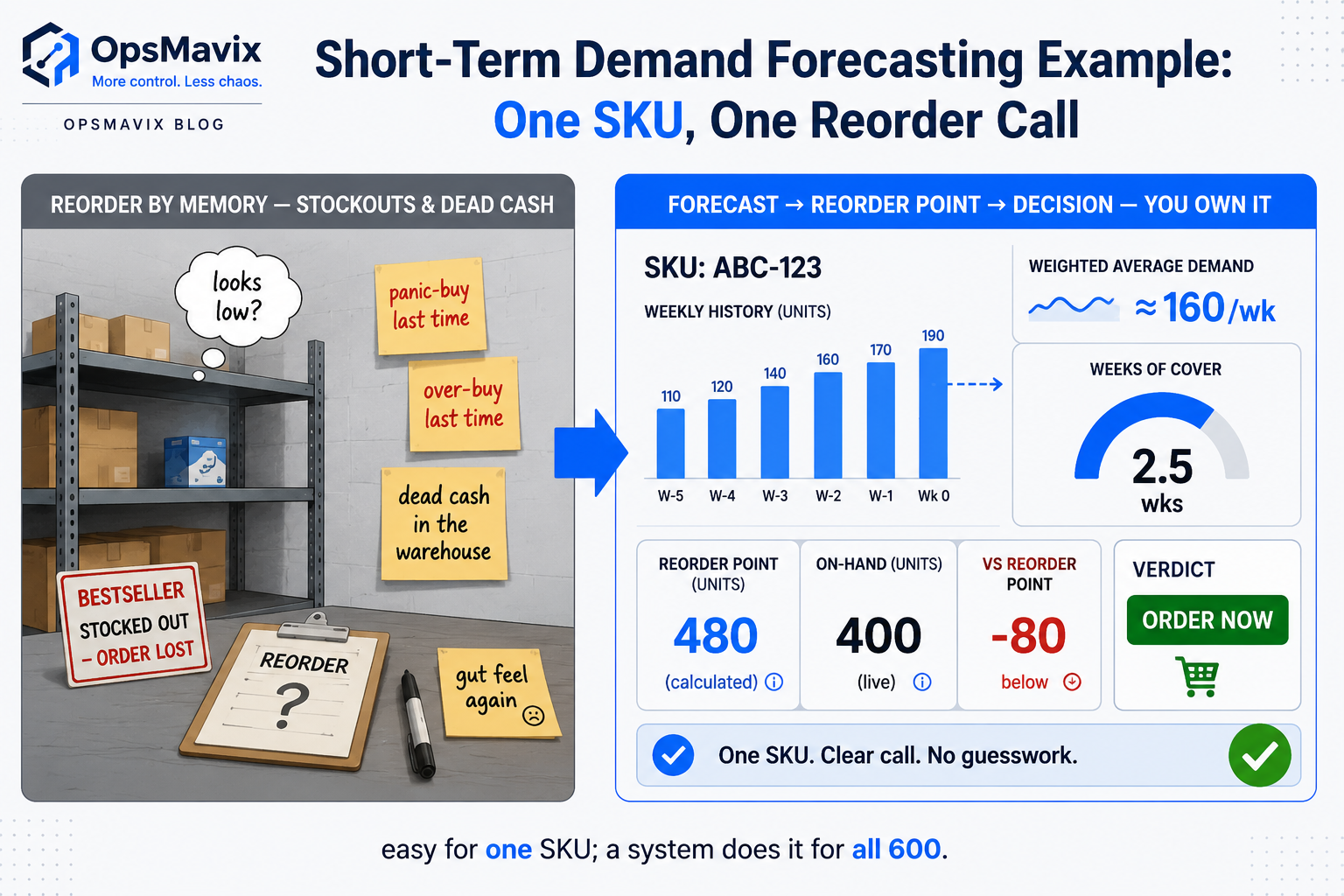
A forecast that doesn’t change what you buy is a chart, not a tool. The whole point is the decision at the end: how much do I order, and when? That means turning “we’ll sell about 40 a month” into a reorder point and a reorder quantity — factoring in how long the supplier takes to deliver (your lead time) and a buffer for the weeks demand runs hot (your safety stock).
The logic is plain. If a line sells ~40 a month and your supplier takes two weeks, you need to reorder while you’ve still got roughly three weeks of cover left, not when the shelf hits empty. Add a little safety stock on your unpredictable winners, less on your steady lines, almost none on the slow movers you don’t want cash sitting in. That’s how the forecast becomes fewer stockouts on the products that make money and less cash frozen in the ones that don’t. Without that final step — forecast to reorder quantity — you’ve done analysis, not planning.
7. Build It Into a System, Not a One-Off Spreadsheet
Most small businesses start forecasting in a spreadsheet, and for a while that’s fine. It stops being fine when it’s a manual monthly slog: exporting sales, copy-pasting into tabs, re-typing reorder points, and hoping nobody fat-fingered a formula. That friction is why forecasts get abandoned — not because the method was wrong, because keeping it fed by hand was too much work on a busy week.
The fix is to build the forecast into the system that already holds your sales and stock, so the history feeds it automatically and the reorder suggestions land next to your live stock figure. This is the layer above day-to-day stock accuracy: your live count keeps the shelf honest — see FMCG stock management for the fast-moving version of that, and building a SKU tracker you can trust for the per-variant count underneath it — while forecasting looks forward from those same numbers to tell you what to buy next. Get the two working together and buying stops being a monthly panic and becomes a decision the system sets up for you.
FAQ
What is demand forecasting for a small business?
It’s predicting how much you’ll sell over a coming period — by line, in units — so you can buy the right amount ahead of time. For a small business it’s a practical estimate built from your own sales history, known seasonality, and things you know are coming, not a statistical modelling exercise. The aim is to buy better than a gut feeling and stop money getting stuck in stock that won’t move.
What’s the simplest demand forecasting method that actually works?
A moving average of your recent sales, adjusted for seasonality, with manual overrides for things you know are coming — promotions, new customers, discontinued lines. Take the average units sold over your last few periods, lift or drop it for seasonal months, then edit by hand for anything the history can’t see. It’s simple enough to run in an afternoon and covers most small-business lines.
How much sales history do I need to forecast demand?
Ideally a year or two, so you can see a full cycle of seasonality and any trend. But even three to six months gives you a usable baseline average for steady lines. Start with what you have — a rough forecast off limited history still beats buying on feel, and the picture sharpens as more history accumulates.
How is demand forecasting different from stock control?
Stock control keeps your current count accurate — what you hold right now. Demand forecasting looks forward from that count to predict what you’ll sell, so you know what to buy next. They work together: forecasting is only as good as the sales and stock numbers feeding it, which is why building it on top of an accurate live stock figure matters.
Do I need forecasting software, or is a spreadsheet enough?
A spreadsheet is fine to start and often all a small business needs at first. It becomes the bottleneck when keeping it fed — exporting sales, re-typing figures, maintaining formulas — is more work than the busy week allows, which is when forecasts get abandoned. At that point, wiring the forecast into the system that already holds your sales and stock removes the manual slog that kills it.
How OpsMavix Can Help
OpsMavix builds custom inventory and planning systems for small and mid-sized businesses stuck between spreadsheets and a full ERP. On the forecasting side, that means the buying decision built on the numbers you already keep: sales history feeding a simple, maintainable forecast, seasonal and trend patterns surfaced per line, and reorder suggestions that land right next to your live stock figure — so you buy the right amount instead of guessing. Scoped to how you actually buy, simple enough to keep running, and owned outright with nothing a vendor can switch off.
If you’re buying on gut feel — cash stuck in dead stock, winners running dry at the worst moment — that’s a planning leak with a price on it. Book a Free Operations Leak Audit and we’ll map where your buying decisions go wrong today, what it’s costing you in tied-up cash and lost sales, and whether a right-sized forecasting system is the genuine fix.
Keep reading
Getting value from OpsMavix? Add us as a preferred source on Google — you'll see more of our operations content in your AI Overviews, AI Mode and Search.