
What Is Operational ERP? (And Why Most Growing Businesses Don't Need the Whole Thing)
Operational ERP is the operations half of an ERP system — the inventory, orders, production, warehouse and procurement capability, as opposed to the finance and accounting core most people picture when they hear "ERP". This post defines operational ERP as a category, walks the functions it actually covers, and gets to the buying decision underneath the term: most growing businesses need the operational capability, not a full finance suite with modules bolted on.
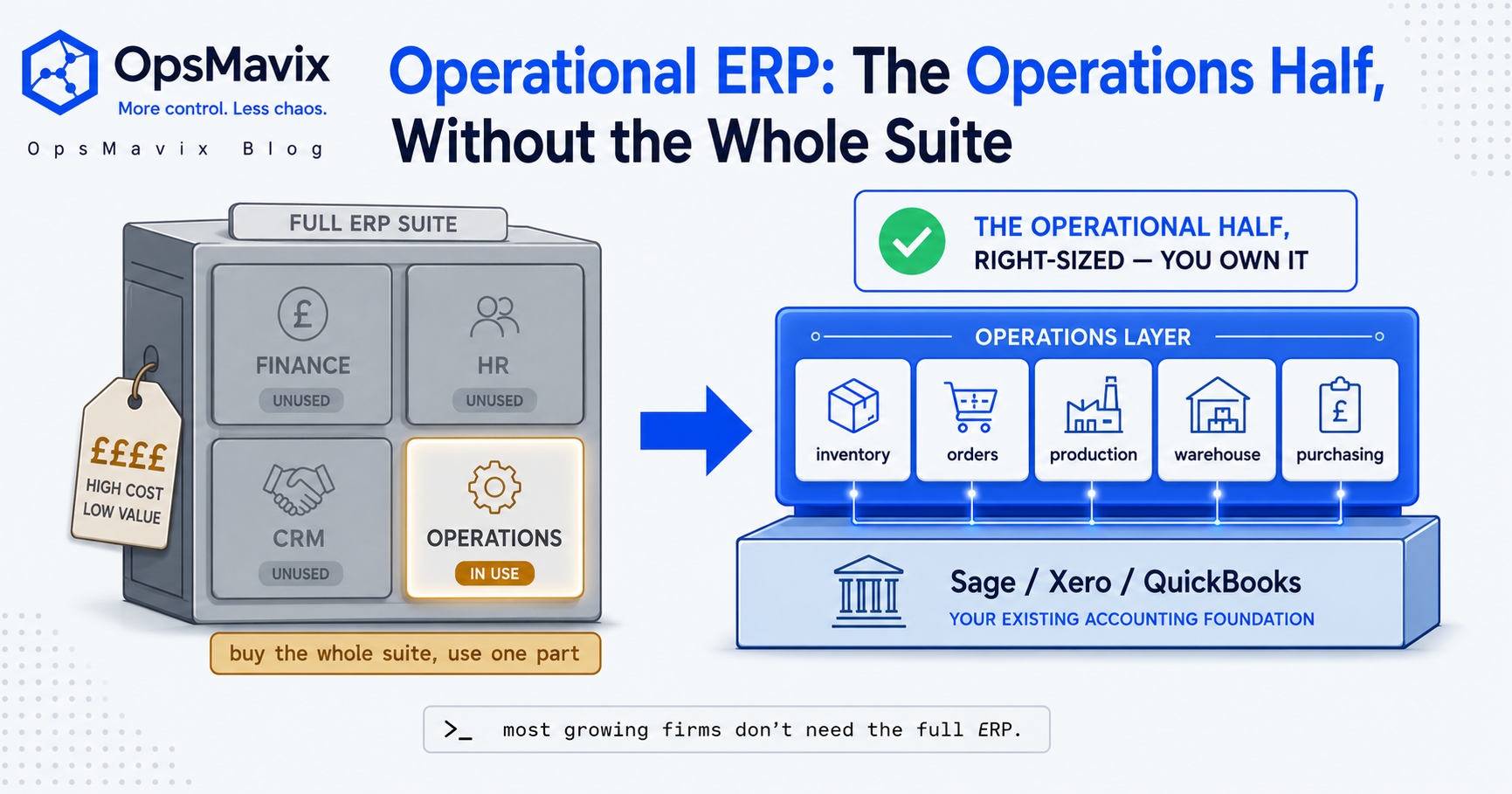
Operational ERP is the operations side of an ERP system — the part that runs inventory, orders, production, the warehouse and procurement, as distinct from the finance and accounting core most people picture when they hear the word “ERP”. It’s a useful term because it names the half of the system that touches the physical business every day: stock moving on and off shelves, orders coming and going, a production line consuming materials, a purchase order chasing a supplier. When someone searches for ERP for operations management, this is the capability they’re after — not the general ledger.
This post is about that term as a category. We’ll define what operational ERP covers, walk the functions inside it, and get to the decision underneath the search: if the operations half is what’s actually broken, do you need to buy the whole ERP to fix it? For a lot of growing firms the honest answer is no — and knowing why starts with seeing operational ERP clearly, as its own thing, not an inseparable lump sold with a finance suite.
Key Takeaways
- Operational ERP is the operations half of an ERP system — inventory, orders, production, warehouse and procurement — as opposed to the finance and accounting core that anchors the traditional suite.
- The term matters because it separates the capability you need (running the physical business) from the platform it usually ships inside (a full ERP you may not need all of).
- Most growing businesses feel operational pain — stock drifting, orders re-keyed, production untracked — long before their accounting software fails.
- ERP sells operations and finance as one bundle, so firms end up buying and running a general ledger they didn’t need to fix a warehouse problem.
- Operational ERP capability can live outside a full ERP — in a right-sized system built around how your operations actually work, feeding your existing accounting rather than replacing it.
- The buying question isn’t “operations ERP, yes or no” — it’s what specifically is broken, and the smallest thing that fixes it without dragging a finance-suite migration behind it.
What “Operational ERP” Actually Means
ERP — enterprise resource planning — is usually pictured as a finance-centred system: one database, one set of numbers, so everything rolls up into the accounts without re-keying. The accounting core became its centre of gravity — the suite people picture first when they hear the word. But ERP carries the operational side of the business too, and that’s the part people mean when they say operations ERP or ERP operations management: the modules that handle the movement of physical things and the work that produces them.
So “operational ERP” isn’t a different product category with its own vendors — it’s a way of naming the operations-facing half of what ERP does: inventory and warehouse, sales and purchase orders, production planning and shop-floor tracking, procurement, demand and materials planning. These are the functions that decide whether an order ships on time, whether you run out of a component mid-run, whether the stock figure on the screen matches the shelf. The finance core records the consequences; the operational side is where they’re created.
Naming it as a category exposes a choice most buyers never realise they’re making. The two halves are technically separable — operations and finance are different jobs — but almost always sold as one platform. Seeing operational ERP as its own thing is the first step to asking whether you need the platform to get the capability.
The Functions Inside Operational ERP
“ERP” as a word is so broad it stops meaning anything, so it helps to be concrete. Operational ERP typically covers five clusters of work.
Inventory and warehouse. Knowing what you hold, where it is, and what it’s worth — across locations, bins, batches and channels: stock levels, goods-in and goods-out, stock takes, transfers, and reconciling the recorded figure against the physical one. When this drifts, everything downstream drifts with it, which is why so much operational pain traces back to inventory discrepancies nobody can explain.
Orders — sales and purchase. The lifecycle of an order in both directions: a customer order captured, allocated, picked, packed, shipped and invoiced; a purchase order raised, sent, received and matched. The failure here is usually re-keying — the same details typed into three tools because the systems don’t talk — and the errors and delays it breeds.
Production and manufacturing. For anyone who makes things: bills of materials, works orders, scheduling, and tracking what’s happening on the floor versus the plan. Two long-standing pieces of the ERP operational stack live here — MRP — materials requirements planning, which works out what to buy and make and when, and the manufacturing execution system layer, which tracks the real-time reality of the shop floor. Both run the physical business, not the accounts.
Procurement and suppliers. Sourcing, supplier records, purchasing rules, approvals and receiving — overlapping with purchase orders but stretching wider into supplier performance and who can commit the business to spend.
Planning. Demand forecasting and the planning that turns a forecast into purchase and production decisions — the connective tissue that stops the other four clusters running blind.
None of that list is a general ledger, accounts payable or financial reporting — which is the point: the operational functions are a coherent set of jobs on their own.
Operational ERP vs the Finance Core — Where the Line Sits
There’s a genuine architectural split running through every ERP: the finance and accounting core on one side, the operational modules on the other. We’ve written the full argument for how that split changes what you should buy in finance ERP vs operational ERP, so we won’t re-run it here. The short version: the two halves solve different problems, fail in different ways, and rarely become urgent at the same time.
The point for defining the term is that the line matters for sequencing. Most businesses hit the operational ceiling first — the spreadsheets and disconnected tools running inventory and orders buckle under volume long before the accounting package does, because accounting software is genuinely good at accounting. So the pain that sends people searching for erp operations is operational pain, and fixing it by buying a full ERP means paying to replace a finance system that wasn’t the problem.
Why Growing Businesses Feel Operational Pain First
Think about what actually breaks as a business scales. Order volume climbs and the manual flow — captured in email, re-keyed into a spreadsheet, re-keyed again to raise an invoice — leaks errors and eats hours. Stock spreads across more SKUs, more locations, maybe more channels, and the single stock spreadsheet stops being believable. Production gets more complex and nobody can say what’s on the floor without walking out to look. Purchasing turns reactive because no planning layer says what to buy before it’s urgent.
Every one of those is operational. None is a signal that your accounting is inadequate. The accounts still close; the numbers the finance side produces are fine — just increasingly late and manual, because the operational data feeding them is scattered across tools that don’t connect. The felt problem is “our operations are held together with spreadsheets and re-keying,” and the correct category for that problem is operational ERP — which is why the search term exists at all. People don’t wake up wanting “enterprise resource planning”; they want the stock to be right, the orders to flow without re-typing, the floor to be visible. They’re right that operational ERP is the correct capability. The mistake, if there is one, comes next: assuming the only way to get it is to buy a full ERP.
Do You Need the Whole ERP to Get the Operational Half?
Here’s the buying decision the term leads to. If operational capability is what’s broken, one option is a full ERP: you get the operations modules, but welded to a finance core, a general ledger and an implementation that touches every corner of the business — solving the operational problem alongside a finance migration you didn’t ask for, a per-seat licence you’ll pay forever, and modules you’ll never open.
The other option is the operational capability without the rest: a system built around your operations — inventory, orders, production, whatever’s actually broken — that feeds your existing accounting instead of replacing it. We’ve laid out that trade-off in full in operational systems vs ERP, so we won’t repeat it here — the one-line version is that a right-sized operational system solves the operations problem without dragging a finance migration and an enterprise price tag behind it.
Sometimes the full ERP is right — we get to when, below. But the common case is a growing business with adequate accounting and broken operations, being quoted for a whole-business ERP to fix half of it.
What Operational ERP Looks Like Outside a Full ERP
If the operations half can be separated from the finance core — and it can — the capability doesn’t have to arrive as an enterprise platform. It can be a system built to fit exactly how your operations work: the stock model that matches your locations and channels, the order flow that matches how your orders really move, the production tracking that matches your floor. This is what an operations system is — operational ERP capability shaped to one business instead of configured out of a generic suite.
The practical difference is what you don’t take on. You keep the accounting software your finance function already trusts, and the operational system feeds it clean data instead of forcing a migration. You don’t pay per seat for a hundred modules to use five, and you own the system rather than renting access to a platform a vendor can reprice or switch off. Whether that’s inventory that stops drifting from the shelf or one operations dashboard everyone trusts, the operational half can stand on its own — which is the case OpsMavix makes: for most growing businesses, operational ERP is best delivered as a right-sized system that fits the operation.
When the Full ERP Is Genuinely the Right Call (the Honest Bit)
We’re not anti-ERP. If your finance core is failing at the same time as your operations — the ledger can’t keep up, the close takes forever, multi-entity consolidation is a manual nightmare — then you have a whole-business problem and a whole-business tool is the honest answer. So is the case where investors, auditors or regulators expect one integrated platform of record end to end; past that threshold, a separate operational system feeding your accounting may not satisfy the requirement no matter how well it runs.
The line is where the pain actually is. If both halves hurt, or the requirement is genuinely one integrated platform, buy the whole thing. If only operations hurt — the usual case for growing firms — get the operational capability and leave the finance core you already have alone. The term “operational ERP” is useful precisely because it lets you ask that question instead of defaulting to the bundle.
FAQ
What is operational ERP?
Operational ERP is the operations-facing half of an ERP system — the functions that run the physical business rather than the accounts: inventory and warehouse, sales and purchase orders, production and manufacturing, procurement, and demand and materials planning. It’s distinct from the finance and accounting core (general ledger, payables, financial reporting) that anchors the traditional ERP, and the term is useful because it separates the operational capability a business needs from the full ERP platform it’s usually sold inside.
What’s the difference between operational ERP and finance ERP?
Finance ERP is about the truth of the numbers — one ledger, controlled and auditable. Operational ERP is about the truth of the physical business — where stock is, whether orders shipped, whether production has its materials. They solve different problems and rarely become urgent at the same time; most growing businesses hit the operational ceiling first, while their accounting is still adequate. There’s a fuller breakdown in our post on finance ERP vs operational ERP.
Do I need a full ERP to get operational ERP capability?
Usually not. If only your operations are broken and your accounting is fine, you can get the operational capability from a right-sized system built around how your operations work, feeding your existing accounting rather than replacing it — without the finance migration, per-seat licensing and unused modules of a full ERP. The full ERP becomes the right call when your finance core is also failing, or when regulators or investors require one integrated platform end to end.
What functions does operational ERP include?
Inventory and warehouse management, sales and purchase orders, production and manufacturing (bills of materials, works orders, MRP and shop-floor tracking), procurement and supplier management, and demand forecasting and materials planning. None of these are finance functions — they run the operation, and the finance core records the results.
How OpsMavix Can Help
OpsMavix builds right-sized operational systems for growing businesses feeling operational ERP pain — stock drifting, orders re-keyed across tools, production nobody can see. Instead of a full ERP that swallows your finance function to reach the half that’s actually broken, we build the operational capability to fit your business — inventory that matches your real locations and channels, order flow that matches how your orders move, production tracking that matches your floor — feeding the accounting software your finance team already trusts rather than replacing it. It’s a system you own, not a platform you rent — no seats to license as the team grows, and no vendor holding a switch over how you run day to day.
If your operations are held together with spreadsheets and disconnected tools and you’re weighing an ERP to fix it, start by seeing the leak. Book a Free Operations Leak Audit and we’ll map where your operations cost you today, what it’s worth to close, and whether the operational half is all you actually need to buy.
Keep reading
Getting value from OpsMavix? Add us as a preferred source on Google — you'll see more of our operations content in your AI Overviews, AI Mode and Search.