
Construction Enterprise Resource Planning, Explained in Plain English
Enterprise resource planning is one integrated system for running the money, work and stock of a business. In construction it looks very different from a factory or a shop. Here is what the term actually means, the jargon that comes with it, and how to tell whether you need the word or just the outcome.
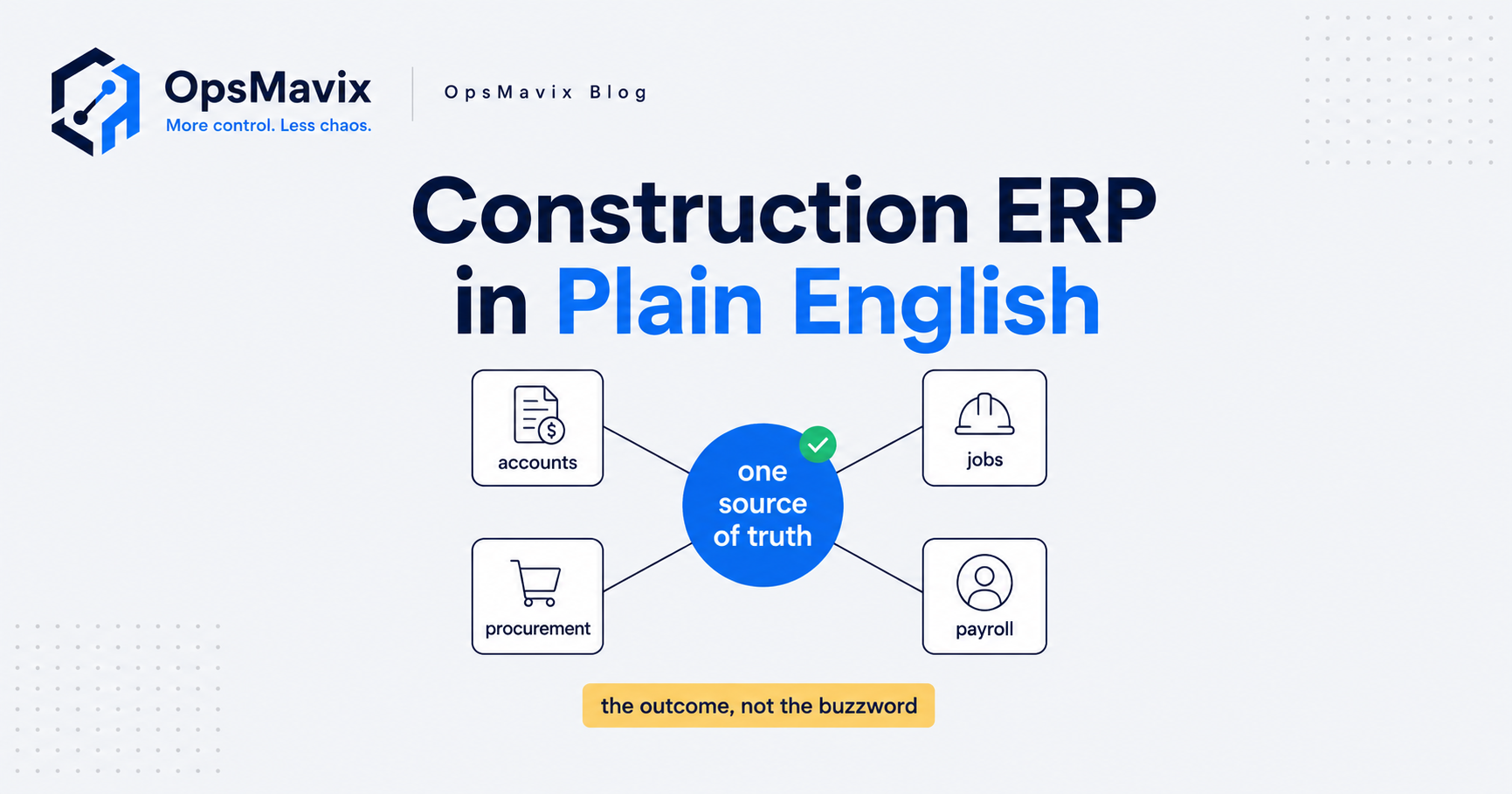
Construction enterprise resource planning is the practice of running a construction business on one integrated system, so that estimating, procurement, site progress, subcontractor payments and finance all share the same data instead of living in separate spreadsheets and inboxes. The phrase sounds heavier than the idea. Strip away the acronym and it means one thing: everyone in the business, from the QS to the bookkeeper, is looking at the same numbers, updated once, at the same time.
Quick summary: Enterprise resource planning (ERP) is, in Gartner’s words, “the ability to deliver an integrated suite of business applications” that share “a common process and data model” across finance, distribution, manufacturing and the supply chain (Gartner). Applied to construction it becomes project-centric rather than product-centric, and it has to speak the trade’s own language — retentions, applications for payment, CIS and cost value reconciliation.
Contents
- What “enterprise resource planning” actually means
- Why construction ERP is different
- Project-centric vs product-centric: the core split
- The one idea that makes it worth it: a single source of truth
- The modules a construction system tends to cover
- Glossary: the construction ERP terms you will hear
- Construction vs manufacturing vs retail: a comparison
- Signs a business has outgrown spreadsheets
- Do you need the word, or just the outcome?
- FAQ
What “enterprise resource planning” actually means
ERP started life in manufacturing in the 1990s as a way to plan materials and resources across a factory. The idea spread to every industry, but the definition stayed the same. Gartner defines it as an integrated suite of business applications that “share a common process and data model, covering broad and deep operational end-to-end processes, such as those found in finance, HR, distribution, manufacturing, service and the supply chain” (Gartner).
Two words in that definition do the heavy lifting: integrated and common data model. Integrated means the parts talk to each other automatically. Common data model means there is one agreed version of each fact — one list of jobs, one list of suppliers, one figure for what a project has cost so far — and every screen draws from it. That is the whole point of the category. Everything else is detail.
If you want the plain-English version of the surrounding idea before you go further, we cover it in what is an operations system.
Why construction ERP is different
Most ERP thinking was built around making or selling a repeatable product. A factory makes ten thousand of the same widget. A shop sells the same SKU a hundred times a day. The system tracks a product moving through predictable stages.
Construction breaks that model. Every project is effectively a one-off. It is built once, on a site you do not own, over months or years, priced before you fully know what you will find, and paid for in stages against valuations rather than on delivery. The “product” is a building, and you only make one of it.
That changes what the software has to do:
- The unit of everything is the project (or the contract), not the SKU. Costs, revenue, margin and cash are all tracked per job.
- Revenue is recognised as work progresses, not when a sale completes. You value work done monthly and bill against it.
- Cash is deliberately held back. Clients retain a percentage of each payment until the job is proven complete and defect-free.
- A lot of the workforce is not yours. Subcontractors are paid under statutory rules, and the tax on those payments is handled through a government scheme.
- The estimate is the baseline you are judged against for the whole life of the job.
A generic ERP that does not understand those five realities will fight you at every step. This is why the market has a distinct category of construction-specific systems, which we go deeper on in the construction ERP software guide.
Project-centric vs product-centric: the core split
This is the single most useful mental model for the whole topic. Product-centric systems (retail, manufacturing, distribution) are organised around things: you buy them, store them, transform them, sell them. Success is measured in margin per unit and stock turns.
Project-centric systems are organised around jobs that have a beginning, a middle and an end. Success is measured in the profitability of each contract, tracked continuously because you cannot wait until a two-year job finishes to find out you lost money on it. Gartner even splits its own ERP definitions along this line, distinguishing product-centric cloud ERP from service-centric ERP, because the two need different engines under the bonnet.
Construction is firmly project-centric with a heavy commercial and cash-flow layer bolted on. Any system you consider has to start there, not treat the project as an afterthought hung off a finance ledger. We compare the two philosophies of system in operational systems vs ERP.
The one idea that makes it worth it: a single source of truth
Behind all the jargon, ERP sells one benefit: a single source of truth. Right now, in most growing construction firms, the truth is scattered. The estimate lives in one spreadsheet. The QS keeps costs in another. Purchase orders sit in an email folder. The accounts package knows what has been invoiced but not what has been committed on site. Retentions are tracked, badly, in a fourth file that one person understands.
When those sources disagree — and they always do — someone spends a day reconciling them, and decisions get made on numbers that are already out of date. A single source of truth means each fact is entered once and everyone sees the same current answer. That is the outcome worth paying for. Whether it arrives wearing the label “ERP” is beside the point, and we walk through building one in how to build one source of truth for your business.
The modules a construction system tends to cover
“Integrated suite” means a set of modules that share data. In construction the common ones are:
- Estimating / tendering — pricing the job and producing the baseline budget.
- Procurement and subcontract — purchase orders, subcontract orders, material scheduling.
- Cost control / commercial — tracking committed and actual cost against budget per project.
- Applications and valuations — measuring work done and billing the client in stages.
- Payments and CIS — paying subcontractors and applying the correct tax deductions.
- Project accounting / finance — the ledgers, tying everything back to the company accounts.
- Reporting — the live view of margin, cash and forecast final position across all jobs.
A true ERP links all of these so a single purchase order flows from budget, to commitment, to invoice, to cost report, to CVR, without being retyped. Smaller firms rarely need every module on day one. They need the two or three where the money is leaking.
Glossary: the construction ERP terms you will hear
You cannot evaluate a construction system without speaking the language. Here are the terms that come up constantly.
- WIP (work in progress). The value of work done but not yet certified or invoiced. On a project-centric system WIP is a live figure, not a year-end accounting exercise.
- Applications for payment. The formal request a contractor or subcontractor submits for the value of work completed in a period, usually monthly. The client then certifies what they agree to pay. This staged process is underpinned in law by the UK’s Construction Act (legislation.gov.uk).
- Valuations. The client’s or QS’s assessment of how much work has actually been done, which drives what gets certified and paid.
- Retentions. A percentage of each payment (often around 5%, released in halves at practical completion and end of the defects period) that the client holds back as security. It is your money, later — but tracking it is where a lot of firms quietly lose cash.
- CIS (Construction Industry Scheme). The HMRC scheme under which contractors deduct tax from subcontractors’ payments and pass it to HMRC as an advance on the subcontractor’s tax. Registered subcontractors are deducted at 20%, unregistered at 30% (GOV.UK). Any system paying subcontractors has to get this right or you have a compliance problem.
- Cost value reconciliation (CVR). A project’s internal profit-and-loss statement, comparing value earned to date against cost incurred to date — including accruals for work done but not yet invoiced — to show the real commercial position and forecast the final outcome (Metroun). CVR is where a good construction system earns its keep, usually run monthly per job.
- Committed cost. Money you have promised via orders but not yet been invoiced for. Ignore it and your cost report flatters you.
- Final account. The agreed, settled total value of the contract once all variations and claims are resolved.
Construction vs manufacturing vs retail: a comparison
The same three letters mean genuinely different software in each sector. This table shows why a manufacturing or retail ERP rarely fits a construction firm off the shelf.
| Dimension | Construction | Manufacturing | Retail |
|---|---|---|---|
| Core unit | The project / contract | The product (SKU / batch) | The product (SKU) |
| What you cost | Labour, plant, materials, subcontract per job | Bill of materials per unit | Cost of goods per line |
| Revenue recognised | Progressively, via valuations | On shipment / sale | At point of sale |
| Cash quirk | Retentions held back; staged payment | Payment on delivery terms | Cash / card at till |
| Workforce | Heavy subcontract, CIS deductions | Mostly employed / shift-based | Store staff / rota |
| Key documents | Application for payment, CVR, final account | Works order, BOM | Invoice, stock count |
| Success metric | Margin and cash per project | Margin per unit, throughput | Margin, stock turns |
The rows that have no equivalent in the other columns — retentions, valuations, CVR, CIS — are exactly the features a generic ERP lacks. That gap is the whole reason “construction ERP” is a phrase at all.
Signs a business has outgrown spreadsheets
You do not need any system, of any name, until the pain is real. The honest triggers:
- You find out a job lost money only after it finished.
- Nobody can tell you this week what you are owed in unreleased retentions.
- Your QS’s costs and your accountant’s numbers never match.
- A CIS deduction was wrong and you had to explain it to HMRC.
- You spend a day a month rebuilding the same report by hand.
- Two people give the client two different figures for the same job.
If none of these bite yet, spreadsheets plus a decent accounts package may be genuinely fine. If several bite every month, you are paying for a system already — in wasted hours and leaked margin — just without owning one.
Do you need the word, or just the outcome?
Here is the part most vendors will not tell you. “Enterprise resource planning” is a category built for enterprises. Full construction ERP platforms are powerful, and for a large contractor running hundreds of jobs they are the right tool. For a firm running a handful of projects, an enterprise-grade ERP is often too much system: expensive, slow to implement, packed with modules you will never switch on, and rigid in exactly the places your business is unusual.
What most growing construction SMBs actually want is not the label. It is the outcome the label promises: one place where the estimate, the costs, the applications, the retentions and the CIS payments agree, updated once, visible to everyone who needs it. You can have that outcome without buying “an ERP.” A right-sized, owned operations system can deliver the single source of truth and the live per-project margin view, shaped around how your firm actually works, without the enterprise price tag or the modules you will never touch.
The useful question is never “which ERP should we buy?” It is “which two or three leaks are costing us the most, and what is the smallest system that plugs them?” Answer that first. The right label follows the outcome, not the other way round. If you are weighing the finance angle specifically, finance ERP vs operational ERP is a good next read.
FAQ
Is construction ERP the same as construction accounting software?
No. Accounting software records what has already happened to the money. Construction ERP is broader: it links estimating, procurement, site costs, valuations and payments to the finance ledger so the commercial picture is live, not a month behind. The difference between a finance-led and an operations-led system is covered in finance ERP vs operational ERP.
What is the difference between ERP and MIS in construction?
An MIS (management information system) is mainly about reporting — turning existing data into dashboards and summaries. ERP is about running the operational transactions themselves, with reporting as a by-product of everything living in one place. We unpack this in ERP vs MIS.
Do small construction firms actually need ERP?
Often not the full enterprise product. Small firms need the outcome — a single source of truth for costs, cash and CIS — which a right-sized owned system can deliver without the cost and complexity of enterprise ERP. Need drives the size of the system, not the other way round.
How does CIS affect what a construction system must do?
Any system that pays subcontractors has to apply the correct CIS deductions (20% for registered, 30% for unregistered) and support the monthly returns to HMRC (GOV.UK). Getting this wrong is a compliance risk, so CIS handling is a non-negotiable for a construction-specific system.
What is cost value reconciliation and why does it matter?
CVR is a project’s internal profit-and-loss, comparing value earned against cost incurred to reveal the true commercial position and forecast the final result (Metroun). It matters because it is how you catch a job going wrong while you can still do something about it, rather than at final account.
How OpsMavix Can Help
OpsMavix is not an ERP vendor and we do not sell generic code. We build right-sized, owned operations systems for construction firms that are outgrowing spreadsheets but not looking for — or not well served by — a full enterprise ERP. That means a system shaped around your projects, your valuations, your retentions and your CIS obligations, giving you one live source of truth and a real-time margin view per job, with a delivery guarantee on the build.
We start by finding the leaks, not by selling you modules. If a full ERP genuinely is the right answer, we will tell you. If the outcome you need is smaller and cheaper than the label suggests, we will build exactly that — often anchored on a live operations dashboard that pulls the numbers together in one place. Book a Free Operations Leak Audit.
Sources
- Gartner IT Glossary — Enterprise Resource Planning (ERP)
- GOV.UK — Construction Industry Scheme (CIS)
- GOV.UK — CIS 340: a guide for contractors and subcontractors
- legislation.gov.uk — Housing Grants, Construction and Regeneration Act 1996 (the Construction Act)
- Metroun — Cost Value Reconciliation (CVR) Explained