
How Much Does Construction ERP Cost? A UK Pricing Breakdown
Construction ERP is rarely priced like it looks. The subscription is the small number; implementation, migration, training and the fees nobody quotes upfront are the big ones. Here is what a UK contractor actually pays over five years, and how to think about it.
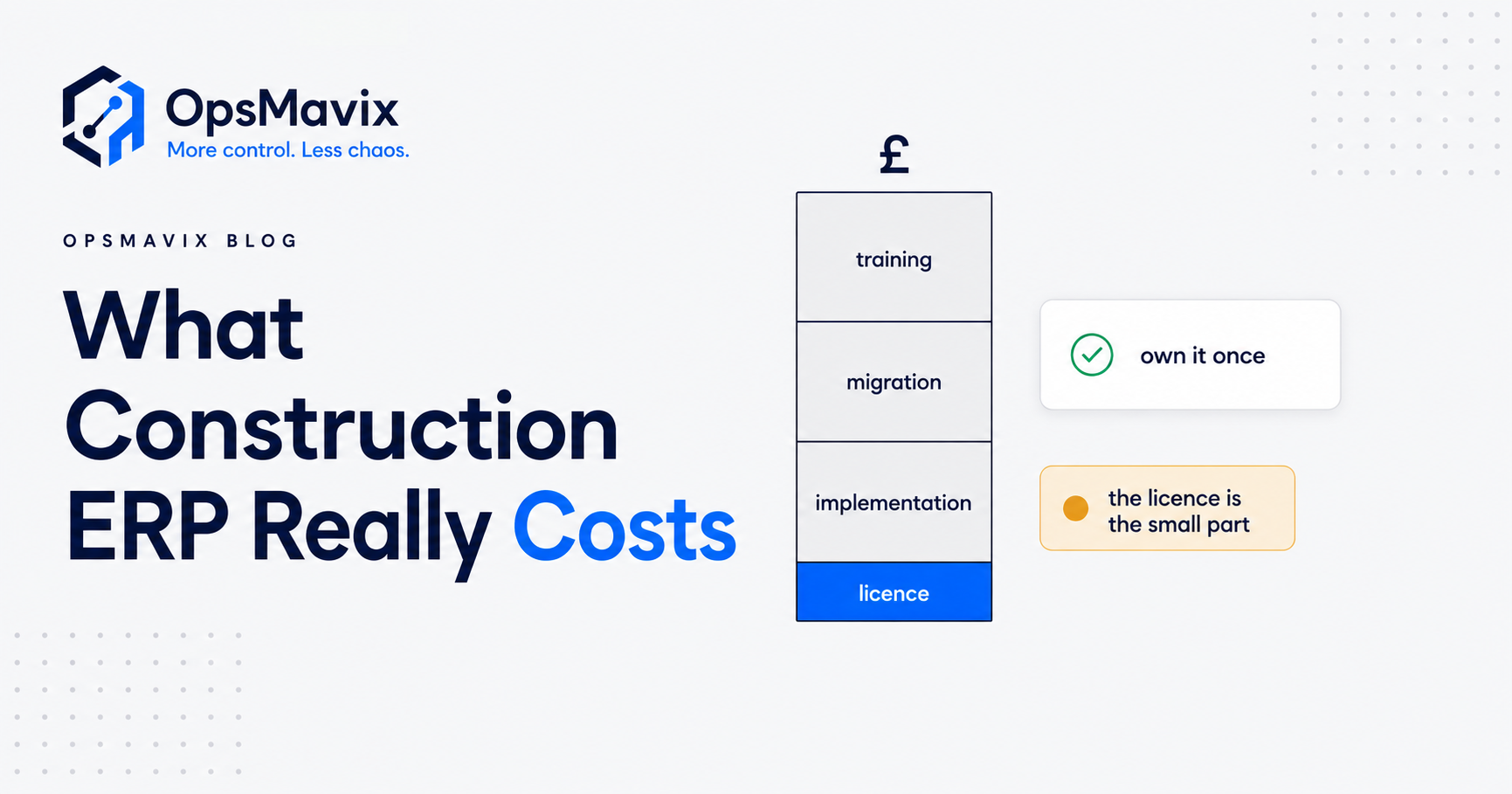
Construction ERP in the UK typically costs a small firm £20,000–£60,000 in the first year and lands at three to five times the annual licence fee over five years once implementation, data migration, training and support are counted. The advertised per-user price is usually the smallest part of the bill.
Quick summary: For a UK small business of 10–30 staff, total year-one ERP cost usually falls between £20,000 and £60,000 covering subscription, implementation, migration and training (Draivix). Implementation alone commonly runs one to three times the first-year subscription, so the licence line is only 20–30% of what you actually spend (Rand Group).
Contents
- What actually goes into the price
- Per-user licensing: the meter that never stops
- Implementation and data migration
- Customisation: paying to make generic fit construction
- Training and change management
- Integrations
- Ongoing support and maintenance
- The cost breakdown, component by component
- The hidden costs nobody quotes
- A worked example: five-year total cost of ownership
- Total cost of ownership vs an owned, right-sized system
- FAQ
What actually goes into the price
When a vendor tells you a construction ERP “starts at £61.50 per user per month,” they are quoting one layer of a five-layer cost. The layers are: software subscription or licence, implementation services, integration and data migration, internal business effort, and ongoing run-state costs. Software licensing represents only about 25–40% of first-year ERP costs; the largest swings come from the non-licence work — converting legacy job-cost data, wiring up estimating and project tools, redesigning workflows and post-go-live support (SysGenPro).
The single most useful habit when comparing quotes is to stop asking “how much per user” and start asking “what is the five-year total cost of ownership.” That is the only number that is comparable across vendors. Everything below feeds into it.
Per-user licensing: the meter that never stops
This is the number vendors put on the pricing page, and it is the easiest to verify.
For generic ERP with construction-capable modules, Microsoft’s UK list price for Dynamics 365 Business Central is £61.50 per user per month for Essentials and £84.60 for Premium (which adds manufacturing and service), billed annually and excluding VAT, with lighter “Team Members” seats from around £6 (Dynamics Square). Dynamics 365 Finance sits higher, around £145 per user per month (converted from US list pricing, approximate). Other mid-market platforms published in the same comparison include SAP Business One at roughly £45–£120, Sage Intacct at roughly £28–£95 plus a platform fee, and Oracle NetSuite at roughly £79–£799 on top of a base platform fee (figures converted from US list pricing, approximate) (ERP Research).
Construction-specific platforms price differently. Procore’s annual cost runs roughly £8,000–£65,000 depending on project volume rather than a simple seat count, and Autodesk Construction Cloud starts at about £750 per user per year (Elevate Software).
The trap with per-user pricing is simple: it penalises growth. Every new hire, every site manager who needs a login, every seasonal subcontractor you want visibility on adds to a bill that never stops climbing. Flat-rate models do not do this (Draivix).
Implementation and data migration
This is the line that turns a tidy subscription quote into a five-figure surprise. Implementation typically represents 50–70% of first-year ERP spend once you combine systems-integrator fees, data migration, training and change management, while the licence itself is only 20–30% (Rand Group).
As a planning benchmark, implementation commonly costs one to three times the first-year subscription. For construction platforms specifically, Sage and Viewpoint-style implementations run £8,000 to £100,000-plus depending on complexity, and typically take three to six months (SysGenPro). Even for a project-management platform, Procore-style implementation adds roughly £8,000–£24,000 on top of the annual fee (Elevate Software).
Data migration is the part most often under-scoped. Moving a decade of cost codes, WIP schedules and job history out of spreadsheets or an old accounts package, cleaning it, and mapping it into a rigid new structure is slow, error-prone work — and dirty data creates problems long after go-live. If you have not seen how implementation fees behave on comparable platforms, our breakdown of Odoo implementation cost shows the same pattern on an open-source system.
Customisation: paying to make generic fit construction
Off-the-shelf ERP is built for “a business,” not for a groundworks contractor with retention, CIS deductions, application-for-payment cycles and plant hire. Closing that gap costs money in three ways: configuration (included, up to a point), customisation (bespoke development billed on top), and workarounds (free to buy, expensive to live with).
Every deviation from the vendor’s standard path — a custom valuation report, a bespoke approval workflow, a field the software does not have — is chargeable and, worse, becomes something you must re-test and often re-pay for at every upgrade. Customisation is where the “1x” implementation estimate quietly becomes “3x.”
Training and change management
Software you have paid for but nobody uses is pure loss. Getting site managers, QSs and office staff to actually adopt a new system is a real cost line, not a rounding error. Training varies by role and system complexity, and change management — the effort of moving people off the old way of working — is one of the most commonly overlooked costs in the whole project (Rand Group). Budget several thousand pounds for a small firm, and expect a productivity dip during the transition regardless.
Integrations
Your ERP does not live alone. It has to talk to your accounts software, your estimating tool, your CAD or project-management platform, sometimes your payroll and CIS submissions. Each connection is planning, building, testing and ongoing support — Procore-style integration work commonly adds several thousand pounds, and every integration is another thing that can break at an upgrade. If your finance and operations data never quite reconcile, it is worth understanding why in our piece on finance ERP vs operational ERP.
Ongoing support and maintenance
The bill does not stop at go-live. Cloud ERP folds maintenance into the subscription, but you will usually still pay a partner retainer for changes, fixes and admin. On-premise and heavily customised systems carry annual maintenance and upgrade costs on top. Across a five-year horizon, total cost of ownership typically lands at three to five times the first-year licence fee once support, upgrades and internal effort are counted (Draivix). That multiplier is the single most important fact in this article.
The cost breakdown, component by component
Here is how the layers stack up for a typical UK small-to-mid construction firm. Ranges are indicative and drawn from the sources cited throughout; your figures will vary with headcount, modules and complexity.
| Component | Typical range (UK) | Notes |
|---|---|---|
| Per-user subscription | £30–£200 / user / month | Business Central £61.50 (Essentials) to £84.60 (Premium); construction-specific platforms vary. Scales with headcount. |
| Implementation & configuration | 1–3x first-year subscription | Largest single line. Construction implementations £8k–£100k+; 3–6 months. |
| Data migration | Bundled in implementation, often £4k–£15k+ | Cleaning and mapping legacy job data; frequently under-scoped. |
| Customisation | Highly variable, £0 to tens of £k | Bespoke reports, workflows, fields to fit construction; re-tested every upgrade. |
| Training & change management | £2k–£6k+ for a small firm | The gap between “bought” and “used.” |
| Integrations | Several £k per connection | Accounts, estimating, CAD, payroll; each one is ongoing risk. |
| Ongoing support / maintenance | Partner retainer + upgrades, annual | Rolls into the 3–5x TCO multiple over five years. |
| Hidden (admin time, bloat, lock-in) | Recurring, rarely quoted | See below — real money that never appears on an invoice. |
Sources: Draivix, Rand Group, ERP Research, Elevate Software, SysGenPro.
The hidden costs nobody quotes
Three costs never appear on a quote but cost you every month:
- Admin time. If staff spend hours re-keying, chasing, and reconciling between the ERP and the spreadsheets they never actually abandoned, that labour is a running cost of the system, not a saving. A common outcome of over-heavy ERP is more admin, not less.
- Module bloat. Enterprise suites bundle modules you will never touch and charge for them. You pay per user for a platform where your team uses maybe a third of the functionality — and the unused two-thirds still makes the system slower to learn and harder to change.
- Lock-in. Once your data, workflows and integrations live inside a vendor’s proprietary structure, leaving is expensive and frightening. That switching cost is exactly what lets per-user prices rise year after year with no realistic alternative. You do not own the system; you rent access to your own operation.
A worked example: five-year total cost of ownership
Take a 20-person contractor choosing Business Central Premium (it includes manufacturing and project modules). The figures below are illustrative modelling built on the cited benchmarks, not a vendor quote.
| Line item | Basis | 5-year cost |
|---|---|---|
| Licence | £84.60 × 20 users × 12 months × 5 years | £101,520 |
| Implementation & configuration | ~1.5x first-year licence (£20,304) | £30,000 |
| Data migration | Legacy job data, one-off | £8,000 |
| Integrations | Accounts + estimating + payroll | £8,000 |
| Training & change management | Small-firm rollout | £4,000 |
| Ongoing partner support | ~£5,000 / year × 5 | £25,000 |
| Indicative 5-year TCO | ~£176,500 |
That is roughly £35,000 a year, and about 1.7 times the raw five-year licence — well within the “3–5x first-year licence” rule the sources describe (Draivix). Add heavy customisation or a bigger headcount and it climbs fast. The point is not the exact figure; it is that the £84.60 sticker price described about 57% of the eventual bill, and the licence keeps running for as long as you use the system.
Total cost of ownership vs an owned, right-sized system
The reason ERP costs behave this way is structural: you are renting a large, generic platform and paying specialists to bend it toward construction, forever. For firms that are genuinely outgrowing spreadsheets but nowhere near needing a full ERP, there is a different shape of spend — building a smaller, owned system that does exactly your jobs, valuations and reporting and nothing else.
An owned right-sized system is a defined-scope project, not an open-ended subscription. There is no per-user meter, so growth does not inflate the bill; there is no module bloat, because you only build what you use; and there is no lock-in, because you own it. At OpsMavix the published bands are Starter Fix £3,000–£10,000, Growth System £10,000–£25,000, and Operations Platform £25,000-plus — one-off builds, not annual licences. Set that against the illustrative £176,500 five-year ERP figure above and the trade-off is clear. For the fuller comparison of the two approaches, see operational systems vs ERP and the construction ERP software pillar.
The honest caveat: an owned system is not the answer for everyone. If you need deep multi-entity finance consolidation, complex manufacturing MRP, or hundreds of concurrent users across many territories, a full ERP earns its cost. The question is whether you are buying that, or paying for it and using a fraction.
FAQ
How much does construction ERP cost in the UK?
For a firm of 10–30 staff, expect £20,000–£60,000 in year one covering subscription, implementation, migration and training, and roughly three to five times the first-year licence fee over five years once support and internal effort are counted (Draivix).
Why is the per-user price so much lower than the total cost?
Because licensing is only about 20–40% of first-year spend. Implementation, data migration, training and change management make up the majority — implementation alone is commonly one to three times the annual subscription (Rand Group).
Why do some vendors hide their pricing?
Many construction ERP vendors do not publish figures because cost genuinely depends on scope, headcount and modules — but it also lets them price to what they think you will pay. If a vendor will not give a range, treat that as a reason to insist on a full itemised five-year total cost of ownership before signing.
What is the biggest hidden cost?
Usually a tie between data migration (under-scoped, slow, and quietly billed as extra) and lock-in (the switching cost that lets per-user prices rise every year). Wasted admin time from a system too heavy for the team is a close third.
Is a custom-built system always cheaper than ERP?
No. For deep multi-entity finance, complex manufacturing or very large user counts, a full ERP is worth it. A right-sized owned system wins when you use only a fraction of an ERP’s modules and the per-user meter and customisation fees dominate your bill. Model both as five-year TCO before deciding.
How OpsMavix Can Help
We are not an ERP vendor, and we will tell you if a full ERP is genuinely what you need. What we do is build owned, right-sized operations systems for construction firms that are outgrowing spreadsheets but not looking to carry full-ERP cost and bloat — systems that track your jobs, valuations, costs and profitability without a per-user meter or a decade of lock-in. You can see the shape of that in our project profitability without spreadsheets walkthrough and the operations dashboard it feeds. Every build comes with a delivery guarantee: we sell the outcome, not the code. Start by finding out where your money actually goes. Book a Free Operations Leak Audit
Sources
- Draivix — How Much Does an ERP Cost in the UK? Pricing Models & TCO
- Rand Group — How much does ERP cost? Pricing, implementation, and hidden costs explained
- ERP Research — Cloud ERP Per-User Pricing Comparison
- Elevate Software — Construction Software Pricing in 2026: What UK Contractors Actually Pay
- Dynamics Square — Microsoft Dynamics 365 Business Central Pricing (2026) UK
- SysGenPro — Construction ERP Pricing Comparison for Implementation Cost Control