
Available to Promise (ATP): What It Is and How to Calculate It
Available to promise (ATP) is the portion of your stock and inbound supply that isn't already spoken for — the quantity you can safely sell without overselling. This post gives you the ATP formula plainly (on-hand + inbound supply − committed demand), a worked example, and why gut-feel promising causes oversells and backorders. It also shows why a spreadsheet can't keep ATP current and how a live owned system computes it per line automatically.
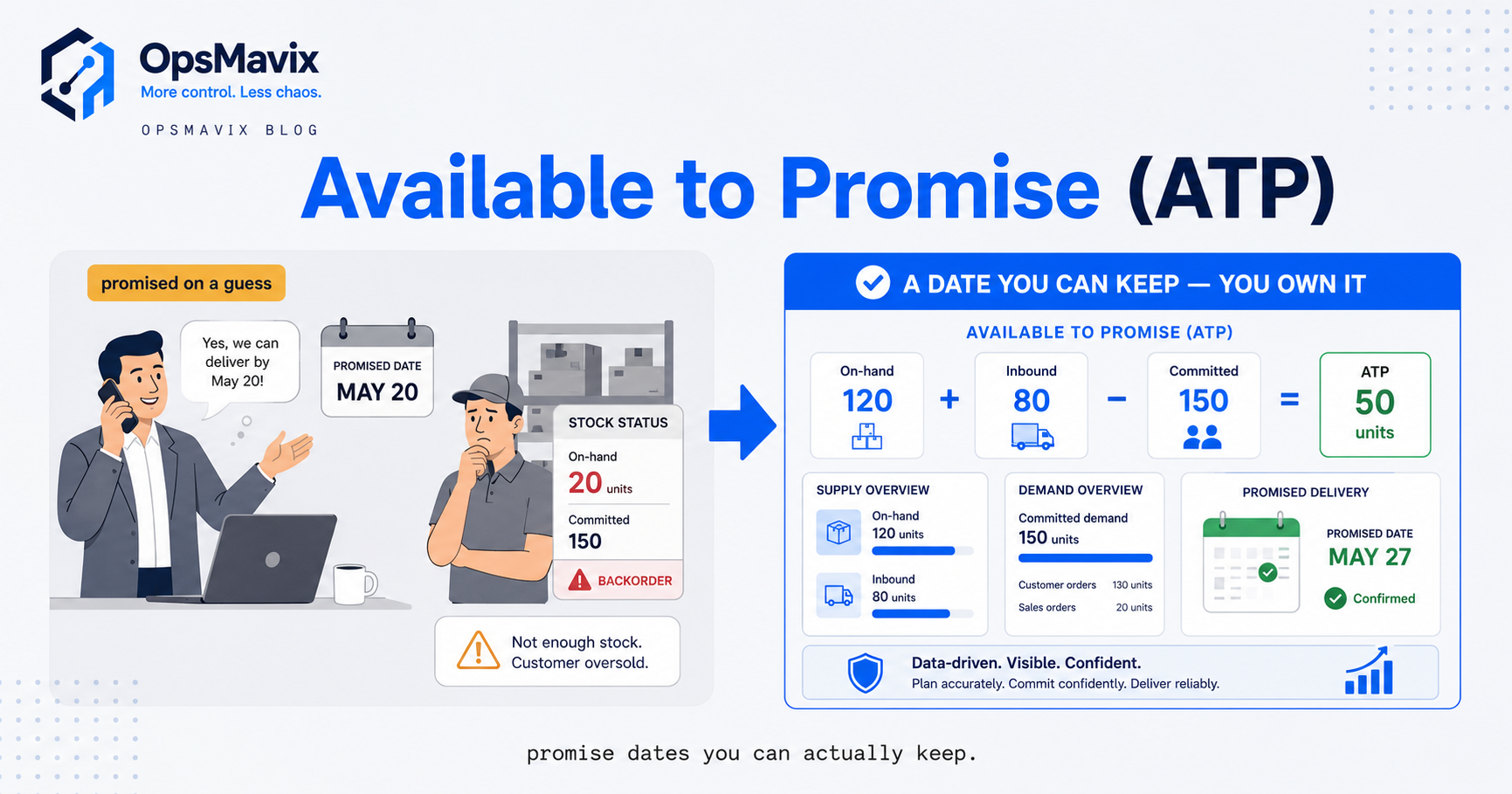
Available to promise (ATP) is the supply that can be committed to a new order under a defined date, location and eligibility policy after existing commitments are considered. It is a promising calculation, not simply the number physically on the shelf. A customer asking for delivery next week needs both a quantity and a feasible date.
For a simplified fixed horizon, a useful net calculation is eligible on-hand stock plus eligible inbound supply available by the requested date, minus existing commitments within the scope and any separately defined withheld quantities. Actual ATP implementations vary, so the calculation must also respect earlier commitments, supply dates, statuses and sourcing rules.
This guide explains the inputs, a time-phased example and how to test a promise when stock is shared across orders and channels. The goal is an explainable commitment backed by eligible supply, rather than a total that includes goods which arrive too late or are already allocated elsewhere.

Stock held on the shelf is only one input to a date-specific customer promise.
Image credit: FIONASUN, CC0 1.0. Displayed at a reduced size; no additional edits.
Key Takeaways
- ATP answers a date-specific commitment question, rather than reporting all stock held.
- Include only eligible supply available in time, with status, location and receiving requirements defined.
- Subtract existing commitments once, using consistent reservation and demand records.
- Check the time-phased position, because later receipts cannot fulfil an earlier due date.
- Distinguish ATP from forecasting and capable-to-promise, which may involve different assumptions and constraints.
- Test changes, partial orders and failed updates, and keep the reservation and approval trail visible.
In this guide:
- 1. Define the Promise and the Stock Scope
- 2. Use a Formula with Explicit Assumptions
- 3. Work Through a Time-Phased Example
- 4. Define Eligible Inbound Supply and Restrictions
- 5. Record Commitments and Order Changes Once
- 6. Keep Multi-Site and Channel Promises Consistent
- 7. Compare Spreadsheets, Planning Tools and Development
- 8. Pilot Promises and Review Missed Outcomes
- Frequently Asked Questions
- How OpsMavix Can Help
1. Define the Promise and the Stock Scope
Ask what the customer needs
An ATP check starts with the item, quantity, required date and fulfilment route. Define whether the date means dispatch, arrival or availability for collection. Transport and preparation can change the feasible outcome.
A stock total can include goods at another site, restricted lots or goods owned by another client. Those units should enter the promise only if the approved sourcing and eligibility rules allow it.
Separate reporting quantities
| Quantity | Meaning to define |
|---|---|
| On hand | Physically recorded stock in the stated scope |
| Available now | Eligible on-hand stock after applicable reservations or restrictions |
| Inbound | Expected or confirmed supply with dates and statuses |
| Committed demand | Existing obligations under the selected policy |
| ATP | Additional commitment supportable under date and sourcing rules |
Oracle’s ATP rules guidance illustrates selection of supply sources and demand scope. This is why two ATP results can differ legitimately if their rules differ.
2. Use a Formula with Explicit Assumptions
Start with a simple net position
For a simplified horizon:
Net eligible supply = eligible on-hand stock + eligible inbound available by the horizon − existing commitments in scope − separately withheld stock.
Document each term and its source. If restricted stock has already been excluded from eligible on-hand, do not subtract it again. If reservations represent the same sales-order demand, do not count both as separate deductions.
Check more than the final total
The net position at the requested date is necessary but may not be sufficient. Earlier commitments can consume stock before a later receipt arrives. A time-phased or product-specific policy must preserve those obligations.
Do not include an unconfirmed planned order as though it were a dependable receipt unless the selected policy permits that assumption and users understand it. Show tentative and confirmed supply separately.
A calculation that ignores units, ownership or dates can look precise while answering the wrong question. Keep the assumptions inspectable in the promising view.
3. Work Through a Time-Phased Example
Follow supply and commitments by date
Hypothetical example: all stock is eligible in one warehouse, units are consistent, and receiving is immediate on the listed dates. There are no further buffers or constraints in this simplified model.
| Point | Supply becoming available | Existing demand due | Uncommitted balance carried forward |
|---|---|---|---|
| Day 0 | 100 units opening stock | 60 units | 40 units |
| Day 3 | 0 | 0 | 40 units |
| Day 5 | 50 units receipt | 40 units | 50 units |
A new request for 30 units on Day 3 fits this model. After committing it, the uncommitted balance is ten units on Day 3 and twenty on Day 5: 100 + 50 − 60 − 40 − 30 = 20.
Do not borrow from a later receipt silently
A request for 50 units on Day 3 cannot be satisfied in full by the 40 then uncommitted units, even though the original Day 5 balance is 50. The later receipt does not arrive in time.
The appropriate response might be a partial promise, a later date or another approved source. Record the agreed outcome and update commitments so the next request does not reuse the same supply.
4. Define Eligible Inbound Supply and Restrictions
Make the availability date practical
A supplier’s expected arrival date may precede inspection, putaway, quality release or transfer to the dispatch site. Define when the stock becomes eligible for the intended order.
Keep confirmed dates, estimates and overdue supply distinguishable. A delayed purchase order should trigger review of promises linked to it, rather than remain a dependable receipt indefinitely.
Respect stock identity and sourcing
The right quantity in the wrong grade, owner, lot or location may not meet the order. Define substitutions and transfers under approved rules, with the relevant transit and processing time.
If the promise relies on future manufacturing, specify which output is confirmed and what assumptions remain. Capable-to-promise may assess additional production or capacity possibilities; do not silently treat every theoretical build as existing ATP supply.
Our inventory workflows page covers the movement and status records supporting these decisions. Eligibility is a policy backed by records, not an automatic property of every unit held.

Available supply must respect its location, status and the time needed to make it ready for fulfilment.
Image credit: Nenad Stojković / Shixart1985, CC BY 2.0. Displayed at a reduced size; no additional edits.
5. Record Commitments and Order Changes Once
Choose the commitment point
An enquiry, quote, accepted order and allocated pick can have different effects. Define which stage reserves supply and when a temporary reservation expires.
If several order channels share stock, they need a consistent commitment policy. A quantity offered to a channel is not necessarily the same record as a firm customer allocation.
Follow amendments through the calculation
Test quantity increases, cancellations, changed dates and partial shipments. Existing demand should change under a controlled event rather than remain in one report after being removed from another.
| Event | Result to demonstrate |
|---|---|
| Quote expires | Temporary hold released under the policy |
| Order accepted | Defined commitment created once |
| Quantity increased | Additional availability checked |
| Order cancelled | Relevant commitment released once |
| Partial shipment | Delivered and outstanding quantities remain clear |
| Date changed | Time-phased position recalculated |
A duplicate imported order must not create duplicate demand. An uncertain update should remain visible until the authoritative records are reconciled.
6. Keep Multi-Site and Channel Promises Consistent
Include transfer and fulfilment rules
Stock at another warehouse may be usable only after an authorised transfer. Include its dispatch, transport and receiving time before promising a customer date.
A combined report can show total quantities while each fulfilment route has different eligibility. This is especially important for FBA, merchant stock, client-owned goods or restricted locations.
Define behaviour during connection failures
An external channel may accept an order before receiving the latest offer update. Reservations, buffers and fallback policies can reduce risk, but they do not remove all delay.
Show source update times and known pending commitments. Decide whether the system holds, reduces or escalates promises when the inputs become stale.
Link the order to the supply and assumptions used where practical. Then a delayed receipt can identify affected commitments instead of forcing the team to rebuild the dependency manually.
7. Compare Spreadsheets, Planning Tools and Development
Use the same time-phased scenarios
A controlled spreadsheet can explain a limited calculation. Existing inventory or planning software may already support ATP rules. Compare those options before assuming custom development is required.
| Route | Where it can fit | What to establish |
|---|---|---|
| Controlled spreadsheet | Limited volume and clearly owned updates | Dates, commitments and reproducible calculation |
| Configure existing inventory or ERP | Relevant promising capability exists | Eligibility, sourcing and reservation policy |
| Integrate working systems | Inputs exist but require manual joining | Authority, timing and duplicate handling |
| Focused custom workflow | A valuable unsupported commitment process remains | Validation, exceptions and handover |
| Full ERP or planning scope | Wider purchasing, production and finance needs justify it | End-to-end requirements and delivery plan |
Include the operating cost
Compare configuration, development, migration, support and ongoing reconciliation. A custom build still depends on source recording and external connections. OpsMavix can build focused systems and full ERPs; the scope should follow the actual decision requirements.
8. Pilot Promises and Review Missed Outcomes
Define the opening position
Agree units, stock status, eligible receipts and existing commitments. Use orders due before and after receipts, not only a single current-stock example.
Acceptance checks should show that:
- Eligible stock excludes the correct restrictions.
- Inbound supply enters on the appropriate availability date.
- Demand and reservations are not double-counted.
- Earlier commitments remain feasible after a new promise.
- Partial and alternative-source decisions are explicit.
- Cancellations and date changes update the position once.
- Delayed supply identifies the affected orders.
- Stale or failed updates create the agreed exception.
- Users can explain the calculation and its source records.
- Exports retain promises and relevant history.
Measure the result by outcome
Review promises missed because of inaccurate records separately from supplier delays or agreed customer changes. Track investigation effort and the age of unresolved commitments.
Expand after the team can operate the exceptions through a busy period. ATP supports a defensible promise; it does not guarantee that suppliers, transport and operations will always perform as expected.
Frequently Asked Questions
What is available to promise?
It is the additional supply that can be committed under defined item, date, location and eligibility rules after existing commitments are considered.
What is the basic ATP formula?
For a simplified horizon, use eligible on-hand plus eligible inbound available by that horizon, minus existing commitments and separately withheld quantities. Time-phased and product-specific rules may add constraints.
Is ATP the same as on-hand stock?
No. On-hand can include restricted or already committed stock, while ATP may include eligible future supply available by the required date.
Can a later receipt satisfy an earlier promise?
Not without another feasible supply route. Check the position by date rather than relying only on a final cumulative total.
Should forecast demand be subtracted as well as sales orders?
Use the defined planning policy. Forecast consumption and actual demand can overlap, so subtracting both without rules may double-count the requirement.
Does accepting an order reserve ATP?
It should have the effect defined by the commitment policy. Specify the stage, temporary holds and expiration so the same supply is not promised repeatedly.
How does ATP differ from capable-to-promise?
ATP concerns eligible supply under its rules. Capable-to-promise can assess additional capacity or production possibilities. Confirm the actual implementation and assumptions.
Can a spreadsheet calculate ATP?
Yes for a controlled scope, but updates, concurrency and changing dates need ownership. Demonstrate that the calculation stays reliable under your workload.
Where should we start?
Reconcile one product, its dated receipts and existing orders. Test a new request before and after the next receipt, then include amendments and failed updates.
How OpsMavix Can Help
OpsMavix builds inventory systems and wholesale order workflows that connect stock, inbound supply and customer commitments.
We define quantity meanings, availability dates, sourcing and reservation policies, then assess configuration, integration and development against the demonstrated gaps. The scope can be focused or a full ERP.
We can help make ATP calculations inspectable, link promises to supply, surface changed dates and failed updates, and pilot exceptions with practical handover.
If customer dates are agreed without a reliable supply picture, book an Operations Leak Audit. Bring one product and its orders and receipts so we can trace the promising gap.
Keep reading
Getting value from OpsMavix? Add us as a preferred source on Google — you'll see more of our operations content in your AI Overviews, AI Mode and Search.