
Backorder Management: Handling Orders You Can't Fulfil Yet
Backorder management is how you hold onto orders you can't fill today instead of losing them. Fair stock allocation across customers, honest promise dates, proactive comms, and turning backorders into purchase orders — here's how growing businesses stop silent backorders bleeding revenue.
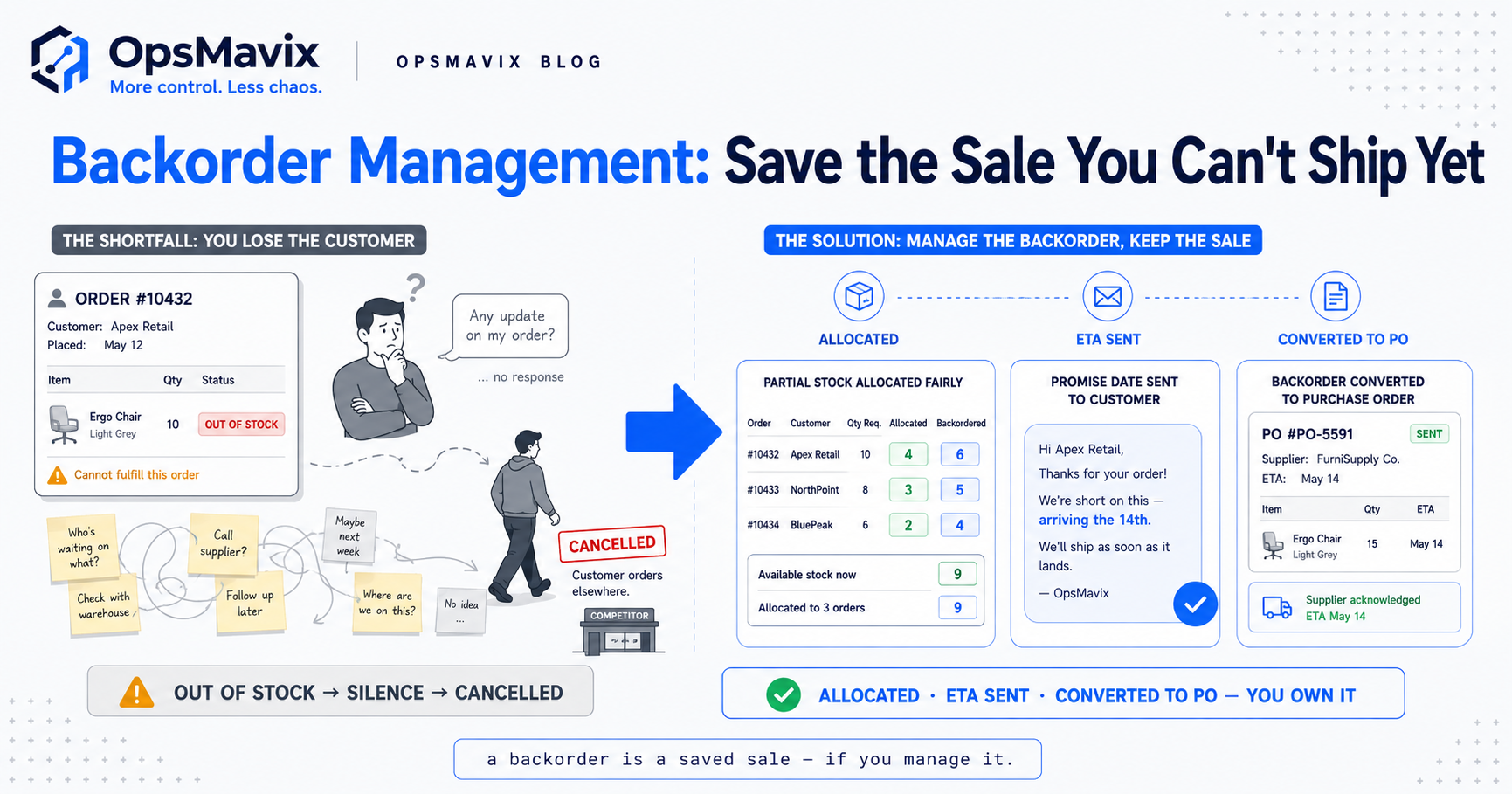
Backorder management is the process for accepted orders or order lines that cannot be fulfilled on the intended date because the required supply is unavailable. It connects the outstanding quantity with an allocation rule, an owner, a realistic next step and customer communication. A backorder remains an obligation to manage, not simply a highlighted row.
The supply gap does not always require a new purchase order. Existing inbound stock, production, a transfer or an agreed alternative may already cover it. Purchasing should respond to the net requirement after those eligible sources and existing commitments are considered.
This guide explains allocation choices, promise dates, partial shipping and a transparent replenishment example. The aim is to keep customers informed and commitments traceable without promising that every delayed order will be retained or that software can prevent every supplier delay.

Backorder management connects the quantity unavailable today with the supply and decisions needed to fulfil it.
Image credit: FIONASUN, CC0 1.0. Displayed at a reduced size; no additional edits.
Key Takeaways
- Track the outstanding line and quantity, with an owner and next review action.
- Choose an explicit allocation policy, including approved exceptions and customer agreements.
- Base dates on eligible supply and fulfilment time, distinguishing estimates from confirmed commitments.
- Record customer preferences for partial shipment, rather than applying a universal order-value rule.
- Buy only the net requirement after existing supply is considered, avoiding duplicate purchasing.
- Measure aged backorders, changed dates and unresolved work, then pilot the connected process.
In this guide:
- 1. Define the Backorder and Its Current State
- 2. Choose Allocation Rules Before Stock Arrives
- 3. Work Through a Shortage and Net Supply Example
- 4. Give Dates with a Defined Basis
- 5. Communicate Changes and Customer Choices
- 6. Decide Partial Shipping and Replenishment Together
- 7. Choose Tools and Measures for the Actual Gap
- 8. Pilot a Complete Backorder Cycle
- Frequently Asked Questions
- How OpsMavix Can Help
1. Define the Backorder and Its Current State
Distinguish a delayed line from a completed order
An order can be partly fulfilled while another line remains outstanding. Track ordered, dispatched, cancelled and remaining quantities under the agreed policy.
A backorder may arise at acceptance, allocation or a short pick. Record when it was identified and why, so users can distinguish unavailable supply from a recording or processing problem.
Give every exception a next action
A useful record includes the item, quantity, customer, intended date, relevant supply, owner and review deadline. “Waiting” alone does not tell the team what to do.
| State | Meaning to establish |
|---|---|
| Supply unresolved | No eligible source or date agreed |
| Supply identified | Linked receipt, production or transfer under review |
| Date communicated | Customer told the current estimate or commitment |
| Partial fulfilment | Some quantity dispatched; remainder still managed |
| Ready to allocate | Eligible supply available under the policy |
| Closed | Outstanding quantity fulfilled or validly cancelled |
Use statuses that reflect the actual operation. Closing a support task should not silently cancel a customer order.
2. Choose Allocation Rules Before Stock Arrives
Make the policy a business decision
First-accepted order, required date, contractual priority and pro-rata allocation can all be relevant policies. Define the rule and any authorised exceptions before the receiving team is under pressure.
Keep the reason for an override visible. A system should make the policy consistent and inspectable, rather than imply that one allocation method is universally fair or commercially correct.
Check the consequences
A first-come policy may fully satisfy some customers while leaving others waiting. Pro-rata allocation can spread available units but create several incomplete orders and more shipments. Date or contract priority may better reflect the obligations.
Include product criticality, agreed substitutions and customer delivery preferences where appropriate. Record the resulting allocation so the same incoming stock is not promised again by another user.
Our B2B order management guide explains the wider lifecycle. Backorder handling needs to remain connected to those commitment and amendment records.
3. Work Through a Shortage and Net Supply Example
Keep the quantities transparent
Hypothetical example: three customers have eligible outstanding demand totalling 300 units. There are 180 eligible units available for allocation. An illustrative pro-rata rule allocates 60% to each customer.
| Customer | Outstanding demand | Allocation | Remainder |
|---|---|---|---|
| A | 120 | 72 | 48 |
| B | 100 | 60 | 40 |
| C | 80 | 48 | 32 |
| Total | 300 | 180 | 120 |
This demonstrates arithmetic, not a recommendation that every business should use pro-rata allocation.
Check existing supply before buying
Assume a confirmed, unallocated 80-unit receipt will be eligible in time to cover the remaining demand, with no other requirements or buffers in this simplified scope. The additional net gap is 120 − 80 = 40 units.
Creating new purchase orders for all 120 remaining units would ignore that existing supply. Equally, counting the 180 already allocated units again as free supply would understate the gap.
Review minimum quantities, pack sizes, supplier terms and other demand before placing an actual order. The example is a planning model, not a purchasing instruction.
4. Give Dates with a Defined Basis
Include the full fulfilment interval
A supplier arrival estimate is not necessarily the customer delivery date. Include transport, receiving, inspection, putaway, picking and the outbound service as required.
Distinguish an estimate from a confirmed commitment. If no dependable date exists, communicate that uncertainty and the next review point instead of inventing a precise day.
Link the promise to its supply
Use the relevant purchase order, production output or transfer as supporting evidence. Our available-to-promise guide explains why quantity and date must be considered together.
If the linked supply changes, identify the affected orders and review their commitments. Retain the previous date and the reason for revision rather than silently overwriting the record.
A source may be suitable for one customer date but arrive too late for another. Do not allocate an incoming total without checking the timing of each obligation.

A promise date must include when stock can actually become eligible for the customer order.
Image credit: Nenad Stojković / Shixart1985, CC BY 2.0. Displayed at a reduced size; no additional edits.
5. Communicate Changes and Customer Choices
Send useful information at the right event
The customer needs the affected line, outstanding quantity, current date basis and available options. An acknowledgement, a material date change and a dispatch confirmation can each serve a different purpose.
Assign who reviews uncertain or commercially sensitive changes before communication. An automatic message should not state a confirmed date when the supply record contains only an estimate.
Record the customer’s decision
Customers may accept waiting, prefer a partial delivery, approve an alternative or cancel under the applicable agreement. Keep that decision linked to the order and update commitments accordingly.
| Communication event | Information to include |
|---|---|
| Backorder identified | Affected quantity and current next step |
| Date changes | Revised basis, reason and options |
| Partial shipment agreed | What ships now and what remains |
| Alternative accepted | Approved product and commercial terms |
| Cancellation agreed | Quantity cancelled and relevant consequences |
| Dispatch confirmed | Actual shipment and remaining position |
Proactive communication can improve clarity, but it does not guarantee that a customer will retain the order. Use actual outcomes when assessing the process.
6. Decide Partial Shipping and Replenishment Together
Use customer and operational requirements
Partial shipping can provide useful stock earlier, but it may add freight, receiving and administration. Holding complete can simplify delivery while extending the wait for available lines.
Record customer preferences and contract conditions. Order value alone is not enough: a low-value critical part may justify a separate shipment, while a large order may need to arrive together for a planned activity.
Join the backorder to the net requirement
Aggregate compatible demand, then consider eligible stock, existing inbound, production and transfers. Keep the required dates, ownership and specifications intact; not every similar-looking product is interchangeable.
A shortage should trigger a purchasing or planning review, not always an automatically released PO. Review quantities and authority under the defined policy.
If supply already covers the gap, the next action may be confirming or expediting that supply. If no suitable source exists, the team may need an alternative or a revised customer agreement rather than another unfulfillable date.
7. Choose Tools and Measures for the Actual Gap
Compare connected workflows
A controlled spreadsheet can work for limited activity with clear ownership. An existing OMS or inventory platform may already support backorders. Integration or development is useful where the required records and decisions remain disconnected.
| Route | Where it can fit | What to demonstrate |
|---|---|---|
| Controlled manual queue | Limited volume and well-owned updates | Dates, outstanding quantities and follow-up |
| Configure current order software | Relevant states and allocation functions exist | Amendments, partial shipments and supply links |
| Integrate purchasing and orders | Both functions work but require manual joining | Net requirements and changed-date updates |
| Focused custom workflow | A valuable unsupported process remains | Authority, exceptions and handover |
| Full ERP | Wider purchasing, stock, production and finance requirements justify it | Complete scope and migration |
Measure what the process can influence
Track aged outstanding lines, unowned exceptions, date changes, missed updates and preventable duplicate purchasing. Record customer cancellations with their known reasons, rather than assuming every cancellation resulted from poor communication.
Compare project, subscriptions, support and remaining administration. OpsMavix can build focused systems and full ERPs; neither guarantees supplier delivery or customer retention.
8. Pilot a Complete Backorder Cycle
Include a shortage and a changed receipt
Choose representative products and customers with different delivery preferences. Agree opening demand, existing supply and any reservations before changing the workflow.
Acceptance checks should demonstrate that:
- Outstanding quantities reconcile to ordered, shipped and cancelled lines.
- Allocation follows the approved policy and retains overrides.
- Eligible existing supply is considered before new purchasing.
- A changed receipt identifies affected promises.
- Estimated and confirmed dates stay distinguishable.
- Customer choices update the order and commitments.
- Partial shipping retains the remaining obligation.
- Duplicate updates do not repeat purchasing or allocation.
- Unresolved work has an owner and next review date.
- Exports and support arrangements work.
Review the outcome before expanding
Run from shortage identification through fulfilment or valid closure. Measure follow-up effort and the age of unresolved work alongside service outcomes.
Expand after users can explain why stock went to a particular order and what supports each remaining promise. The goal is a maintainable decision process that handles uncertainty honestly.
Frequently Asked Questions
What is backorder management?
It manages accepted orders or lines that cannot yet be fulfilled, linking the outstanding quantity to supply, allocation, dates, ownership and customer decisions.
Is a backorder the same as a lost sale?
No. The order remains outstanding until fulfilled or validly closed. A customer may later cancel, but that is a separate event to record.
Which customer should receive scarce stock first?
Use an approved allocation policy based on the relevant obligations and commercial priorities, with documented exceptions. There is no universal rule for every business.
Should every backorder create a new PO?
No. Review the net requirement after eligible stock, existing inbound, production and transfers are considered. Avoid duplicate supply.
How should a promise date be calculated?
Use eligible supply dates plus the required receiving, preparation and delivery time. Distinguish estimates from confirmed commitments.
Should we always part-ship large orders?
No. Customer preferences, contract conditions, urgency and operational cost matter. Order value alone does not establish the right decision.
Can updates be automated?
Yes for defined events and approved wording, but uncertain dates and exceptions need the appropriate review. Messages should reflect the actual record state.
Does software guarantee customers will wait?
No. It can improve visibility and follow-through, but retention depends on supply, communication and the customer situation. Measure actual outcomes.
Where should we start?
Reconcile one outstanding order, its allocation and eligible supply. Follow a changed date or partial shipment through customer communication and closure.
How OpsMavix Can Help
OpsMavix builds wholesale order workflows connected to inventory and purchasing records.
We map outstanding demand, allocation rules, supply links and customer decisions, then assess configuration, integration and development. The scope can be focused or part of a full ERP.
We can help make backorders owned and dated, calculate reviewable net requirements, surface changed supply, retain partial-shipment history and pilot exception handling with practical handover.
If orders keep waiting without a clear next action, book an Operations Leak Audit. Bring a recent backorder and its supply records so we can trace the gap.
Keep reading


Getting value from OpsMavix? Add us as a preferred source on Google — you'll see more of our operations content in your AI Overviews, AI Mode and Search.