What Does Supply Chain Management Software Do? Plan, Source, Make, Deliver, Return — Kept in Sync
What does supply chain management software do? In one line: it keeps the five stages of your supply chain — plan, source, make, deliver, return — working off one shared, current set of numbers instead of five disconnected ones. This guide breaks down what that actually means in day-to-day ops, then makes the case most vendors won't: a growing UK business rarely needs the whole suite. The real question is which two or three functions stop your specific leak.
What does supply chain management software do? In plain terms, it keeps the five stages of getting a product from raw material to a customer’s hands (plan, source, make, deliver, and return) working off one shared, up-to-date set of numbers, instead of each stage keeping its own private version that drifts out of step with the others. That’s the whole job underneath the jargon. Everything else the category sells, from dashboards to forecasting to “AI-driven visibility,” is a consequence of that one thing: when demand, stock, purchase orders, production and shipments all read from the same live figures, the chain stops fighting itself.
The trouble is that “supply chain management software” is sold as one giant thing, and most growing UK businesses hear the phrase and picture a system the size of their whole company. In reality it’s a stack of separate functions, and the honest answer to “which of them do I need?” is almost never “all of them.” A five-person wholesale operation and a global manufacturer both technically “run a supply chain” — they need wildly different amounts of software. This guide explains what each function does, then makes the point vendors won’t: figure out which two or three functions stop your leak, and ignore the rest.
What Does Supply Chain Management Software Do? The Coordination Job Underneath
Strip out the marketing and what supply chain management software does is coordination: it holds the state of your goods, your orders and your money as they move through the business, and it keeps every part of that picture consistent as things change. A customer places an order, a supplier confirms a delivery date, a production run finishes, a pallet ships, a return comes back — each of those events updates a shared set of records, and every other function reads from those updated records rather than from its own stale copy.
Without software doing this, the coordination still happens — it just happens in people’s heads, in email threads, and in spreadsheets updated at different times. Sales promises a lead time based on stock they think is coming. Purchasing raises an order without knowing production already flagged the shortage. The warehouse ships against a pick list printed before two lines got cancelled. None of these people are careless. The system is asking each of them to be the source of truth for information the whole chain depends on, and human-updated silos always drift.
So the concrete work SCM software does breaks down into a few things:
- It records events once — an order, a receipt, a build, a shipment, a return — and lets every function read that record instead of re-keying it.
- It holds current quantities and statuses — how much stock, on which purchase orders, at what stage of production, in transit where — so decisions run off live numbers, not last week’s.
- It connects the stages so an event in one triggers the right response in the next: a confirmed sales order draws down available stock and, if that trips a reorder point, flags a purchase.
- It surfaces the gaps — the late supplier, the line about to stock out, the order stuck unshipped — before they become a customer problem.
That’s it. Everything glossy sits on top of those four jobs. The forecasting is only as good as the current numbers it plans from; the dashboard is only a window onto the same shared records. Get the coordination right and the rest follows. Get it wrong and no amount of reporting saves you, because you’re reporting on figures that were already out of date when they were captured.
The Purpose: One Synced Truth Across the Chain
The purpose of supply chain management software — the reason the category exists at all — is to replace many disconnected versions of the truth with one synced version that every stage shares. That single sentence is worth more than any feature list.
Think about what a supply chain physically is. Demand comes in at one end; raw materials, suppliers and cash go in at the other; and in between sit planning, buying, making, storing, shipping and handling returns. Every one of those stages generates and consumes information the next stage needs. The whole thing only works if that information stays consistent as it flows. The moment planning is working off one stock figure and the warehouse is working off another, you don’t have a supply chain — you have several departments guessing about each other.
This is why “visibility” is the word the category can’t stop using. Visibility isn’t a dashboard; it’s the state you reach when every function can see the same current reality. A wholesaler who knows exactly what’s on hand, what’s on order, what’s promised to customers and what’s arriving Thursday can make a confident decision in seconds. The same wholesaler working from four separate spreadsheets makes the same decision slowly, defensively, and often wrong — over-ordering to be safe, over-promising to win the sale, and firefighting the collision when both catch up.
The £-cost of that gap is rarely a single dramatic event. It’s the drip: the safety stock you carry because you don’t trust the count, the expedited shipping you pay because a shortage surfaced late, the customer who leaves because “in stock” turned out to mean “in stock last Tuesday.” Sync the truth and each of those leaks narrows at once, because they all trace back to the same root cause.
The Five Functions, in Real Ops Language
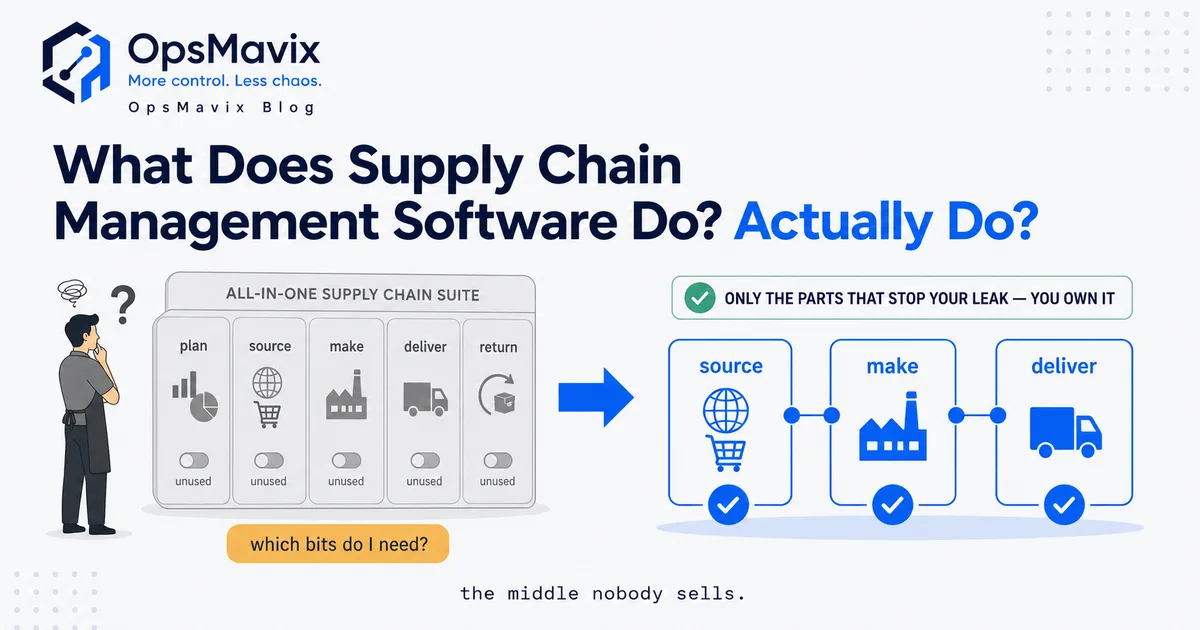
Here’s what the five SCOR stages mean once you translate them out of consultant-speak and into what actually happens in a growing UK business. Vendors package the same stages as supply chain management software modules, which we break down one by one.
Plan — deciding what you’ll need and when. Demand planning and forecasting, setting reorder points and safety stock, matching expected sales to expected supply. In a small operation this is often one person and a gut feel; software turns it into reorder logic that watches live sales velocity and flags replenishment before you run dry. Our guide to how to calculate a reorder point is planning in its most practical, un-fancy form.
Source — buying the inputs. Supplier management, purchase orders, lead times, goods-in. This is where “we thought it was coming” becomes “it’s three weeks late and nobody chased it.” Sourcing software tracks every PO against its promised date, holds each supplier’s real lead time, and stops you raising a second order for something already inbound.
Make — turning inputs into finished goods. Production planning, works orders, bills of materials, tracking a job through its stages. Not every business has a “make” stage — a pure distributor skips it — but for manufacturers it’s often the messiest one, because a build consumes components (source) and produces stock (deliver) at the same time. The bill of materials in supply chain is the record that keeps this honest.
Deliver — getting goods to the customer. Order management, picking, packing, dispatch, and the promise you made about when it arrives. This is the stage customers actually feel, and the one where a broken sync shows up as a cancelled order or a bad review. Multi-channel sellers feel it hardest, which is why order and inventory sync sits at the centre of any wholesale order management system.
Return — handling what comes back. Reverse logistics: returns, faults, recalls, credits. The stage everyone designs last and needs most in practice, because a return that isn’t recorded is stock you own but can’t see, and money you owe a customer but haven’t accounted for.
The point of listing them plainly is this: most businesses are strong in some of these and bleeding in one or two. A distributor might have “make” as a non-issue and “deliver” as a nightmare. A manufacturer might buy well but plan badly. You don’t fix a supply chain by buying software that’s equally mediocre at all five. You fix it by finding the one or two stages that leak and closing them properly.
The Contrarian Turn: You Rarely Need the Whole Suite
Here’s the part the enterprise vendors have a commercial reason not to tell you: a growing SMB almost never needs a full supply chain management suite, and buying one is a common, expensive mistake.
A full SCM platform — or the supply chain module of a big ERP — is built to run all five functions for a large, complex, multi-site enterprise with hundreds of suppliers and thousands of SKUs. It’s genuinely good at that. But it prices, implements and operates for that scale too. One finance director who’d sat through the demos put the trap plainly to us: the pitch is a system you’ll half-use, on a licence you’ll pay forever, implemented by consultants you’ll never quite be free of. Another described the recurring frustration of being stuck in the gap — the small tools are too small, the enterprise ones are too much, and no one sells the middle.
That middle is where most growing UK businesses actually live. You’ve outgrown the spreadsheet — too messy, too many collisions, too much re-keying. But you’re nowhere near the scale that justifies a platform covering procurement, production, warehousing, logistics, demand planning and returns as one giant rented machine, most of which you’d never switch on. Paying for four functions to fix one leak isn’t prudent; it’s the same overkill dressed as safety.
The OpsMavix position is blunt: the question isn’t “what does supply chain management software do?” in the abstract — it’s “which two or three of those functions are actually costing you money, and what’s the smallest system that closes exactly those?” Answer that and you often find you need a sharp, owned tool for one or two stages, integrated with what you already run, rather than a suite that swallows your whole operation and your budget with it. This is the same reasoning we lay out in operational systems vs ERP: buy the slice that stops the leak, own it, and extend it when the business genuinely grows into more.
How to Find the Two or Three Functions That Matter
If the smart move is buying for the stages that leak, the obvious next question is: how do you tell which stages those are? You don’t need a consultant to start. You need to look honestly at where things go wrong.
Walk the five stages and ask, for each, “when did this last cause a fire?”
- Plan: Do you run out of bestsellers while cash sits in dead stock? Do you reorder by gut and get burned? That’s a planning leak.
- Source: Are supplier deliveries routinely late and un-chased? Do you double-order because you can’t see what’s already coming? That’s a sourcing leak.
- Make: Do jobs stall because a component wasn’t there? Do you not know a build’s true cost or status until it’s done? That’s a production leak.
- Deliver: Do you oversell across channels? Do orders get shipped wrong, late, or twice? Does “in stock” lie? That’s a delivery leak.
- Return: Do returns vanish into a corner, un-restocked and un-credited? Do you lose track of faults and recalls? That’s a returns leak.
Most businesses find one stage that’s on fire and one that smoulders. Those two are your system. The stages that already work — where the spreadsheet or the existing tool is fine — you leave alone, and you make sure whatever you build talks to them rather than replacing them.
This is also why the integration question matters more than the feature count. A right-sized system for your two leaking stages has to read from and write to the tools running your working stages — your accounts package, your ecommerce platform, your existing stock tool. Ownership is what makes that possible on your terms: when the business changes and a third stage starts to leak, you extend the system you own, instead of filing a feature request with a vendor and waiting on their roadmap. The whole discipline is the same one behind any good inventory automation system — let each real event update the shared truth automatically, and only for the stages where that truth is actually costing you.
A Worked Example: The Wholesaler Who Bought Too Much
Numbers make the argument concrete. These figures are illustrative — not a specific client — but the shape is one growing distributors recognise on sight.
A UK wholesale distributor, roughly £4M turnover, sells about 1,200 SKUs into trade and online. Their supply chain has no “make” stage — they buy finished goods and resell. On paper they run all five SCOR functions; in reality, only two of them leak.
- Source leaks. Suppliers run 2–4 weeks late with no systematic chasing, and because inbound POs aren’t visible to the sales desk, staff occasionally double-order. Trapped cash and the odd panic-expedited shipment cost, conservatively, a few thousand pounds a quarter.
- Deliver leaks. Trade orders (phone/email) and the website draw from the same stock but sync overnight, so oversells happen at peak. Say 6 oversells a month at an average £180 order — cancellations, apologetic calls, a lost repeat customer or two.
Plan is fine (steady, well-understood demand). Make doesn’t exist. Return is small and manageable. So of the five functions, exactly two are on fire.
Now the two roads. Road one: a supplier’s “supply chain management suite” quote lands — a platform covering procurement, WMS, demand planning, logistics and returns, priced on licence-plus-per-seat, implemented over months. It would fix the two leaks. It would also charge them, every year, for three functions they don’t need, and bend their working processes to fit its generic model.
Road two: a right-sized owned system that does only the two things that leak — one live stock pool that trade and web both read in real time (killing the oversells), and PO tracking with real supplier lead times and inbound visibility (killing the double-orders and late-delivery surprises) — integrated with the accounts and ecommerce tools they already run and keep. Same two leaks closed. A fraction of the cost. No rented core, no per-seat meter, and when a third stage eventually starts to leak, they extend what they own.
The wholesaler’s actual problem was never “we lack a supply chain suite.” It was “two of our five functions are costing us money.” Naming it that way turned a six-figure, five-function decision into a right-sized, two-function build — and that’s the decision most growing businesses should be making.
FAQ
What does supply chain management software do, in one sentence?
It keeps the five stages of moving a product from raw material to customer (plan, source, make, deliver and return) working off one shared, current set of numbers, so that an event in one stage — an order, a delivery, a build, a shipment, a return — automatically updates the records every other stage relies on. The result is coordination without re-keying, and decisions made off live figures instead of stale silos.
What is the purpose of supply chain management software?
Its purpose is to replace many disconnected versions of the truth with one synced version that every function shares. When planning, purchasing, production, warehousing, dispatch and returns all read from the same current data, the chain stops fighting itself — you stop over-ordering to be safe, over-promising to customers, and firefighting the collisions between departments that were each guessing about the others.
What are the main features of supply chain management software?
The core features map to the five SCOR functions: demand planning and forecasting (plan), supplier and purchase-order management (source), production and works-order tracking (make), order management and dispatch (deliver), and returns/reverse logistics (return). Underneath all of them sits the real feature that matters — a shared, event-driven record so every function reads the same live numbers. Dashboards and reporting are windows onto that record, not the thing itself.
Does a small business need a full supply chain management suite?
Usually not. A full suite is built for large, multi-site enterprises running all five functions at scale, and it prices and implements for that. Most growing SMBs have one or two stages that actually leak time and money and the rest running fine. Buying a suite to fix one leak means paying, forever, for functions you’ll never use. The right-sized move is a sharp system for the stages that leak, integrated with the tools already running the stages that don’t.
How do I know which supply chain functions I actually need software for?
Walk the five stages and ask which last caused a genuine problem. Running out of bestsellers while cash sits in dead stock is a planning leak; late, un-chased suppliers and double-orders are a sourcing leak; stalled jobs and unknown build costs are a production leak; oversells and wrong or late shipments are a delivery leak; un-restocked, un-credited returns are a returns leak. Most businesses find one stage on fire and one smouldering — those two are your system. The rest you leave alone and integrate with.
How OpsMavix Can Help
OpsMavix builds right-sized, owned operations systems for growing UK businesses whose supply chain has outgrown spreadsheets but doesn’t justify a full ERP or SCM suite. Instead of selling you a platform that covers all five functions — and charging you forever for the ones you’ll never use — we map your actual chain across plan, source, make, deliver and return, find the one or two stages that are genuinely leaking time and money, and build a system that closes exactly those: shaped to how you already run, integrated with the accounts and ecommerce tools you keep, and owned outright by you so you extend it when you’re ready rather than filing a feature request and waiting. It’s the practical middle between a tool that’s run out of road and a suite that’s overkill. If you’re not sure which part of your supply chain is costing you the most, start by finding out: Book a Free Operations Leak Audit
Sources
- ASCM — SCOR reference model — the standard process framework (from ASCM, formerly APICS) that defines the supply chain as linked stages: plan, source, make, deliver and return.
- OpsMavix — Operational Systems vs ERP — the right-sized-vs-full-suite argument in depth.
- OpsMavix — Supply Chain Management Software — a broader walkthrough of the SCM software category for growing businesses.
Keep reading
Getting value from OpsMavix? Add us as a preferred source on Google — you'll see more of our operations content in your AI Overviews, AI Mode and Search.