
The Bill of Materials in Supply Chain Management: From BOM to Purchase Order
On the shop floor a BOM is a build instruction. On the buying side it decides what you order, how much, and when — through explosion, netting, yield, lead time offsetting and minimum order quantities. This guide follows one 250-unit build from the parts list to the purchase orders it generates.
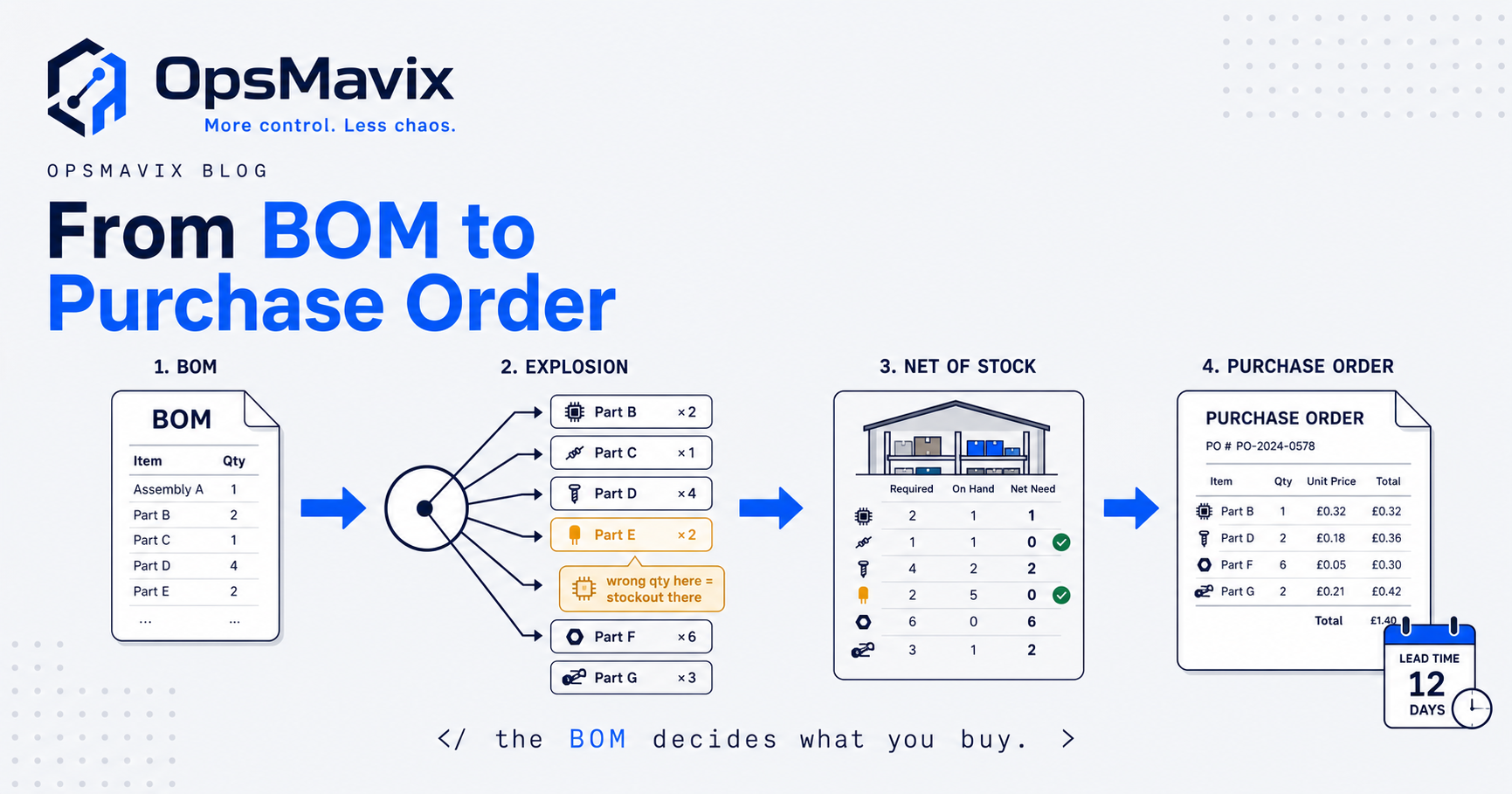
The bill of materials in supply chain management is the record that turns a production plan into dated buying, costing and traceability decisions. Exploded against a build quantity, it tells purchasing what to order, tells planning when to order it, tells finance what a finished unit should cost in materials and tells quality which supplier lots went into which products.
The practical problem is that each of those jobs multiplies whatever is on the BOM. A wrong quantity per unit becomes a wrong purchase order on every batch, a missing yield factor becomes a recurring shortage, and a BOM that does not record lots leaves a supplier defect with no clear boundary. This guide follows one hypothetical build from the parts list through to purchase orders, cost and lot records.
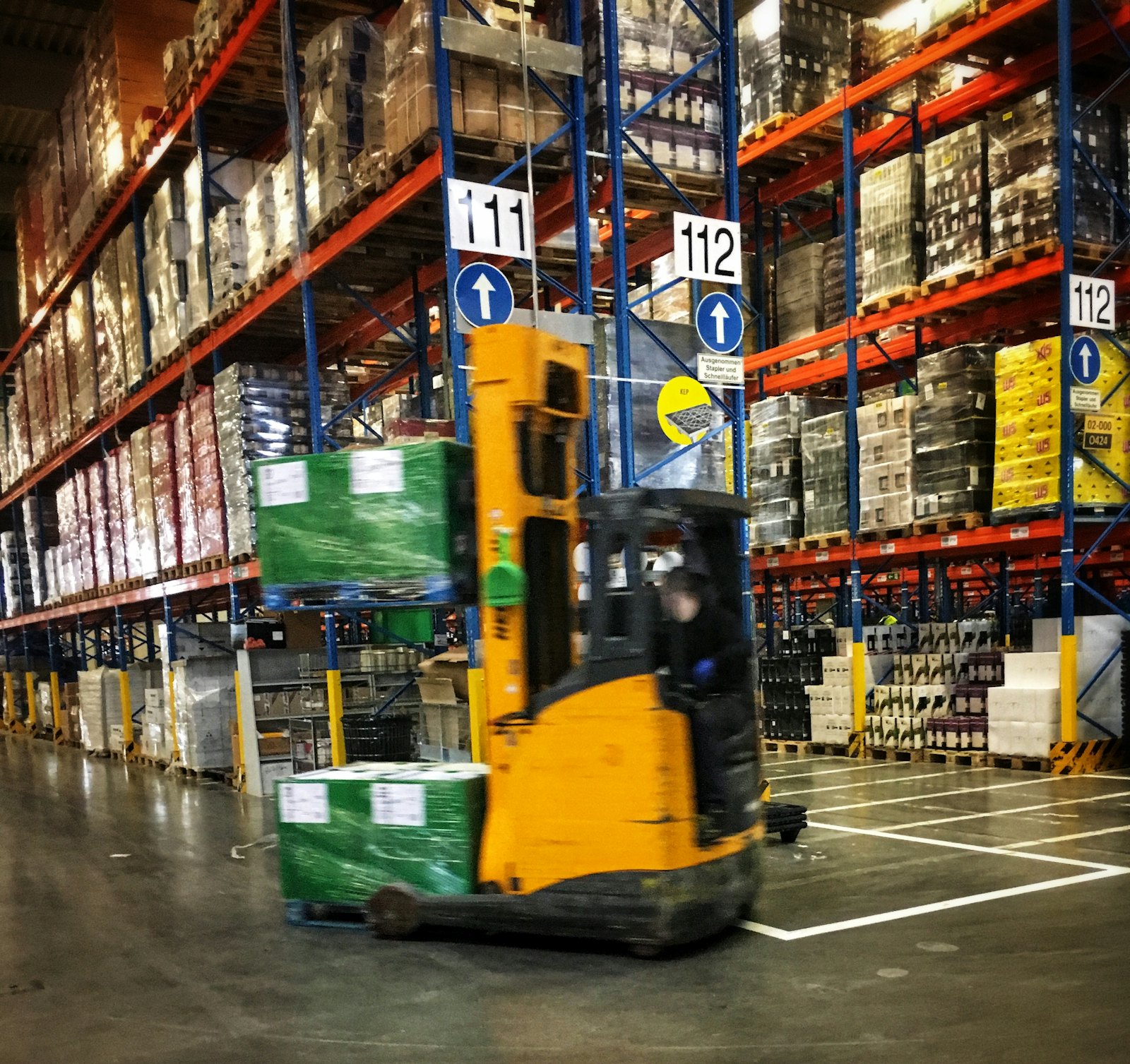
Every pallet that arrives for a build was ordered because a BOM line asked for it. Illustrative photograph, not an OpsMavix project.
Image credit: Bernd Dittrich, Unsplash License. No edits.
Key Takeaways
- The BOM is the source of dependent demand: components are bought because a parent item needs them.
- Explosion gives gross requirements; netting against free stock and in-time orders gives what to buy.
- Yield, minimum order quantities and pack multiples mean the purchase quantity rarely equals the BOM quantity.
- Order-by dates come from offsetting supplier lead time backwards in working days, not calendar days.
- The same BOM drives material cost roll-up, so a price or quantity change should flow up automatically.
- Recording supplier lots against works orders turns the BOM into a traceability record as well as a recipe.
In this guide:
- 1. See the BOM as the Source of Supply Chain Demand
- 2. Explode the BOM Into Gross Requirements
- 3. Net Requirements Against Real Supply
- 4. Turn Net Requirements Into Purchase Orders
- 5. Offset Supplier Lead Times Backwards
- 6. Roll Up Material Cost From the BOM
- 7. Trace Supplier Lots Through the BOM
- 8. Choose Where BOM Driven Planning Should Run
- Frequently Asked Questions
- How OpsMavix Can Help
1. See the BOM as the Source of Supply Chain Demand
Dependent and independent demand
A customer orders a finished product. Nobody orders a gasket for its own sake; the gasket is needed because the product needs it. That is dependent demand, and the BOM is where it comes from. Forecast or reorder-point demand for items you sell or consume directly is independent demand.
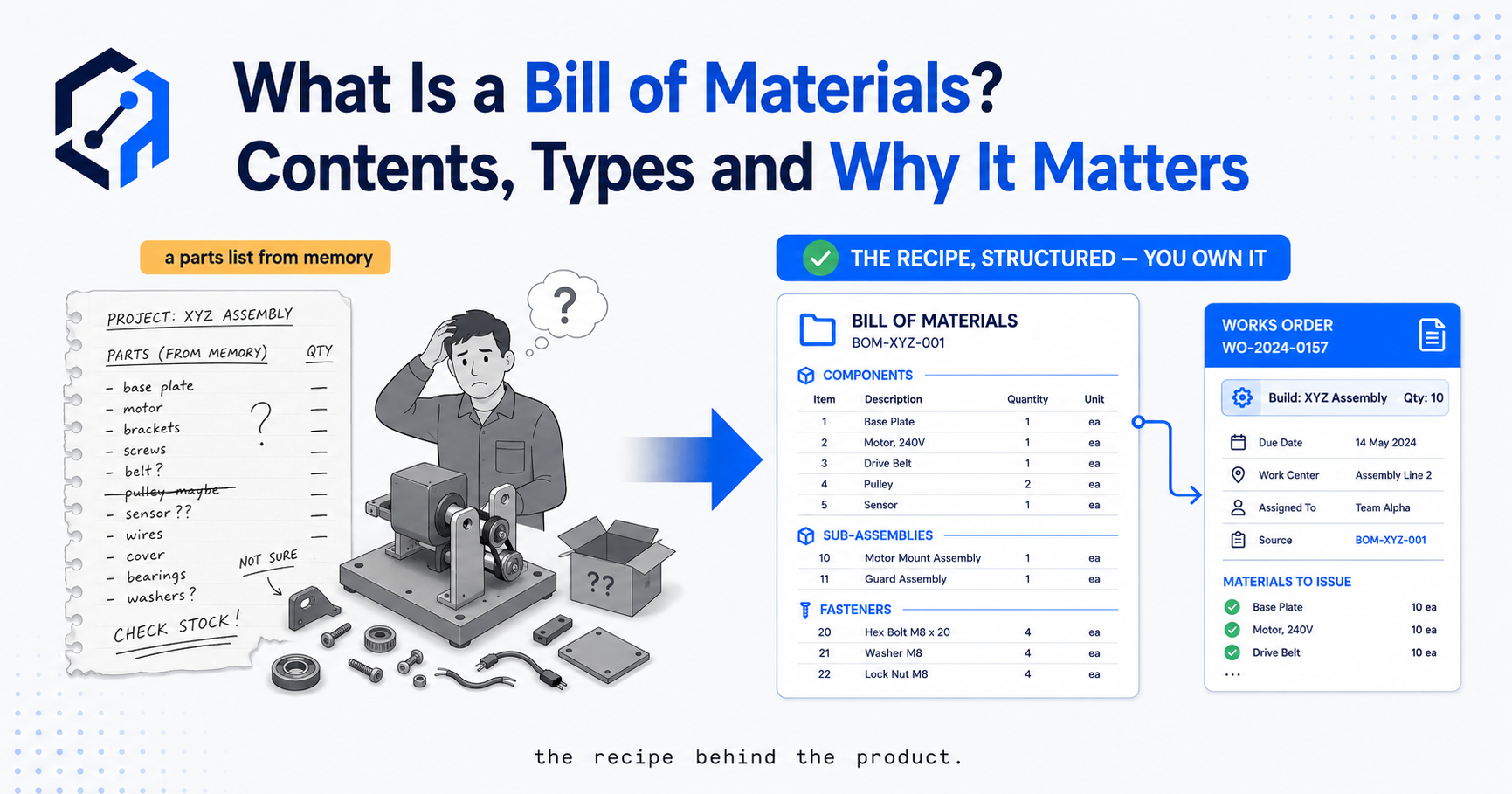
This guide assumes you already know what a BOM contains. The definition and fields are covered in what is a bill of materials, and the different BOM types (engineering, manufacturing, sales and service) in types of bill of materials. Here the focus is what the supply chain does with a manufacturing BOM once it is roughly right.
One record, five supply chain jobs
| Supply chain job | What it takes from the BOM | What it adds |
|---|---|---|
| Purchasing | Components and quantity per parent | Supplier, price, minimum order quantity and pack size |
| MRP or planning | The full multi-level structure | Stock, open orders, allocations and dates |
| Lead time planning | Which items are bought and which are made | Supplier and internal lead times |
| Costing | Quantities, yields and structure | Component prices, labour and overhead rates |
| Traceability | Which components go into which parent | Supplier lot numbers, works orders and customers |
If the BOM is wrong, all five jobs are wrong in the same direction. That is why BOM accuracy is a supply chain issue, not only an engineering one.
2. Explode the BOM Into Gross Requirements
What explosion does
Explosion multiplies every BOM line by the quantity of its parent, then repeats the calculation for every level below. Microsoft’s Dynamics 365 documentation describes it this way: a demand explosion of a BOM version “creates a demand for each BOM line item at a specific site and, possibly, at a specific warehouse”, and that resulting demand “becomes the starting point for additional demand explosion”.
Two consequences follow. Quantities must be stated per one immediate parent, not per finished unit, or the explosion multiplies an already multiplied figure. And demand lands at a site or warehouse, so stock held in the wrong location may not count towards the build. How quantities behave through several levels, including netting sub-assembly stock before exploding its components, is worked through in single level vs multi level BOM, and the structuring rules are in how to set up a multi-level BOM.
The hypothetical build
Every figure from here onwards is hypothetical. A small manufacturer assembles a countertop water filter unit. A works order for 250 units is due to start on Tuesday 1 June 2027. The BOM is single level for simplicity, with seven bought components.
| Component | Qty per unit | Yield | Gross requirement |
|---|---|---|---|
| Housing moulding | 1 | 1.00 | 250 |
| Carbon cartridge | 2 | 1.00 | 500 |
| Tap assembly | 1 | 1.00 | 250 |
| Silicone gasket | 4 | 0.90 | 1,112 |
| Stainless bracket | 1 | 1.00 | 250 |
| Fixings pack | 1 | 1.00 | 250 |
| Carton and insert | 1 | 1.00 | 250 |
Why the gasket line is larger than 1,000
The BOM says how much of a component ends up in the product. Purchasing needs how much goes into the process. Oracle’s item and BOM attributes documentation defines component yield as “the percentage of a component on a bill of material that survives the manufacturing process” and says the usage quantity is divided by the yield factor, giving the example of 2 divided by 0.90, or 2.22.
For the gaskets: 4 / 0.90 = 4.44 per unit, and 250 x 4.44 = 1,111.1, rounded up to 1,112. Without the yield on the BOM line, someone buys “a few extra” from memory, and nobody can later say what real consumption is.
3. Net Requirements Against Real Supply
The netting formula
Gross requirements are what the build consumes. Net requirements are what you still need to obtain. Oracle’s gross to net explosion example treats gross requirements plus safety stock as total demand and scheduled receipts plus quantity on hand as total supply: “The net requirements, total demand (150) minus total supply (130), equals 20.”
Net requirement = gross requirement + safety stock - free stock on hand - scheduled receipts due in time
Hypothetical netting for the 250-unit build
No safety stock is held on these items in the example.
| Component | Gross | On hand | Allocated elsewhere | Open PO due in time | Net requirement |
|---|---|---|---|---|---|
| Housing moulding | 250 | 60 | 40 | 0 | 230 |
| Carbon cartridge | 500 | 180 | 0 | 200 | 120 |
| Tap assembly | 250 | 0 | 0 | 0 | 250 |
| Silicone gasket | 1,112 | 300 | 0 | 0 | 812 |
| Stainless bracket | 250 | 0 | 0 | 0 | 250 |
| Fixings pack | 250 | 500 | 0 | 0 | 0 |
| Carton and insert | 250 | 40 | 0 | 0 | 210 |
The arithmetic: housings 250 - (60 - 40) = 230; cartridges 500 - 180 - 200 = 120; gaskets 1,112 - 300 = 812; cartons 250 - 40 = 210. Fixings need nothing because 500 are already free.
Checklist: what spoils netting
- Stock that is physically present but allocated to another works order or customer order.
- Open purchase orders that are due after the build starts, which are supply but not supply for this build.
- Goods sitting in receiving that have not been booked in, which look like a shortage.
- Safety stock treated as usable, which quietly consumes the buffer you agreed to hold.
- Stock in a location the build cannot draw from.
4. Turn Net Requirements Into Purchase Orders
Apply order modifiers
Suppliers do not sell in the quantities a BOM implies. Oracle’s order modifiers reference gives the fixed lot multiple example: “when the fixed lot multiple quantity is 100 and the requirement equals 110 units, place a single order for 200 units”. It also warns that rounding up “may suggest a planned order for more than what is actually needed. This extra quantity is carried over into the next period as supply.”
| Component | Net requirement | Minimum or multiple | Order quantity | Left over | Hypothetical unit price | PO value |
|---|---|---|---|---|---|---|
| Housing moulding | 230 | Multiples of 100 | 300 | 70 | £6.80 | £2,040.00 |
| Carbon cartridge | 120 | Minimum 250 | 250 | 130 | £4.20 | £1,050.00 |
| Tap assembly | 250 | Multiples of 25 | 250 | 0 | £3.10 | £775.00 |
| Silicone gasket | 812 | Bags of 500 | 1,000 | 188 | £0.35 | £350.00 |
| Stainless bracket | 250 | Multiples of 50 | 250 | 0 | £1.25 | £312.50 |
| Fixings pack | 0 | Not needed | 0 | 0 | £0.40 | £0.00 |
| Carton and insert | 210 | Multiples of 500 | 500 | 290 | £0.90 | £450.00 |
| Total | £4,977.50 |
Prices exclude VAT. The left-over column is the residue of rounding: 70 x £6.80 + 130 x £4.20 + 188 x £0.35 + 290 x £0.90 = £476.00 + £546.00 + £65.80 + £261.00 = £1,348.80 of stock bought on purpose for later builds. Managed, it is next month’s opening stock. Unmanaged, it becomes slow-moving stock that nobody can explain.
Follow the planned order to a PO
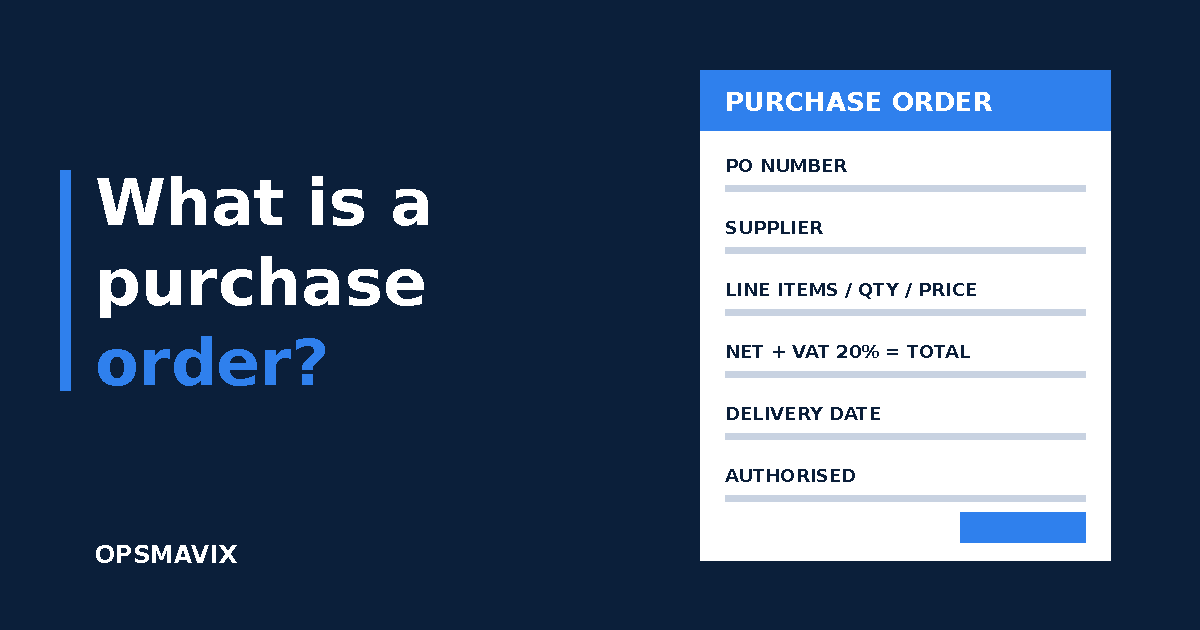
A planned order is a recommendation with a quantity, a supplier and a date. Turning it into a commitment usually runs: planned order, requisition, approval, purchase order, supplier acknowledgement, goods received, invoice match, payment. The common failure points are approval delays nobody planned for, acknowledged dates that differ from requested dates and never reach the plan, and supplier part numbers that do not match the BOM. Following open orders after they are raised is covered in purchase order tracking system.
One method per component
Low-value consumables are often cheaper to manage on a reorder point system than to plan from every BOM. That is a reasonable choice, but each component should use one method. An item exploded from the BOM and also sitting on an automatic reorder trigger can be bought twice.
5. Offset Supplier Lead Times Backwards

Components with different lead times have to be ordered on different dates to arrive together. Illustrative photograph, not an OpsMavix project.
Image credit: CHUTTERSNAP, Unsplash License. No edits.
From quantity to order-by date
Oracle’s time-phasing documentation puts it directly: “Time-phasing delays release of orders for components until they are needed and offsets the requirements by item lead time (lead time offset).”
Order-by date = build start - (supplier lead time + goods-in and inspection + internal approval time)
Hypothetical order-by dates
The example allows 2 working days for goods-in and inspection and assumes approval is same-day. Dates are counted back in working days from Tuesday 1 June 2027, excluding the England and Wales bank holidays on Monday 3 May and Monday 31 May 2027.
| Component | Supplier lead time (working days) | Plus goods-in | Working days back | Order by |
|---|---|---|---|---|
| Carbon cartridge (imported) | 40 | 2 | 42 | Wed 31 March 2027 |
| Housing moulding | 25 | 2 | 27 | Wed 21 April 2027 |
| Carton and insert | 20 | 2 | 22 | Wed 28 April 2027 |
| Tap assembly | 15 | 2 | 17 | Thu 6 May 2027 |
| Stainless bracket | 12 | 2 | 14 | Tue 11 May 2027 |
| Silicone gasket | 10 | 2 | 12 | Thu 13 May 2027 |
Two lessons come out of the table. The imported cartridge must be ordered in March for a June build, often before anyone has raised the works order. And the order-by dates span about six weeks, so “raise the POs for the June build” is six separate decisions, not one task.
Lead time details that change the dates
- Working days, not calendar days. Both bank holidays above push dates earlier than a plain five-day count.
- Cumulative lead time. On a multi-level product, a made sub-assembly’s own build time adds to its longest-lead component.
- Internal latency. A requisition waiting four days for approval adds four days to every lead time.
- Measured, not quoted. Use lead times measured from your own PO and goods-received dates; the method is in supplier lead time management.
6. Roll Up Material Cost From the BOM
The same BOM drives standard cost
The quantities that drive purchasing also drive costing. Microsoft describes cost roll-up and sales price calculations as BOM calculations, which use the item’s BOM and route versions to calculate the cost of a manufactured item. Other systems differ in detail, but the principle is the same: cost comes from the structure, not from a typed-in figure.
Hypothetical material cost per unit
| Component | Calculation | Material cost per unit |
|---|---|---|
| Housing moulding | 1 x £6.80 | £6.80 |
| Carbon cartridge | 2 x £4.20 | £8.40 |
| Tap assembly | 1 x £3.10 | £3.10 |
| Silicone gasket | 4.44 x £0.35 | £1.56 |
| Stainless bracket | 1 x £1.25 | £1.25 |
| Fixings pack | 1 x £0.40 | £0.40 |
| Carton and insert | 1 x £0.90 | £0.90 |
| Total material cost | £22.41 |
The figures exclude labour, overhead and VAT. The gasket yield adds 0.44 x £0.35 = £0.16 per unit compared with a BOM that ignores losses. Small per unit, but it is real cost that a yield-free BOM hides inside “variance”.
When a price changes
Suppose the cartridge price rises from £4.20 to £4.60. Each unit uses 2, so material cost rises by 2 x £0.40 = £0.80 to £23.21, and a 250-unit batch by 250 x £0.80 = £200.00. If the BOM and cost roll-up are connected, rerunning the calculation shows this. If unit cost is a typed-in figure in a price list, quotes keep using £22.41 until someone notices.
Reconcile planned against actual
At the end of each works order, compare quantities issued with BOM quantities. A persistent gap is a BOM defect to correct through your change process (see bill of materials management), not just a shop floor discipline problem.
7. Trace Supplier Lots Through the BOM
What traceability adds to the BOM
A BOM says which components a product type uses. Traceability records which specific supplier lots went into which works order, finished batch or serial number, and which customers received it. The BOM provides the structure; lot capture at goods-in and at material issue provides the evidence.
Some sectors have legal requirements. For food businesses, the Food Standards Agency’s quick reference guide on traceability says “You must have traceability information for your suppliers and business customers (one step back and one step forward)”, and lists internal process traceability, matching inputs to outputs, as something to consider rather than a stated requirement. Other sectors have their own rules, so check what applies to your products.
Hypothetical recall scope
Suppose the filter maker builds four batches of 250 in a quarter, 1,000 units in total, and the gasket supplier later reports a defect in one lot. If the business recorded which gasket lot was issued to which works order, and only batch two used that lot, the affected units are 250. Without lot records, every unit built while that lot could have been in stock is in scope: all 1,000. Same BOM, four times the recall.
Traceability checklist
- Capture supplier lot or batch at goods receipt, against the PO line.
- Record which lots were issued to each works order, including part-used lots.
- Link finished batch or serial numbers to the works order.
- Link despatches to finished batches and customers.
- Test a trace in both directions before you need it: from a supplier lot to customers, and from a customer complaint back to suppliers.
8. Choose Where BOM Driven Planning Should Run
Why spreadsheets struggle here
A spreadsheet can hold a BOM. It struggles with the supply chain layer because it cannot net against live stock, does not know what is allocated, will not re-explode when a build quantity changes, has no working-day calendar and cannot record which lot went into which batch. The calculations above then happen in someone’s head, which is fine until that person is away.
Compare the approaches
| Approach | Where it fits | Limitations to check |
|---|---|---|
| Configure current tools | Your stock or accounts system already supports BOMs and planning | Edition, multi-level support, yield fields, lot tracking |
| Connect existing systems | BOM, stock, purchasing and accounts sit in separate tools that work individually | Record ownership, sync failures, reconciliation |
| Packaged MRP or ERP | Wider planning, costing and traceability needs across many products | Licence and implementation cost, fit with how you build |
| Focused custom application | A clear gap such as BOM explosion to POs or lot capture | Build scope, support, integration with accounts |
| Full custom ERP | Many connected processes that packaged tools do not fit well | Delivery capacity, migration, ongoing maintenance |
Packaged MRP and ERP systems offer established explosion, netting, costing and lot tracking features, and are often the right answer. Whether a full MRP is justified for a small manufacturer is discussed in do you actually need an MRP system. Whatever the approach, test it with a real build: explode it, net it, raise the POs, receive with lots, issue to the works order and roll up the cost.
Questions to ask any system
- Does explosion handle yield and multi-level structures correctly?
- Does netting separate free stock from allocated stock and time-phase open orders?
- Are minimum order quantities and pack multiples applied, and is the residue visible?
- Are order-by dates calculated in working days with your holiday calendar?
- Does a component price change roll up to every parent that uses it?
- Can you trace a supplier lot to customers and back in minutes?
Frequently Asked Questions
What is the role of a bill of materials in supply chain management?
It is the source of dependent demand. Exploded against a production plan, it tells purchasing which components are needed, how many and by when. The same record drives material cost roll-up and, with lot capture, traceability from supplier to customer.
How does MRP use the bill of materials?
MRP explodes the BOM against planned builds to get gross requirements, nets them against stock and open orders, applies order modifiers such as minimum quantities, and offsets the results by lead time to produce dated planned orders.
Why is the purchase quantity different from the BOM quantity?
Because yield losses inflate the gross requirement, existing stock and open orders reduce it, and supplier minimums or pack sizes round it up. In the hypothetical example, 4 gaskets per unit (1,000 for the batch) became a gross requirement of 1,112, a net requirement of 812 and a purchase of 1,000.
How do supplier lead times connect to the BOM?
Each bought component has its own lead time, so the build start date is offset backwards for each line. Long-lead items may need ordering weeks before the works order exists.
How does the BOM affect product costing?
Material cost is rolled up from component quantities, yields and prices through the BOM structure. When a price or quantity changes, rerunning the roll-up updates the cost of every parent that uses the component.
Does a BOM provide traceability on its own?
No. The BOM shows which component types go into a product. Traceability also needs supplier lot numbers recorded at receipt and at material issue, linked to finished batches and customers.
Should every component be planned from the BOM?
Not necessarily. High-value, long-lead or product-specific items usually justify BOM-driven planning. Low-value consumables can sit on a reorder point, as long as each item uses only one method.
Can OpsMavix build a BOM-driven purchasing and traceability system?
Yes. OpsMavix can build focused applications or a full custom ERP, and can configure or integrate suitable existing tools where those approaches fit the requirements.
How OpsMavix Can Help
OpsMavix can follow one of your builds from the BOM to purchase orders, goods receipt and cost, then define where quantities, dates or lot records break between people and systems.
That may mean configuring tools you already own, connecting BOM data to live stock and purchasing through an inventory automation system, building manufacturing production tracking that issues lots against works orders, or adding invoice approval workflows that match supplier invoices to receipts.
Contact OpsMavix with one recent build shortage or surplus purchase order, the BOM and stock records behind it and the handoff that creates the most rework. We can use that evidence to define requirements and a practical pilot.
Keep reading
Getting value from OpsMavix? Add us as a preferred source on Google — you'll see more of our operations content in your AI Overviews, AI Mode and Search.