
Inventory Management Software for the Food Industry
A generic stock app counts units. Inventory management software for the food industry has to track batches, expiry dates and allergens, drive first-expired-first-out picking, and trace one-up and one-down for a recall. This guide covers what food inventory software must do differently, and the right-sized owned alternative to bending your business around a heavy food ERP.
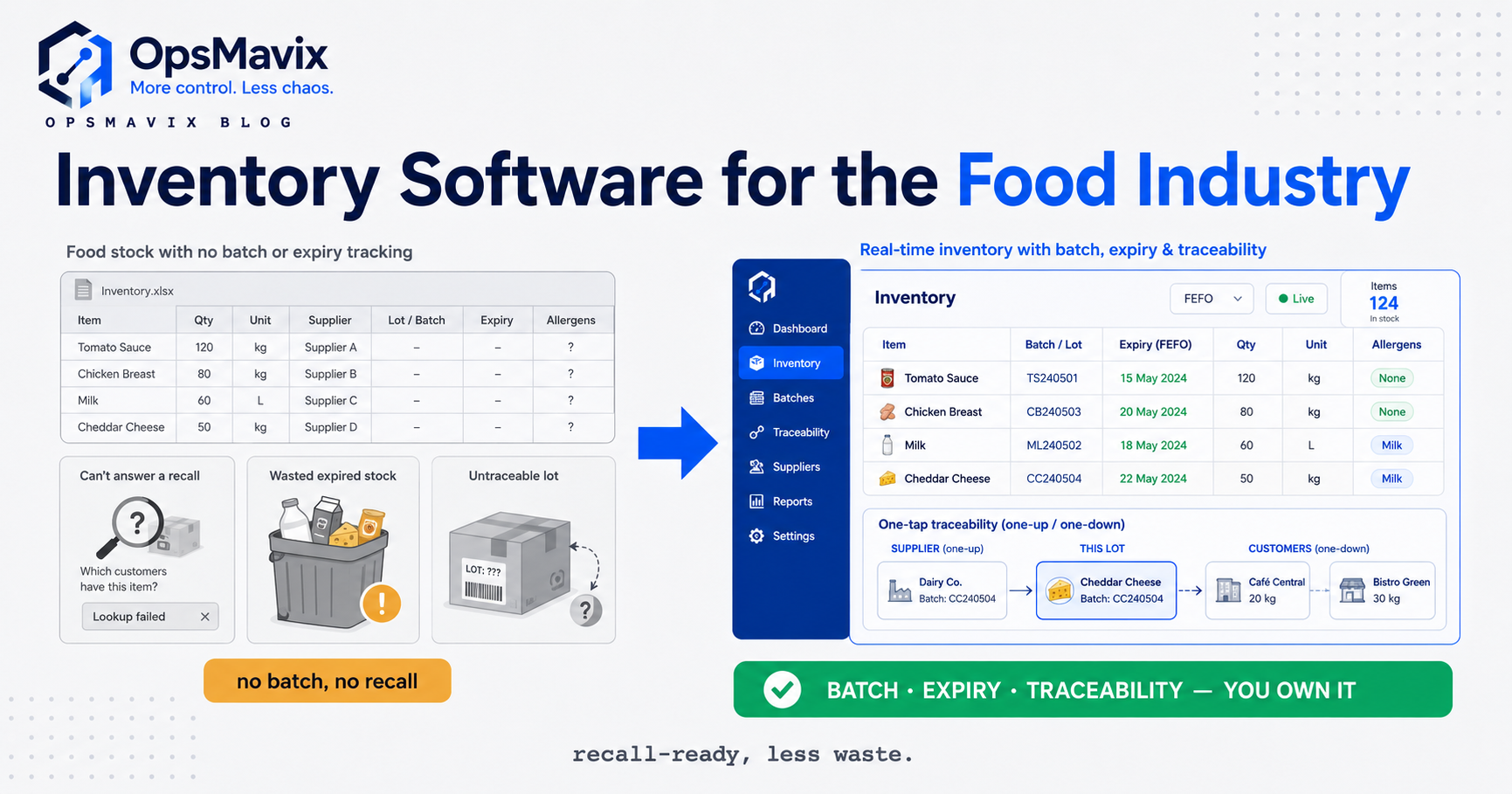
Inventory management software for the food industry has a harder job than the stock app a hardware shop or a clothing brand runs. In most industries a unit is a unit: you buy it, shelve it, count it down as it sells, and today’s unit is interchangeable with next month’s. Food does not work like that. A tub of yoghurt made on Monday is a different thing from the identical tub made on Thursday, because one expires sooner. A sack of flour carries a batch number that has to follow it into every finished product it touches. And the moment something goes wrong upstream, you have hours, not days, to answer one question with total confidence: where did that batch go?
That is the food-specific reality generic inventory tools handle badly. They treat stock as a single interchangeable pool with a quantity attached, when a food business is really managing dated, batched, allergen-carrying stock that loses value every day it sits and can become a legal liability overnight. The two most expensive failures both come from this gap: waste, when product expires unsold because nobody was picking oldest-first, and a slow recall, when a traceability request turns into an afternoon of paper-chasing. This guide covers what food inventory software must do differently, what waste and traceability really cost, and the honest three-way choice between a cheap generic app, a full food ERP, and a right-sized system built around your business and owned by you.
Quick summary: UK households alone throw away around 6.0 million tonnes of food a year, roughly £17 billion worth of edible food, according to WRAP’s Household Food and Drink Waste in the UK 2022 report. That is the consumer end. Inside food businesses, the same rot compounds through the supply chain every day product expires unsold, and the biggest lever a producer or wholesaler controls is knowing what they hold, by batch and by date, and shipping it in the right order before it turns.
Contents
- Why food inventory is a different problem
- What food inventory software must do differently
- The real cost of waste and shelf-life
- Traceability and compliance
- Generic app vs food ERP vs owned system
- Integrations and ownership
- A worked example: a Yorkshire chilled-food wholesaler
- FAQ
- How OpsMavix Can Help
- Sources
Why food inventory is a different problem
A food business holds four things a generic app cannot see properly, because generic apps were built for stock that does not change over time.
Batches, not just SKUs. The meaningful unit is not the product, it is the batch or lot made or received together. Two batches of the same SKU can have different expiry dates, suppliers and quality histories. A system that only counts SKUs has thrown away the exact information you need the day something goes wrong.
Dates that matter. Every batch carries a use-by or best-before date, and its value is a function of how much shelf-life is left. Stock is a quantity with a clock attached. Software that ignores the clock lets your oldest, most at-risk stock sit at the back while fresher product ships first, which is exactly backwards.
Allergens and specifications. Allergen declarations, storage temperature and provenance have to travel with the batch and be checkable, because getting them wrong is a safety event, not a data-entry mistake.
A chain of custody. Every ingredient batch has to be linkable to every finished batch it went into, and every finished batch to every customer it shipped to. This is the spine of a recall, and it is absent from a stock app that models the world as “units on a shelf.”
Miss these and you do not have food inventory software. You have a counter pointed at food.
What food inventory software must do differently
Food-specific inventory software earns its keep on a handful of concrete jobs. The feature list on the box matters far less than whether it does these.
Batch and lot tracking as the default
Stock is tracked by batch, not just by product. Every receipt, production run and movement is stamped with a batch or lot number, so at any point you know not just “we hold 400 units” but “batch A expires in nine days, batch B in three weeks.” This is the foundation everything else is built on, and it is the thing generic apps most commonly lack.
Expiry, shelf-life and FEFO
The software drives first-expired-first-out. FEFO means the system directs your team to pick and ship the batch that expires soonest, not the one that arrived first or sits at the front of the rack. It should warn you as batches approach their date so you can move, discount or divert them before they become waste. A good inventory automation system treats the expiry clock as a first-class input to picking, not a note someone might read.
One-up, one-down traceability
Trace forward and backward in seconds. Start from an incoming ingredient batch and list every finished batch and customer it reached; start from a finished batch and list every ingredient batch that went in. This turns a recall from an existential event into a contained one, and in the UK it is not optional, as we cover below.
Allergen and specification control
Allergen and storage data travels with the batch. The system should hold allergen declarations and handling requirements against products and batches so they are visible at goods-in, production and dispatch, not stranded in a separate document nobody checks under pressure.
Recipe and yield for food manufacturers
If you make food, the software understands recipes. For a manufacturer, finished product is defined by a bill of materials, or recipe, and the system should consume ingredient batches when you produce, account for yield and loss, and carry the batch link from ingredient to finished good automatically. This is the same discipline serious manufacturing production tracking applies to any maker, tuned for perishable inputs. If you sit closer to the manufacturing end, our guide to food manufacturing inventory management software goes deeper on recipe and production.
The real cost of waste and shelf-life
Food waste is not a sustainability footnote for a food business, it is margin walking out the door. The WRAP figure above, roughly £17 billion of edible food wasted by UK households alone, is the visible consumer tip. Inside a producer or wholesaler, the same loss happens quietly on your own shelves every time a batch times out unsold, and unlike the household version you have already paid for it: the ingredients, the labour, the storage, the cold chain, all sunk before the write-off.
The mechanism is almost always the same. Without batch-level expiry visibility, teams pick whatever is easiest to reach, fresher stock ships ahead of older, and the oldest units drift toward their date at the back of the rack. By the time anyone notices, the choice is a fire-sale discount or a bin. Multiply a few percent of shrinkage across a year of turnover and it is one of the largest controllable costs in the business, larger than most owners realise because it hides across hundreds of small write-offs rather than one line.
Right-sized software attacks this directly. FEFO picking means oldest-at-risk stock leaves first by default. Expiry alerts give you a window to act while product still has value, so a batch nine days out gets promoted or moved rather than binned. Accurate batch counts mean you stop over-ordering perishables “to be safe” and then throwing the safety margin away. None of this needs an enterprise suite. The same discipline that helps any stock management system for a small business stop the slow bleed of miscounts applies with sharper teeth in food, because your stock has an expiry clock the hardware shop’s never does.
Traceability and compliance
In the UK, food traceability is a legal requirement, not a best-practice nice-to-have. Under food law, businesses must be able to identify their suppliers and business customers, the “one step back, one step forward” principle, and must be able to withdraw or recall unsafe food quickly if something goes wrong. The Food Standards Agency is explicit that when food is unsafe you must “immediately withdraw or recall the food from the market” and inform your local or port health authority (FSA / GOV.UK guidance on food incidents, product withdrawals and recalls).
The gap between businesses is not whether they keep records, it is how fast and how precisely they can use them. A business running batch traceability in a proper system answers a recall query in minutes: this ingredient batch went into these three production runs, which shipped to these eleven customers, recall exactly those. A business on spreadsheets and paper answers the same query in hours, and often recalls far more than necessary because it cannot prove which batches were affected. That is targeted containment versus scorched-earth over-recall, and the second is both more expensive and more damaging to the relationships you depend on.
This is where “just use a cheap stock app” breaks down for food. A generic app can tell you how many units you hold. It usually cannot tell you which batch went where, which means the one job UK food law most cares about is the one it cannot do. That does not make it worthless, it makes it the wrong category for a business carrying real traceability obligations.
Generic app vs food ERP vs owned system
There are three honest paths for a growing food business, and each is genuinely right for someone. The trick is matching the tool to your actual risk and scale, not to the loudest sales pitch.
| Factor | Generic inventory app | Full food ERP | Right-sized owned system |
|---|---|---|---|
| Batch / lot tracking | Weak or absent, SKU-only | Full, enterprise-grade | Native, built around your batches |
| Expiry / FEFO | Rarely, if at all | Yes, deeply configurable | Yes, tuned to your shelf-life reality |
| One-up / one-down traceability | Usually none | Yes, comprehensive | Built in, forward and backward |
| Allergen / spec control | Manual, bolt-on | Yes, with complexity | Modelled to your product range |
| Recipe / yield (manufacturers) | None | Yes, full MRP | Right-sized to your recipes |
| Cost shape | Cheap monthly subscription | Large licence + heavy implementation | One build cost, you own the asset |
| Time to value | Days | Many months, a project | Weeks, scoped to the leak |
| You bend to it, or it fits you | It fits, but does too little | You bend to the suite | Built around how you work |
| Right for | Very small, low-risk, long shelf-life | Large, multi-site, complex food businesses | Growing UK food producers and wholesalers in the middle |
Be fair to the cheap option. If you are a small operation with long shelf-life, ambient stock and modest traceability exposure, say a dry-goods brand shipping through one channel, a good generic app may be exactly enough, and paying for anything heavier would be waste of a different kind. It only becomes the wrong answer when batch, expiry and traceability move from edge cases to daily reality, which for most chilled, fresh or manufactured food is fast.
The full food ERP is genuinely right for some too. If you run multiple sites, thousands of SKUs, complex production and need statutory consolidation, the big suites do all of it well. The catch for a mid-sized food business is that you pay enterprise cost, wait through a multi-month implementation, then bend your process to fit a generic template. On a busy floor or in a fast-moving cold store, that is exactly where rollouts stall and the spreadsheet survives alongside the software you are still paying for.
The right-sized owned system is the middle most growing UK food businesses actually need: batch tracking, expiry and FEFO, one-up one-down traceability, allergen control and, for makers, recipe and yield, built around how your business runs, owned outright rather than rented forever.
Integrations and ownership
A food inventory system does not live alone, and a right-sized one connects rather than replaces. It should feed the finance package you already run, Xero, QuickBooks or Sage, with real stock movements and costs, so you are not re-keying or reconciling two versions of the truth. It should connect to how you sell, whether that is EDI to supermarket customers, a B2B ordering portal or your online store, so orders flow in and dispatch flows back out without double-entry. And where cold-chain records matter, it should hold or link that data against the batch rather than leaving it stranded in a separate logbook.
Ownership is the quiet difference that compounds. A rented app or per-user ERP is a permanent line on your P&L that someone else controls, re-priced at renewal, re-metered every time you add a warehouse hand. An owned system is paid to build once and sits on your side of the table: your data, your batch logic, your cost curve. For a food business on thin margins with seasonal swings in headcount, not paying a per-user meter forever on the software that runs your traceability is not a small thing. If you also make product, the same logic runs through our guide to inventory management software for manufacturing, because a food manufacturer is a manufacturer with an expiry clock bolted on.
A worked example: a Yorkshire chilled-food wholesaler
The following is illustrative, a realistic but fictional case, not a real client.
A chilled-food wholesaler in West Yorkshire, turning over around £6m a year, supplies delis, cafes and independent retailers with short-shelf-life products across a few hundred SKUs. Today, incoming stock is logged in a spreadsheet, batch numbers are written on boxes, and picking is done from memory and whatever is easiest to reach.
The pain. Waste runs at roughly 4% of purchases, call it £190,000 a year on chilled stock that times out at the back of the rack because fresher deliveries got picked first. Twice a year a supplier flags a problem batch, and tracing which customers received it takes most of a day, so to be safe they over-recall and refund customers who were never affected. When a supermarket prospect asks about traceability during onboarding, they cannot answer confidently, and the deal stalls.
The over-buy. A full food ERP is quoted: a per-user subscription across warehouse and office plus a six-figure-adjacent implementation. It would do everything, far more than a single-site £6m wholesaler will ever switch on, and the real risk is the cold-store team never adopts it and the labels-and-spreadsheet habit survives.
The right-sized fix. Instead they get an owned system doing the jobs that matter: batch tracking from goods-in, FEFO picking so the oldest at-risk batch goes out first, expiry alerts a week ahead so at-risk stock gets promoted before it turns, and one-up one-down traceability so any batch traces to its customers in seconds. It connects to the Xero they already run and to their B2B order flow. They own it.
The illustrative outcome. If FEFO and expiry alerts cut waste from 4% to 2.5%, that is roughly £70,000 a year recovered on this example’s numbers. Recalls become targeted rather than refunding half the book, and the traceability question that used to stall onboarding becomes a live demo. They did not buy an enterprise suite to get there, they bought the food-specific jobs done well and own the thing that does them.
FAQ
What makes food inventory software different from a normal stock app?
A normal stock app treats every unit as interchangeable and tracks a single quantity. Food inventory software has to track stock by batch, hold an expiry date against each batch, drive first-expired-first-out picking, carry allergen and storage data, and link every ingredient batch to every finished batch and customer. A generic app models about a third of what a food business holds, which is why operations that buy one end up keeping a spreadsheet alongside it.
What is FEFO and why does it matter?
FEFO stands for first-expired-first-out. It means the system directs your team to pick and ship the batch that expires soonest rather than the nearest or the newest. It matters because in food, shipping fresher stock ahead of older stock is how perfectly good product ends up expiring unsold at the back of the rack. FEFO, backed by expiry alerts, is one of the biggest levers a food business has to cut waste.
Do I legally need batch traceability in the UK?
Yes. Under UK food law you must be able to identify your suppliers and business customers, the “one step back, one step forward” principle, and withdraw or recall unsafe food quickly. You can keep those records on paper, but in a real recall the difference is speed and precision: a proper batch system answers a trace query in minutes and lets you recall only the affected batches, while paper often forces a slower, broader, more expensive over-recall.
Can a small food business get away with a cheap generic inventory app?
Sometimes, and it is worth being honest about it. If you are small, sell long-shelf-life ambient goods through one channel, and carry limited traceability risk, a good generic app can be exactly enough. It becomes the wrong tool once batch, expiry and one-up one-down traceability become daily realities rather than edge cases, which for most chilled, fresh or manufactured food happens quickly as you grow.
Will a food inventory system connect to my accounting and sales channels?
A right-sized one should. It is designed to sit alongside the finance package you already run, Xero, QuickBooks or Sage, and to connect to how you sell, whether that is EDI to retail customers, a B2B ordering portal or an online store, so stock and orders flow without re-keying. Replacing a finance system that already works to fix a stock and traceability problem is the wrong operation.
How OpsMavix Can Help
OpsMavix builds right-sized, owned inventory and operations systems for growing UK food producers and wholesalers stuck in the messy middle between spreadsheets and a full food ERP. We are not a generic stock app and not an enterprise ERP vendor. We build the system that does the jobs food demands: batch and lot tracking from goods-in, expiry-driven FEFO picking, one-up one-down traceability for fast, targeted recalls, allergen and spec control, and, for manufacturers, recipe and yield, built around how your business already runs, connected to the finance and sales tools you already use, and owned by you rather than rented forever. Start by finding out exactly where your batch tracking, shelf-life and traceability are leaking time and money. Book a Free Operations Leak Audit
Sources
- WRAP — Household Food and Drink Waste in the UK 2022 (6.0 million tonnes wasted, £17 billion worth of edible food): https://www.wrap.ngo/resources/report/household-food-and-drink-waste-uk-2022
- Food Standards Agency / GOV.UK — Food incidents, product withdrawals and recalls (traceability, “one step back, one step forward”, duty to withdraw or recall unsafe food): https://www.gov.uk/guidance/food-incidents-product-withdrawals-and-recalls