
Inventory Management Software for Manufacturing: What It Must Do
A retail stock app counts finished goods on a shelf. A manufacturer has to track raw materials, work-in-progress, bills of materials and finished goods at once, with lot traceability underneath. This is what inventory management software for manufacturing must actually do, and why growing UK makers keep landing in the gap: outgrowing spreadsheets and disconnected tools.
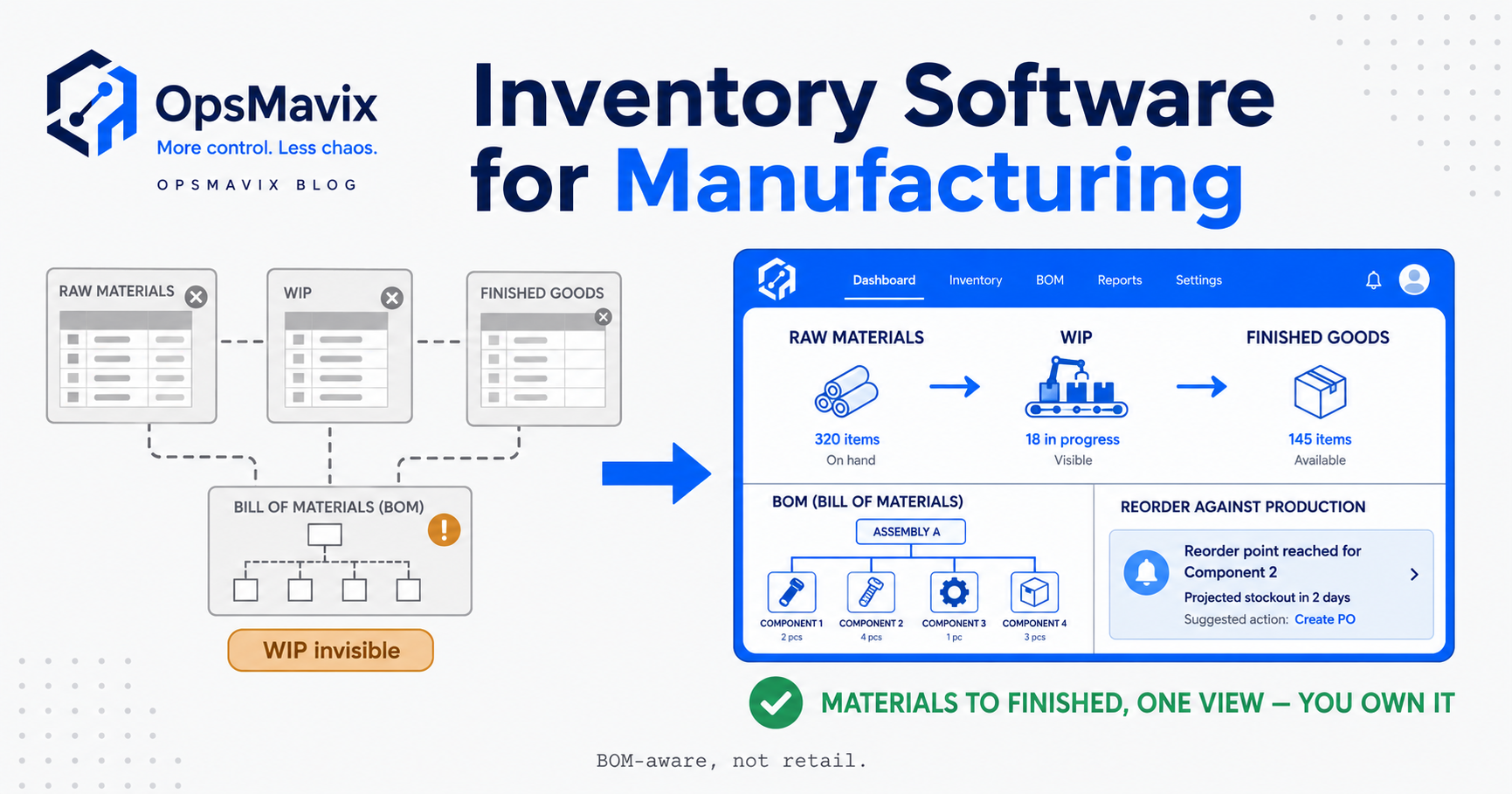
Inventory management software for manufacturing has a fundamentally harder job than the stock app a shop or an online store runs. A retailer buys a finished thing, puts it on a shelf, and counts it down as it sells. That is one state of stock: sellable units, in one place, going out the door. A manufacturer never has the luxury of one state. At any moment you are holding raw materials you have bought but not yet used, work-in-progress that is half-built and worth something between the two, and finished goods ready to ship — and every unit of finished stock is quietly made of a list of the other things, defined by a bill of materials (BOM). Count the shelf and you have counted a third of the picture.
That is why generic retail inventory apps consistently disappoint manufacturers, and it is why the honest answer for a growing UK maker is rarely “buy a bigger stock app.” A manufacturing inventory system has to understand that consuming ten metres of steel and eight hours of labour produces one finished frame, that the frame is only shippable once its components exist, and that if a customer’s part is ever recalled you need to know which batch of raw material went into which finished unit. This guide walks through what that software must actually do, where both the cheap retail apps and the heavyweight MRP/ERP suites miss for an SMB manufacturer, and the right-sized owned system that sits in between.
Quick summary: UK manufacturers are squeezing more output from fewer people — factory output rose £21bn in 2025 even as the workforce shrank by over 36,000, lifting output per employee by roughly £7,000 in real terms (FourJaw / ONS). You do not capture that kind of gain by counting a shelf. You capture it by knowing what materials, WIP and finished goods you actually hold, tied to what production is about to consume — and most growing makers get there with a right-sized owned system, not an enterprise suite they rent forever.
Contents
- Why manufacturing inventory is a different problem
- What manufacturing inventory software must do
- Why generic retail apps fall short
- Why full MRP and ERP overshoot for SMBs
- The right-sized owned alternative
- Spreadsheets vs apps vs owned system
- Worked example: a Midlands metal fabricator
- How to know which one you need
- FAQ
- How OpsMavix Can Help
Why manufacturing inventory is a different problem
The word “inventory” hides three completely different things inside a factory, and conflating them is where most stock trouble starts.
Raw materials are what you buy in: sheet metal, resin, components, packaging. You do not sell these — you consume them. Their value only matters in relation to what you are about to make, which means a raw-materials count that is not tied to production demand is just a number with no verb attached to it.
Work-in-progress is the value that exists between “bought” and “finished.” A job that is 60% built has consumed real material and real labour, and it is worth real money — but it is not sellable, not countable as finished goods, and invisible to any system that only recognises stock as “sitting on a shelf.” WIP is where money hides in a manufacturer, and it is exactly what a retail app has no concept of.
Finished goods are the shippable units — the only part that looks like retail stock, and the only part a generic app handles well. But even here, a manufacturer needs to know that finishing one more unit is possible, which loops straight back to whether the components exist. That relationship is the bill of materials, and it is the spine of the whole system.
Underneath all three sits traceability: which batch of raw material became which finished unit, on which day, on which line. For anyone making food, drink, medical, aerospace or regulated components, that is not a nice-to-have — it is the difference between a targeted recall of one batch and a catastrophic recall of everything. A stock app that cannot answer “which lot went where” is not a manufacturing inventory system; it is a counter.
What manufacturing inventory software must do
Strip the feature lists away and manufacturing inventory software earns its keep on five concrete jobs. Miss these and the badge on the box does not matter.
BOM-aware stock, not shelf counting
The system has to know your recipes. Every finished product is defined by a bill of materials — the components and quantities that go into it. BOM-aware stock means the software understands that finished stock and component stock are the same pool viewed at different stages, so when you commit to building 200 units it can immediately tell you whether the components exist and what will be left afterwards. Without BOM awareness you are back to counting three separate spreadsheets and doing the maths by hand, which is exactly the error-prone manual work you were trying to escape. A proper manufacturing production tracking view treats stock and build as one connected question, not two.
Work-in-progress visibility
You need to see value mid-build, not just at the ends. The software should show what is on the floor right now, at what stage, and roughly what it is worth — so that at any point in the month the owner can answer “what is the factory holding?” without a stock-take. WIP visibility is the single biggest thing retail apps lack and the single most common reason manufacturers’ numbers do not reconcile at month end.
Backflushing
Consume materials automatically when a job completes. Backflushing means that when you record a finished build, the system automatically deducts the components its BOM says it used, rather than someone hand-keying every material movement. For a shop running dozens of jobs a week, hand-keying consumption is where the stock figure quietly drifts into fiction. Backflushing keeps raw-material stock honest with almost no floor-level admin — as long as the BOMs are right, which is why they are the foundation.
Lot and batch traceability
Track which batch went into which unit, both directions. The system should let you trace forward (this raw-material batch ended up in these finished units and shipped to these customers) and backward (this finished unit was built from these specific batches). This is what turns a recall from an existential event into a contained one, and it is increasingly a condition of supplying larger customers at all. Any inventory automation system worth buying for a regulated maker treats lot tracking as core plumbing, not an add-on module.
Reordering against production demand
Reorder points must reflect what you are about to build, not just what you sold. A retail reorder rule looks backward at sales velocity. A manufacturer has to look forward at the order book: if next month’s jobs need 4,000 fixings and you hold 1,200, you need to order now, before the job stalls. Manufacturing inventory software ties reorder logic to the demand implied by confirmed works orders and their BOMs, so purchasing is driven by what the floor will consume — which is really where inventory meets purchase order inventory management.
Why generic retail apps fall short
The retail and e-commerce stock apps — the ones that plug into your online store and count units — are genuinely good at what they do. The problem is that what they do is a subset of the manufacturing problem.
They only model finished goods. There is no concept of raw materials becoming WIP becoming finished stock. You can bolt “components” on as separate products, but the app does not understand the relationship between them, so it cannot tell you whether you can build to an order.
No BOM, no backflushing. Without a bill of materials the app cannot deduct components when you build, so every material movement is manual — and manual is where accuracy dies. Across manufacturers, average inventory accuracy is commonly found to sit between 60% and 80%, well short of the 95%-plus that is considered world-class, and facilities below 90% accuracy suffer two to three times more production schedule disruptions (Allserv / APICS). A retail app with no backflushing pushes you toward the wrong end of that range by design.
No WIP, no traceability. The two things a manufacturer most needs — value on the floor and batch history — are simply absent. You can run reports on what sold; you cannot answer “what are we holding mid-build” or “which lot shipped to whom.”
No production-demand reordering. The reorder logic is built for sell-through, not build-through. It will happily tell you to restock a finished SKU while your raw-material stock quietly runs out from under a job.
None of this makes retail apps bad. It makes them the wrong tool: a finished-goods counter asked to run a factory.
Why full MRP and ERP overshoot for SMBs
The instinctive fix is to jump to the other end — a full MRP or ERP suite that does model materials, WIP, BOMs and traceability properly. SAP, Oracle NetSuite, Microsoft Dynamics, Infor and the like genuinely do all of this, and for large, complex, multi-site manufacturers they are the right answer. For a growing SMB maker, they usually overshoot in three expensive ways.
You pay for breadth you cannot use. These suites are priced and built for netting hundreds of components across multiple sites and currencies with statutory consolidation on top. If you are one site, one company, a few dozen live jobs, you carry the cost and complexity of capability you will not use for years.
Implementation is a project, not a purchase. The suite arrives as a configurable kit that has to be mapped onto your process — data migration, BOM loading, integration, testing, training. That work routinely costs several times the licence and ties up one of your best people for months.
Adoption is where it stalls. A generic template asks the floor to change how it works to suit the software. On a busy shop floor that is exactly where rollouts die: the spreadsheet stays open “just in case,” and you end up running two systems and trusting neither. A production management system that nobody on the floor actually uses is not control — it is shelfware with a subscription.
The honest read: full MRP/ERP is not wrong, it is just aimed at a bigger business. Buying it to solve an SMB’s problem means paying enterprise cost and carrying enterprise risk to fix a mid-sized leak.
The right-sized owned alternative
Between the retail app that does too little and the enterprise suite that does too much sits the option most growing UK manufacturers actually need: a right-sized system, built around how you make things, that you own outright.
Right-sized means it does the five jobs that matter — BOM-aware stock, WIP visibility, backflushing, lot traceability, and reordering against production demand — and deliberately leaves out the finite-capacity simulation, multi-entity consolidation and forty other modules an SMB will not switch on. Scope follows the leak, not the brochure.
Built around your process means the BOMs, stages, units and stock flows encode how your business works, rather than a generic template you bend yourself around. That is the difference between a system the floor adopts and one it quietly ignores.
Owned means you pay to build it once and it is an asset on your side of the table — your data, your logic, your cost curve — connected to the finance package you already run (Xero, QuickBooks, Sage) rather than replacing it. No per-user meter running forever, no renewal that re-prices you because you added three people.
This is the OpsMavix position in one line: a right-sized, owned operations system for the manufacturers the enterprise suites price out and the spreadsheet has outgrown — outgrowing spreadsheets and disconnected tools. If you genuinely need multi-site MRP across hundreds of parts, buy the suite. If you need materials, WIP, BOMs and finished goods on one shared truth and want to own the thing that runs it, you do not.
Spreadsheets vs apps vs owned system
| Factor | Spreadsheets | Generic retail app / full MRP-ERP | Right-sized owned system |
|---|---|---|---|
| Raw materials | Manual, separate tab, drifts fast | App: weakly, as extra SKUs / ERP: fully but heavy | Modelled properly, tied to builds |
| Work-in-progress | Invisible; guessed at month end | App: none / ERP: yes, with complexity | Visible live, valued mid-build |
| BOM awareness | Hand-maintained, error-prone | App: none / ERP: yes, hard to configure | Native, mirrors your real recipes |
| Backflushing | Impossible | App: none / ERP: yes, after big setup | Automatic on build completion |
| Lot / batch traceability | Painful, often absent | App: none / ERP: yes, enterprise-grade | Built in, forward and backward |
| Reorder vs production demand | Manual, backward-looking | App: sell-through only / ERP: full MRP netting | Driven by confirmed works orders |
| Cost shape | “Free” but eats hours + errors | App: cheap-but-wrong / ERP: subscription forever + big implementation | One build cost; you own the asset |
| Adoption | Familiar but fragile | App: too little / ERP: heavy change, stalls | Mirrors real workflow, floor uses it |
| Right for | Very small, simple builds | Retailers / large multi-site makers | Growing single-site UK manufacturers |
The row people underweight is cost shape. A retail app is cheap because it solves a smaller problem; an enterprise suite is a permanent line on your P&L you do not control. An owned system is paid once and is yours — it does what your factory does, and nobody can re-price it out from under you at renewal.
Worked example: a Midlands metal fabricator
Make it concrete with a fictional but typical case. A 35-person metal fabricator in the West Midlands, turning over around £4.5m a year, runs 50–70 live jobs at a time across cutting, welding and finishing. Today, raw-material stock lives in one spreadsheet, jobs on a whiteboard, and finished goods in a third sheet that only one person keeps up.
The pain. Nobody can say what WIP is worth mid-month. Twice a quarter a job halts because a “in-stock” material was not actually there. Purchasing reacts to shortages instead of anticipating them, so there are both stockouts and a corner of the yard full of steel bought for a job that changed. When a customer asks which batch went into a delivery, it is an afternoon of paper-chasing. This is not carelessness — average manufacturer inventory accuracy sits around 60–80%, and below 90% you get two to three times more schedule disruptions (Allserv / APICS). They are living that statistic.
The over-buy. A full ERP is quoted: a per-user subscription across the team plus a six-figure-adjacent implementation to migrate data, load BOMs and train everyone. It would do everything — and far more than 35 people at one site will ever use. The real risk is that the floor never fully adopts it and the whiteboard survives, leaving them paying enterprise money to still run on a whiteboard.
The right-sized fix. Instead they get an owned system doing exactly the five jobs: BOM-aware stock so committing to a job instantly shows what components are left; WIP valued live; backflushing so material is consumed automatically as jobs complete; lot traceability so any delivery traces to its batches in seconds; and reorder points tied to the confirmed order book so purchasing gets ahead of shortages. It connects to the Xero they already run rather than replacing it. They own it.
The outcome. Jobs stop stalling for phantom stock, WIP is no longer a month-end surprise, purchasing gets ahead of demand instead of chasing it, and a traceability request is a two-minute lookup. They did not buy an enterprise suite to get there — they bought the five jobs done well, sized to a £4.5m single-site shop, and own the thing that does them.
How to know which one you need
Right-sizing is a handful of honest questions, not a feature checklist.
- Do you make things, or just sell them? If you consume materials to produce goods, a retail stock app is the wrong category — full stop.
- One site or several? Several sites to consolidate → you are leaning toward a suite. One site → lean lighter and owned.
- Is the problem visibility or planning? Seeing materials, WIP and finished goods on one truth → right-sized control. Netting hundreds of components across demand and capacity → full MRP.
- Does your finance package already work? If Xero, QuickBooks or Sage is fine, connect to it — do not replace finance to fix a stock problem.
- Can the floor absorb a year-long rollout? If not, the heavy suite rules itself out.
Match the system to the actual leak. Most growing UK manufacturers are squarely in the middle — too big for a spreadsheet, too lean for an ERP — and the right move is a system sized to that middle and owned outright.
FAQ
What is the difference between manufacturing and retail inventory software?
Retail software tracks finished goods you buy and resell — one state of stock, counted down as it sells. Manufacturing software has to track raw materials, work-in-progress and finished goods at once, understand the bills of materials that link them, deduct components as you build, and trace which batch went where. A retail app models a third of what a manufacturer holds, which is why makers who buy one end up running the rest on spreadsheets.
What is a bill of materials and why does inventory software need it?
A bill of materials (BOM) is the recipe for a product — the components and quantities that go into one finished unit. Inventory software needs it because in a factory, finished stock and component stock are the same pool at different stages. Without the BOM the software cannot tell whether you can build to an order, cannot deduct materials automatically when you build (backflushing), and cannot keep the raw-material count honest. The BOM is the spine of manufacturing inventory.
Do I need a full ERP to manage manufacturing inventory?
Not usually. A full ERP is built for multi-site, high-complexity manufacturers netting hundreds of components with statutory consolidation. Most growing single-site UK makers need materials, WIP, BOMs, traceability and demand-driven reordering on one shared truth — which a right-sized owned system delivers without the per-user subscription, the multi-month implementation, or the adoption risk that stalls big suites on a busy floor.
What is backflushing?
Backflushing is when the system automatically deducts a product’s components — as defined by its BOM — the moment you record a completed build, instead of someone hand-keying every material movement. For a shop running dozens of jobs a week it is the difference between a stock figure that stays accurate and one that drifts into fiction. It relies on accurate BOMs, which is why getting the recipes right comes first.
Can a manufacturing inventory system connect to my accounting software?
Yes, and a good one should. A right-sized system is designed to sit alongside the finance package you already run — Xero, QuickBooks or Sage — feeding it real stock movements and job costs, rather than forcing you to rip out and replace a finance system that already works. Replacing finance to fix a stock problem is the wrong operation entirely.
How OpsMavix Can Help
OpsMavix builds right-sized, owned inventory and operations systems for growing UK manufacturers stuck in the messy middle between spreadsheets and a full enterprise suite. We are not a retail stock app and we are not an MRP or ERP vendor — we build the system that does the jobs that actually matter for a maker: BOM-aware stock, live WIP, backflushing, lot and batch traceability, and reordering driven by your real order book, built around how you already make things, connected to the finance package you already run, and owned by you rather than rented forever. Start by finding out exactly where your materials and work-in-progress are leaking time and money, and what the honest, right-sized fix looks like. Book a Free Operations Leak Audit.
Sources
- FourJaw / ONS — UK manufacturing output rose £21bn in 2025 (workforce down 36,000+) and output per employee up ~£7,000 in real terms: https://fourjaw.com/blog/uk-manufacturing-output-increases-by-21bn-in-2025
- Allserv / APICS — average manufacturer inventory accuracy sits between 60% and 80% vs 95%+ world-class, and facilities below 90% suffer 2–3x more production schedule disruptions: https://blog.allserv.com/posts/the-true-cost-of-poor-inventory-accuracy-in-manufacturing
- Reliamag — review of inventory record-accuracy studies (DeHoratius & Raman: 65% of ~370,000 records inaccurate) and SPARETECH 2025 survey (32% report frequent critical-part stockouts; 45% cite lack of cross-site visibility): https://reliamag.com/guides/mro-spare-parts-inventory-statistics/
- The Manufacturer — UK Manufacturing Statistics (Make UK): https://www.themanufacturer.com/uk-manufacturing-statistics/ </content> </invoke>