
Thinventory Alternative: When a Growing Operation Outgrows the Template
A Thinventory alternative is what you look for once an off-the-shelf inventory and order tool stops bending to how you actually run — extra channels, a bulk side, a warehouse quirk it has no field for. This post is fair about what these tools do well, honest about the ceiling you hit, and clear on what a system built around your own process changes instead.
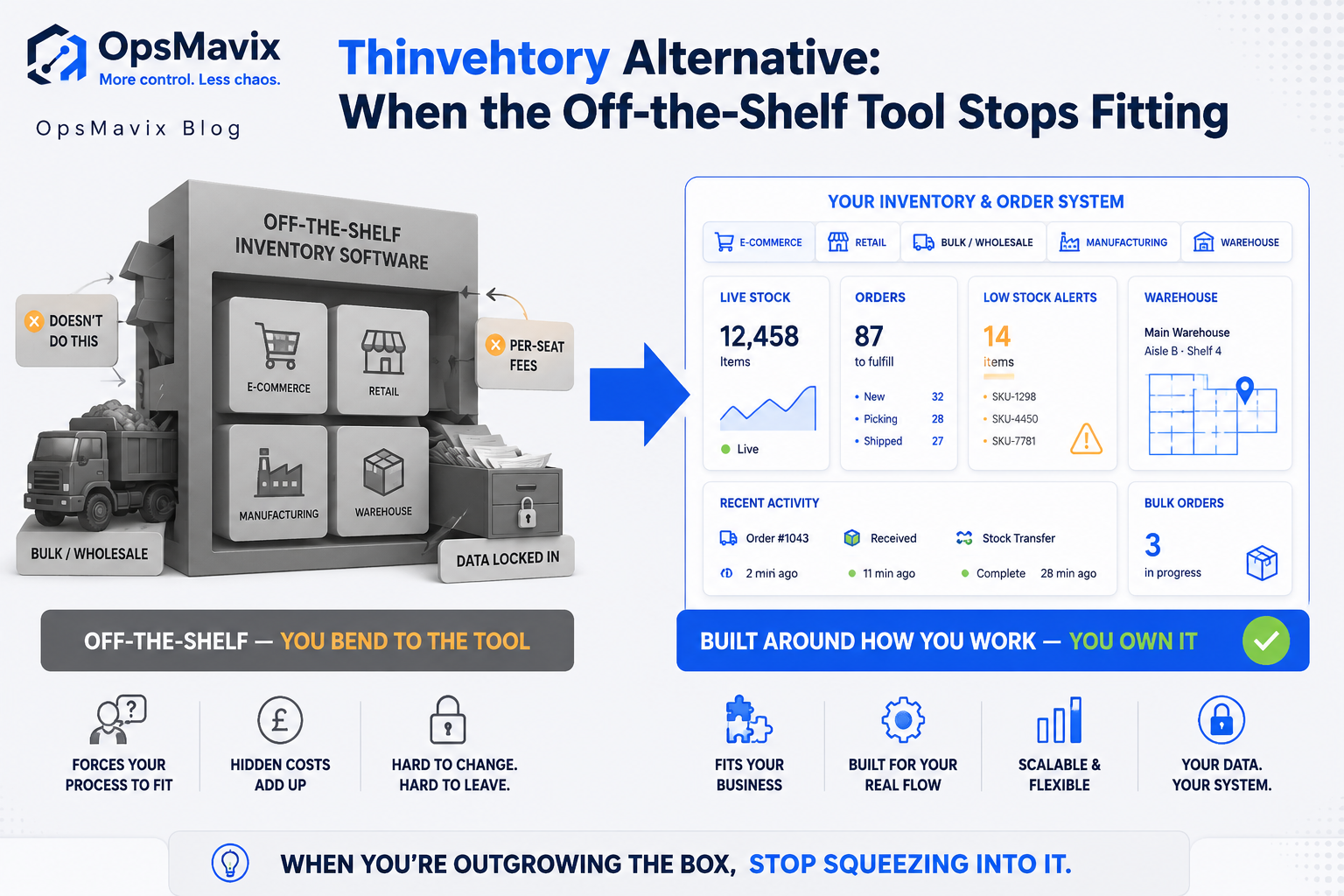
A Thinventory alternative is the thing you start hunting for once an off-the-shelf inventory and order tool stops fitting how your business actually runs. Thinventory sits in the category of packaged inventory and order management software — tools that give a growing business a ready-made way to track stock, handle orders, and see what’s on the shelf without building anything. For a while that’s exactly right: it’s faster than a spreadsheet and cheaper than an ERP, and if your operation matches the template it ships with, it does a genuine job.
The trouble starts when your operation stops matching the template. A new sales channel, a bulk or trade side, a second warehouse, a customer who buys on their own price tier, a picking route the product has no setting for — and suddenly you’re bending the way you work to fit the software instead of the other way round. This post is fair about what tools like Thinventory do well, honest about the ceiling a growing UK operator eventually hits, and clear about what a system built around how you already work changes instead. If you want the ground-level basics first, what inventory management actually is is a separate read — this is the platform-versus-custom layer above it.
Key Takeaways
- Off-the-shelf inventory tools like Thinventory are strong out of the box for a single, standard operation — one channel, one warehouse, tidy SKUs.
- You’ve outgrown one when you keep side-spreadsheets to cover what it can’t hold, and your real process no longer fits its fields.
- Off-the-shelf fits the average; a custom system fits you — your channels, your warehouse, your odd cases, none of them a workaround.
- Per-seat and per-order fees mean the tool taxes the growth you wanted, and the more people and volume you add, the more the “cheap” option costs.
- Data lock-in is the quiet risk — your stock history, pricing and orders live in a product a vendor controls and can reprice or retire.
- Don’t switch on principle. Move only when the workarounds and fees cost more, month after month, than building the right thing once.
1. What Tools Like Thinventory Actually Do Well
Be fair to the category first. Packaged inventory and order tools take a business off spreadsheets and give it a single place to see stock, raise and fulfil orders, and stop the worst of the double-selling and lost-count chaos. For an operation that’s outgrown a shared workbook but is nowhere near needing an ERP, that’s real value — you’re live in days, not months, and you’re not paying a developer to reinvent stock tracking that already works.
If your business is one channel, one warehouse and a catalogue that fits neatly into rows, a tool like this is often the correct answer, and swapping working software for a custom build would be its own kind of leak. The honest test isn’t whether the tool is good. It’s whether the shape it assumes still matches the shape you actually run.
2. The Signs You’ve Outgrown It
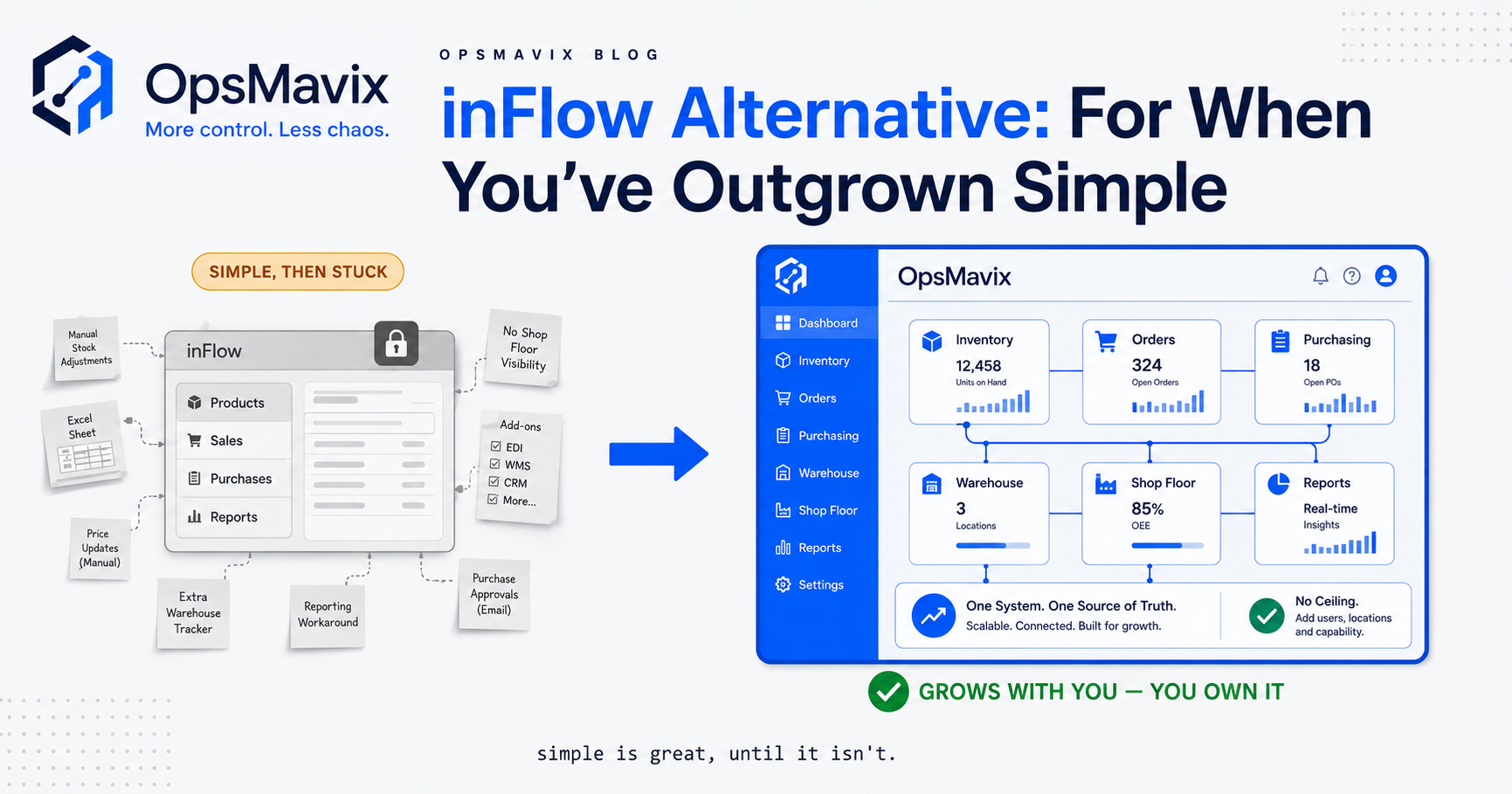
The clearest tell is the side-spreadsheet. When your team keeps a workbook alongside the tool — for the trade pricing it can’t hold, the bundle drawn from three SKUs, the pre-order that shouldn’t decrement yet, the channel it has no field for — you’ve stopped using one system and started running two. Every one of those spreadsheets is a place the number quietly drifts, and a tax somebody pays forever.
The other signs stack up fast: a report you have to export and rebuild by hand every week, a workaround only one person knows, a new channel you can’t switch on without breaking the count. One operations lead we spoke to described it as the tool being “90% right and 10% impossible” — and the 10% was the part that made their business theirs. That last tenth is where the pain lives, because it’s not an edge case to you. It’s Tuesday.
3. Off-the-Shelf vs Custom — the Real Difference
Off-the-shelf software is built for the average customer in its category. That’s its strength and its ceiling. To serve thousands of businesses, it has to assume a common shape — and the further your operation sits from that average, the more of your day goes into bending your process to fit its fields. You configure, you work around, you accept “that’s just how it does it.” A custom system inverts the deal: it’s shaped to how you already work, so the odd cases that break a template are simply how the software behaves.
This isn’t a case for custom-everything. Plenty of a growing business’s stack should stay off-the-shelf — email, accounting, payroll. The contrarian point is narrower and it’s the one most “alternative” searches miss: the closer a system sits to your core operational flow — the exact way you take stock in, hold it, pick it and ship it — the more the generic fit costs you, and the more a build shaped to that flow pays back. The commodity stuff, buy. The thing that is how you actually run, own.
4. The Multichannel and Warehouse Squeeze
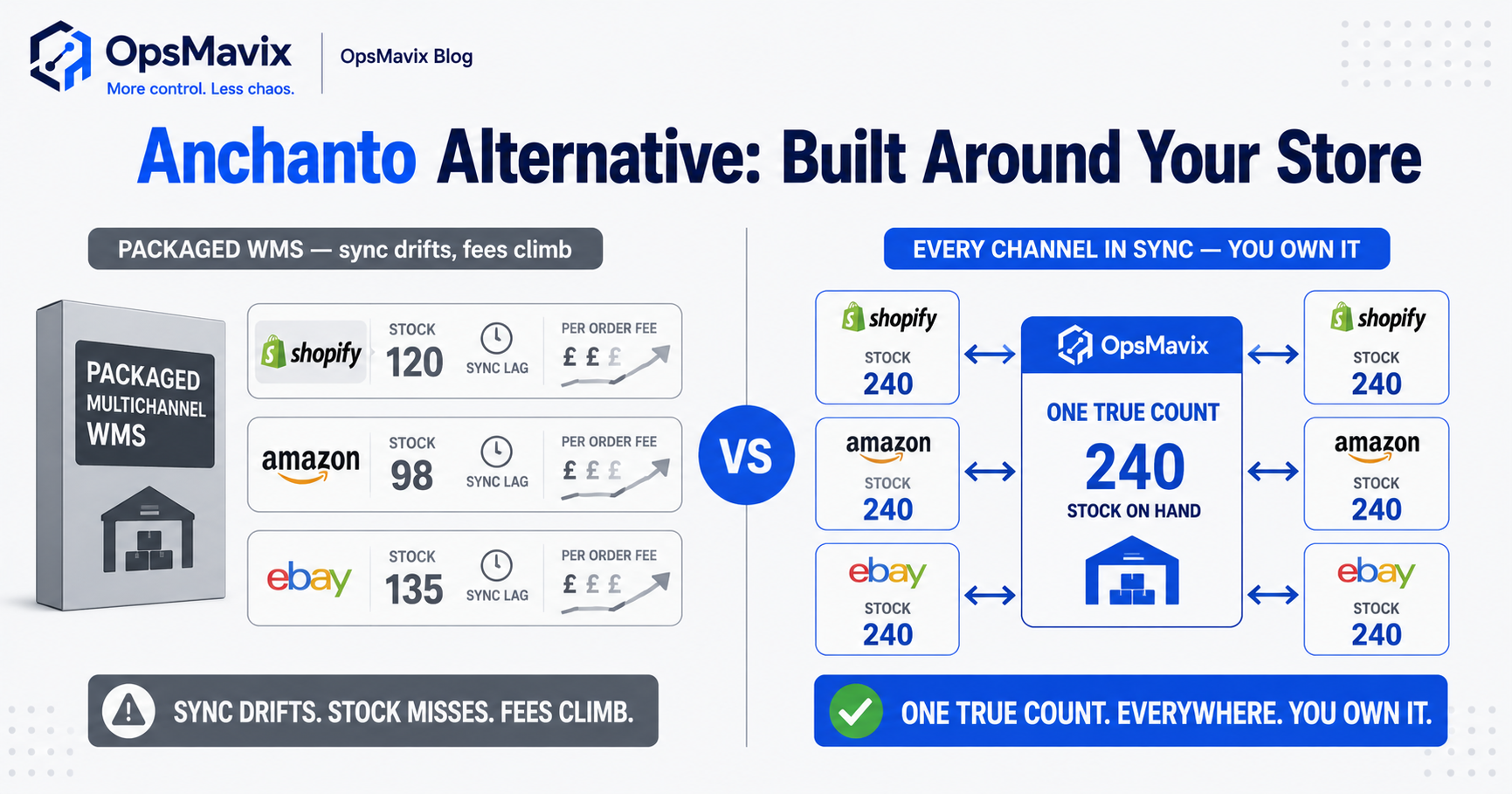
Here’s where the template cracks in practice. Picture a UK homeware business: it started on Shopify, added Amazon and eBay, then landed a handful of trade accounts buying by the pallet on net-30 terms. Stock now lives across a main unit and an overflow container down the road. The off-the-shelf tool was built for the Shopify shop it began as — and now it’s straining to be a multichannel inventory system and a B2B order desk and a two-location warehouse app at once, and it does none of the three cleanly.
The count is the first casualty. Two channels both sell the last unit because the sync lagged; the trade order gets keyed by hand into the accounts package off an emailed PO; the overflow stock isn’t really tracked, so someone walks down the road to check. The tool isn’t broken — it’s being asked to hold a shape it was never built for. A system designed around that exact flow treats every channel, location and price tier as a movement against one true stock figure, which is the whole idea behind B2B order management sitting on the same spine as your retail channels rather than beside it in a spreadsheet.
5. Per-Seat Fees, Volume Creep and Locked-In Data
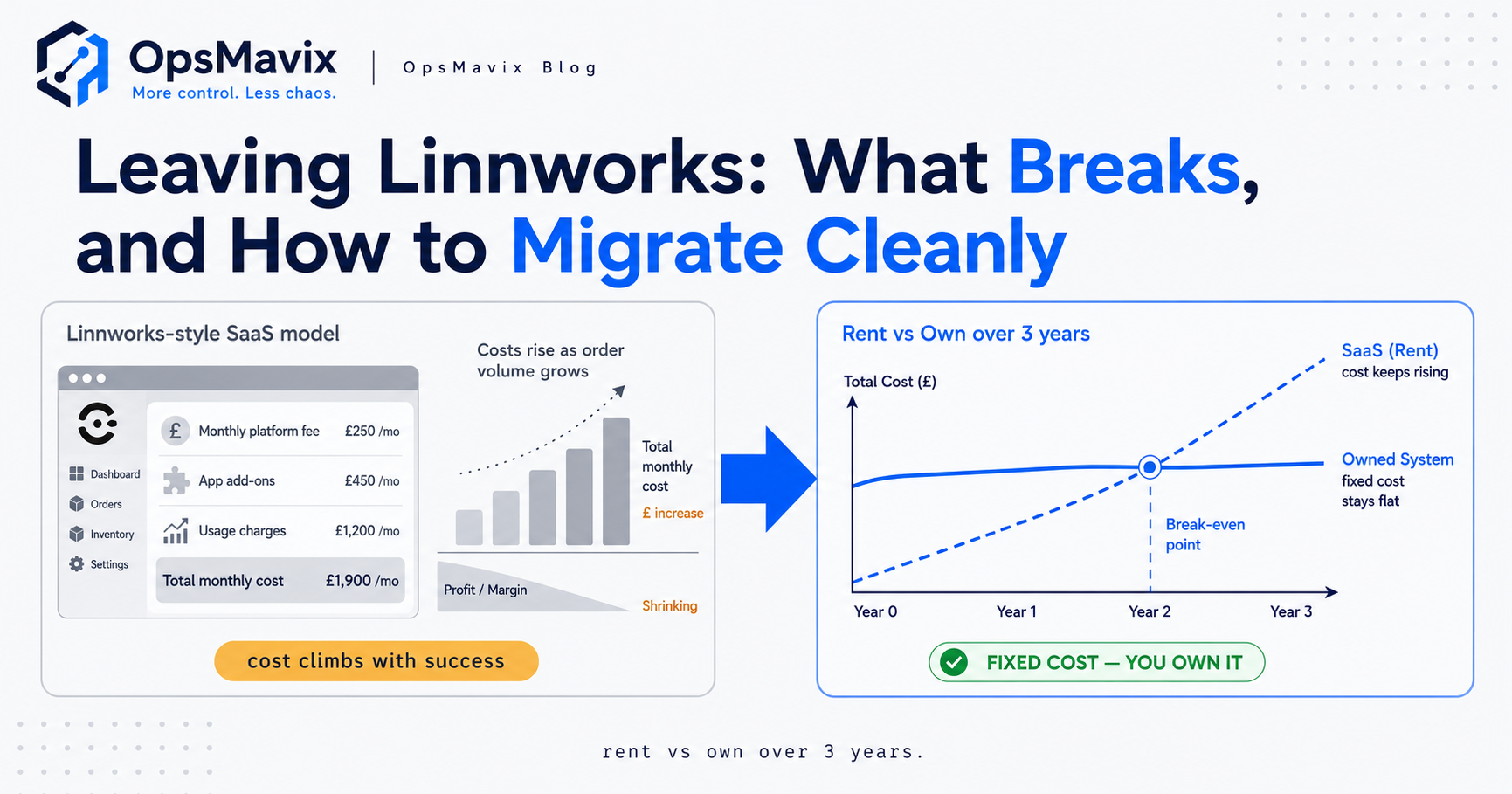
The headline price on a packaged tool looks fine — until your operation depends on it. Then the way it scales becomes the real cost. Per-seat pricing means every new picker, buyer or order clerk is another monthly line; per-order or per-location tiers mean the busier and bigger you get, the more you pay. You wanted software that rewarded growth. Instead the “cheap” option quietly taxes it, and the bill climbs exactly when you can least spare the attention.
Then there’s the data. Your stock history, supplier records, customer pricing and order trail all live inside a product someone else controls. If it gets repriced, acquired or retired, that’s your operational memory tied to a decision you didn’t make and can’t appeal. Take a rough before-and-after: a mid-sized operator paying, say, £600 a month across seats and add-ons is spending north of £7k a year — and rising — for a tool that still needs three spreadsheets around it. A fixed-scope custom build in the Starter-to-Growth range (£3k–£25k) that you own outright changes the maths the longer you run it, and nothing in it can be switched off from the outside.
6. What “Built Around How You Already Work” Actually Changes
A custom system isn’t a stripped-down clone of Thinventory — it’s the part of an inventory tool you’d actually use, shaped to your operation and nothing else. Stock in, held, picked and shipped the way your warehouse genuinely does it. One true count every channel and location reads from, decremented the instant anything sells anywhere, so you stop overselling what you don’t have. Trade pricing built into the order flow instead of held in a rep’s head. A reorder point system tuned to your suppliers’ real lead times rather than a generic default. Reports that already show the numbers you rebuild by hand today.
The deeper change is that nothing has to be bent to fit. Where the packaged tool made you choose between its way and a spreadsheet, a built-for-you system treats your odd cases as first-class — because they’re not odd to you, they’re your business. That’s the core of an inventory automation system: the process you already run, made faster and trustworthy, instead of a template you have to work around. And it grows the way you do, without a per-seat meter running against you.
7. When You Should Stay Put (the honest limit)
Custom isn’t the answer for everyone, and pretending otherwise would be the same overselling we’re warning you about. If your operation genuinely fits the template — one channel, one location, standard SKUs, a team small enough that per-seat fees stay trivial — an off-the-shelf tool like Thinventory may be the right call for years yet, and rebuilding it would be spending money to stand still. The category exists because it solves a real problem for a lot of businesses.
The line to watch is total cost over time, not the sticker. When the workarounds, the manual reports, the re-keying and the climbing fees add up to more — month after month — than building the right system once and owning it, that’s when the switch pays. Until then, stay put. We’d tell you so on the audit call if that’s what the numbers said.
FAQ
What is the best Thinventory alternative?
There isn’t a single best answer — it depends on whether your problem is “I need a standard inventory and order tool” or “the product doesn’t fit how I actually take stock in and ship it.” If your operation matches the template, another packaged tool in the same class may serve. If you’re keeping side-spreadsheets, re-keying orders, watching the count drift across channels or locations, and paying more in fees as you grow, a system built around your own flow addresses the cause rather than the symptom.
How do I know I’ve actually outgrown an off-the-shelf inventory tool?
The tells are concrete: you keep spreadsheets alongside the tool for pricing, bundles or channels it can’t hold; you rebuild the same report by hand every week; a new channel or location can’t be switched on without breaking the count; and the monthly bill rises faster than the value as you add seats and volume. Those are signs your operation has outgrown the template — not that you’re running it badly.
Is a custom system more expensive than a tool like Thinventory?
On the headline number, a packaged tool is cheaper to start — that’s the honest bit. The fair comparison is total cost over a few years. Per-seat and per-order pricing climbs as you grow, and the time lost to workarounds and re-keying is a real cost too. A fixed-scope build you own can change the maths the longer you run it. For a business the packaged tool genuinely fits, the switch may not be worth it — and we’ll say so.
Can a custom system handle multiple sales channels and warehouses?
Yes — that’s often the exact reason to build one. Where a packaged tool strains to be a retail app, a B2B order desk and a two-location warehouse system at once, a built-for-you system treats every channel, location and price tier as a movement against one shared stock figure. A sale or transfer anywhere updates the count everywhere, so you stop overselling and stop walking down the road to check what’s really on the shelf.
What happens to my data if I move off a packaged tool?
That’s the quiet risk worth naming. On an off-the-shelf tool your stock history, supplier and customer records and order trail live inside a product a vendor controls, and getting them out cleanly can be its own project. A custom system you own holds that data as yours from day one — nothing a supplier can reprice, gate or retire. Any sensible migration starts by exporting and validating what you already have before a single new order is entered.
How OpsMavix Can Help
OpsMavix builds inventory and order systems shaped to how a growing UK business actually runs — one true stock count across every channel and location, trade pricing built into the order flow, reorder points tuned to your real lead times, and the reports you currently rebuild by hand already waiting for you. Nothing has to be bent to fit, because the system is built around your operation rather than an average one. And there’s nothing a vendor can switch off or charge you more for as you scale, because you own it outright.
If you’ve hit the ceiling of an off-the-shelf tool but you’re not ready — or willing — to be dragged into a full ERP, that middle ground is exactly what we build. We’ll map where your stock, orders and channels drift today, put a pound figure on what it’s costing, and tell you honestly whether a custom system is worth the move or whether you’re better off staying put. Book a Free Operations Leak Audit
Keep reading
Getting value from OpsMavix? Add us as a preferred source on Google — you'll see more of our operations content in your AI Overviews, AI Mode and Search.