
B2B OMS: Do You Need a Full Order Management System or a Right-Sized One?
A B2B OMS promises to put every order — fax, phone, email, portal — on one screen, priced and validated before it ships. Most distributors don't need the enterprise version of that. Here's where the line sits between a full order management system and a right-sized one built around how you actually take orders.
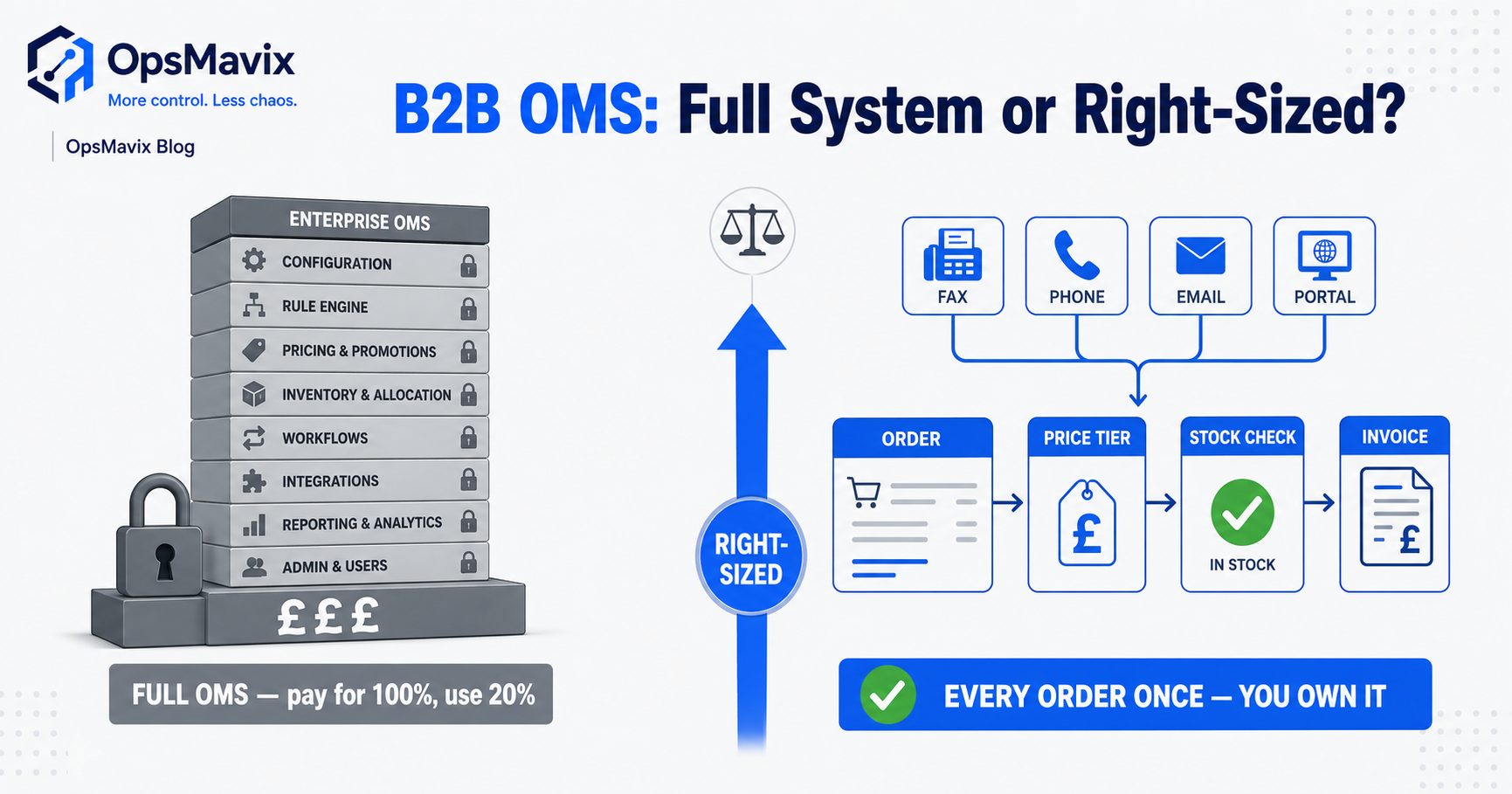
A B2B OMS — order management system — exists to do one thing: take every order that lands by fax, phone, email and portal, get it onto one screen at the right customer price, check it against stock, and hand it to invoicing without anyone re-typing it. Whether you need the full enterprise version of that or a right-sized system depends on your volume and how bespoke your pricing is. A full OMS earns its keep across many channels, complex allocation, and thousands of order lines a day. Below that, a right-sized order system covers the same core — capture, pricing, stock check, invoice hand-off — built around how you already sell, and owned outright.
This post is about that decision, not a feature tour. Where the line sits between “you genuinely need a full B2B OMS” and “a right-sized order system covers what breaks,” what each side actually buys you, and when paying for the big platform is the wrong call. The re-keying and double-entry problem underneath it is a sibling topic — covered in how to stop re-keying orders by hand — and this is the build-vs-buy layer above it.
Key Takeaways
- A B2B OMS solves problems of scale: many channels, complex allocation, high line-volume. Most distributors use a slice of an enterprise one.
- The real cost isn’t the licence — it’s the implementation, per-seat creep, and paying yearly for modules you never switch on.
- A right-sized order system covers the part you run — capture every order once, customer-specific pricing, live stock check, invoice hand-off — and you own it.
- “Too big for spreadsheets, too small for an enterprise OMS” is the exact gap a custom order system fills.
- Don’t buy a platform for scale you don’t have, and don’t keep re-keying orders by hand because the only alternative looks like a year-long rollout.
What a B2B OMS Actually Does (and Who the Full Version Is For)
A full B2B OMS, in enterprise form, is a heavy machine: multi-channel order capture, complex allocation and back-order logic, customer-specific contract pricing at scale, credit control, multi-warehouse fulfilment, and deep ERP integration. When you process thousands of order lines a day across dozens of channels, every one of those modules saves real money. The complexity is the point.
The trouble starts when a £4m-turnover distributor buys the same machine. Most are not rejecting capability — they’re rejecting capability they’ll never use, sold at a price that assumes they will. One distributor’s whole wish-list was modest: a “B2B order portal,” a way to “stop double entry,” and “self-service ordering for customers” so “orders flow straight to invoices.” That’s not an enterprise OMS. That’s the 20% of one, built around how they already take orders.
1The Real Job Is Killing Double Entry, Not Adding Software
Ask a distributor what actually hurts and it’s rarely “we lack an OMS.” It’s the manual handling around the order. Orders arrive every way at once — and a wholesaler’s daily grind is “manually inputting order data onto QuickBooks invoices,” then doing it again for the next channel. The wish is plain: “no longer receive faxes, photos of handwritten orders or email with inaccurate item numbers,” because even “on a telephone you can still hear wrong amounts.”
That’s the core leak — every order keyed by hand is a chance to mistype a quantity, miss a line, or quote the wrong price. A B2B OMS is supposed to remove that, but a packaged platform only does so if your channels and pricing fit its template. A right-sized system captures each order once, in the shape you actually receive it, and validates it before it moves. The win isn’t more features; it’s the double entry gone.
2Customer-Specific Pricing Is Where Off-the-Shelf Strains
Wholesale pricing is the hard part. Different customers, different tiers, contract rates, volume breaks, one-off deals agreed on the phone. A generic OMS handles standard price lists well and bespoke arrangements badly — so the right number ends up living in someone’s head or a side-spreadsheet, and gets keyed in manually order by order. That’s the same trap stock-holding businesses describe when a rigid tool forces “a million messy spreadsheets” to cover what it won’t do.
A right-sized order system models your pricing the way you actually quote it — per customer, per tier, per agreed rate — so the correct price attaches to the order on capture, not from memory. The order, priced right, then flows to invoicing without re-entry. For the broader build-vs-buy logic behind that, whether you need an operations system or a full ERP walks the same line.
3Orders and Stock Have to Share One Number
An order system that doesn’t see live stock is half a tool. You confirm an order, the stock isn’t really there, and the shortfall surfaces at picking — too late, with the customer already told it’s coming. A full OMS solves this with multi-warehouse allocation you may not need; a right-sized system solves the version you do have by checking each order line against one shared stock figure as it’s captured.
That shared number is the same discipline behind why the stock never matches the system — the moment orders and stock are tracked in separate places, they drift. Tie the order to live stock and the back-order surprise disappears: the system flags the short line at capture, not at the loading bay.
4The Real Cost Is Implementation and Lock-In, Not the Licence
The sticker price on a B2B OMS is the least of it. The expensive part is the implementation, the per-seat creep as your team grows, and the dependency on a vendor you can’t leave. Plenty of distributors describe the rollout itself as the trap — “a 4-week ordeal… too time invested to back out” — and the bigger platforms come with a partner model one operator called out flatly: “this whole partner driven industry is a robbery really!!”
There’s a quieter version too: paying for breadth you don’t touch. “We don’t even use half the functions,” and the platform “only makes sense for very large companies.” A custom system flips it — no per-seat fees, no implementation partner on retainer, and nothing a vendor can sunset, because you hold it. You’re not renting your order desk; you own it.
5What a Right-Sized B2B Order System Actually Covers
A right-sized system isn’t a stripped-down enterprise OMS — it’s built around how your order desk genuinely runs. Capture every order once, in whatever form it arrives. The customer’s own price attached on entry. A live stock check on each line. A shared order status the whole team can see, placed to shipped. And a clean hand-off to invoicing so order details never get re-typed into the accounts tool. For the shape of that, see our wholesale order management system.
A B2B order portal sits naturally on top of it — let standing customers place and track their own orders at their own prices, which takes the entry off your team entirely. That’s the “self-service ordering” wholesalers ask for, built once, on a system that matches how you sell instead of bending your desk to fit a product.
6When a Full B2B OMS Is the Right Call (the Honest Bit)
Sometimes the big platform is correct, and we’ll say so. If you run high order volumes across many channels, need complex allocation and back-order automation, manage contract pricing for hundreds of accounts, or fulfil from several warehouses with real allocation rules, a full B2B OMS earns its cost — the modules a smaller distributor would call overkill become the things that pay for it.
The decision isn’t “custom good, OMS bad.” It’s matching the tool to the order desk you actually run. The mistake cuts both ways: don’t run a true multi-channel, high-volume operation on a lightweight system, and don’t buy an enterprise OMS for a desk that re-keys a few hundred orders a week. If staying manual is still cheaper than either, stay manual a while longer — switch when the leak outgrows the fix, not before.
Full B2B OMS vs a Right-Sized Order System
| Enterprise B2B OMS | Right-Sized Custom Order System | |
|---|---|---|
| Built for | Many channels, high line-volume, complex allocation | Growing distributor, a few channels, real pricing |
| Feature use | You run ~20%, maintain 100% | You run what’s built; nothing spare |
| Customer pricing | Standard tiers well, bespoke deals badly | Modelled the way you actually quote |
| Stock link | Multi-warehouse allocation you may not need | One shared figure, checked at capture |
| Upfront cost | High licence + implementation partner | Fixed build (£3k–£25k range) |
| Ongoing cost | Per-seat fees, annual modules, partner hours | You own it — no per-seat, no retainer |
| Right when | True multi-channel scale and allocation | “Too big for spreadsheets, too small for enterprise” |
FAQ
What is a B2B OMS?
A B2B OMS (order management system) captures orders from every channel a wholesaler sells through — fax, phone, email, portal — puts them on one screen at the correct customer price, checks them against stock, and hands them to invoicing without re-keying. The enterprise versions add complex allocation, multi-warehouse fulfilment and contract pricing at scale; a right-sized version covers the core capture-price-check-invoice flow built around how you already take orders.
Do I need a full B2B OMS or a right-sized order system?
It depends on volume and complexity. If you process thousands of lines a day across many channels with complex allocation, a full OMS is justified. If your real problem is re-keying orders by hand, pricing that lives in someone’s memory, and order confirmations against stock you can’t see, a right-sized system fixes that without the enterprise overhead — and you own it. Most growing distributors are in the second group.
Will a custom order system handle customer-specific pricing?
Yes — that’s a core reason to build rather than buy off-the-shelf. A right-sized system models pricing the way you actually quote it: per customer, per tier, per agreed rate, attached to the order on capture instead of keyed from memory. Generic platforms handle standard lists well and bespoke wholesale deals poorly, which is what drives the side-spreadsheets in the first place.
Can customers place their own orders?
Yes. A B2B order portal lets standing customers place and track their own orders at their own prices, which takes the entry off your team and keeps every order on one board. It’s the self-service piece wholesalers most often ask for, and it sits on top of the same order system rather than being a separate product to integrate.
Is a custom order system cheaper than an enterprise OMS?
The honest comparison is total cost, not sticker price. A custom build is a fixed cost you own. An enterprise B2B OMS adds an implementation partner, per-seat fees, and annual modules you may never switch on — distributors routinely describe paying for functions they don’t use. When you’d only run a fraction of a full OMS, right-sized usually wins on total cost over a few years.
How OpsMavix Can Help
OpsMavix builds right-sized wholesale order management systems for distributors stuck in the gap — too big for spreadsheets, too small to justify an enterprise OMS. We build the part you actually run: every order captured once at the customer’s own price, checked against one live stock figure, shared on one board placed to shipped, and handed to invoicing without re-keying. No enterprise modules to configure, no implementation partner on retainer, and nothing a vendor can switch off, because you own it.
If you’re weighing a B2B OMS against building the right thing once, start by seeing where the order desk actually leaks. Book an Operations Leak Audit and we’ll map where re-keying, pricing and stock checks break down today, what it’s costing you, and whether a full OMS or a right-sized system is the genuine fit.