
The inFlow Alternative for When You've Outgrown Simple
inFlow Inventory is a well-liked, genuinely simple inventory and order tool — until your operation grows past the scope it was drawn for and you start living in workarounds. This is the honest guide to when an inFlow alternative makes sense, and why the real answer is usually not another app but one operations system shaped to how you actually run.
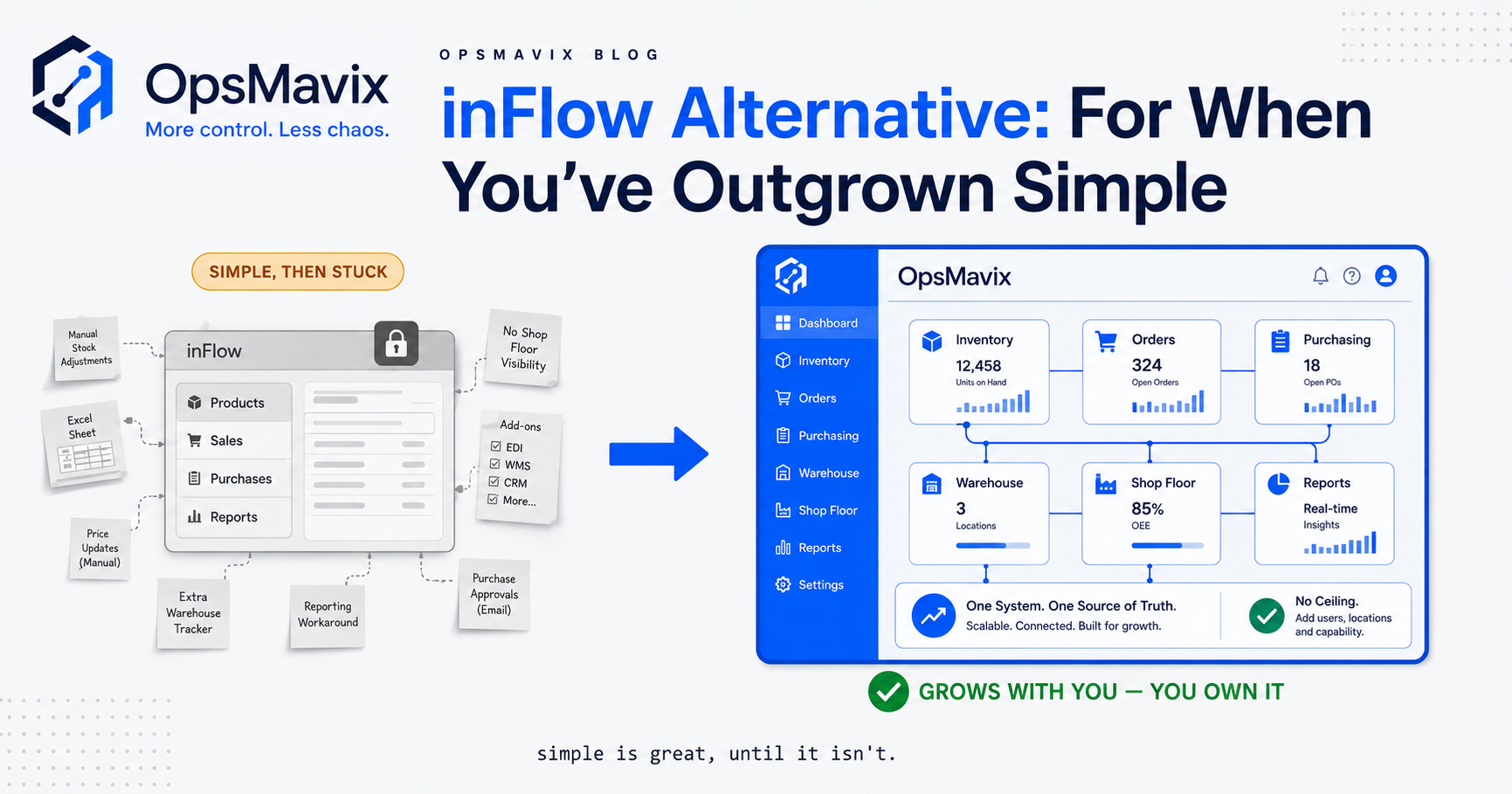
The best inFlow alternative is usually not another inventory app — it’s one owned operations system shaped to how your business actually runs. inFlow Inventory is a good, deliberately simple tool: it tracks stock, handles purchase and sales orders, and gets a small operation off spreadsheets without a painful setup. But “simple” is a scope, not just a feeling. It was drawn for small operations, and the further you grow past that outline, the more of your day you spend in the gaps it leaves — the side-spreadsheet for the case it can’t hold, the re-key between it and the tool beside it, the report you rebuild by hand.
Most people searching for a replacement aren’t unhappy with inFlow’s features. They’re bending their operation to fit the software, or paying for a shape that no longer matches how they work — stock rules in a spreadsheet, a production step tracked on paper, a second app bolted on for the part inFlow was never built to do. That’s not a features problem you fix by swapping to a slightly different box. It’s a fit problem — and the honest question is whether the answer is another template or a system built around your flow that you own outright.
Key Takeaways
- inFlow is a genuinely good simple tool — clean stock, purchase and sales order tracking that gets a small operation off spreadsheets quickly, and it’s well-liked for good reason.
- “Simple” is a scope — it was built for small operations, and growth in volume, locations, production complexity or channels is exactly what surfaces its caps.
- You’ve outgrown it when the workarounds become routine — a side-spreadsheet for the case it can’t hold, a bolt-on app for the step it doesn’t cover, a report rebuilt from exports.
- Pricing is published in USD and tiered — the model matters more than any figure: plan limits on orders, users and features push you up the tiers as you grow.
- Sometimes buying inFlow is the right call — for a small, stable operation with a standard flow, it fits, and replacing working software for its own sake is its own kind of leak.
- The real alternative isn’t another app — it’s the practical layer between a spreadsheet and an ERP: one operations system shaped to your exact flow, owned, with no per-seat or per-order creep.
What inFlow Actually Is
Be fair to it first. inFlow Inventory is an inventory and order management product made by Archon Systems, a company based in Toronto, Canada. It’s aimed squarely at small and medium businesses that have outgrown spreadsheets and want something that tracks stock, manages purchase and sales orders, handles basic costing, and keeps a tidy record of what came in and out. It runs primarily as a cloud product, with a legacy on-premise edition still around for businesses that started on it years ago.
Its reputation is well-earned. inFlow does the ordinary job well and doesn’t drown a small team in configuration. You can set it up quickly, teach it to a new starter, and trust it to hold a clean stock figure for a straightforward operation. For a business whose problem is “our spreadsheet has become dangerous”, that simplicity is the whole value, and it earns its keep at that size.
Where inFlow Hits Its Ceiling
The ceiling isn’t a flaw; it’s the edge of the scope it was drawn for. The first place you feel it is complexity the simple case never anticipated. Light assembly or manufacturing — a finished item built from components, a bill of materials, a production step that consumes stock and outputs something new — sits at the far edge of what a simple inventory tool holds cleanly, so the routing and part-tracking end up on a spreadsheet beside it. If that’s your normal day, you’re running the operation in the gaps.
The second is scale the small case ignores: multiple stock locations that each need their own truth and transfers between them, a user count that needs real roles, order volume that turns a manual step into an hourly tax — multi-location inventory management is a different problem from single-store stock. The third is the edges: the integration to your accounting or channel setup that isn’t quite there, the field the product has no home for, the report your decisions need in a shape it doesn’t produce. Each gap becomes a spreadsheet or a second app — a fresh place for the numbers to drift with no audit trail behind them.
The Pricing Reality
inFlow publishes tiered plans priced in US dollars, so a UK buyer is converting and, on the cloud product, paying against a moving exchange rate. Entry plans sit around a hundred-odd pounds per month (converted), rising into the high hundreds of pounds per month at the top published tier, with quote-based enterprise arrangements above that — check the current numbers directly, because the figure you convert today isn’t the one you’ll pay next quarter.
The model matters more than any single number. Plans are gated on things that grow with you: monthly sales order counts, users, stock locations, and which features are switched on. The better you do, the more likely you are to be pushed up a tier — you’re renting capacity against your own growth. For a small, stable operation that’s fair value. For one that’s scaling, model your bill at next year’s volume, not today’s, against the fixed cost of a system you’d own outright.
When inFlow Is Genuinely the Right Choice
Sometimes buying inFlow is simply correct, and it would be dishonest to pretend otherwise. If you’re a small operation with a standard flow — buy stock, hold it in one or two places, sell it, track what you have — no real production complexity and integrations inFlow already covers, then it fits. It’ll get you off spreadsheets, hold a clean figure, and cost far less than commissioning anything built. At that size, replacing working software would just be a bigger leak.
The test is whether the scope is still yours. If inFlow holds your real operation cleanly and the workarounds are rare exceptions rather than your daily normal, keep it — a different simple tool like Zoho Inventory is the same category with a different template, and switching within it only helps if a specific product annoys you rather than the packaged shape not fitting. The signal to look further is when the gaps have become the job.
The Right-Sized Middle: One Operations System
There’s a middle most “alternative” lists skip. When you’ve outgrown a simple tool, the reflex is to jump to a bigger one, or all the way to a full ERP — and both can be wrong. The bigger tool is another template you’ll bend to; the ERP is thirty rooms of suite when you needed four. The middle is one operations system shaped to how you run: outgrowing spreadsheets and disconnected tools.
That isn’t a stripped-down inventory app and it isn’t code for its own sake — it’s the parts of an inventory and order system you actually use, built the way you work. Stock, purchase and sales orders entered once and validated so wrong codes and quantities can’t slip through. One true stock figure across every location and channel, decremented the moment anything moves. The production step, the bill of materials and the handling rule treated as first-class parts of the system instead of exceptions on a spreadsheet — the ground a fully automated inventory system is built on. The reports your decisions need in the system, not rebuilt from exports. You own it: no per-seat or per-order creep, nothing a vendor reprices or switches off.
The Honest Build-vs-Buy Take
Buying inFlow is cheaper to switch on than any build is to commission — true, and the right call for a small, stable operation whose flow fits the template. The honest comparison isn’t the headline monthly fee, though; it’s total cost and control over three years or so, workarounds and all. Renting a simple tool is the subscription plus the tier creep plus every hour lost to the gaps it can’t hold. Owning a right-sized system is a fixed build cost, then a system that’s yours, with no edges to work around.
Run four checks before you decide. Fit: does inFlow hold your real flow cleanly, or are the workarounds now your normal day? Complexity: is there production, assembly or multi-location stock the simple case was never drawn for? Cost trajectory: what’s your bill at next year’s volume, converted? Ownership: how much does it matter that a vendor controls the price on the system your stock depends on? A small, stable operation should keep inFlow with a clear conscience — and we’ll say so. Four checks pointing the other way means you’ve outgrown simple, and the fix is a shape that’s yours.
Keep reading
Getting value from OpsMavix? Add us as a preferred source on Google — you'll see more of our operations content in your AI Overviews, AI Mode and Search.