
Supplier Order Management Software: Running the Inbound Side End-to-End
Supplier order management software isn't about raising a purchase order — it's about everything that happens after you send it. The acknowledgement that never came, the lead time nobody's tracking, the delivery that turned up short, the invoice that doesn't match what you ordered. Creating the PO is one document; managing the supplier and the inbound order over time is the capability that actually keeps stock on the shelf. Here's what that capability has to do, and where a right-sized system beats both the spreadsheet and the ERP.
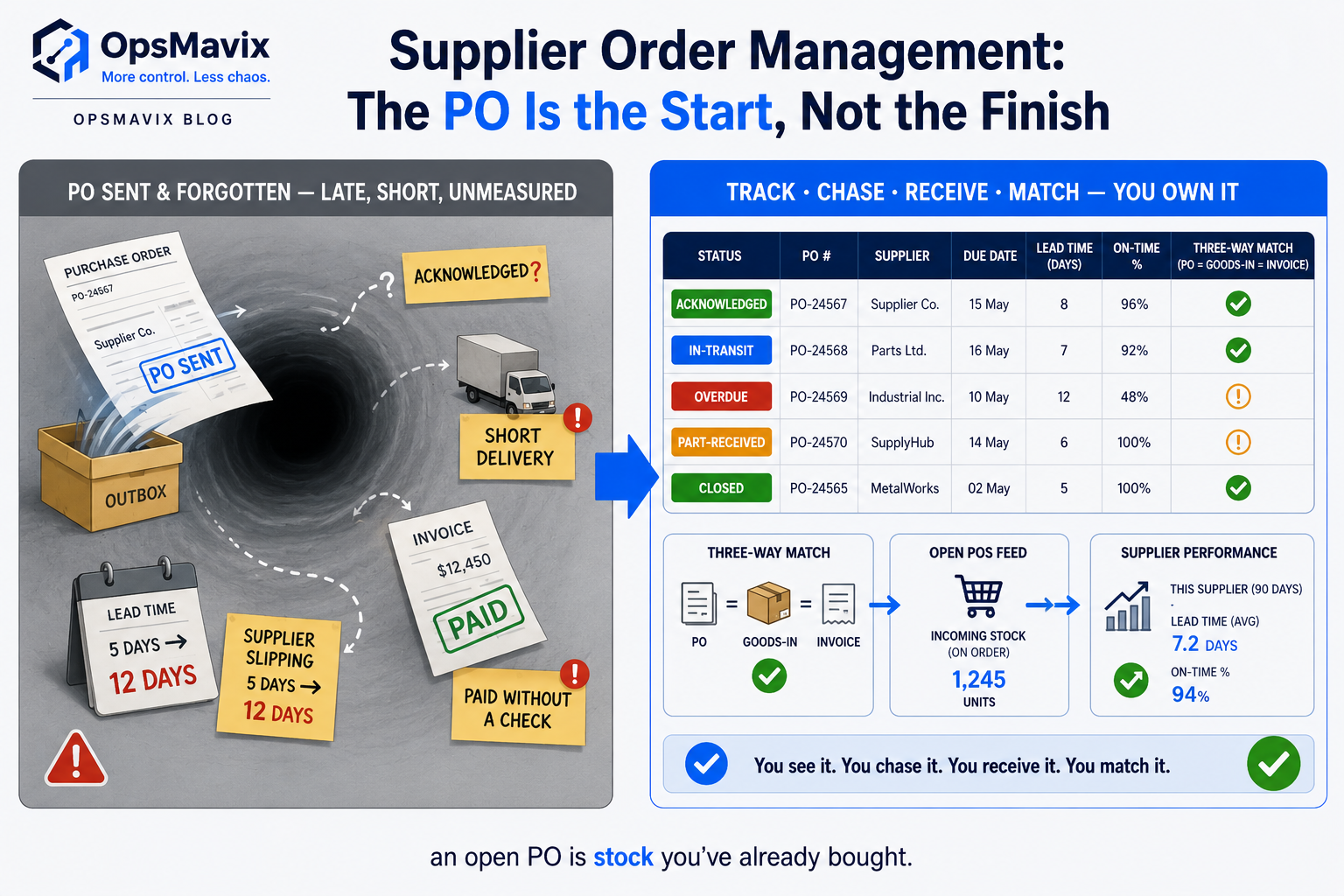
Supplier order management software tracks every purchase order after it is sent — acknowledgement, lead time, delivery, receiving and invoice match — so open orders never fall into the gap between “sent” and “received.”
Supplier order management software is the tool that runs the inbound side of your business over time — tracking every purchase order you’ve sent to a supplier from the moment it leaves your hands until the goods are received, checked and the invoice matches. It’s the layer that answers the questions a raised PO can’t: did the supplier acknowledge it, when is it actually landing, are they hitting their lead times, did the delivery come in complete and correct, and does the invoice match what you ordered and what you received. That’s a different job from writing the order. Creating and sending the purchase order document is one moment; managing the supplier relationship and the open orders across weeks is an ongoing capability — and it’s the part most growing businesses have no system for at all.
This post is about that ongoing capability and where it leaks. If you want the mechanics of raising, approving and sending a PO, that’s a separate job covered in purchase order software — we won’t repeat it here. What we’re looking at is what happens once the PO is out the door: the chase-ups, the late deliveries nobody flagged, the supplier who’s quietly slipped from five days to twelve, and the invoice that got paid without anyone checking it against the goods. Here’s what supplier order management has to do to be worth the name, and when a right-sized system built around how you actually buy beats both the inbox and the enterprise procurement suite.
Key Takeaways
- Supplier order management is the ongoing tracking of open purchase orders after they’re sent — acknowledgement, lead time, delivery status, receiving and invoice match — not the one-off act of creating the PO document.
- Most growing businesses raise POs fine but manage the aftermath in an inbox and a spreadsheet, so late deliveries and unacknowledged orders only surface when the stock runs out.
- Lead time and on-time percentage are the numbers the spreadsheet hides — you can’t hold a supplier accountable for slippage you never measured.
- Receiving without a three-way match means paying for goods you didn’t get; the check has to connect the PO, the delivery and the invoice, or the leak is invisible.
- Supplier order management is inseparable from stock — an open PO is future inventory, and if your reorder logic can’t see what’s already on the way, you over-order or run dry.
- A right-sized custom system models your suppliers, your lead times and your receiving process, gives one live view of every open order, and you own it — no per-seat procurement licence.
Three Ways to Run the Inbound Side, Compared
Most “supplier order management software” searches are really a choice between three approaches. Here is how they stack up for a business buying from ~40 regular suppliers:
| Capability | Inbox + spreadsheet | Enterprise procure-to-pay suite | Right-sized custom system |
|---|---|---|---|
| Open-PO visibility | Manual, scattered across emails | Full, but buried in modules | One live view, scoped to you |
| Lead time / on-time % | Not measured | Measured (heavy setup) | Measured automatically |
| Three-way match | Skipped or manual | Enforced | Enforced at receiving |
| Open PO seen as future stock | No | Via ERP integration | Built into the loop |
| Fit for ~40 suppliers | Outgrown | Overkill | Purpose-fit |
| Cost model | “Free” (hidden leak) | Per-seat licence, climbs | Owned outright, no per-seat |
Best-in-class supplier performance is >95% on-time delivery — a number you cannot hold anyone to from an inbox, because nobody is measuring it. The rest of this post is what each row above actually takes.
What Supplier Order Management Software Actually Does (and Who the Full Version Is For)
At the enterprise end, procure-to-pay and source-to-pay platforms are large machines: supplier onboarding and qualification, sourcing events and RFQs, contract compliance, catalogues, spend analytics, multi-level approval routing, and deep ERP and payment integration. When you run thousands of suppliers and millions in spend across categories, every one of those modules earns its place — the compliance and analytics alone justify the cost. The weight is doing real work.
The trouble starts when a business buying from forty regular suppliers licenses the same machine. What they actually need is narrow and specific: one view of every open purchase order, which ones the supplier has acknowledged, which are overdue, when each is due to land, and a receiving step that flags short or wrong deliveries before the invoice gets paid. That’s not source-to-pay. That’s the core of supplier order management, shaped to how one business actually buys — and it’s the part they’ll use every single day, not the sourcing-event engine they’ll never switch on.
The PO Is the Start, Not the Finish
Here’s the mistake that costs the most: treating the purchase order as done the moment it’s sent. Raising the PO is the easy part — most businesses do it fine, in their accounts package or a template. The order goes out, and then it falls into a black hole. Nobody owns it until either the goods arrive or, more often, they don’t and someone notices the shelf is empty. The gap between “PO sent” and “goods received” is where the money leaks, and it’s exactly the gap the spreadsheet doesn’t cover.
Supplier order management is the discipline of owning that gap. Did the supplier confirm the order and the date? Is it still on track a week later? Has it shipped? Is it late, and if so, who’s chasing it? A system that’s worth building keeps every open PO in one live view with a status you can trust — acknowledged, in transit, overdue, part-received, closed — so an order going quiet is something the system surfaces, not something you find out about when a customer’s order can’t be filled.
Lead Times and On-Time Percentage: the Numbers You Can’t Hold a Supplier To
Ask a buyer which suppliers are reliable and you’ll get a gut answer — “that lot are always late.” Ask them to prove it and they can’t, because nobody’s measuring it. Lead time is how long a supplier actually takes from order to delivery, and on-time percentage is how often they hit the date they promised. Both live in the history of your orders, and if that history is scattered across emails and a spreadsheet, the pattern is invisible. So the supplier who’s quietly drifted from a five-day lead time to twelve keeps getting ordered from on a five-day assumption, and you keep running dry.
A right-sized system records the promised date and the actual received date on every order, and adds them up. Now the drift is a number, not a hunch. You can see which suppliers hit their dates and which don’t, set your reorder points against real lead times instead of optimistic ones, and have a supplier conversation backed by their own performance instead of a vague complaint. This is where supplier order management stops being admin and starts being a lever you can pull.
Receiving and the Three-Way Match: Paying for What You Actually Got
The most expensive leak on the inbound side isn’t a late order — it’s a paid one that came in short. Goods arrive, someone signs for them, the invoice lands, and it gets paid, and nobody ever lined up the three documents that should agree: what you ordered, what actually turned up, and what you’re being billed for. When those three don’t meet, you pay for cases that never arrived, prices that crept above the quote, and quantities nobody counted. Industry accounts-payable benchmarking puts the exposure in numbers: roughly 39% of invoices contain at least one error (Ardent Partners), and the only thing that catches those before payment is a match that lines the invoice up against the PO and what actually arrived.
That check is the three-way match, and it’s the backbone of honest receiving. Supplier order management software makes it a step that happens instead of a step that’s meant to. The goods receiving process records what physically arrived against the open PO, so a short or wrong delivery is flagged at the door. Then the invoice gets matched against both before a penny is approved. Skip it and you’re trusting that every supplier bills you exactly for what they sent, every time — and the ones who don’t are counting on you not checking.
An Open PO Is Future Stock — and Your Inventory Has to Know
Supplier orders and stock aren’t two systems; they’re one loop. Every open purchase order is inventory that’s already on its way, and if your stock view can’t see it, two failures follow. You reorder something that’s already coming because the shelf looks low and the incoming order is invisible — now you’re overstocked. Or your reorder logic doesn’t account for lead time at all, and you run out in the window between hitting the reorder point and the goods landing. Both are the same root cause: the buying side and the stock side not talking.
A right-sized system ties open supplier orders to stock levels so incoming quantities count. Available-to-promise reflects what’s on hand plus what’s genuinely inbound with a real date. Reorder suggestions account for the supplier’s actual lead time, not a guess. One wholesale distributor described the pain plainly: the stock and the orders were disconnected, so the business would promise a customer goods it may not have had, while the reorder engine ran off logic nobody fully understood. Joining supplier orders to inventory automation closes that gap — the same connected order-to-stock loop a wholesale order management system brings together on the sales side.
The Real Cost Is the Blind Spot, Not the Software
The reason to fix supplier order management isn’t that spreadsheets are ugly — plenty of businesses run on them. It’s that the spreadsheet has no memory and no alarm. It doesn’t tell you an order’s gone quiet, add up a supplier’s on-time record, flag the short delivery, or warn that you’re about to double-order. Every one of those is a decision made blind, and blind decisions on the inbound side turn into stockouts, overstock, overpaid invoices and firefighting that eats your buyer’s week. A right-sized system replaces those blind spots with a live view scoped to how you actually buy — your suppliers, your lead times, your receiving rules, your stock — owned outright, with no per-seat procurement licence climbing every time you add a buyer.
FAQ
What is supplier order management software?
Supplier order management software tracks purchase orders after they’re sent to a supplier — acknowledgement, lead time, delivery status, receiving and invoice match — so open orders don’t fall into a black hole between “sent” and “received.” It’s distinct from software that raises the PO: creating the document is one moment, while managing the supplier and the inbound order over time is an ongoing capability. A right-sized version covers the core loop — track, chase, receive, match, and connect it to stock.
How is this different from purchase order software?
Purchase order software is about creating, approving and sending the PO document — the mechanics of raising the order, covered in purchase order software. Supplier order management is everything that happens after that: is the order acknowledged, is it on time, did it arrive complete, does the invoice match, and how is this supplier performing over many orders. One is the document; the other is the relationship and the open orders across weeks. You need both, but the aftermath is where the money usually leaks.
What is a three-way match and why does it matter?
A three-way match lines up three documents that should agree before an invoice is paid: the purchase order (what you ordered), the goods receipt (what actually arrived), and the supplier invoice (what you’re billed). When they don’t match, you catch short deliveries, price creep and wrong quantities before you pay for them. Without it, you’re trusting every supplier to bill exactly what they sent — and paying for the gaps when they don’t. It’s the backbone of honest receiving.
Why should supplier orders connect to inventory?
Because an open purchase order is inventory that’s already on the way. If your stock view can’t see incoming orders, you’ll reorder things that are already coming (overstock) or run out in the window between the reorder point and delivery (stockout). Connecting supplier orders to stock means available quantities reflect what’s on hand plus what’s genuinely inbound, and reorder logic accounts for each supplier’s real lead time instead of a guess.
Do we need this if we already raise POs in our accounts package?
Usually yes — raising the PO is the part accounts packages do well, but they rarely manage the aftermath. They don’t track acknowledgements, measure supplier lead times and on-time percentage, flag late or short deliveries, or connect open orders to your stock. That management layer is exactly the gap supplier order management fills, and it’s where the leaks live. A right-sized system adds it around how you already buy, rather than replacing everything.
How OpsMavix Can Help
OpsMavix builds right-sized supplier order management systems for businesses stuck in the gap — too big to run inbound orders from an inbox and a spreadsheet, too small to justify an enterprise procurement suite. We build the part you actually run: one live view of every open purchase order, with acknowledgement, lead time, delivery status and overdue flags you can trust; a receiving step that catches short or wrong deliveries at the door; a three-way match so no invoice gets paid without agreeing to the PO and the goods receipt; and supplier performance tracked over time so “they’re always late” becomes a number you can act on. It ties open orders to stock through inventory automation so incoming quantities count, and connects to the sales side through a wholesale order management system. You own it outright — no per-seat licence, nothing a vendor can switch off.
If you’re weighing supplier order management software against building the right thing once, start by seeing where the inbound side actually leaks. Book a Free Operations Leak Audit and we’ll map where late orders, blind receiving and unmeasured suppliers cost you today, what it’s worth to close, and whether a full procurement platform or a right-sized system is the honest fit for how you buy now.
Keep reading

Getting value from OpsMavix? Add us as a preferred source on Google — you'll see more of our operations content in your AI Overviews, AI Mode and Search.