
Three-Way Matching: Catching the Invoices That Don't Add Up
Three-way matching is the check that lines up the purchase order, the goods received note and the supplier invoice — so you never overpay, double-pay, or pay for goods that never arrived. Here's how the match actually works, where tolerances belong, and why doing it by eye collapses the moment your volume climbs.
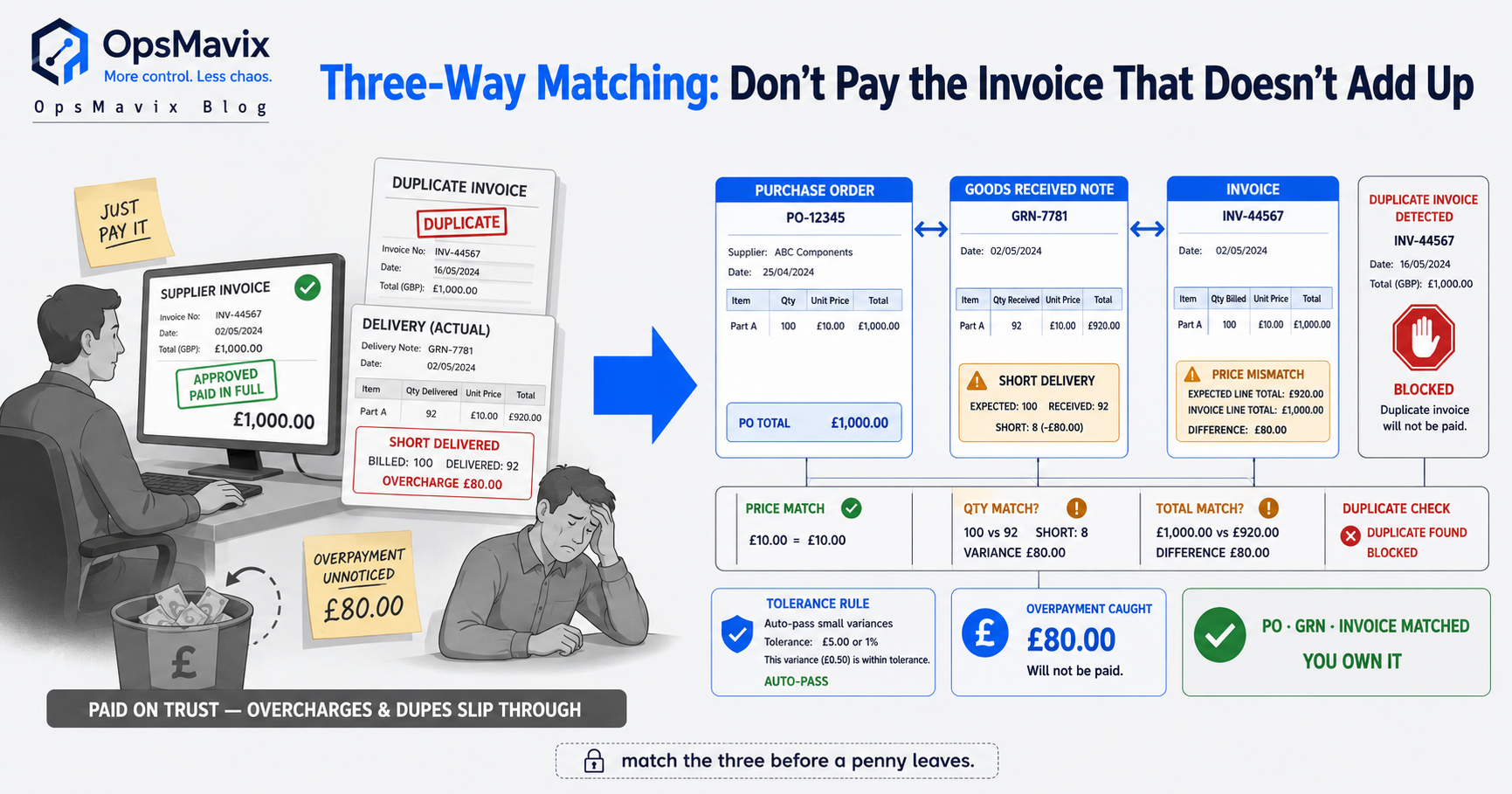
Three-way matching is the check that lines up three documents before a supplier gets paid: the purchase order (what you agreed to buy), the goods received note (what actually turned up), and the supplier invoice (what you’re being billed for). When all three agree, the invoice clears. When they don’t — a price that crept up, a quantity that fell short, a bill for goods that never arrived — the mismatch gets flagged instead of paid. That single discipline is where the quiet money in accounts payable is either saved or lost.
The manual version is someone in finance holding an invoice in one hand and a delivery note in the other, squinting for a PO number, then deciding whether it “looks about right.” On a slow week with a handful of invoices, that works. On a busy week with two hundred, it doesn’t — the eye tires, the queue backs up, and the invoices that don’t quite add up get waved through because chasing each one costs more attention than anyone has to spare. The overpayments aren’t dramatic. They’re a few pounds here, a duplicate there, a short delivery billed in full — small enough to miss one at a time, large enough to matter across a year.
Key Takeaways
- Three-way matching compares the purchase order, the goods received note and the supplier invoice — all three must agree before payment, not just two.
- It catches the four expensive errors: price mismatches, quantity mismatches, duplicate invoices, and billing for goods never received.
- Two-way, three-way and four-way matching are different levels of rigour — the more checks, the more leaks caught, and the more manual effort it costs to do by hand.
- Tolerance thresholds are the trick that makes matching workable: tiny variances auto-pass, meaningful ones flag, so people only look at what’s genuinely wrong.
- Manual matching collapses at volume — it scales with headcount, not with a rule, so the errors slip through exactly when there are most of them.
- The leak is real £: unmatched overcharges, double-paid bills and short deliveries billed in full add up quietly across a year of invoices nobody had time to check.
1. What Three-Way Matching Actually Compares
Strip it back and three-way matching is a simple question asked three ways: did we agree to buy this, did it actually arrive, and does the bill match both? The purchase order answers the first — the price and quantity you committed to. The goods received note answers the second — what physically landed at the door, checked and recorded during your goods receiving process. The supplier invoice is the third — what they want paying. The match is the moment those three are held against each other, line by line, before money moves.
The reason it’s three documents and not two is that each one can lie on its own. The invoice agrees with itself. The delivery note agrees with itself. Only when you anchor both against the PO — your intent, in writing, from before anything shipped — do the gaps show up. Ordered a hundred at £4, received ninety-two, invoiced for a hundred at £4.20: every document is internally consistent, and every one of those three lines is a discrepancy you’d pay for without the match.
2. The Four Errors It Catches (and What Each One Costs)
There are four ways a supplier invoice quietly takes money it shouldn’t, and three-way matching is built to catch all four. A price mismatch: the PO said £4 a unit, the invoice says £4.20, and nobody remembers the quote well enough to argue. A quantity mismatch: you’re billed for the full order when the delivery came up short — you pay for units that never arrived. A duplicate invoice: the same bill comes in twice, once by email and once by post, and both get entered because nobody’s cross-referencing. And billing for goods never received: an invoice for a delivery that’s still outstanding, or was cancelled, or went to a different site.
None of these are fraud, mostly. They’re the ordinary noise of buying from dozens of suppliers — a price list that changed, a picker who short-shipped, an accounts system that generated a second copy. But noise costs money. One accounts-payable clerk we spoke to described finding the same £600 carriage invoice paid twice, three weeks apart, only because a supplier statement didn’t reconcile at month-end. The match would have caught it at the door. Instead it became a credit note to chase and an awkward call to make.
3. Two-Way vs Three-Way vs Four-Way Matching
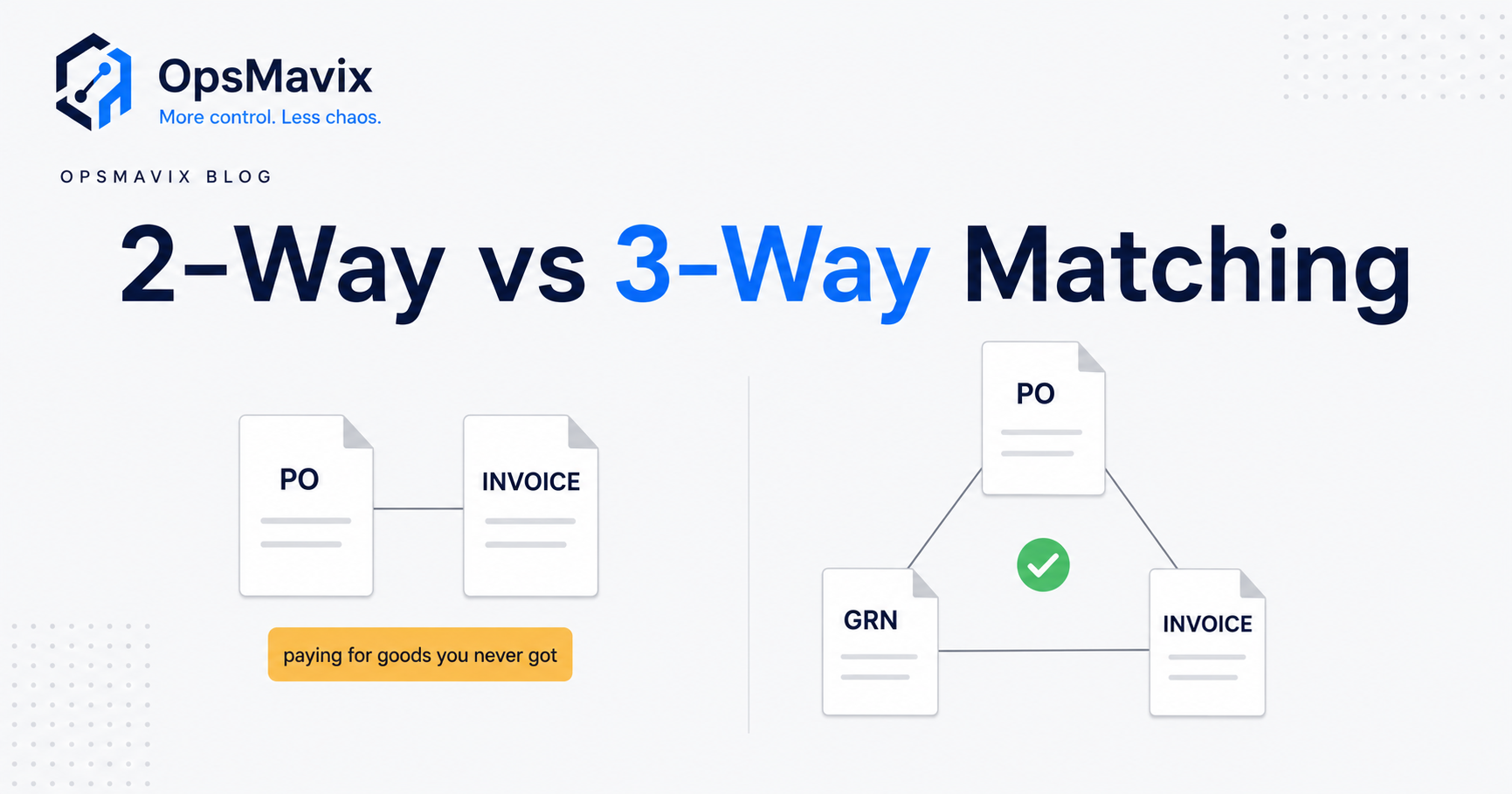
Matching comes in levels, and the number tells you how many documents have to agree. Two-way matching compares the PO and the invoice only — did we order this, at this price? It’s fast and it catches price and quantity mismatches against what was ordered, but it’s blind to what actually arrived. Pay a two-way-matched invoice and you might be paying in full for a short delivery, because nothing checked the goods in.
Three-way matching adds the goods received note — PO, receipt, invoice — so the bill has to agree with what physically landed, not just what was ordered. That’s the standard most growing businesses should aim for, because it closes the short-delivery gap that two-way leaves wide open. Four-way matching goes one further and adds an inspection or quality-acceptance step: the goods not only arrived but passed check before the invoice clears. Four-way earns its keep where quality is contractual — regulated inputs, high-value components, anything where “arrived” and “acceptable” aren’t the same thing. For most, it’s overkill; three-way is the sweet spot between rigour and effort.
4. Tolerance Thresholds Are What Make It Workable
Here’s the part people miss: perfect matching is unworkable, and it’s supposed to be. If every invoice had to agree with the PO to the penny, half of them would flag on rounding, a shipping charge, or a 2p unit-price drift, and your finance team would spend the week clearing exceptions that don’t matter. The fix is tolerance thresholds — rules that say how much variance is allowed to auto-pass and how much forces a flag.
Set a price tolerance of, say, 2% or £5, and an invoice that’s a couple of pence over the PO clears without a human touching it, while one that’s 15% over stops dead and lands in someone’s queue. Set a quantity tolerance so a delivery within a unit or two of the order passes, but a real short forces a review against the GRN. Done well, tolerances mean your team only ever looks at the invoices that are genuinely wrong — the exceptions — instead of eyeballing every single one to find the few that matter. The threshold is the dial between “nothing gets checked” and “everything gets checked and nothing gets paid on time.”
5. Why Manual Matching Collapses at Volume
Doing three-way matching by hand doesn’t scale, and the reason is structural, not a matter of hiring better people. Manual matching costs a fixed slice of attention per invoice — pull the PO, find the GRN, compare three sets of lines, decide. At twenty invoices a week that’s an afternoon. At two hundred it’s a full-time job that nobody has, so the corners get cut: the small ones get trusted, the familiar suppliers get waved through, and the check that was meant to catch overcharges becomes a rubber stamp under time pressure.
That’s the cruel part — manual matching fails hardest exactly when you need it most. Low volume, and you barely need the check; high volume, and the check is the only thing standing between you and a steady drip of overpayments, but it’s also when you’ve no time to do it. One finance manager we spoke to put it plainly: the invoices that slip through aren’t the obvious ones, they’re the plausible ones — a fiver over here, a short line there, each one individually not worth stopping the payment run for. Multiply plausible-but-wrong across a year of invoices and the leak has a number. This is the same routing-and-approval pressure covered in invoice approvals — but the matching itself is the part that quietly breaks first, because it’s the part that’s most tedious to do right.
6. Matching Is a Different Job From Approving
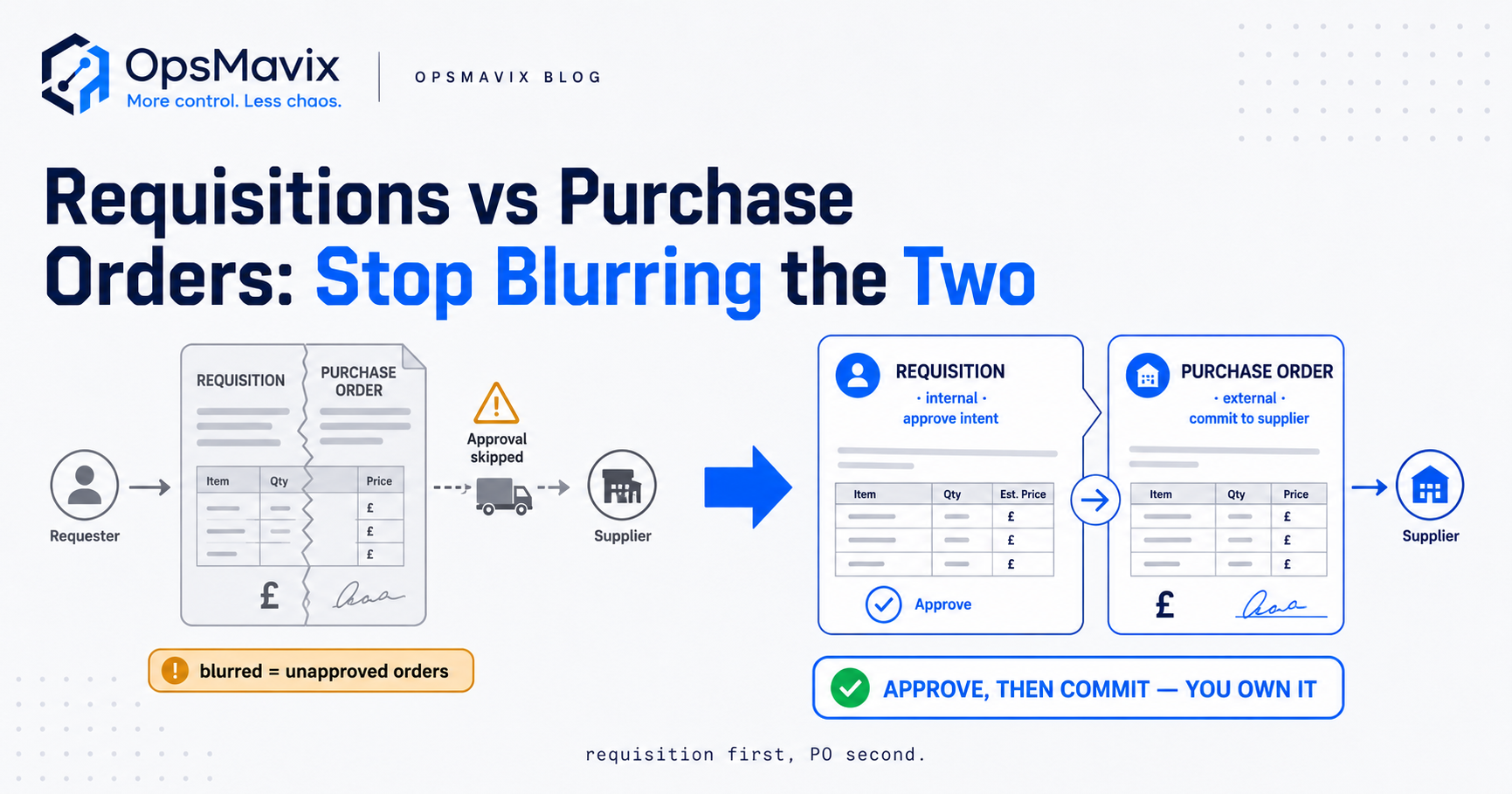
It’s worth being clear about where matching ends and approval begins, because they get lumped together and they’re not the same. Matching is the factual check: do the PO, the receipt and the invoice agree on price and quantity? It’s arithmetic — either the numbers line up within tolerance or they don’t. Approval is the judgement call that comes after: given that this invoice matches (or matches with a flagged exception), who’s authorised to release it for payment, and did they? That routing, sign-off and audit-trail side is a topic in its own right — how spend thresholds route to the right person and nothing sits in an inbox is covered in our guide to invoice approval workflow automation.
Why does the distinction matter? Because a lot of businesses bolt on an approval step — someone clicks “yes” — without ever doing the match underneath it. So the invoice gets a signature, but nobody checked it against what was ordered and received. Approval without matching is authorising a payment you haven’t verified. The match is the evidence; the approval is the decision. Do them in that order and the person signing off is agreeing to something that’s actually true.
7. Building Matching That Fits How You Actually Buy
Off-the-shelf accounts tools tend to offer matching as a box you tick, then make you do the real work by hand anyway — because they can’t see your goods received notes, don’t know your supplier price lists, and can’t model the tolerances you’d actually want. So the “matching” feature checks the PO against the invoice and stops there, leaving the short-delivery gap wide open, or it flags so aggressively that everyone learns to ignore the alerts. Our contrarian view at OpsMavix: most businesses don’t have a matching feature problem, they have a matching connection problem — the PO, the GRN and the invoice live in three different places that never talk, so no tool can line them up without a person copying between them.
A right-sized system closes that by making the three documents share one record. The purchase order is raised in the system, the goods received note is captured against it at the door, and when the supplier invoice arrives it’s matched automatically against both — within your tolerances, flagging only what genuinely disagrees. Before, a clerk pulls three documents and compares by eye across a backlog. After, the clean invoices clear themselves and a human only ever sees the exceptions: the price that jumped, the delivery that came up short, the bill that’s arrived twice. That’s the difference between matching as a chore nobody has time for and matching as a check that runs whether the week is quiet or not.
FAQ
What is three-way matching?
Three-way matching is an accounts-payable check that compares three documents before a supplier invoice is paid: the purchase order (what you agreed to buy, at what price), the goods received note (what actually arrived), and the invoice (what you’re being billed). When all three agree — within set tolerances — the invoice clears. When they don’t, the mismatch is flagged for review instead of paid, which is how you catch price creep, short deliveries, duplicate bills and charges for goods that never turned up.
What’s the difference between two-way, three-way and four-way matching?
Two-way matches the PO against the invoice only — it checks what you ordered against what you’re billed, but it’s blind to what actually arrived. Three-way adds the goods received note, so the invoice has to agree with the physical delivery, closing the short-delivery gap. Four-way adds an inspection or quality-acceptance step, so goods must arrive and pass check before the invoice clears. Three-way is the right target for most growing businesses; four-way suits regulated or high-value inputs where acceptance is contractual.
What are tolerance thresholds in invoice matching?
Tolerance thresholds are the rules that decide how much variance between the documents is allowed to pass automatically and how much forces a flag. A small price or quantity difference — a rounding penny, a couple of units, a minor carriage charge — auto-passes, while a meaningful one stops the invoice for review. Tolerances are what make matching workable at volume: they keep your team focused on the exceptions that cost real money instead of clearing trivial variances all day.
Can three-way matching catch duplicate invoices?
Yes — and it’s one of the most valuable things it does. A matching system holds a record of every invoice already received against a PO, so when the same bill arrives a second time (a common error when suppliers send by both email and post), it’s flagged as a probable duplicate rather than entered and paid again. Manual checking rarely catches these, because the two copies usually arrive weeks apart and nobody’s cross-referencing every incoming invoice against everything already logged.
Why does manual invoice matching fail as we grow?
Because manual matching costs a fixed slice of attention per invoice, so it scales with headcount, not with a rule. At low volume it’s easy but barely needed; at high volume it’s essential but there’s no time to do it properly, so the checks get skipped exactly when there are most invoices to check. The errors that slip through are the plausible ones — a few pounds over, a short line, a quiet duplicate — each too small to stop a payment run for, but adding up to a real leak across a year.
How OpsMavix Can Help
OpsMavix builds right-sized systems for businesses stuck in the gap — outgrowing spreadsheets and disconnected tools — and three-way matching is one of the clearest places that gap costs money. We connect the purchase order, the goods received note and the supplier invoice into one record, match them automatically against your own tolerance thresholds, and surface only the exceptions: the price that crept up, the delivery that came up short, the bill that arrived twice. Your finance team stops eyeballing every invoice and starts looking only at the ones that are genuinely wrong — and the matching runs whether it’s a quiet week or the busiest one of the quarter.
If invoices get paid on trust because nobody has time to line them up against what was ordered and received, you’re almost certainly overpaying in ways that are invisible one invoice at a time. We’ll show you where, what it’s worth, and whether the fix is the match itself or the approval workflow that sits on top of it. Book a Free Operations Leak Audit.
Keep reading

Getting value from OpsMavix? Add us as a preferred source on Google — you'll see more of our operations content in your AI Overviews, AI Mode and Search.