
Metal Fabrication Software: EN 1090 Traceability Without Buying an ERP You Do Not Need
EN 1090 is the reason most fabricators start shopping for software, and the reason most of them overbuy. Here is what the standard actually demands of your records, which systems cover it, and how to tell a traceability feature from a traceability obligation.
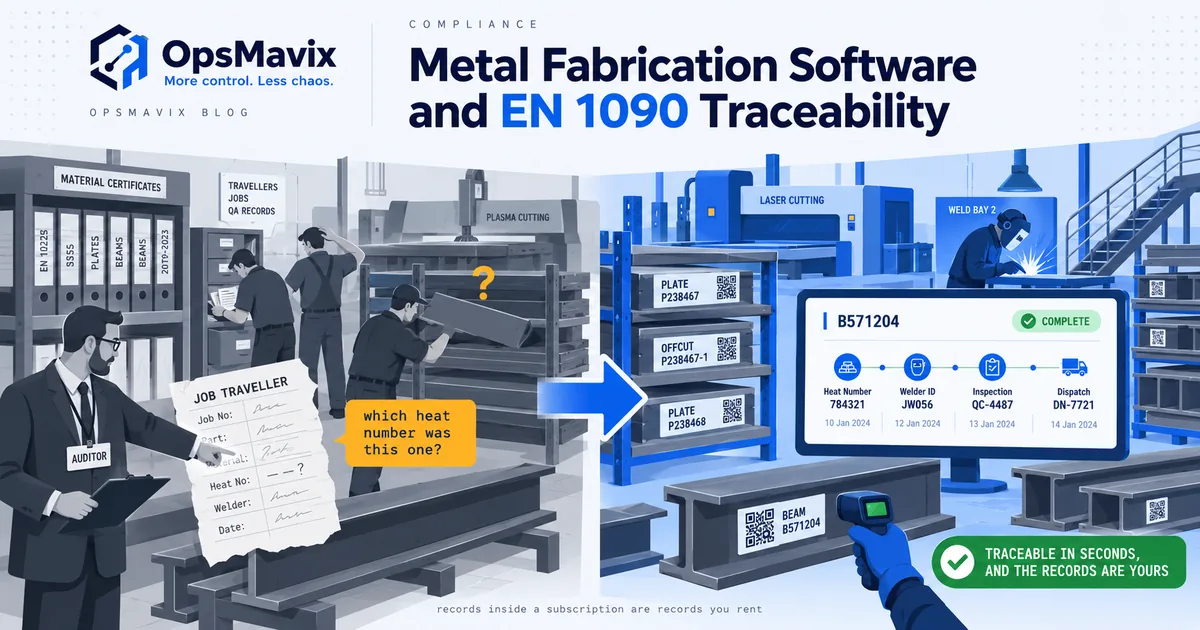
Metal fabrication software manages the work a fab shop does day to day: quoting, cutting and forming, welding, inspection and dispatch, with material traceability running through all of it. In structural steel it also has to hold the records EN 1090 requires, tying every finished item back to its cast number, its welder and its inspection.
Most fabricators do not go looking for software because they want software. They go looking because a main contractor asked for something they could not produce fast enough, or because an auditor asked a question about a heat number and the answer was in a lever-arch file in the corner of the office.
That is a useful thing to notice about yourself before you start booking demos, because it changes what you should buy.
What does EN 1090 require for traceability?
EN 1090 requires that a fabricated item can be traced to the material it was made from, the welder who welded it, the welding procedure used and the inspection it passed, and that factory production control was demonstrably followed throughout. EN 1090 has applied to structural steel and aluminium fabricators across Europe since 2014, and it is what stands between a small fabricator and the larger, better-paid work. It proves you can trace materials, welds and people, and that your factory production control is genuinely under control.
For the purposes of choosing software, the standard resolves into a small number of record-keeping duties. You need to be able to show, for a given fabricated item:
- Which material went into it, tied back to the cast or heat number and the supplier’s certificate
- Who welded it, and that the welder held a valid qualification at the time
- Which welding procedure was used, and that it was qualified
- What inspection happened, by whom, and with what result
- That your factory production control process was followed, consistently, not just on the day of the audit
None of that says “buy an ERP”. It says keep records that survive scrutiny years later, and be able to retrieve them by item.
That is the crux. What the standard creates is a retrieval problem. Any shop can produce a certificate. The question is whether you can produce the right one, for one specific beam in one specific building, three years after it shipped, in the time the auditor is standing in your office.
Why does the paper system fail at exactly the wrong moment?
The paper system fails at exactly the wrong moment because it does not degrade gradually: it holds up through ordinary weeks and then collapses when a label goes missing, a traveller card is destroyed, or an auditor asks for one specific item during a busy month. The paper system does not fail day to day. It fails under a specific and predictable set of conditions, which is what makes it so dangerous.
An internal traceability number gets created when material arrives, and it needs to follow that material through cutting, forming, fitting, welding and finishing. Every time a plate is cut into three parts, the traceability has to split with it. Every time an operation happens, a person and a time attaches to it.
On paper that works while volume is low and the same four people do everything. It breaks when:
- A plate gets cut and the offcut goes back to the rack without a label, and later becomes part of a different job
- A traveller card gets wet, torn, or left in a van
- The person who knew is on holiday, and the knowledge was never anywhere but their head
- The audit arrives during a busy month and the retrieval takes two people three days
None of these are software problems. They are labelling and capture problems. Which is exactly why the software decision should start at the floor and not at the office.
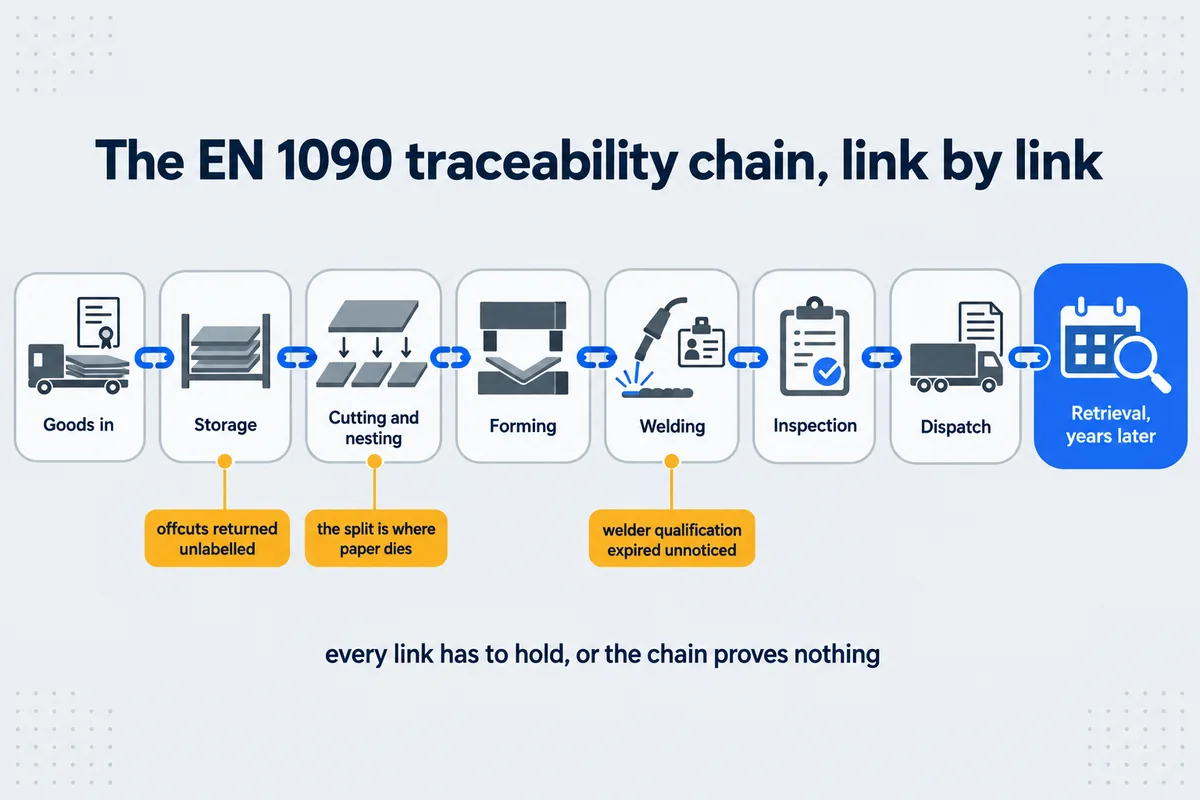
The traceability chain, link by link
If you evaluate nothing else, evaluate whether a system holds every one of these links without a spreadsheet alongside it.
| link | what has to be captured | where it usually breaks |
|---|---|---|
| Goods in | Heat or cast number, supplier cert, internal trace ID | Cert filed by delivery, not by material |
| Storage | Where it is, what it is, what is left | Offcuts returned to the rack unlabelled |
| Cutting and nesting | Which parts came from which plate | The split is where paper traceability dies |
| Forming | Which operation, which machine, who | Not captured at all in most shops |
| Welding | Welder ID, procedure used, qualification valid on the date | Welder qualification held separately, expiry unnoticed |
| Inspection | Who inspected, result, any NCR raised | Paper NCRs that never close |
| Dispatch | Which items shipped, on which delivery, with which docs | Documentation assembled retroactively |
| Retrieval | Any of the above, by item, years later | The whole point, and the usual failure |
Print that table and walk your own shop against it. Wherever you answer “in someone’s head” or “in a folder”, that is where the audit will find you, and it is also where the money leaks, because the same missing capture is the reason you cannot cost the job.
The systems, and what each one publishes
The fabrication-specific market is smaller and more specialised than general manufacturing ERP. Most of these vendors do not publish prices, so this table records what is public rather than inventing numbers.
| system | shape | EN 1090 traceability | pricing published |
|---|---|---|---|
| EZIIL | Steel fabrication specific, aimed at 15 to 150 people | Yes, stated explicitly, offered as a module | Yes, flat team-size pricing |
| Tekla PowerFab | Fabrication management, strong on model integration | Yes | No, quote only |
| StruMIS | Steel fabrication management, established | Yes | No, quote only |
| Steel Projects | Production management with traceability focus | Yes, documented in depth | No, quote only |
| ProShop ERP | Engineering-first, strong compliance orientation | Yes, quality-system oriented | No, quote only |
| Construsteel | Steel fabrication ERP | Yes | No, quote only |
| Statii | Small manufacturer system, UK | Partial, job-level | Yes |
| OpsMavix | Custom operations system or full ERP, you own it | Built to your FPC, records held by you | Yes, band published from £3,000 |
Checked September 2026. Verify with each vendor before deciding anything, because these change.
Credit where it is due. EZIIL has the sharpest offer in this market. Fabrication-specific, an explicitly stated target of 15 to 150 person project-based shops, flat team-size pricing rather than per-user, EN 1090 traceability as a named module, QR-based floor reporting, and fast deployment. If you are inside that profile and your process is close to standard, they are a genuinely serious option and you should get a demo.
We are telling you that on our own comparison page because a comparison that never concedes anything is an advert.
Taken one at a time, here is what each of those systems is and who it fits.
EZIIL
EZIIL is a steel fabrication system rather than a general manufacturing ERP, aimed at project-based shops of roughly fifteen to a hundred and fifty people. It covers quoting, production planning, drawing and document handling, QR-based shop floor reporting and material traceability, and it charges on flat team-size tiers rather than per user. It suits a fabricator whose cut, fit, weld, finish and dispatch flow is close to standard, and who wants the whole floor on the system without paying a penalty per head.
Tekla PowerFab
Tekla PowerFab, from Trimble, is fabrication management software built around the steel model. It links estimating, project management, production control, purchasing and delivery back to the 3D model, so material lists and part data flow out of the model rather than being re-entered. It suits fabricators who already work model-driven in Tekla Structures or a comparable detailing package, because the duplication it removes is real. Where you do not work from models, much of that advantage disappears.
StruMIS
StruMIS is a long-established steel fabrication management system covering estimating, procurement, nesting and material control, production tracking and traceability through the fabrication process. It integrates with the common steel detailing packages and is used by structural steel contractors internationally. It suits a fabricator who wants a specialist system with a long track record in structural steel rather than a general manufacturing ERP, and it is sold through a quoted process rather than published tiers.
Steel Projects
Steel Projects is production management software for structural steel and metal fabrication, with an unusually strong emphasis on driving and monitoring production machinery alongside planning and traceability. It takes CAD data through to the machines on the floor and tracks parts through the process. It suits shops with a significant amount of automated beam and plate processing, where much of the value is in feeding the machines correctly and knowing where every part is at any moment.
ProShop ERP
ProShop ERP is an engineering-led, paperless system that came out of a working machine shop, and it is unusually strong on quality-system workflow: document control, non-conformance handling and inspection records captured as part of normal work rather than bolted on. It suits precision machining and fabrication shops whose certification obligations are as demanding as their scheduling, and where the audit trail is a first-class part of the system rather than a reporting module.
Construsteel
Construsteel is an ERP built for steel construction and fabrication, covering estimating, project and production management, purchasing, stock and shop floor registration, with links to steel detailing software. It suits steel construction businesses that want one system spanning the commercial and production sides of a project rather than an operations tool sitting alongside separate estimating. Pricing is handled through a quoted process rather than published tiers, so expect a sales conversation before a number.
Statii
Statii is a UK cloud system for small manufacturing businesses, covering enquiries and quoting, purchasing, works orders, shop floor time capture, delivery and invoicing in one place. It is deliberately simple and it publishes its pricing, which makes it easy to evaluate without entering a sales process. Traceability is job-level rather than item-level, so a fabricator with a full EN 1090 obligation should check carefully how far it reaches for their execution class.
Feature or obligation: the question that separates them
Here is the distinction that should drive your decision, and almost nobody frames it this way.
Every system in that table can tick “EN 1090 traceability”. The tick means the software can store and retrieve the records. It does not tell you who is holding them.
Your traceability records are not a feature you consume while you are a customer. They are a compliance obligation with a lifespan measured in decades, because a structure you fabricated in 2026 may be inspected, modified or investigated long after your relationship with any software vendor has ended.
So ask a different question in the demo:
- If we leave in five years, what happens to the traceability records?
- In what format do they come out? Is it a usable structured export or a PDF dump?
- Does the export preserve the links, so a heat number is still connected to the item and the welder, or does it export flat tables that no longer join?
- What does that export cost?
- If you were acquired or shut down, what is our position?
You will learn more from the answers to those five questions than from any feature grid. And they are questions the salesperson usually has not been prepped for.
What 2,324 reviews say about the years after you sign
We collected 2,324 public reviews across 19 inventory and ERP systems that UK product businesses run, and coded all 840 negative reviews by what the customer was actually complaining about. The method, rule set and measured precision are published so you can check it.
The result reframes software buying generally, and it is especially sharp for compliance.
- Relationship complaints (support, commercial terms, account management, what sales promised): 75.0% of negative reviews
- Product complaints (bugs, missing function, integrations, implementation): 53.9%
- Relationship complaints with no product complaint at all: 31.7%
Almost a third of unhappy customers never criticise the software. The product worked. The relationship did not.
For UK buyers specifically, price increases appear in 22.3% of negative reviews against a 16.7% global average, and commercial complaints as a group reach 41.0% of UK negative reviews.
And the finding that matters most here:
The compliance-specific risk nobody prices in
Put those two things together and you get a risk that is unique to regulated fabrication, and that no feature comparison will show you.
In year three, when the renewal conversation happens and the price moves, an ordinary business weighs the cost of switching against the cost of staying. A fabricator under EN 1090 has an extra weight on the scale: your compliance records are inside the thing you are negotiating about.
That is not leverage you want the other side to have. It is not that any vendor is behaving badly, either. It is a structural position you walked into at signing, and it is entirely avoidable if you think about it beforehand.
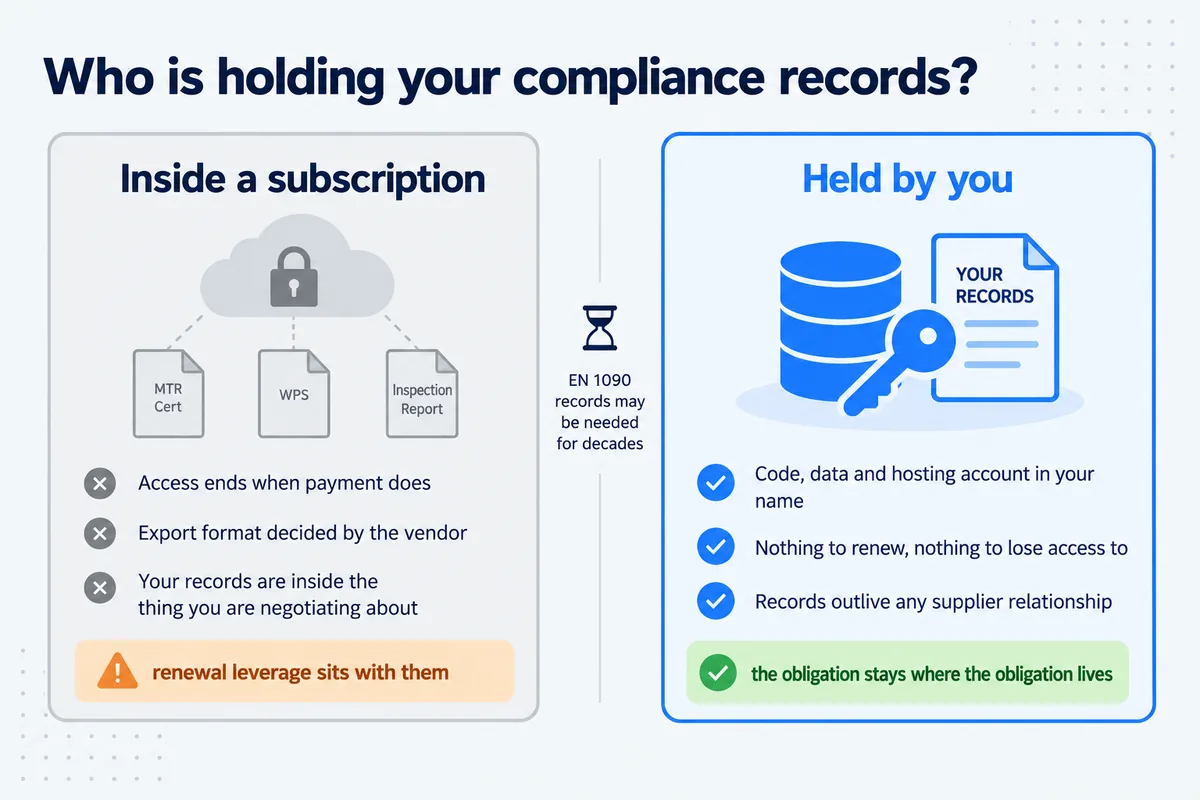
There are three honest ways to avoid it:
- Buy from someone who publishes flat, predictable pricing, so the year-three conversation is small. EZIIL’s flat team-size model is genuinely better on this axis than per-user pricing.
- Get a data-export guarantee in the contract, with the format specified, not promised verbally.
- Hold the records yourself, which is what an owned system means: the code, the database and the hosting account in your name.
Any of the three is defensible. Doing none of them is the common case.
When is a packaged fabrication system the right answer?
A packaged fabrication system is the right answer when your shop sits inside the profile the specialists are built for and your process is not the thing that wins you the work. Buy packaged if these are true:
- You are inside the profile the specialists aim at. A 15 to 150 person project-based steel fabricator running a fairly standard cut, fit, weld, finish, dispatch flow is precisely who EZIIL, StruMIS and Tekla PowerFab are built for.
- Your process is not the thing that wins you work. If you win on capacity, price or relationships rather than on an unusual capability, standard software will fit.
- You need it live in weeks and have no appetite for a build.
- You want somebody else to own the roadmap, including future changes to the standard.
That is a real and common situation, and in it, buying is the right call.
When is an owned system the right answer?
An owned system is the right answer when your traceability regime is genuinely your own, when your process is the thing that wins you work, and when the records have to outlive any supplier relationship.
- Your traceability regime is genuinely yours. Some shops carry EN 1090 plus a customer-specific quality regime plus their own way of handling NCRs. Every bolt-on to a packaged system is a workaround you pay for twice.
- Your process is your edge. A finishing capability, a nesting approach, a scheduling method. Packaged software makes you conform, and conforming costs you the edge.
- You need the records to outlive the supplier. Discussed above, and for a fabricator it is the strongest argument on this page.
- You do not want the bill to grow with the shop. Look at what the meter runs on. Users, sites, modules. All numbers you are trying to grow.
We build both shapes. A focused system that handles quoting, routing, floor capture and traceability, or a full ERP with finance and purchasing around it. What does not change is who owns it at the end.
A practical order to do this in
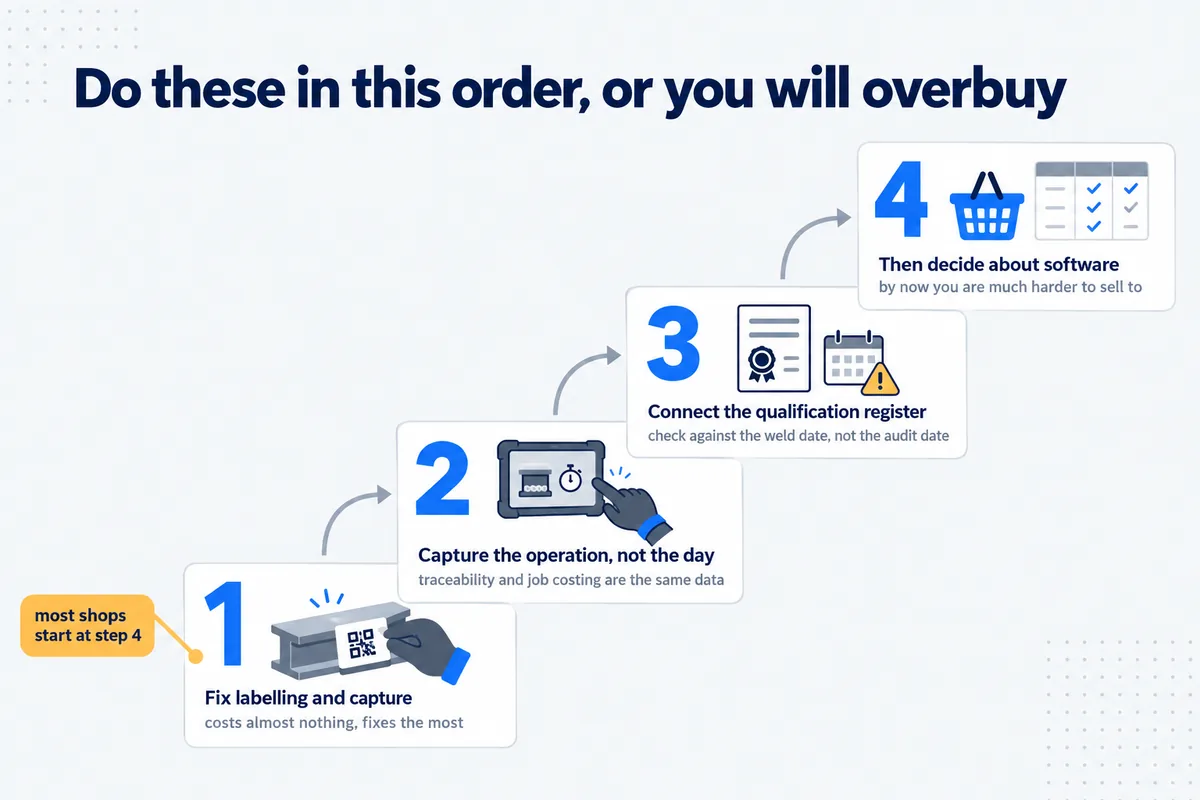
If you take one thing from this article, take the sequence, because doing these in the wrong order is what causes overbuying.
First, fix labelling and capture. Before any purchase. If your offcuts go back to the rack unlabelled, no software fixes that. QR or barcode at goods-in, and the label survives the cut. This is a process change and it costs almost nothing.
Second, capture the operation, not the day. Welder ID, procedure, item, time. On the floor, in gloves, in under five seconds. If you get this and nothing else, you have both traceability and job costing, because they are the same data captured once.
Third, connect the qualification register. Welder qualifications with expiry dates, checked against the date of the weld rather than the date of the audit. This is the link that most commonly fails, and it is a small piece of work.
Fourth, then decide about software. By this point you know your own process well enough to evaluate honestly, and you will be much harder to sell to.
Most shops do this in exactly the reverse order, buy a system to solve a labelling problem, and end up with an expensive system and the same labelling problem.
One beam, end to end: what good traceability actually looks like
Abstract requirements are easy to nod along to and hard to evaluate against. So here is a single item, followed the whole way, with the record that has to exist at each step. Take this into a demo and ask the vendor to reproduce it.
A 6-metre S355 beam arrives as part of a delivery of twelve. The supplier’s certificate covers a cast number. At goods-in, that cast number is recorded and an internal traceability ID is created and physically attached to the steel. The certificate is filed against the material, not against the delivery note. That distinction sounds pedantic and it is the whole thing: filed by delivery, you can find what arrived on Tuesday, filed by material, you can find what went into a specific building.
It goes to the rack. The label survives handling. If your labels come off in the yard, stop here and fix that, because everything after this point inherits the failure.
It is cut into three. One 2.4-metre section to job 4471, one 2-metre section to job 4488, and a 1.5-metre offcut back to the rack. Three records now exist where there was one, all inheriting the same cast number, and the offcut gets a new label that carries the parentage. This is the exact moment paper traceability dies, because in practice the offcut goes back on the rack bare and becomes anonymous steel.
It is drilled and coped. Operation, machine, operator, time. Most shops capture none of this, which is a shame, because it is also the data that would tell them what the operation actually costs.
It is welded into an assembly. Welder ID, welding procedure reference, date. The system checks the welder’s qualification was valid on that date, not on the date you look. That check is the single most commonly missed link in the chain, because qualifications live in a separate folder with expiry dates nobody watches.
It is inspected. Inspector, method, result. If an NCR is raised, it exists as a record with a state, and it can be seen to have closed. Paper NCRs that never formally close are one of the most common audit findings and one of the easiest to fix.
It is finished and dispatched. Which items on which delivery, with which documentation, on what date, to which site.
Three years later somebody asks about one beam in one building. This is the test. Not “can you show me your traceability system”, but: given a location in a finished structure, produce the cast number, the mill certificate, the welder, the procedure, the qualification validity on that date, the inspection result and the dispatch record. In minutes.
If a system can do that walkthrough on live data in a demo, it works. If the answer involves exporting to a spreadsheet and joining it up by hand, then the software is storing your records rather than making them retrievable, and those are different products.
What does an EN 1090 audit actually check?
An EN 1090 audit checks retrieval and consistency rather than the existence of records: the auditor picks specific items, asks for the chain on each, and looks at whether the answers were assembled the same way every time. There is a version of this decision that gets made calmly, with a shortlist and a scoring matrix. There is another version, far more common, that gets made three weeks after an uncomfortable audit or a lost tender, in a hurry, from a position of anxiety.
The second version is where shops overbuy, because anxiety buys the biggest thing on offer. It is worth understanding the pressure so you can recognise it while it is acting on you.
An audit does not usually fail on the existence of records. It fails on retrieval time and consistency. The auditor picks items, not filing cabinets. They ask for the chain on something specific, then something else, then they notice that the two answers were assembled in different ways by different people, which raises the question of whether the process is genuinely controlled or reconstructed on demand.
That is the actual finding in most cases. Not “you have no records” but “your factory production control is not demonstrably consistent”. Which is a process problem that software can support and cannot solve on its own.
The practical consequence for your purchase: a smaller system that everyone follows every day beats a comprehensive system that half the floor works around. Consistency is the thing being audited. A large deployment that the welders bypass because the screen is awkward produces exactly the inconsistency you were trying to buy your way out of.
This is also why the sequencing section below matters more than the vendor comparison above it.
FAQ
Does EN 1090 require software?
No. It requires records, factory production control and the ability to demonstrate both. Plenty of small fabricators comply on paper. The question is whether you can retrieve a specific record years later within an audit’s patience, and whether the paper system survives your current volume.
What is the difference between EN 1090 and CE marking?
EN 1090 is the standard governing the execution of structural steel and aluminium work, including factory production control. CE marking is the declaration you are entitled to make when you comply with it. The records are what connect the two.
Can we do this in a spreadsheet?
For a very small shop, sometimes. The failure point is not the spreadsheet, it is the split: when one plate becomes several parts on several jobs, a flat spreadsheet stops representing reality and people stop maintaining it. When you notice the spreadsheet has become someone’s full-time job, it has already failed.
How much does metal fabrication software cost in the UK?
Most of the specialists quote rather than publish, which means the number depends on your headcount and the negotiation. EZIIL publishes flat team-size pricing and Statii publishes too, so both are useful anchors before you enter a quoted process. Our own builds start at £3,000, fixed before work begins.
We already have accounts software. Does this replace it?
No. Accounting software is good at accounting and blind to the shop floor, because it never sees hours or heat numbers. The right shape is operations feeding the accounts.
Will this help with job costing too?
Yes, and this is the part people miss. The capture that satisfies EN 1090, which operation, which person, which item, when, is the same capture that tells you whether the job made money. You are paying for it once either way. Most shops buy compliance and never turn on the costing that comes free with it.
What about the offcuts? They are where we lose track.
Offcuts are the single most common failure point in fabrication traceability, and the fix is procedural before it is technical. The rule that works is that no material leaves a cutting operation without a label, including the remnant, and the remnant label carries its parentage back to the original cast. Whatever system you buy has to make relabelling an offcut a five-second action at the machine. If it requires walking to an office terminal, it will not happen and your rack will fill with anonymous steel.
How long do we have to keep these records?
Longer than you will keep any software vendor, which is the point being made throughout this article. Confirm the specific retention period with your certification body, because it depends on the execution class and the structure. Then ask every vendor on your shortlist what happens to those records at the end of the relationship, and get the answer in the contract.
Our welders are not going to use a computer.
They do not need to. What works on a fabrication floor is a fixed rugged screen or a scanner at the bay, with a badge or a QR scan and two taps. If a system requires a login and a keyboard, the answer to this objection is that you are right and you should reject that system, not that your welders need to change.
Can one system do EN 1090 and ISO 9001 together?
Usually yes, and there is significant overlap in what has to be recorded. The practical caution is that quality-system requirements tend to be specific to your own documented procedures, so the question is not whether a system supports ISO 9001 generically but whether it supports your procedures without a spreadsheet alongside. Ask them to configure one of your actual NCR workflows during the evaluation.
We are considering building it ourselves in Excel or Access. Is that mad?
It is not mad and plenty of shops have done it. Two things usually kill it. First, the split at cutting, because flat files stop representing a branching structure and people stop maintaining them. Second, the bus factor, because it becomes one person’s system and that person eventually leaves. If you go this route, the two things to get right early are a proper parent-child relationship for material and a second person who understands it.
Does a main contractor ever ask to see the system itself?
Increasingly, yes, particularly on larger structural packages. The request is usually not to inspect your software but to be satisfied that traceability is systematic rather than reconstructed. Being able to demonstrate the one-beam walkthrough above, live, is a commercial asset in that conversation, not just a compliance one.
Where does this leave BIM and model-driven fabrication?
If you already work from models, the fabrication management systems that integrate with them, such as Tekla PowerFab, remove genuine duplication and are worth serious consideration. That integration is a real advantage and we would not argue otherwise. It does not change the records question, which is who holds them and for how long.
About this article, and its limits
Written by Martin Gjini at OpsMavix, September 2026.
We sell one of the options on this page. OpsMavix builds custom operations systems and full ERP solutions, and we are the last row in both tables. That is why the sections naming when EZIIL, StruMIS and Tekla PowerFab are the better buy are specific rather than token.
The review dataset covers 19 inventory and ERP systems, not fabrication-specific software. EZIIL, StruMIS, Tekla PowerFab and Steel Projects are not in it. The findings describe how buyers of operations software are treated after signing, which we believe generalises to this market, but that is an inference and you should weigh it as one.
Nothing here is compliance advice. We build systems, we are not a notified body. Confirm your obligations with your certification body before you make decisions based on any article, including this one.
The full dataset and coding rules are published at what actually goes wrong with inventory and ERP software. There is an anonymised fabrication shop case study with real screenshots, and a clickable fabrication control room demo that needs no sign-up.
Keep reading
Getting value from OpsMavix? Add us as a preferred source on Google — you'll see more of our operations content in your AI Overviews, AI Mode and Search.